 | Everything you need to enjoy a weekend yoga retreat in your own home! From our sponsors |
| CNN.com - Top Stories |
| CNN.com delivers up-to-the-minute news and information on the latest top stories, weather, entertainment, politics and more. |
Toronto mayor Rob Ford has cancer
9/17/2014 9:44:21 PM
- Rob Ford decided not to run for re-election after his tumor was discovered
- The controversial mayor has a rare cancer, which has spread from his abdomen
- Doctor is unsure about the prognosis, but treatment will start with chemo
- Ford returned to work in late June after two months in rehab
(CNN) -- Toronto Mayor Rob Ford soon will begin chemotherapy to treat a rare and aggressive cancer, a doctor at Mount Sinai Hospital in the city said Wednesday.
Dr. Zane Cohen said Ford has a malignant liposarcoma, and a second biopsy on his tumor done Monday shows it is aggressive.
"However, we are optimistic about this tumor," Cohen said.
Ford, who recently announced he will not run for re-election, will start chemotherapy by Friday afternoon.
The cancer has spread from the fatty tissue of Ford's abdomen to other parts of his body, including his buttocks, Cohen said.
The doctor added that this type of tumor comprises only about 1% of all cancers and has at least 60 different types of cells, making it difficult to treat.
Cohen said there would be 18 days in between chemo and there would be another 18-day break, after which doctors would reassess Ford's treatment plan.
Those three-day rounds of chemotherapy might eventually be followed by surgery, radiation or both, he said.
The health ailment adds to the list of struggles facing Ford, whose fall from grace began in May 2013 with the release of a cell phone video that appeared to show him smoking crack cocaine. The Toronto city council largely stripped him of his mayoral powers months later over those and other allegations of bad behavior.
Ford didn't back down, though, instead vowing "outright war" on the city council.
The mayor apologized for "a lot of stupid things," including having used crack cocaine, but he refused to resign or enter rehab. In fact, despite all the criticism and his becoming a punchline for jokes in Canada as well as the United States, Ford launched a bid for re-election.
This past spring, after a local newspaper reported on a new video that allegedly showed him smoking crack cocaine, Ford relented on one front: by going into rehab.
He returned to work in late June, after a two-month rehab stint, saying he was "ashamed, embarrassed and humiliated" by some of his past actions.
But he refused to resign or refrain from campaigning, saying to the voters of Toronto, "I look forward to serving you for many, many more years."
Ford's term officially ends December 1.
When he announced his decision not to seek re-election last week, Ford has asked his brother, Doug Ford, to run for mayor in the October 27 balloting.
Doug Ford released a statement Wednesday on behalf of the Ford family saying of his brother's diagnosis: "I can't begin to share how devastating this has been for Rob and our family."
"Rob has always been so strong for all of us and now I ask us all to be strong for him," Doug Ford said in the statement, adding, "Rob will beat this."
CNN's Greg Botelho contributed to this report.
Ukraine: Rocket attack kills 10
9/17/2014 7:17:25 PM
(CNN) -- A rocket attack by pro-Russia rebels killed 10 civilians and injured 12 others in eastern Ukraine on Wednesday, the Ukrainian military said. It was the latest report of violence amid a shaky ceasefire in the region.
The rebels fired Russian-made Grad rockets near the village of Nyzhnya Krynka, where Ukrainian forces are positioned, the military said. The village is near the rebel-held city of Donetsk.
Nine civilian buildings were destroyed in the attack, according to the Ukrainian military.
READ: Ratification of landmark EU deal brings Ukraine closer to West
Man nabbed in river near N. Korea
9/17/2014 11:44:25 PM
- NEW: U.S. Embassy says it's aware of reports the man was trying to swim to North Korea
- A South Korean official says not immediately clear if the man was attempting to cross the border
- He was caught on the bank of the Han River where it divides the two Koreas
Seoul, South Korea (CNN) -- South Korean marines detained an American man on the bank of a river bordering North Korea late Tuesday, according to a South Korean Defense Ministry official and a senior U.S. State Department official.
The marines were on a regular patrol mission west of Seoul when they caught the man by the Han River in an area where it divides North and South Korea.
The U.S. citizen was being interrogated Wednesday, the defense ministry official said, adding that it was not immediately known whether the American was trying to cross into North Korea.
The U.S. Embassy in Seoul said it was "aware of the reports that a U.S. citizen has been detained attempting to swim from South Korea to North Korea."
The Embassy said it had been in contact with South Korean authorities but didn't have any additional information to share.
Americans are allowed to travel to North Korea, usually arriving by plane from Beijing. But it's forbidden to cross from South Korea into North Korea. The U.S. State Department warns citizens against all travel to the authoritarian state led by Kim Jong Un.
Three U.S. citizens are currently in detention in North Korea: Kenneth Bae, Matthew Todd Miller and Jeffrey Fowle.
A North Korean court on Sunday sentenced Miller to six years hard labor for committing "acts hostile" to North Korea, although the circumstances surrounding his alleged crime remain murky.
Bae, a Korean-American missionary, is serving a 15-year sentence for allegedly trying to bring down the North Korean government. Fowle, who was arrested in June while traveling as a tourist, is still awaiting trial.
Fast facts on detained Americans
CNN's K.J. Kwon reported from Seoul, and Jethro Mullen from Hong Kong. CNN's Paula Hancocks, Elise Labott and Josh Levs contributed to this report.
U.S. military 'ready to strike ISIS inside Syria'
9/18/2014 11:11:02 AM
- In open letter, UK imams implore militants to release British aid worker
- Former Syrian rebel leader: ISIS is more dangerous than the Syrian regime
- ISIS captured 16 villages in northern Syria in the past day, opposition group says
- Senate could vote on Obama's plan to arm Syrian rebels as early as Thursday
(CNN) -- Top U.S. military leadership has approved a plan to strike ISIS targets inside Syria, U.S. Defense Secretary Chuck Hagel told a House panel Thursday.
Hagel said President Obama was briefed on those plans, approved by Hagel and the chairman of the Joint Chiefs of Staff, during his visit to U.S. Central Command on Wednesday. Obama has not signed off on those plans yet, CNN has learned.
While ISIS continues spreading its radical Islamist rule in Syria and Iraq, a slew of U.S. lawmakers are debating the best way to stop them.
On Wednesday, the House approved Obama's plan to arm and train Syrian rebels. The House then tacked that onto a government spending bill that would allow leaders to continue funding the U.S. government and sent it to the Senate. On Thursday, the Senate will be voting on that whole package, fueling criticism that lawmakers are avoiding a separate vote on arming the Syrian rebels.
Sen. Susan Collins, a Republican from Maine, told CNN's "New Day" she had serious concerns.
"I'm going to vote for the continuing resolution because I don't want government to shut down," she said. "Right now, the Senate isn't even scheduled to have a separate vote on the Syrian resolution, and that's just plain wrong."
Meanwhile, the terror group, which refers to itself as the "Islamic State," has captured 16 predominantly Kurdish villages in northern Syria over the past 24 hours, a Syrian opposition group said Thursday.
ISIS used artillery and tanks against the villages along the Syria-Turkey border, the Syrian Observatory for Human Rights said.
The U.S. military has everything it needs to strike ISIS inside Syria and is waiting on the President's authorization to move forward, U.S. military officials told CNN on Thursday.
For weeks, intelligence and military targeting specialists have been working around the clock on a list of targets. The list is expected to be shown to Obama one more time. An analysis of the risks of bombing inside Syria will be included, as well as an assessment of how the destruction of the targets could degrade ISIS, officials said.
It is most likely that the President will get a broad description of the list, with some analysis of what would be accomplished. Presidents generally do not review each and every target before a strike. General guidance is given, and then the military selects the time, date and place after the President makes the political decision to proceed.
Obama is "actively" reviewing options and has "offered guidance" to the Department of Defense about the target sets that he's reviewed, White House spokesman Josh Earnest said last week. But Earnest said that Obama is not signing off on each strike.
Read more: U.S. ready to strike ISIS, officials say
Some Democrats leery of arming rebels
Even though some senators expect Obama's plan to pass in the Democrat-controlled chamber, the President could see tough challenges from his own party.
"I think it's very hard to sort out the moderate rebels from the extremists and I have a real worry that once we send these rebels back into the battle space there is very little we can do to prevent them from locking arms with al Qaeda or elements of ISIS," said Sen. Chris Murphy, a Democrat from Connecticut.
But Sen. Claire McCaskill, a Democrat from Missouri and a member of the Armed Services Committee, said the U.S. intelligence community will play an important role in vetting the rebels.
She also said training could take up to a year before arms are provided.
"All of those people criticizing this choice, I have yet to hear their better idea," McCaskill said.
Sen. Collins said she's worried that it will be difficult to vet the "so-called moderate Syrian opposition."
"We spent billions of dollars and a decade training the Iraqi security forces. And look what happened when they were confronted with the ISIS threat -- they basically cut and run, with the exception of the Kurdish forces in the north."
British imams call ISIS 'un-Islamic fanatics'
While the U.S. debates its role, dozens of imams from across the United Kingdom signed an open letter, published in British newspaper The Independent, calling for ISIS to release Alan Henning. He is the latest British hostage that ISIS has threatened to kill.
If the aid worker who went to Syria to help people is not released, ISIS will be committing the "worst condemnable sin" against Islam, they write.
The letter condemns the terror group, calling ISIS "un-Islamic fanatics."
"This is not Jihad," it read, "it is a war against all humanity."
Three years of waiting
If the United States ends up arming Syrian rebels, it would come after three years of clamoring by opposition forces.
Syrian rebels started asking the West for weapons in 2011, after peaceful political protests led to a deadly crackdown by Bashar Al-Assad's government forces. It spiraled into an armed uprising and a civil war that has killed more than 190,000 Syrians over the past three years.
The United States has provided $2.9 billion in humanitarian aid to Syria, but has stopped short of giving Syrian rebels weapons.
The difference now? ISIS, its bloody takeover of stretches of Iraq and Syria, and its threat to Americans.
How much of a threat is ISIS to the U.S.?
A former chief of staff for the rebel Free Syrian Army is now more concerned about ISIS than the Syrian regime.
"At this time, it is more dangerous than the regime itself," Gen. Salim Idriss told CNN's Chris Cuomo.
Idriss acknowledged there are problems among rebel forces -- which is why U.S. training would help, he said.
"They are not unified, not organized, not working according to chain of command and control," he said. "We would like now to organize them with the help of our friends in the international community to build a kind of regular army to get better results fighting the regime and other extremist groups in Syria."
Idriss said the Free Syrian Army now has about 4,000 to 5,000 "well-trained fighters" in the country.
"And if we are going to train about 5,000 more, the whole number of the moderate fighters in the FSA will be ready and capable of fighting against ISIS."
Inside the mind of an ISIS fighter
Obama: No boots on the ground in Iraq
Obama reiterated Wednesday that the United States will not send combat troops back to Iraq.
"As your commander in chief, I will not commit you and the rest of our armed forces to fighting another ground war in Iraq," Obama told troops Wednesday at MacDill Air Force Base in Florida.
"The American forces that have been deployed to Iraq do not and will not have a combat mission. They will support Iraqi forces on the ground as they fight for their own country against these terrorists."
On Thursday, Secretary of State John Kerry will testify before the House Foreign Affairs Committee, and Defense Secretary Chuck Hagel will testify before the House Armed Services Committee.
Iraq: More than 1,000 soldiers MIA from June attack
Just as in Syria, the crisis in Iraq continues to unfold.
Iraq's Human Rights Ministry said Thursday that 1,095 Iraqi soldiers still are missing after an ISIS attack in June on a military base formerly known as Camp Speicher.
ISIS says it killed 1,700 Iraqi troops in the attack. The Iraqi government hasn't released a number of those killed; Human Rights Watch says ISIS executed hundreds of soldiers.
CNN's Deirdre Walsh, Ted Barrett, Jessica Moskowitz, Jim Acosta and Mohammed Tawfeeq contributed to this report.
Fallout from double agent's story
9/18/2014 1:15:31 AM
- Morten Storm was a radical Islamist turned double agent
- He claims Danish agency recruited him to work with CIA
- PET said it had nothing to do with Anwar al-Awlaki operation
(CNN) -- When first revealed, Morten Storm's account of his life as a double agent inside al Qaeda sent shockwaves through Denmark's political and intelligence establishment. The first accounts came in the Danish newspaper Jyllands-Posten in October 2012.
In those articles, and in his new memoir "Agent Storm: My Life Inside al Qaeda and the CIA," which we co-authored, Storm recounted how after being recruited by Danish intelligence agency PET, he helped the CIA target several al Qaeda terrorists for assassination, most notably the American terrorist cleric Anwar a-Awlaki, who was killed in a CIA drone strike in September 2011.
The allegations have proven explosive in Denmark, where it is illegal for the government to take part in targeted killings.
Storm says his Danish handlers set up and attended meetings he had with the CIA in Denmark and overseas at which plans to track down terrorists were set in motion. He says Danish intelligence was fully aware the Americans planned to use lethal force.
Storm has significant corroborating evidence to back up his claim. He provided us with several hours of secret iPhone recordings of meetings and phone calls with his Danish and American intelligence handlers during which several of the kill missions were discussed.
CNN has not been able to independently authenticate the recordings, but the time the electronic files were first created were consistent with his account.
One of the recordings was of a meeting he says was set up with his PET and CIA handlers at a Danish resort a week after al-Awlaki was killed. On the tape, Storm makes clear to an American interlocutor that he and Danish intelligence had been key to getting al-Awlaki:
"We took initiative to create this because the Americans failed in their attempt to hit Anwar, they failed in their attempts to trace Anwar al-Awlaki, the Americans have failed in every single attempt to arrest or kill Anwar al-Awlaki, except when we went in, we traced him down again, created contacts with him, now he is dead, because of the work we have done."
Agent claims he had been promised $5 million
In the same recording, the American can be heard telling Storm that President Barack Obama knew about his contribution to the al-Awlaki mission, "We had our whole project going forward -- of which you played the highest role,' he said.
But the American denied Storm provided the critical breakthrough, frustrating Storm, who told CNN he had been promised $5 million if he led the CIA to the terrorist cleric. It was after this meeting he first made contact with the Danish newspaper.
After Jyllands-Posten first broke the story, PET refused to confirm or deny Storm's claims. "Out of consideration for PET's operational work, the PET neither can nor will confirm publicly that specific persons have been used as sources by the PET," it said.
"However, the PET does not participate in or support operations where the objective is to kill civilians. The PET did therefore not contribute to the military operation that led to the killing of al-Awlaki in Yemen," then-PET director Jakob Scharf stated.
Neither PET nor the CIA responded to CNN's requests for further comment.
Storm's revelations led Danish parliamentarians to demand new oversight rules for PET.
In January 2013, Storm met with several of them in Copenhagen. Denmark's Ministry of Justice announced it would set up a supervisory board to oversee the Danish intelligence agency, without acknowledging Storm was the reason. Then-Justice Minister Morten Bodskov said the new board would strike "the right balance that will ensure that we have an effective intelligence agency and a good rule of law."
But the government resisted calls from opposition MP's for a full parliamentary inquiry.
After the publication of another Jyllands-Posten article in March 2013, with fresh evidence retrieved from Storm's cell phones, Storm's account received heavyweight backing from Denmark's former spy chief.
Hans Jorgen Bonnichsen, Scharf's predecessor as head of PET, told Danish television that the corroborating evidence presented in the Danish media suggested the PET had used Storm to track down terrorist operatives overseas to help the U.S. target them for assassination. Bonnischen was at the helm of the intelligence agency in the period before Storm says he was recruited as an agent.
In late 2013, a political scandal forced the resignations of PET Director Scharf and Interior Minister Bodskov after it emerged Scharf had instructed subordinates to obtain information on the movements of a Danish MP.
Reforms may be coming in Denmark
The revelations put Storm's story back in the public spotlight. Bonnichsen sharpened his criticism of PET, asserting the disclosures on Danish involvement in assassination plans overseas were so serious there was a basis for a criminal investigation.
At the end of the year the beleaguered agency was put under more pressure when Jyllands-Posten disclosed PET's refusal to offer Storm protection after ISIS linked militants in Syria threatened his life in a video.
"Is it really a satisfactory way for the security services to carry out their task in that it takes three weeks before you answer a former employee who -- rightly -- felt threatened by Islamists?' the chairman of the Danish People's Party told the newspaper. Storm now lives in hiding in an undisclosed location in the UK, and says he currently receives no protection from any Western intelligence service.
In April 2014, the pressure on Denmark increased further when the Open Society Foundation, a New York based legal advocacy group, called on Denmark to acknowledge its role in al-Awlaki's killing and announced it had filed freedom of information requests with the Danish government regarding Storm.
"Danish officials have refused to respond specifically and meaningfully to numerous questions posed on this subject by the legal affairs committee of Denmark's parliament," a press release by the group stated.
"The evidence that has been revealed by Jyllands-Posten, is very worrying. They show that PET actively cooperated with the CIA in the operation to track down and kill Anwar al-Awlaki. They show that PET was eager to cover up his role in the program. They show that PET was trying to hide the truth from the Danish public. The evidence suggests that PET may have violated the Danish Criminal Code provisions relating to murder and international legal prohibitions on, among others, the right to life, among other laws. These are very serious offenses," Amrit Singh, the senior legal officer for national security and counterterrorism for the Open Society Justice Initiative, told Jyllands Posten.
Bonnischen told CNN new oversight rules for PET are now being discussed which would require the agency to submit an annual report to a parliamentary oversight committee on how many agents it was running and how they were being run.
Magnus Ranstorp, one of Scandinavia's leading counterterrorism academics, told CNN Storm's revelations had "opened a Pandora's box of ethical problems which will probably lead in the future to PET's ability or leeway to act being restricted."
It is rare indeed for an intelligence informant to go public about his work. In Storm's case the disclosures may change the law -- and radically change the way his former employer works.
Excerpt from 'Agent Storm': Finding a wife for Anwar al-Awlaki
Stolen phone means $500k bill
9/18/2014 4:52:49 AM

- Phone stolen in Europe was used to make calls to Somalia
- Despite theft being reported, customer was told to pay more than $500,000
- Case highlights global concerns over the costs of cell phone roaming
(CNN) -- Think your vacation cell phone bill is high? Then spare a thought for the Australian hit with more than $500,000 in charges for calls made when his device was stolen in Europe.
The whopping figure came to light in a recent report by Australia's telecoms ombudsman, who received a complaint about the bill after the customer's phone provider insisted he pay it -- even though he'd reported the theft.
Astonishingly, the calls -- including several to Somalia -- were made within a single 24-hour period, a fact that'll do little to reduce concerns about the high cost of roaming charges both in Australia and the rest of the world.
The complaint about the bill was made by a man identified as "David" whose son had his phone stolen during a trip to Europe.
"He reported the theft to local police and to his provider in Australia, but because of the time difference between the continents, the provider recorded the theft as having happened a day later than it occurred," the ombudsman said in a report.
"Back in Australia, his son's bill came to more than AUS$570,000 ($517,000) and listed calls to Somalia."
MORE: Do we need phones on planes?
Huge data charges
The story has a relatively happy ending: after the ombudsman stepped in, the phone provider eventually agreed to waive its demands.
For many of us though, roaming costs remain a major pitfall of travel in an age when we're all carrying data-enabled device that, unless disabled, will rack up huge charges for overseas internet and email access.
A 2011 report by the Organisation for Economic Cooperation and Development (OECD) identified Australia as one of the most expensive countries for data roaming charges.
Of the 34 nations surveyed, Australia was the seventh most costly country of origin for average roaming charges, behind Poland, Japan, Israel, Chile, Mexico, the United States and Canada. Greece and Iceland were the cheapest.
Mounting anger over the high cost of phone use abroad has led to efforts to rein in phone companies.
In Europe, the European Union has placed a cap on roaming charges for customers traveling within the trading bloc. The European Parliament this year voted to scrap them altogether, pending approval from individual EU governments.
ETNO, the European telecoms industry body, has complained it needs roaming revenues to maintain investment in mobile networks.
Either way, it's clearly a talking point -- just as long as you're not talking on a long-distance line.
MORE: How smartphones are revolutionizing travel
Victims buy 'Ebola survivor blood'
9/18/2014 1:58:37 PM
- The Ebola outbreak in West Africa has killed at least 2,400 people
- The WHO says it's working with affected nations to eliminate the black market trade of blood
- Convalescent serum is said to have antibodies that can fight the deadly virus
- Though unproven, desperate patients are doing whatever it takes
(CNN) -- As hospitals in nations hardest hit by Ebola struggle to keep up, desperate patients are turning to the black market to buy blood from survivors of the virus, the World Health Organization warned.
The deadliest Ebola outbreak in history has killed at least 2,400 people in Guinea, Liberia and Sierra Leone -- the countries most affected by the virus.
Blood from survivors, referred to as convalescent serum, is said to have antibodies that can fight the deadly virus. Though the treatment is unproven, it has provided some promise for those fighting a disease that's killing more than half of those it has infected.
"Studies suggest blood transfusions from survivors might prevent or treat Ebola virus infection in others, but the results of the studies are still difficult to interpret," the WHO said. "It is not known whether antibodies in the plasma of survivors are sufficient to treat or prevent the disease. More research is needed."
Convalescent serum has been used to treat patients, including American aid worker Rick Sacra, who is hospitalized in Omaha, Nebraska. He got blood from Kent Brantly, a fellow American who survived Ebola. Both got infected when they were helping patients in Liberia.
But unlike their situation, patients in affected nations are getting blood through improper channels. The illicit trade can lead to the spread of other infections, including HIV and other blood-related ailments.
"We need to work very closely with the affected countries to stem out black market trading of convalescent serum for two reasons," Margaret Chan, the WHO's director-general, said this week.
"Because it is in the interest of individuals not to just get convalescent serum without ... going through the proper standard and the proper testing because it is important that there may be other infectious vectors that we need to look at."
'Just sitting, waiting to die'
Heath experts have declared the disease a global emergency and criticized the international community for a lax response.
President Barack Obama on Tuesday announced the United States will send troops, material to build field hospitals, additional health care workers and community care kits to affected nations. The United States will also create a facility to help train thousands of health care workers to identify and care for Ebola patients.
"Men and women and children are just sitting, waiting to die right now," Obama said.
Hospitals in affected nations are overwhelmed, and the WHO has described the outbreak as a "dire emergency with ... unprecedented dimensions" of human suffering.
"If the outbreak is not stopped now, we could be looking at hundreds of thousands of people infected with profound political and economic and security implications for all of us," Obama said.
What you need to know about the Ebola virus
There is also a concern that the virus could mutate into an even more dangerous form.
Ebola currently transmits only though contact with bodily fluids; a mutation that allows the virus to spread through the air would pose a catastrophic threat to people worldwide, experts say.
Meanwhile, a French volunteer with Doctors Without Borders contracted Ebola in Liberia and will be taken to France for further treatment, the group said Thursday.
A private American plane will be used for the evacuation, according to the organization, which is known by its French acronym, MSF.
Voters choose to remain with UK
9/19/2014 12:43:24 AM
- NEW: Scotland will remain part of the United Kingdom
- "No" camp wins majority of councils already declared
- With majority of councils reporting, "No" lead unlikely to be overturned
- The referendum will decide if Scotland remains part of the United Kingdom
Glasgow, Scotland (CNN) -- [Breaking news alert, 6:23 a.m. GMT (01:23 a.m. ET)]
Scotland will remain part of the United Kingdom -- along with England, Wales and Northern Ireland -- following a historic referendum vote. A majority of voters rejected the possibility of Scotland breaking away and becoming an independent nation.
With 31 of 32 councils declared, the "No" campaign has won the referendum on Scottish independence.
Scottish First Minister Alex Salmond admitted defeat in Scotland's independence referendum Friday -- and urged the rest of Scotland to do the same.
In a televised statement, he thanked Scotland "for 1.6 million votes for Scottish independence."A turnout of 86% is one of the highest in the democratic world for any such vote, he said.
[Original story published at 12.37 p.m. ET]
Voters in Scotland made their choice Thursday -- remain part of the United Kingdom, or form their own independent nation. They chose to remain.
With 31 of 32 of councils reporting, the "No" campaign had garnered enough votes to secure their victory, and with it Scotland's continued place within the union.
The first councils to declare all went to the "No" campaign, as did the capital, Edinburgh, which voted overwhelmingly to stay in the union with 123,927 for "Yes" and 194,628 "No" votes. Argyll and Bute and Aberdeenshire also voted "No."
Glasgow delivered a solid win for the independence camp with 194,779 votes for "Yes," and 169,347 for "No," but lead was not big enough to overturn the "No" camp's overall majority so far, which maintains a 8% (54% to 46%) lead over pro-independence camp.
The majority of the early results have been going the anti-independence camp's way. The "No" campaign extended lead with Angus and East Dunbartonshire council results, alongside a landslide in Dumfries and Galloway. The oil-rich city of Aberdeen also strongly voted for the unionist camp.
The city of Dundee was the first big gain for the independence campaign, voting "Yes" with 53,620 votes for, 39,880 against.
The individual counts by local authorities are ultimately immaterial as it is the total number of votes countrywide that will determine the outcome.
Polls at more than 5,500 stations across all districts, from the remote highlands and islands to the big cities of Edinburgh and Glasgow, closed at 10 p.m. local time (5 p.m. ET). People still in line to vote at that time were allowed to cast ballots.
High turnout
The first districts to report turnout reported high participation -- well over 80% in most cases -- Mary Pitcaithly, chief counting officer, announced in Edinburgh.
Turnout in Glasgow, one of the Yes campaign's heartlands, was a relatively disappointing 75%.
More than 4.2 million people registered to vote on the question: "Should Scotland be an independent country?"
A vote for independence would mean Scotland, with its population of about 5.3 million, splits from the rest of the United Kingdom, made up of England, Wales and Northern Ireland, in addition to Scotland.
"The people of Scotland have engaged in this conversation," Phil MacHugh, a spokesman for the "Yes" camp, told CNN on Thursday night. "They have really gone out there, found out the information that they wanted to know, and made that choice today."
Prime minister's address
British Prime Minister David Cameron will make an address Friday morning. The content will depend on the outcome of the vote, but in the event that Scottish voters decide to stay in the union, Downing Street says he will refer to plans for further redistribution of powers from the central government to the Scottish Parliament, signed by Westminster leaders earlier this week.
The counting officer for Edinburgh, Sue Bruce, explained just after 10 p.m. that each ballot will be double-checked, to verify each voter's decision.
Addressing dozens of election workers, Bruce added, "I look forward to working with you during the course of the evening to deliver an accurate and transparent Edinburgh count in which you and the voters of Edinburgh can have full confidence."
READ: What you need to know
Voting was brisk at one polling station in Glasgow as the polls opened Thursday, with many people voting on the way to work or before taking their children to school.
Bad weather or the sheer volume of votes cast could slow down the counting process. However, the weather forecast appears good so far -- important when some ballot boxes must be collected by helicopter, plane or boat from polling stations on distant islands.
Allegations of voting fraud were reported by Glasgow City Council, with several instances of people turning up at voting booths in Scotland's largest city to vote, only to be told that they had already voted.
The Council stressed that there was never actually a situation of double voting and the affected ballots are now being searched for and taken away.
Scotland's First Minister Alex Salmond, who has led the pro-independence "Yes Scotland" campaign, cast his ballot Thursday morning in the village of Strichen, Aberdeenshire.
Labour lawmaker Alistair Darling, who has headed the pro-union "Better Together" campaign -- backed by the main parties in Westminster -- voted in Edinburgh, while former Prime Minister Gordon Brown, another pro-union campaigner, voted in the town of Kirkcaldy.
For the first time, the vote was extended to 16- and 17-year olds living in Scotland. Nearly 110,000 people younger than 18 have registered to vote.
Voters in the referendum did not have to be British citizens; Commonwealth, Irish and EU citizens who live in Scotland and are registered to vote there can cast a ballot. However, Scots living outside Scotland do not have a say.
Nearly 790,000 people applied for a postal vote -- the largest volume of registration for postal votes ever in Scotland.
After the polls closed, Salmond tweeted, "This has been a remarkable day. Scotland's future truly is in Scotland's hands."
CNN's Nic Robertson reported from Glasgow, Laura Smith-Spark wrote and reported in London and Euan McKirdy wrote and reported in Hong Kong. CNN's Richard Allen Greene, Lindsay Isaac and Greg Botelho contributed to this report.
Salmond: We fell short
9/19/2014 12:36:05 AM
First Minister of Scotland Alex Salmond gives his concession speech as Scotland rejects independence from the U.K.
If your browser has Adobe Flash Player installed, click above to play. Otherwise, click below.
Air strikes alone won't beat ISIS
9/19/2014 2:02:26 AM
- President Obama's strategy for destroying ISIS seems to rely on air strikes, writes Haider Mullick
- Obama says strategy has been successful in Yemen and Somalia
- Mullick says in both countries, some kind of presence was needed on the ground
- U.S. also needs to focus on improving governance for long-term security, Mullick says
Editor's note: Haider Ali Hussein Mullick is a lecturer at the Naval Post Graduate School and an adjunct professor at the Naval War College. The views expressed are his own.
(CNN) -- President Obama's strategy for destroying the Islamic State of Iraq and Syria (ISIS) appears to depend on a volley of airstrikes followed by a (currently absent) holding force of Syrian rebels and Iraqi troops. "[T]his strategy of taking out terrorists...is one that we have successfully pursued in Yemen and Somalia for years," the President said.
Not so fast. The reality is that the few victories against al Qaeda in Somalia, Yemen and Pakistan are not a product of U.S. air power alone, but a combination of American boots on the ground, advisers and special forces, and as importantly, years of promoting local governance and military reform. Absent such security and political initiatives, Obama's counterterrorism strategy is destined to fail.
There are two critical lessons from the experiences in Somalia, Yemen and Pakistan for the war against ISIS.
First, airstrikes without troops on the ground don't work. Despite innovations in air power such as advanced targeting, intelligence, surveillance, and reconnaissance capabilities, there is simply no substitute for eyes, ears and feet on the ground. With this in mind, the United States has had a presence on the ground in Somalia, Yemen and Pakistan even when the missions were strictly counterterrorism.
At various times in Somalia, Yemen and Pakistan, U.S. troops have directly engaged al Qaeda, protected fellow advisers, marked targets for airstrikes, embedded with and transported local troops, and used armed drones, helicopters and gunships. And yet even after more than 500 air strikes in Somalia, Yemen and Pakistan since 9/11, U.S. troops still had to conduct high-profile raids against specific top terrorist leaders.
American troops have been deployed to Yemen, Somalia and Pakistan to help train local troops, conduct operations and work closely with CIA operatives and local proxies. So boots on the ground are clearly an essential part of any counterterrorism strategy -- as long as local politicians and generals are willing to share power, promote efficiency and embrace diversity.
The second lesson for defeating ISIS is that improving local governance and building pluralistic militaries is difficult, but still the best deterrent against recurring Islamic radicalism.
Of course, Washington cannot fix local politics within failing states that are embroiled in decades of conflict made worse by ethnic and religious divisions. Yet progress in Yemen, Somalia and Pakistan shows that American diplomats have, albeit slowly, pushed central governments to become more inclusive and share power with the periphery, and their militaries to embrace ethnic and religious diversity.
In Somalia, with the help of European and African allies, including the 22,000 well-trained and equipped African Union troops, Washington has prodded the central government to implement the "National Stabilization Strategy," which is focused on promoting national and local reconciliation, facilitating tribal disputes and devolving power to local and regional administrations. Lack of governance and security is the main source of local grievances that Al-Shabaab frequently exploits.
In Yemen, U.S. diplomats have offered $40 million in assistance to encourage President Abdu Rabu Mansour Hadi to convert the National Dialogue Conference into a sustainable peace plan for his fractured country, which will include constitutional reform. Like Somalia, Yemen is in desperate need of a strong plan for disarmament, demobilization and reintegration that devolves power to local districts and places the security forces under the rule of law, guaranteeing religious freedoms.
In nuclear-armed Pakistan's northern tribal badlands, the situation is more complex but governance deficiencies are similar to Somalia's south and Yemen's east. The United States has given billions to improve local infrastructure and supported democracy. Most of the $4.4 billion in aid to Pakistan between 2010 and 2014 is conditioned on strengthening Pakistani democracy.
The passage of the 18th amendment to the Pakistani constitution was a small but encouraging effort to transfer power from the center to the provinces. Moreover, in the most recent protests in Islamabad the Pakistani military has restrained from directly intervening.
Besides helping improve local governance, the United States has spent years training and equipping Yemeni, Somali and Pakistani militaries, subtly encouraging ethnic diversity. In Pakistan, for example, U.S. trainers helped transform a ragtag Frontier Corps, commanded by Punjabi outsiders, into a counterinsurgency force that has several units commanded by Pashtuns.
Of course, not all investments have paid off. Tribal and religious divisions continue to threaten the Somali and Yemeni armies, while the Pakistani military and intelligence services are widely seen as sympathetic to the Afghan Taliban, although troops have finally put pressure on militants in North Waziristan territory.
So what does all this say about how to tackle ISIS?
True, the group trumps al Qaeda and affiliates across the greater Middle East in terms of finances, numbers and territorial control. But it can be defeated. President Obama's push for more representative Iraqi government and improved vetting of Syrian rebels are steps in the right direction.
But realistically the United States should be expecting to send some 4,000 to 6,000 additional U.S. service members to help gather intelligence, train Syrian rebels, revive the Iraqi Army, build a national guard, protect advisers, mark targets and conduct raids against high-profile targets. This cannot be realistically be done without U.S. troops -- and will likely take about two years.
Meanwhile, U.S. diplomats should be pushing for better Iraqi governance, including ensuring all major ethnic and religious groups are represented in the Iraqi and Syrian security forces.
Defeating a foe like ISIS won't be easy, and it will require political courage from the United States to follow through. But a multi-pronged commitment is absolutely necessary. This is one conflict that cannot be won from the air.
Cameron 'delighted' as Scots reject independence
9/19/2014 6:00:45 AM
- Final results give pro-union camp 55% of the vote to 45% for independence camp
- "We hear you," Prime Minister David Cameron says, vows to change UK for the better
- First Minister Alex Salmond admits defeat, urges all of Scotland to accept result
- He thanks Scotland "for 1.6 million votes for Scottish independence," hails high turnout
Glasgow, Scotland (CNN) -- Scotland will remain part of the United Kingdom -- along with England, Wales and Northern Ireland -- following a historic referendum vote.
By 55% to 45%, a majority of voters rejected the possibility of Scotland breaking away and becoming an independent nation.
UK Prime Minister David Cameron welcomed Scotland's decision in a televised statement outside 10 Downing Street, saying it was a clear result.
"Like millions of other people, I am delighted," he said.
Cameron said he would have been heartbroken to see the United Kingdom broken up -- but paid tribute to the efforts of both sides in the campaign.
"We hear you," he said to those who voted for independence, adding this was an opportunity to change the way people in the United Kingdom are governed, and "change it for the better."
His government has delivered on devolution in the past and will deliver on it again, Cameron said.
A "new and fair settlement" will be created for Scotland and for the other countries of the United Kingdom, he said.
Scottish First Minister Alex Salmond accepted defeat in an earlier televised statement -- and urged the rest of the pro-independence camp to do the same.
He thanked Scotland "for 1.6 million votes for Scottish independence" and said the turnout -- which electoral officials said was 84.6% from an electorate of more than 4.2 million -- was one of the highest in the democratic world for any such vote.
Sigh of relief
The final result in the referendum was 1,617,989 votes in favor of independence from the United Kingdom to 2,001,926 against.
This means the pro-union camp won by a margin of 55.25% of the vote to 44.65% -- a much wider gap than opinion polls in the final days leading up to the vote had suggested.
The result means the main political parties in Westminster -- and many people across the United Kingdom and Scotland -- can breathe a collective sigh of relief that the threat of a breakup of a centuries-old union is over. However, many on the "Yes" side will be bitterly disappointed.
The referendum was closely watched around the world, particularly in nations like Spain, whose Catalonia province is home to a vocal independence movement.
The outcome will likely please President Barack Obama, who said that while the decision was down to the Scots, it was in the interest of the United States to have the United Kingdom remain a "strong, robust, united, and an effective partner."
NATO Secretary General Anders Fogh Rasmussen also welcomed the news that the United Kingdom, a key member of the defense bloc, would remain united.
Investors liked what they saw. The pound was firm against the U.S. dollar and the euro, after recovering much of the ground lost earlier this month when surveys suggested Scotland was on the brink of abandoning the union.
Stock markets also rose, with shares in Scottish companies doing particularly well.
Darling: 'Unity over division'
Alex Salmond, Scottish First Minister
Salmond, who heads the governing Scottish National Party, hailed the political engagement seen in Scotland during the campaign and appealed for unity going forward.
"Today of all days, as we bring Scotland together, let us not dwell on the distance we have fallen short. Let us dwell on the distance we have traveled and have confidence that a movement is abroad in Scotland that will take this nation forward, and we shall go forward as one nation," he said.
Salmond has previously said that if the "Yes" campaign lost the referendum there would not be another vote on independence in a generation.
Labour lawmaker Alistair Darling, who led the pro-union campaign in the Scottish referendum, hailed the result Friday but said that the message that the people of Scotland want change must be heard.
"The people of Scotland have spoken," he said."We have chosen unity over division and positive change rather than needless separation.
"Today is a momentous result for Scotland and also for the United Kingdom as a whole -- by confirming our place within the union we reaffirm all that we have in common and the bonds that tie us together. Let them never be broken."
He gave a commitment that the political changes promised by the Westminster parties -- involving the devolution of more powers to Scotland -- would be kept.
Darling also called for the country to unify after debate that "has created some fairly deep divisions in our country," and a campaign "that has both energized but at times divided" the Scottish people.
"Those divisions now need to be addressed and that requires leadership," he said, promising to play his part.
Clegg: Radical package of powers
Deputy Prime Minister Nick Clegg, whose Liberal Democrats are in a coalition government with Cameron's Conservatives, said he was "absolutely delighted" by the result.
"But a vote against independence was clearly not a vote against change and we must now deliver on time and in full the radical package of newly devolved powers to Scotland," he said.
"At the same time, this referendum north of the border has led to demand for constitutional reform across the United Kingdom as people south of the border also want more control and freedom in their own hands rather than power being hoarded in Westminster."
Labour Party leader Ed Miliband also hailed a "historic achievement" in keeping the union together.
He promised change across the United Kingdom in a speech to supporters in which he looked forward to the general election battle due next May.
The first of the 32 councils to declare all went to the "No" campaign, as did the capital, Edinburgh, which voted overwhelmingly to stay in the union. Fife and Aberdeenshire also voted "No."
Glasgow delivered a solid win for the independence camp but the lead was not big enough to overturn the "No" camp's overall majority. Dundee, North Lanarkshire and West Dunbartonshire were the only other councils to vote "Yes."
Political fallout
Scotland has had a devolved government since 1999, meaning many, but not all, decisions are made at the Scottish Parliament in Holyrood, Edinburgh.
As opinion polls showed the lead held by the "no" vote shrinking fast in the days leading up to the referendum, the leaders of all three main parties in Westminster responded with the promise to give major new powers over tax, spending and social welfare to Scotland if it stuck with the United Kingdom.
Now the party leaders face the challenge of pushing those changes through a possibly rebellious Parliament on a tight timetable.
The process of handing over those new powers will start from Friday, Cameron said in a speech in Aberdeen earlier this week, with draft legislation expected as soon as January. "This is a timetable that is now agreed by all the main political parties and set in stone and I am prepared to work with all the main parties to deliver this during 2015," he said.
Although Scotland has chosen to stick with the union -- staving off potential calls for his resignation -- Cameron will still face political fallout over the vote.
Critics have accused him of complacency during the long months of campaigning when Salmond's "Yes Scotland" campaign was laying the groundwork for its late surge. Cameron's longtime Labour rival, former Prime Minister Gordon Brown, is credited by many with bringing the vital energy that eventually carried a lackluster "No" campaign to victory.
Critics have also accused Cameron and the other main party leaders of giving away too much in a last-ditch effort to keep Scottish voters on board.
It remains to be seen how the promise to give greater powers also to England, Wales and Northern Ireland will be borne out.
Cameron will also likely face difficult questions over his own leadership in the run-up to a general election due to take place next May.
READ: What Scotland's 'No' vote means for David Cameron
READ: Why Scotland's 'No' vote will relieve UK allies
CNN's Nic Robertson reported from Glasgow, Laura Smith-Spark reported and wrote in London. CNN's Richard Allen Greene, Euan McKirdy, Mark Thompson, Lindsay Isaac and Andrew Carey contributed to this report.
NASA 'missed chance to revitalize'
9/18/2014 12:25:41 PM
- NASA missed a chance to back cheaper, more innovative design in new contract, Newt Gingrich says
- Decision to award SpaceX a contract was a modest step forward for the commercial space industry, he says
- But NASA will need to embrace new entrants and promote a lot more competition, he adds
Editor's note: Newt Gingrich is a co-host of CNN's "Crossfire" and will be on The Situation Room with Wolf Blitzer tonight at 5 p.m. ET. Newt is the author of the book, "Breakout: Pioneers of the Future, Prison Guards of the Past, and the Epic Battle That Will Decide America's Fate." The opinions expressed in this commentary are solely those of the author.
(CNN) -- It didn't take a rocket scientist to predict that NASA's plan to pay Russia to launch American astronauts into orbit wasn't going to turn out well.
Three years after NASA retired the space shuttle program, relations between the United States and Russia are worse than at any point since the end of the Cold War. Americans have reportedly been paying Russia $70 million a seat to send our astronauts to the International Space Station. That's three and a half times what the Russians charge private space tourists for the same ride on their 1960s-era spacecraft.
Now Russian President Vladimir Putin is reconstituting the Russian empire, and senior Russian officials have reacted to our economic sanctions by suggesting that Americans "bring their astronauts to the International Space Station using a trampoline."
NASA and our elected officials are to blame for this embarrassment.
NASA has tried to replace the shuttle on its own before resorting to the commercial industry -- programs that were canceled after ludicrous cost overruns and technical setbacks. And worse, politicians and bureaucratic backscratchers repeatedly undermined the nascent commercial space industry, where new American companies are working to do less expensively what NASA was failing to do itself: develop a spacecraft capable of carrying humans into orbit.
Instead of accelerating the creation of a thriving commercial space industry, NASA's second choice -- after its own program failed -- was to pay the Russian government rather than American companies for tickets into orbit.
But now that NASA's funding of the Russian space program has become unattractive politically, its 4-year-old program to hire American companies to send crew to the International Space Station takes on new importance.
On Tuesday, NASA announced the winners of its "commercial crew" competition.
Which of the entrants did the agency award for the biggest contract?
Was it SpaceX, a new leader in commercial spaceflight, which has gone from startup to multibillion dollar company in just over a decade, spent hundreds of millions of private investment designing and building three new rockets and a human-rated space capsule, completed more than a dozen launches and lined up dozens more for commercial customers, and proved itself more cost effective than its larger competition?
Was it Sierra Nevada, another private company that has developed a small, winged space plane that lands passengers returning to Earth comfortably on runways, rather than sending them hurdling into the ocean -- giving the design a unique commercial potential?
No. The largest contract in a program designed to boost competition within the commercial space industry went to Boeing -- the gigantic, heavily subsidized government contractor with a history of huge cost overruns. Although SpaceX did win a smaller prize of its own, the fact that the old incumbent is getting a contract to provide services to the space station is going to limit the promise of America's commercial space industry.
But worse, despite committing to purchase some of these services from Boeing and SpaceX, NASA is still reportedly at work on its own, vastly more expensive design, the Space Launch System, in which Boeing is also involved.
To anyone who isn't a NASA employee, a NASA contractor or a U.S. senator with a protected workforce in his state, this makes no sense. NASA should not be developing its own proprietary version of capabilities it could purchase commercially at much lower cost, especially when we know the agency's bureaucratic tendencies will be to view the commercial versions as competitors to kill.
Instead, Congress should kill the NASA version and require the agency to purchase basic launch services from companies such as SpaceX, Sierra Nevada, and even Boeing -- if it can make its designs cost-competitive. Commercial space advocates in Congress have been trying to do this for years, but bureaucracies -- both government agencies and their giant contractors -- are extraordinarily adept at protecting themselves and their interests.
In addition, Congress should hold hearings on why NASA selected such an expensive proposal for its commercial crew program when potentially cheaper, more innovative designs were available.
Tuesday's announcement was a modest step forward for the commercial space industry, since it will mark the first time NASA has bought tickets from American companies to send astronauts into space. But NASA will need to embrace new entrants and promote a lot more competition to make sure this one small step for NASA isn't one giant leap backward on the taxpayer dime.
Read CNNOpinion's new Flipboard magazine
Follow us on Twitter @CNNOpinion.
Join us on Facebook.com/CNNOpinion
NFL enduring off-field PR nightmares
9/18/2014 9:33:01 AM
- NEW: Jonathan Dwyer's arrest is the sixth of late after he allegedly broke his wife's nose
- The National Football League has seen several of its players appear in mug shots
- Groups are demanding change; one calls for ouster of Commissioner Roger Goodell
- One NFL player was released from jail Thursday, and two took leave Wednesday
(CNN) -- Surely, not. Sometimes things happen that propel a palm to your head. You just ask aloud, "Really?"
With the brightest of spotlights on the NFL -- and its handling of domestic violence issues threatening to tarnish the shield that represents the most profitable and popular sports league in the country -- you'd think the nation's pro football players would be on their best behavior.
So, it sparks a little incredulity when -- on the heels of five players' arrests, the indefinite suspension of a premier running back and the deactivation of two of the NFL's biggest stars -- yet another NFL player is alleged to have exacted violence against loved ones.
As women's groups demand change from the top down -- and one group is demanding the ouster of Commissioner Roger Goodell and flying banners over stadiums that say, "#GoodellMustGo" -- the bad news kept piling on the National Football League on Wednesday.
Jonathan Dwyer walked off the Arizona Cardinals' practice field and into the backseat of a Phoenix police cruiser after multiple allegations of felony assault.
It was the latest public relations debacle for the NFL, as Dwyer brought the total number of players facing domestic violence or child abuse charges to six, after July incidents in which police say he broke his wife's nose with a head butt and punched her in the face.
Here is a quick look at those players and their travails.

Adrian Peterson
One of the top players in the NFL, he left the Minnesota Vikings on Wednesday to deal with child abuse accusations in Texas. Peterson had been deactivated by the Vikings and missed Sunday's game, then reactivated Monday. But the team said it needed to correct its mistake and deactivated him again.
Peterson then took a leave of absence and Goodell placed him on the exempt list, which gives the team the opportunity to continue to pay him while he deals with his legal issues. At no point has Peterson been suspended.

Greg Hardy
The Carolina Panthers' defensive star also took a leave of absence because of legal troubles. As with Peterson, Hardy will be paid while he is away from the team. Hardy was convicted by a judge in July on misdemeanor assault charges. He asked for a new trial in front of a jury, which is scheduled for mid-November. Hardy played one game then was deactivated as the outrage against the NFL grew over how it was dealing with domestic violence issues.
He has proclaimed his innocence of the charges, which were filed after police said he assaulted his then-girlfriend and threatened to kill her. He was sentenced to 18 months of probation and received a 60-day suspended sentence.

Jonathan Dwyer
The most recent player to be arrested, the running back is alleged to have assaulted a 27-year-old woman and an 18-month-old child. Sgt. Trent Crump, a Phoenix police spokesman, said it would be reckless to identify the victims. Dwyer, 25, spent Wednesday night in the Maricopa County Jail, and the Arizona Cardinals deactivated him. Crump said neighbors reported two incidents in July.
Dwyer posted bond and was released from jail Thursday after a judge set a $25,000 "cash-only" bond and required him to wear an electronic monitoring device and abide by a curfew. He won't be able to take part in any team activities after his release.
The woman didn't allege any violence until last week, when she called from another state, where she had moved with the child. The most serious of six charges were three counts of assault, one of which caused a fracture. CNN's attempt to reach his agent was unsuccessful.
Ray Rice
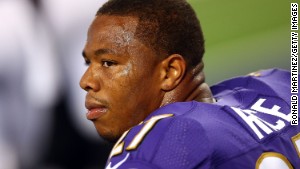
The running back without a team is appealing his indefinite suspension by the league. While Rice has called punching his future wife in the head and knocking her out "inexcusable," he is seeking to have the opportunity to play in the NFL again. The players' union has complained that Rice didn't receive due process from Goodell, who suspended him in June to a two-game ban, then increased the penalty to an indefinite suspension. That came earlier this month after TMZ Sports posted a video that showed the punch.
Rice was three days away from completing the original suspension when the indefinite ban was handed down and when the Baltimore Ravens terminated his contract.

Ray McDonald
On August 31, three days after Goodell created an NFL policy against domestic violence, San Francisco 49ers defensive tackle Ray McDonald was arrested on an accusation of felony domestic violence. The new policy imposes a minimum six-game unpaid ban for first-time offenders and up to a lifetime ban for second-time offenders.
No charges have been filed in the incident involving McDonald. Neither the team nor the league has levied any discipline in the case, and the starter at left defensive tackle played the first two games of the season.

Quincy Enunwa
The Jets practice squad player's arrest went practically overlooked outside of the New York area. According to USA Today's "NFL Players Arrests" tracker, he was arrested on September 4.
Enunwa was charged with simple assault after a woman told police he pulled her off a bed at a hotel, causing a head injury, ESPNNewYork.com reported. He pleaded not guilty, ESPN said, adding that the player was still practicing with the team.
NFL's past penalties for domestic violence 'a different story'
ISIS attack 'captures Syrian villages'
9/18/2014 2:20:47 PM
- NEW: The U.S. military has approved a plan to strike ISIS in Syria, officials said
- NEW: President Barack Obama still has to sign off on the plan, they said
- NEW: ISIS releases a video of British hostage John Cantlie
- ISIS captured 16 villages in northern Syria in the past day, opposition group says
Washington (CNN) -- The U.S. military has everything it needs to strike ISIS targets inside Syria, a plan that officials told CNN on Thursday is still waiting for President Barack Obama's signoff.
The news came as the terror group that calls itself the Islamic State advanced its grip on portions of Syria and Iraq, seizing 16 predominantly Kurdish villages near the Turkish border.
The move by ISIS was just one in a series of developments that saw new reports of atrocities emerge and the release of a video of a captive British journalist criticizing the American and British governments.
Even as top U.S. military leadership approved a plan to strike ISIS in Syria, there was a question of whether Congress would sign off on Obama's plan to arm and train Syrian rebels to fight the terror group.
The Senate was set to take up the issue late Thursday afternoon, a day after the House approved the plan and then tucked it into a bill that would continue funding the U.S. government.
U.S. military on deck
At the same time, U.S. lawmakers are debating the best way to stop ISIS.
In testimony before the House Foreign Affairs Committee, Defense Secretary Chuck Hagel said America's top military leaders have developed a plan to hit ISIS targets in the terror group's stronghold in northern Syria.
Obama has been briefed on those plans, which were approved by Hagel and Gen. Martin Dempsey, the chairman of the Joint Chiefs of Staff.
For weeks, U.S. intelligence and military targeting specialists have been working around the clock on a list of potential targets in Syria. The list is expected to be shown to Obama one more time, U.S. military officials said.
An analysis of the risks of bombing inside Syria will be included, as well as an assessment of how the destruction of the targets could degrade ISIS, they said.
Carrying out airstrikes against ISIS in Syria would be a continuation of the U.S. military operation in Iraq, where American airstrikes are being carried out against the terror group.
U.S. airstrikes on Thursday struck an ISIS training camp southeast of Mosul, the group's stronghold in Iraq, the U.S. military said. Another strike southeast of Baghdad damaged an ISIS ammunition stockpile, according to the military.
Read more: U.S. ready to strike ISIS, officials say
French air support
The Obama administration has spoken of a "broad" coalition of 40 nations that will ban together to fight ISIS.
Read more: Who is doing what in the coalition?
French President Francois Hollande said Thursday that there have been French reconnaissance flights over Iraq this week. When French officials "identify targets, we will act" in a short time frame, he told reporters in Paris. Hollande thanked the United Arab Emirates for allowing France to use an air base there.
Hollande stressed that France "will not go beyond" air support and will not send ground troops into Iraq.
Obama said the same for the United States on Wednesday.
"As your commander in chief, I will not commit you and the rest of our armed forces to fighting another ground war in Iraq," Obama told troops at MacDill Air Force Base in Florida.
Iraq: More than 1,000 soldiers MIA from June attack
ISIS captured 16 predominantly Kurdish villages in northern Syria over the past 24 hours, a Syrian opposition group said. ISIS fighters used artillery and tanks against the villages along the Syria-Turkey border, the Syrian Observatory for Human Rights said.
Just as in Syria, the crisis in Iraq continues to unfold.
Iraq's Human Rights Ministry said Thursday that 1,095 Iraqi soldiers still are missing after an ISIS attack in June on a military base formerly known as Camp Speicher.
ISIS says it killed 1,700 Iraqi troops in the attack. The Iraqi government hasn't released a number of those killed; Human Rights Watch says ISIS executed hundreds of soldiers.
The news came as ISIS released a video of British hostage John Cantlie criticizing the American and British governments for their failure to negotiate for the hostages as other governments have done.
In a video posted online, Cantlie -- wearing an orange shirt and seated alone at a desk with a black backdrop -- says he is sending what will be the first in a series of messages on behalf of the group that calls itself the Islamic State.
Since Cantlie is delivering ISIS propaganda and makes clear in the video he is speaking under duress, CNN is not showing the video on its platforms.
In recent weeks, ISIS has drawn growing attention for spewing brutal propaganda across social media -- messages meant both to terrify and recruit Westerners. The group appears to have a well-funded, well-organized social media and video production effort. Its videos are slickly produced, with high production values, experts say.
The anatomy of ISIS: How the 'Islamic State' is run, from oil to beheadings
Read more: Friends of Alan Henning plead with ISIS to let him go
Inside the mind of an ISIS fighter
Barbara Starr reported from Washington, Anna Coren reported from Irbil, Iraq, and Chelsea J. Carter and Holly Yan wrote and reported from Atlanta. CNN's Ashley Fantz, Elise Labott, Deirdre Walsh, Ted Barrett and Mohammed Tawfeeq contributed to this report.
Anatomy of ISIS reflects West
9/18/2014 3:13:16 PM
- New research reveals ISIS government structure in parts of Syria and Iraq
- Abu Bakr al-Baghdadi, a former U.S. inmate in Iraq, is leader of so-called "Islamic State"
- TRAC research shows ISIS' evolution from military force to basic services provider
- Many ISIS officials, including key deputies, are Saddam Hussein-era military officers
(CNN) -- Put yourself in the shoes (and sixth-century black robes) of ISIS' Abu Bakr al-Baghdadi, the mysterious boss of the terror group that is striking fear into the hearts of leaders around the world.
In the past couple of years you've managed to avoid drone attacks and survive civil wars, unify militant groups in two different countries under your banner, raise an army of jihadis from across the globe, and seize a chunk of land stretching from northern Syria to central Iraq.
Your newly-declared "Islamic State" is the size of Pennsylvania, so how do you govern it? You compartmentalize.
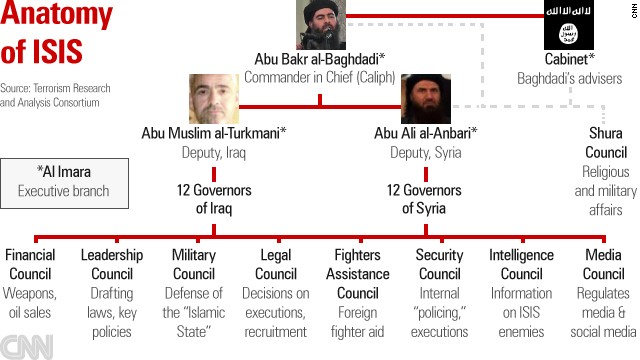
New data from the Terrorism Research and Analysis Consortium (TRAC) has revealed that ISIS is putting governing structures in place to rule the territories the group conquers once the dust settles on the battlefield.
The research shows how ISIS has gone from being a purely military force to building a system that can provide basic services, such as making sure that gas and food are available, to its new citizens.
From the cabinet and the governors to the financial and legislative bodies, ISIS' bureaucratic hierarchy looks a lot like those of some of the Western countries whose values it rejects -- if you take away the democracy and add in a council to consider who should be beheaded.
Baghdadi, his Cabinet advisers and his two key deputies comprise the executive branch of the government, known as "Al Imara."
The two deputies -- Abu Ali al-Anbari and Abu Muslim al-Turkmani, veteran Iraqi military officials who served under Saddam Hussein -- oversee Syria and Iraq, respectively.
ISIS has probably split the governance of the "Islamic State" into Syrian and Iraqi branches simply to make it easier to run, according to Jasmine Opperman, TRAC's Southern Africa Director.
"They see the caliphate as one state, yet there are two different governments," Opperman told CNN. "I believe this split is purely administrative at this time. They don't want to be seen as downplaying the caliphate, but to make it easier to govern they were forced to make a separation between Syria and Iraq."
The two deputies deliver orders to the governors in charge of the various sub-states in Syria and Iraq under ISIS control, who then instruct local councils on how to implement the executive branch's decrees on everything from media relations and recruiting to policing and financial matters.
The Shura council -- which reports directly to the executive branch -- is the caliphate's religious monitor, appointed to make sure that all the local councils and governors are sticking to ISIS' version of Islamic law.
The recent murders of Western hostages James Foley, Steven Sotloff, and David Haines would have fallen under the Shura council's purview, according to Opperman.
"Let's say a significant execution is going to take place, something that will get ISIS on the front page of the newspaper," Opperman said. "It cannot be done without Shura council approval."
The Shura council also has the power to censure the leadership for running afoul of its interpretation of Sharia law, according to Opperman.
"The Shura council has the right to tell Baghdadi to go if he's not adhering to ISIS' religious standards," she told CNN. "It would most probably never happen, but the fact that it's possible indicates the council's prominence."
Baghdadi -- who was once imprisoned by U.S. forces in Iraq -- seems to have incorporated the American military's own counter-insurgency mantra of "Clear and Hold" to win territory, establish control over the area, then get the locals to help govern it.
As time goes on, ISIS is evolving into a government whose political decision-making cannot be separated from its military capabilities, according to Opperman.
"It's two sides of the same coin," she said. "We've seen the military side, with the war cabinet that directs brigades. But now on the other side we're seeing how ISIS wants to govern. The two processes inform one another."
READ MORE: Kurds push back ISIS in bloody battle
READ MORE: "No ground troops in Iraq," says Obama
READ MORE: What's with Baghdadi's bling timepiece?
First results of Scotland vote trickle in
9/18/2014 8:57:20 PM
- NEW: First results have been reported -- 'No' camp wins Clackmannanshire council
- With seven councils reporting so far, turnout was just over 85%
- The referendum will decide if Scotland remains part of the United Kingdom
- Edinburgh official looks forward to an "accurate and transparent" vote count
Glasgow, Scotland (CNN) -- [Breaking news alert, 2:24 am GMT (9:24 p.m. ET)]
With two councils having declared their results, there have been 21,233 'Yes' votes and 29,040 'No' votes, a margin of 57.8% to 42.2% against independence.
[Original story published at 9.08 p.m. ET]
Voters in Scotland made their choice Thursday -- remain part of the United Kingdom, or form their own independent nation.
Now, the counting of the votes is underway, with the first councils beginning to report counts.
Clackmannanshire, the first council to report results, has swung for the 'No' camp, with 19,036 voters, or just under 54% of the total, choosing to stay part of the union, over 16,350 'Yes' votes, according to the counting officer.
The count from the island of Orkney shows voters rejecting independence by a margin of two to one.
The individual counts by local authorities -- there are 32 in Scotland -- are ultimately immaterial as it is the total number of votes countrywide that will determine the outcome.
Polls at more than 5,500 stations across all districts, from the remote highlands and islands to the big cities of Edinburgh and Glasgow, closed at 10 p.m. local time (5 p.m. ET). People still in line to vote at that time were allowed to cast ballots.
The first districts to report turnout have reported high participation -- well over 80% in each case -- Mary Pitcaithly, chief counting officer, announced in Edinburgh.
With seven of Scotland's 32 councils so far having announced their figures, overall turnout in the referendum was around 85%, according to CNN calculations.
More than 4.2 million people registered to vote on the question: "Should Scotland be an independent country?"
A vote for independence would mean Scotland, with its population of about 5.3 million, splits from the rest of the United Kingdom, made up of England, Wales and Northern Ireland, in addition to Scotland.
"The people of Scotland have engaged in this conversation," Phil MacHugh, a spokesman for the "Yes" camp, told CNN on Thursday night. "They have really gone out there, found out the information that they wanted to know, and made that choice today."
Official results will be announced at a central counting location in Edinburgh as they come in through the night, with a final tally expected early Friday.
British Prime Minister David Cameron will make an address Friday morning. The content will depend on the outcome of the vote, but in the event that Scottish voters decide to stay in the union, Downing Street says he will refer to plans for further redistribution of powers from the central government to the Scottish Parliament, signed by Westminster leaders earlier this week.
The counting officer for Edinburgh, Sue Bruce, explained just after 10 p.m. that each ballot will be double-checked, to verify each voter's decision. She said that she hopes to announce the final result for her district -- Scotland's second largest, after Glasgow -- by 5 a.m. local time Friday.
Addressing dozens of election workers, Bruce added, "I look forward to working with you during the course of the evening to deliver an accurate and transparent Edinburgh count in which you and the voters of Edinburgh can have full confidence."
How all of Scotland decides on this crucial vote is far from clear. A final poll of polls by the independent research organization ScotCen showed the "No" camp with a narrow lead on the eve of the vote, with 52% support.
A new poll, conducted Thursday, suggests that margin may have grown.
The research and consulting organization YouGov asked more than 1,800 people who voted Thursday in Scotland as well as 800 who cast postal ballots. A small but significant majority -- 54% to 46% -- said Scotland should remain part of the United Kingdom, according to the poll, which was not conducted for CNN.
What you need to know
Voting was brisk at one polling station in Glasgow as the polls opened Thursday, with many people voting on the way to work or before taking their children to school.
Bad weather or the sheer volume of votes cast could slow down the counting process. However, the weather forecast appears good so far -- important when some ballot boxes must be collected by helicopter, plane or boat from polling stations on distant islands.
Allegations of voting fraud were reported by Glasgow City Council, with several instances of people turning up at voting booths in Scotland's largest city to vote, only to be told that they had already voted.
The Council stressed that there was never actually a situation of double voting and the affected ballots are now being searched for and taken away.
A simple majority is needed for either side to claim victory.
Scotland's First Minister Alex Salmond, who has led the pro-independence "Yes Scotland" campaign, cast his ballot Friday morning in the village of Strichen, Aberdeenshire.
Labour lawmaker Alistair Darling, who has headed the pro-union "Better Together" campaign -- backed by the main parties in Westminster -- voted in Edinburgh, while former Prime Minister Gordon Brown, another pro-union campaigner, voted in the town of Kirkcaldy.
For the first time, the vote was extended to 16- and 17-year-olds living in Scotland. Nearly 110,000 people younger than 18 have registered to vote.
Voters in the referendum did not have to be British citizens; Commonwealth, Irish and EU citizens who live in Scotland and are registered to vote there can cast a ballot. However, Scots living outside Scotland do not have a say.
Nearly 790,000 people applied for a postal vote -- the largest volume of registration for postal votes ever in Scotland.
After the polls closed, Salmond tweeted, "This has been a remarkable day. Scotland's future truly is in Scotland's hands."
CNN's Nic Robertson reported from Glasgow, Laura Smith-Spark wrote and reported in London and Euan McKirdy wrote and reported in Hong Kong. CNN's Richard Allen Greene, Lindsay Issac and Greg Botelho contributed to this report.
'Yes would humiliate PM'
9/18/2014 7:06:46 PM
CNN's Christiane Amanpour speaks to Robin Oakley about how Scotland's independence might impact British politics.
If your browser has Adobe Flash Player installed, click above to play. Otherwise, click below.
You are receiving this email because you subscribed to this feed at feedmyinbox.com
If you no longer wish to receive these emails, you can unsubscribe from this feed, or manage all your subscriptions

No comments:
Post a Comment