 | Make HipChat Your Collaboration Command Center. Group Chat, Video Chat & Screensharing. $0/Unlimited Users. Get Started >> From our sponsors |
| CNN.com - Top Stories |
| CNN.com delivers up-to-the-minute news and information on the latest top stories, weather, entertainment, politics and more. |
NATO: 1,000 Russian troops in Ukraine
9/11/2014 9:17:50 AM
- NEW: Obama: The U.S. will join the European Union in implementing sanctions
- Russia has 1,000 soldiers and advanced military equipment in Ukraine, a NATO officer says
- Ceasefire in eastern Ukraine is "very fragile," Russian Foreign Ministry spokesman says
- He cites "mounting evidence" of Kiev government strengthening its military presence
(CNN) -- Russia still has about 1,000 troops inside eastern Ukraine, a NATO military officer said Thursday, a week after Ukraine's government and pro-Russian rebels agreed to a ceasefire aimed at ending months of conflict.
NATO also sees 20,000 more Russian troops aligned along the border, the NATO officer told CNN. He was not named according to standard practice in the organization.
NATO believes that these numbers amount to a large and effective military force, the officer said. In addition to the troop numbers, NATO continues to see sophisticated Russian military equipment in Ukraine.
NATO remains concerned and urges Russia to engage with the international community and Ukraine to find a political solution to the crisis, the officer said.
Moscow has consistently denied allegations by Kiev and the West that Russia has troops in Ukraine, and that it has armed and supported the rebels.
On Wednesday, Ukrainian President Petro Poroshenko said some 70% of the Russian troops believed to have been in Ukraine had withdrawn back across the border, according to the national news agency Ukrinform.
Information released by Ukraine's National Security and Defense Council on Thursday indicated that the rebel forces control a strip of eastern Ukraine running from the city of Luhansk down to the Sea of Azov.
'Very fragile' ceasefire
The truce was signed Friday after talks in Minsk, Belarus, between representatives of Ukraine, the rebels and Russia.
But more substantive talks on issues, including the decentralization of power and constitutional reform in Ukraine, must still take place before a lasting resolution can be found.
Russian Foreign Ministry spokesman Aleksandr Lukashevich told a briefing Thursday that the ceasefire was "very fragile" and that both sides must implement the framework agreed to in Minsk.
"There is mounting evidence of the Kiev government strengthening its military groups in different areas, regions; there are eyewitness reports to prove it," he said, "though Ukrainian authorities keep on reassuring us that they're not planning a military operation."
Lukashevich said Russia was also surprised by NATO's announcement of plans to hold joint military exercises with Kiev in Ukraine later this year.
"This might cause the escalation (of the situation) and put the progress in peaceful settlement of the crisis in Ukraine under threat," he warned.
New sanctions
A new round of European Union sanctions against Russia over its actions in Ukraine will come into force Friday, European Council President Herman Van Rompuy said Thursday.
EU officials will review the implementation of the ceasefire before the end of the month, he said, after which the sanctions could be amended or lifted.
The sanctions include tougher restrictions on Russia's access to EU capital markets; a ban on loans by EU companies or individuals to five major Russian state-owned banks; a ban on debt financing to three major Russian defense companies and three major energy companies; and an asset freeze and travel ban against 24 more individuals.
This means 119 people in total are now subject to sanctions, while 23 entities remain under an asset freeze in the European Union.
Russia has warned it will respond to any additional measures.
In his remarks, Lukashevich said the deadly crash in July of Malaysia Airlines Flight 17 -- which Kiev and the West believe was shot down from rebel-held territory using a Russian-made missile launcher -- was being used to justify the imposition of broad Western sanctions against Russia.
A preliminary report into the crash released this week by Dutch investigators did not apportion blame for the crash but said the plane was brought down by "high-energy objects" from outside.
The United States will join the European Union in implementing additional sanctions against Russia over its "illegal actions in Ukraine," President Obama said Thursday. "We will deepen and broaden sanctions in Russia's financial, energy, and defense sectors," he said. The administration will outline the specifics of the sanctions Friday.
"We are implementing these new measures in light of Russia's actions to further destabilize Ukraine over the last month, including through the presence of heavily armed Russian forces in eastern Ukraine. We are watching closely developments since the announcement of the ceasefire and agreement in Minsk, but we have yet to see conclusive evidence that Russia has ceased its efforts to destabilize Ukraine," Obama said.
Aid convoy
Lukashevich also said there had not yet been a "breakthrough" allowing a new Russian aid convoy to start moving into Ukraine in the next few days.
"We hope that the delivery will be carried out with participation of Ukraine's border guards and customs officers as well as officials from the International Committee of the Red Cross," he said. "We hope, however, that the coordination would not be dragged out."
A previous convoy carrying aid for civilians caught up in the fighting in the Donetsk and Luhansk regions was sent over the border by Russia without permission from Ukrainian authorities.
The Presidents of Russia and Ukraine are "broadly satisfied" with the status of the ceasefire, Kremlin foreign policy adviser Yuri Ushakov told Russia's Interfax news agency on Wednesday.
CNN's Andrew Carey in Kiev and Alla Eshchenko in Moscow contributed to this report. CNN's James Frater also contributed.
U.S. copters surprise Polish village
9/11/2014 11:39:07 AM
- Bad weather forces six helicopters to land
- Villagers flock to a field for the surprise visit
- They mayor of the small village of Gruta regrets they didn't feed the U.S. soldiers
(CNN) -- When a flight of military helicopters descended into a field in the small village of Gruta, Poland, on Tuesday, residents had reason to be alarmed.
After all, the village is only about 100 miles (161 kilometers) from the Russian enclave of Kaliningrad. And with current tensions between Poland and its NATO allies and Russia over the situation in Ukraine, well, it would be natural to worry.
But it turned out this was more treat than threat.
The six copters were U.S. Army. The five Black Hawks and one Chinook were on their way back to their temporary base in Poland from NATO exercises in Lithuania when bad weather forced them to land in the Gruta field, a Polish military spokesman told Bloomberg News.
Whoever could in the village of 1,600 people flocked to the scene, according to the town's website, chatting with the U.S. troops and posing for pictures.
"It's a big treat to be able to see up close such a colossus," the website said of the twin-rotor CH-47 Chinook. Town residents posed for pictures with the troops and the machine.
"Thank God it was the Americans," the town's mayor, Halina Kowalkowska, told Bloomberg. But she said the town's excitement may have made residents forget their hospitality.
"Now, when I think about it, we could have served them some food, but we were in shock and the boys had to go," Bloomberg quoted her as saying.
U.N. peacekeepers in Golan freed
9/11/2014 8:09:12 AM
- NEW: U.N. chief Ban Ki-moon says he "appreciates the efforts" to get the troops' "safe release"
- The peacekeepers are from Fiji
- The United Nations says they are in good condition
- They had been captured by an al Qaeda affiliate
(CNN) -- The 45 U.N. peacekeepers seized in the Golan Heights have been freed and are in good condition, the United Nations said Thursday.
The peacekeepers were captured two weeks ago by the al-Nusra Front, an al Qaeda affiliate, in the buffer zone between Syria and the Israeli-occupied territory, a day after rebels seized control of a border crossing between the two.
The personnel were handed over to the U.N. Disengagement Observer Force. A spokesman for U.N. Secretary-General Ban Ki-moon said discussions had been ongoing with captors by "various parties" at "various levels" to obtain the peacekeepers' release.
The U.N. Disengagement Observer Force has overseen a buffer zone in the Golan Heights since 1974 to maintain a ceasefire between Israel and Syria. Fighting from Syria's civil war spilled over into the buffer zone last week.
The al-Nusra Front used civilian cars to take the peacekeepers to a U.N. base on the Syrian side of the border, a CNN source said, and the troops walked about 200 meters to the Israeli-occupied Golan side. U.N. vehicles then took the troops to the U.N. observer force command center, the source said.
Ban's spokesman said the secretary-general "appreciates the efforts of all concerned to secure their safe release."
"The Secretary-General emphasizes to all parties the impartiality of United Nations peacekeepers," the spokesman said. "The Secretary-General demands that all parties respect UNDOF's mandate, freedom of movement and the safety and security of its personnel."
CNN's Kareem Khadder contributed to this report.
Solar storm heads toward Earth
9/11/2014 12:28:04 PM

- Strong Geomagnetic Storm Watch issued
- Storm could impact power grid, satellites
- Auroras possible in northern latitudes
(CNN) -- This is not your usual weather forecast. Big storms are brewing. Your umbrella won't help, but you might want to keep a flashlight handy.
These storms are coming from the sun. It's raining down a huge amount of radiation. We're safe, but it could affect power grids, radios and satellites.
Experts say the combined energy from two recent solar events will arrive at Earth on September 13, prompting the Space Weather Prediction Center to issue a strong Geomagnetic Storm Watch.
Whaat kind of watch? Basically, the sun is a giant ball of gas -- 92.1% hydrogen and 7.8% helium. Every now and then it spits out a giant burst of radiation called a coronal mass ejection, or CME.
CMEs are sometimes associated with solar flares, the most explosive events in the solar system. The sun has released two CMEs in the past two days and both are linked to solar flares. NASA says the second flare is an X1.6 class, putting it in the most intense category.
The energy from those two CMEs is heading toward Earth.
Space weather experts aren't sure yet what this solar storm will do.
"This is a pretty strong solar storm and we just won't know until it gets here" what it will do, said CNN Meteorologist Chad Meyers.
Earth's atmosphere usually protects us humans, but you might want to keep a flashlight handy. Solar storms can knock out power, interfere with GPS and radio communications -- including those on commercial airliners -- and they can damage satellites.
On March 13, 1989, a solar storm knocked out power for the entire province of Quebec for 12 hours. Power grids in the U.S. were impacted, but didn't have blackouts. NASA says some satellites tumbled out of control for hours during what's known as the Quebec Blackout. The Space Shuttle Discovery was in orbit at the time and had a mysterious sensor problem that went away after the storm, NASA says.
On the upside, solar storms also create beautiful aurora. Aurora watchers in the northern U.S. should be watching the skies on Thursday and Friday nights.
Study: Massive solar storm barely missed us in 2012
Election woes haunt Afghanistan
9/11/2014 7:55:09 AM
- Afghanistan's government is at an impasse as awaiting election audit results
- Abdullah Abdullah and Ashraf Ghani accuse each other of fraud and manipulation in June election
- Dispute has stymied what was to be Afghanistan's first democratic transfer of power
- UN's Ban Ki-moon and Hamid Karzai call for unity government
Kabul, Afghanistan (CNN) -- Afghanistan has been thrown into political turmoil after a months-long dispute between two presidential candidates prevented a successor to outgoing President Hamid Karzai being named.
The country's presidential election was held on April 5, and was followed by a runoff vote in June after the first result was inconclusive. The two contenders, Abdullah Abdullah and Ashraf Ghani, have accused each other of fraud and manipulation.
Despite pleas from Karzai and United Nations Secretary General Ban Ki-Moon to come to a resolution, the two opponents remain at an impasse, sparking concerns of bloodshed and instability in the fragile, war-torn country. It has significantly delayed what was to be Afghanistan's first democratic transfer of power.
This comes at a time as the Taliban have carried out deadly attacks on high-profile targets and fought heavily for control of the Helmand province. As the U.S.-led war effort against the Taliban winds down, most NATO troops are due to withdraw from Afghanistan by the end of this year.
Afghanistan "urgently needs a new government," and the two runoff candidates must form a unity government, Karzai said earlier this week.
"We want a new government and that can be brought to us by Dr. Abdullah Abdullah and Dr. Ashraf Ghani Ahmadzai."
READ: Taliban suicide bombers target Afghanistan spy agency
A crumbling agreement?
In July, Abdullah and Ghani came to an agreement, brokered by U.S. Secretary of State John Kerry, to accept the result of a nationwide audit and form a unity government.
READ: Kerry unveils audit in Afghan presidential election crisis
The Independent Election Commission of Afghanistan conducted the audit, under the supervision of UN specialists and international observers. It completed the audit of about 8 million votes on September 4, but the results have not been released.
"The audit work is completed," said Noor Mohammad Noor, a spokesman for the election commission on Wednesday. "Only some physical work is yet to be done and we are hoping to be able to announce it in the next few days."
Meanwhile, both candidates appear they are backing off their July commitment with statements reported in the media that Abdullah would reject the official results and Ghani indicated he may not be open to power sharing.
In a statement this week, Ban urged the candidates to fulfill their end of the agreement "on a government of national unity in accordance with the commitments they reached on 12 July," according to his spokesman.
"The Secretary-General emphasizes that this is a pivotal moment for Afghanistan, and that genuine partnership will be required in tackling Afghanistan's many challenges. Both parties share a real responsibility to guide Afghanistan to a peaceful and more prosperous future. Given the scale of the challenges, this can only be done jointly."
The impasse has also vexed Karzai, whose last day in office was supposed to be three months ago. After 13 years in power, Karzai had said that he hoped to leave office by September 2, but was asked by the UN Special Representative to stay as the vote audit was underway.
Abdullah and Ghani at odds
There are concerns that the political deadlock can spiral into a bloody dispute between supporters for the two candidates.
On Tuesday, Abdullah's supporters took to the streets to commemorate the 13th anniversary of the death of Ahmad Shah Massoud, who is regarded as a national hero. At the scene, a boy died when members of the crowd fired their guns into the air.
In the general election on April 5, Abdullah secured 45% of the vote, while Ghani got 31.6%. Abdullah was a vocal critic of the Taliban during their years in power. Although he was once an ally of Karzai, serving in his government as foreign minister, he become an opponent in recent years and even challenged him in the 2009 election. Abdullah dropped out after that election after the first round to protest what he said was large-scale voting fraud.
In the June vote, Ghani appeared to pull off a comeback, gaining more votes over Abdullah. Ghani is a former academic and U.S. citizen who gave up his passport to run for the Afghan presidency in 2009. He worked as an adviser to Karzai and as finance minister in his Cabinet.
CNN's Masoud Popalzai reported from Afghanistan and Madison Park wrote from Hong Kong.
Facebook testing disappearing posts
9/11/2014 11:39:20 AM

- Facebook users might be able to schedule expiration times for their posts
- Facebook says it's doing a small test of the feature
- Delete times would range from one hour to seven days
(CNN) -- If you want to use Facebook a little more like Snapchat, you might soon get your chance.
The social-media giant is testing a feature that would let users set a time for their status updates to disappear. A Facebook spokesman said the feature is part of a "small pilot" and is available only for certain people using Facebook's iOS app.
Several users reported noticing the test on their iPhones. One post on Twitter showed a list of expiration options ranging from one hour to seven days.
It's not the first time Facebook has tried to emulate emerging social media services designed to be used in the moment without leaving a permanent digital mark.
In 2012, Facebook toyed with the concept with a standalone app, Poke. Apparently coded in part by CEO Mark Zuckerberg himself, the effort was described as something of a lark over a holiday weekend.
It was shut down this year and replaced by Slingshot, a similar app on which short-lived messages show up only once two users have sent them to each other.
The ephemeral has become increasingly alluring in the social-media world, particularly among younger users, in the past couple of years. The runaway success of Snapchat, which lets you send photos, texts or videos that disappear in a matter of seconds, has led the way.
The scheduled deletions on Facebook, as being considered, obviously have a longer shelf life than a few seconds. Users might also want to delete updates that would no longer be of use after a short time, i.e. "I'll be in Atlanta until noon tomorrow" or "I have two tickets for tonight's concert. Who wants to go?"
Terra-cotta warriors get 'sex change'
9/11/2014 10:37:49 AM
- Artist Prune Nourry's show, "Terracotta Daughters," opens in New York on Wednesday
- Creating female terra-cotta warriors is a way to address the issue of gender imbalance
- Due to cultural preference for boys, China will have a big surplus of men, which is a problem
- Nourry worked with local craftsmen in China to make each female terra-cotta statue unique
Editor's note: Flora Zhang is a producer at CNN Digital. Follow her on Twitter: @flozha
(CNN) -- When Emperor Qin Shi Huang, the first emperor of China, anticipated his death more than 2,000 years ago, he wanted an army of warriors to guard his mausoleum forever and protect him in the afterlife.
So he ordered the creation of some 8,000 terra-cotta soldiers, along with hundreds of terra-cotta horses and chariots, to be buried with him in his tomb. Historians speculate the soldiers were modeled after eight individuals. When the statues were discovered by workers digging a well in Xi'an, Shaanxi Province, in 1974, the world was stunned by the spectacular funerary art and the legacy of the powerful emperor. Since then, it's become a major tourist attraction and a World Heritage site.
Now, these soldiers have a counterpart: female terra-cotta warriors.
Prune Nourry, a Paris-born artist based in New York City, has created a small army of them. In "Terracotta Daughters," 116 are featured in an exhibition at the China Institute from September 10 through October 4. The show's U.S. premiere is presented by the French Institute Alliance Francaise and China Institute as part of FIAF's Crossing the Line festival.
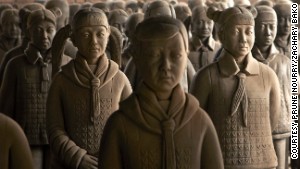
The difference is these female terra-cotta warriors are not out to protect any emperor, but were created to bring attention to the plight of girls in China.

"In China, there is a huge imbalance between boys and girls. I wanted to highlight the issue of gender preference," said Nourry. "I needed a strong cultural symbol to base this project on, and a universal one that would speak both to Chinese villagers in the countryside and to citizens abroad."
And, in a striking parallel to the terra-cotta soldiers, the terra-cotta girls will also become an archaeological project. After the exhibition, they will be buried in China until 2030, the year that, according to Chinese sociologists, men will have the hardest time finding a wife because of the skewed gender ratio.
The imbalance of the sexes is a serious problem for the Chinese. A 2010 census indicates there are at least 34 million more men than women. Due to the one-child policy and traditional preference for boys, as well as sex-selective technologies, China will have a huge surplus of men, which presents daunting demographic challenges for the world's most populous country.
Perhaps for those reasons, Nourry didn't encounter difficulties with the Chinese government in pursuing this project in China. She started working on the terra-cotta statues two years ago after finishing an installation in India that also explored gender bias.
In deciding on the size of the female army, Nourry chose the number eight because of its auspiciousness in Chinese culture. She created the first eight statues modeled after eight girls whom she met through an orphan charity in China.
Then, working with local craftsmen in Xi'an, 108 permutations of statues were made based Nourry's original eight statues by combining the different heads, torsos and legs. "For Xian Feng, the main craftsman I worked with in China, my project seemed at first impossible since women 'can't be soldiers.' But after we began the project, he changed his view and even turned one of the 108 combinations into a portrait of his own daughter," said Nourry.
The local craftsmen of Xi'an are used to making copies of the terra-cotta warriors which are sold primarily to tourists. When Nourry asked them to give their artistic interpretation in sculpting the female statues, they were initially tentative. Over time, they lost their hesitancy and gave each statue unique faces. No two statues have the same features.
Each terra-cotta warrior girl stands nearly 5 feet tall and weighs about 260 pounds. Their hairstyles are contemporary, as are their uniform, which is modeled after the orphan girls' school attire. Unlike the male warriors, they look approachable, friendly and even charming.
"It was a very enriching collaboration, based on exchange and mutual respect," said Nourry.
Her favorite moment was when the eight girls saw the terra-cotta statues of themselves and were delighted. Part of the proceeds from the sale of the eight original statues will pay for the cost of the eight girls' education for three years.
"Terracotta Daughters" is impressive in its artistic craftsmanship and social statement. It's a refreshing reinterpretation of one of China's national symbols. With these modern female warriors, Prune raises the pressing issue of gender discrimination without pointing fingers at anyone or anything. One looks at these amazing terra-cotta statues and feel compelled to ask -- why aren't there more of them? And why aren't there more girls in China?
Read CNNOpinion's new Flipboard magazine
Follow us on Twitter @CNNOpinion.
Join us on Facebook.com/CNNOpinion.
The English weigh in
9/11/2014 1:54:12 PM
CNN's Open Mic takes to the streets of London to find out what people in the English capital make of the Scottish Referendum.
If your browser has Adobe Flash Player installed, click above to play. Otherwise, click below.
Would 'yes' vote affect whisky?
9/11/2014 10:38:58 PM
Max Foster finds out what makes Scotch whisky so special and whether the independence debate is affecting the industry.
If your browser has Adobe Flash Player installed, click above to play. Otherwise, click below.
Banks threaten to leave
9/11/2014 10:02:20 PM
The Royal Bank of Scotland and other big banks say they would leave an independent Scotland. CNN's Jim Boulden explains.
If your browser has Adobe Flash Player installed, click above to play. Otherwise, click below.
No to coalition of the killing
9/11/2014 10:37:01 PM
- Sally Kohn: Pro-military hawks are pleased that President Obama plans to attack ISIS
- Kohn: Military action will not get rid of ISIS but make the situation worse in Iraq, Syria
- She offers three reasons why striking ISIS is a bad idea, and four strong diplomatic solutions
- She says bombing ISIS will worsen instability in Iraq and fuel radical ideology more
Editor's note: Sally Kohn is an activist, columnist and television commentator. Follow Sally Kohn on Twitter @sallykohn. The opinions expressed in this commentary are solely those of the author.
(CNN) -- Pro-military hawks must be pleased with President Obama's speech on Wednesday night about attacking ISIS. We're sure to hear many of them -- the same voices that have been hounding the President to take military action in the first place -- call for more extensive strikes and even American troops on the ground.
What we won't hear enough of are the voices of the opposition -- those who argue that military action will not get rid of ISIS but make the situation worse in Iraq and Syria. There are strong reasons why many analysts think fighting ISIS is the wrong course of action, and that there are more effective alternatives. For one thing, the United States can pursue diplomatic and political solutions instead.
Military action against ISIS is a bad idea because:

1. U.S. intervention is what destabilized Iraq in the first place -- and more bombing will likely make Iraq less stable.
Our invasion of Iraq and the installation of Nuri al-Malaki as prime minister reignited deep sectarian tensions and created a power vacuum into which ISIS stepped. You can't save a country by destroying it. A bombing campaign that is perceived as taking the side of Shia Muslims while undoubtedly decimating communities and killing civilians will only worsen Iraq's instability.
2. Airstrikes won't destroy radical ideology, they'll make it worse.
Most would-be terrorists don't wake up one morning and suddenly decide to hate America. Often, there's a reason. In 2006, the classified National Intelligence Estimate found that the 2003 U.S. invasion and occupation of Iraq helped create a new generation of terrorists and increased the overall terrorism threat against America. More American military action in the Middle East will just inflame more anti-American terrorists -- which perversely only strengthens the ideology that fuels ISIS and other terrorist groups.
3. There is no direct threat to the United States.
When we see Yazidi refugees being slaughtered and American journalists being beheaded, of course our humanity calls for action. But those beating the drums of war have made assertions that ISIS poses a direct threat to American soil. This is simply not true. Even while playing up potential future threats to the homeland to justify military actions -- thus essentially embracing President George W. Bush's pre-emption doctrine -- the Obama administration reports ISIS currently poses no threat to the United States.
If bombing isn't the solution, what is?
The solution to destroying ISIS -- and mitigating Iraq's problems in general -- isn't military but political. Here are some key steps, according to analysts like Phyllis Bennis and advocates like Win Without War:
1. Cut access to guns and money.
It should be noted that ISIS has access to weapons because U.S. and Saudi weapons have been flooding the region for over a decade. The United States can take steps to shut down the weapons supply routes that ISIS is relying on. This is the opposite of what Obama has outlined as a strategy in Syria and Iraq. The U.S. also needs to re-evaluate its broader arms policy.
In addition, part of ISIS' strength is due to its robust financial resources, a significant part of which relies on black market sales of oil now under ISIS control. The U.S. and allies can take clear steps, some of which Obama has proposed, to block the processing and sale of this oil.
2. Fix Iraq's political rifts.
While ISIS allegedly has 20,000 fighters, there are 25 million Sunnis across the Middle East, and as long as they remain disillusioned with Iraqi and Syrian political leaders, they're a potential recruiting ground for ISIS to expand. This political crisis needs a political solution. Encouraging al-Maliki to step down and supporting a new, more inclusive Iraqi government is an important first step. The United States, along with allies, must help heal the sectarian rifts. And yes, that means serious engagement with Iran -- a traditional U.S. enemy which nonetheless shares our goal in stabilizing Iraq and has far more diplomatic influence in the region than we do.
3. Provide humanitarian assistance.
While airstrikes won't help the Syrian and Iraqi people, humanitarian assistance will. Millions have been displaced and have become refugees. It would be nice if American politicians cheering on expensive and deadly bombing campaigns would be at least as enthusiastic, if not more so, about spending money on food and water and shelter for those in desperate need. The Obama administration recently announced an additional $48 million in such aid -- but that number is nothing compared with how much will be wasted in airstrikes.
4. Lead a truly international response.
We don't need a coalition of the willing or a coalition of the killing. We need a coalition of nations that will help put Iraq on firm political and cultural footing and restart real negotiations in Syria involving all parties in the crisis there. The United States should work through the United Nations and seek diplomatic solutions through a broad coalition of nations.
Obama's critics want him to act tough in the face of ISIS. But if acting tough by bombing ISIS doesn't solve the problem -- and makes the threat worse -- then acting tough is stupid. Diplomacy may not have the same sexy veneer as aggressive military action, but if diplomacy could actually help the Syrian and Iraqi people and make the world safer, isn't that what counts?
Read CNNOpinion's new Flipboard magazine.
Follow us on Twitter @CNNOpinion.
Join us on Facebook.com/CNNOpinion.
The Pistorius I knew
9/11/2014 3:23:41 PM
- The trial of Oscar Pistorius in the death of girlfriend Reeva Steenkamp is ending
- A verdict is due from the judge on Thursday
- CNN's Robin Curnow first met Pistorius in 2008, and has covered his case
- She writes from an insider's view of a tragedy played out in a global spotlight
Editor's note: Robyn Curnow is an anchor and correspondent for CNN.
Johannesburg, South Africa (CNN) -- It took the tragedy of Reeva's Steenkamp's death for the media, for South Africa, to realize just how brightly Oscar Pistorius' star had ascended after the London Olympics when he ran against able-bodied athletes.
Shock over the shooting reverberated across the world, not just at home.
His story had touched people -- it was the classic tale of triumph over adversity, of hope and determination. And then it was all over.
The fallout was immediate, furious and personal. South Africans seemed to have a deep emotional attachment to Oscar Pistorius the hero and then, inevitably, his fall from grace.
The interest in the case and the court case has never really subsided, every twist and turn has been analyzed and debated and there is still an insatiable appetite for the story.
I first met Oscar Pistorius in 2008 at his home, in the bedroom that was to become a crime scene five years later.
He was young, enthusiastic and eager. Sitting on the edge of his bed, he showed our camera his different prosthetics and his stumps, explaining patiently about his birth defect and where his legs had been amputated as a child. He seemed determined, somewhat naïve and enthusiastic about his future.
By Valentine's Day last year he was a different person.
He walked into the magistrate's court days after he shot his girlfriend and looked like a blank, broken man. The implications of his actions -- whether it was intentional or negligent or neither -- were etched on his face. His future plans and the life that of the woman he said he loved were over.
The vomiting, the crying and the sobbing in court seemed genuine, I didn't think he was 'faking it' as the state and critics suggested. No matter whether he's judged innocent or guilty it was clear Pistorius' emotions were raw, remorseful.
He still treasures photographs of Reeva and him together, his uncle Arnold told us in an interview at the home where Oscar is living. The vomiting and retching were a physical manifestation of the gut-wrenching reality of his actions. Later, psychiatrists said it was a result of post-traumatic stress disorder
Throughout the court drama and the media focus on Oscar Pistorius, Reeva's Steenkamp's mother, June, sat a few meters from him -- still, stony-faced and stoic.
I don't know how she managed to compose herself, especially on the days in court when Pistorius described the night her daughter died and then, shockingly, the day the state showed the court images of her dead daughter's bloodied head. Brave, strong woman.
On Thursday, Judge Thokozile Masipa is set to deliver her verdict in the case, with possibilities ranging from a life sentence to Pistorius -- nicknamed the "Blade Runner" for the prosthetic devices on his legs -- leaving court a free man.
For all the families involved, this has been a tragedy played out in the glare of cameras and intense public interest. For our CNN team covering the story since February 14, 2013, it's been important for us not have to have taken sides, or to reduce Reeva's death and Oscar's actions to a tawdry soap opera. Instead, we've tried to instead reflect public sentiment and to let the justice system and the legal process wind its way to a conclusion.
Follow CNN's live blog for the verdict
The only white person in the room
9/11/2014 3:26:29 PM
- What happens when whites live in in a black world?
- White student at black school: Your vision shifts
- Some still can't define what being black means
- Why you should never say "I don't see color"
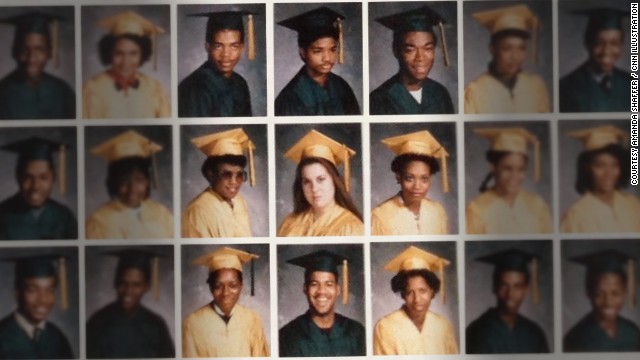
(CNN) -- Flip open Amanda Shaffer's high school yearbook, and you'll notice something that stands out even more than her classmates' earnest smiles and big hairdos.
Only a handful of white faces appear among the portraits of African-American students -- flecks of white on a canvas of black and brown. One of those faces belongs to Shaffer, who was bused to a black high school in Cleveland, Ohio, after refusing to follow her friends to a white, private academy.
For three years, Shaffer was the only white person in the room. She had to learn how to fit in, how to not say the wrong thing. She had to deal with the peculiar sensation of being the only white girl in the bleachers as jittery white basketball teams entered a raucous gym filled with black people.
"It shifted my point of view," Shaffer says. "It's like when you go to the optometrist, and they slap those new lenses on you -- you see the world differently."
At least some do. A co-owner of the NBA's Atlanta Hawks recently offered another perspective on race when he complained in an email that the presence of too many black fans at Hawks' games scared away Southern whites who are "not comfortable being in an arena or a bar where they are the minority."
Bruce Levenson, the owner, resigned. But the focus on his remarks ignored the perspective of people who actually have a lot of practice at being the only white person in a black crowd. They are whites who, by choice or necessity, lived in an all-black world. They became the white minority.
There's a long tradition in America of people offering unsolicited advice to racial minorities on how to blend in. But there's no instruction book for those who struggle with an experience that one white NBA player described as "the loneliness of being white in an all-black world."
It's not all racial angst, though, says one civil rights activist who left his all-white upbringing in Vermont to live for two years among black residents in Mississippi, where he discovered R&B singer Otis Redding, okra and black preaching.
"I lived in a completely black world; every couple of weeks, I looked in the mirror to remind myself that I was white," says Chris Williams, who was then an 18-year-old volunteer for a civil rights campaign known as Mississippi Freedom Summer.

What did he learn? Williams and others with similar experiences gave this minority report.
You learn to imagine
He was a raised in a small town in Missouri and went on to become a Rhodes Scholar, a U.S. senator and a presidential candidate. But some of the most important lessons Bill Bradley learned came on the basketball court as a player for the New York Knicks.
Bradley joined a team dominated by black superstars such as Willis Reed, Earl "The Pearl" Monroe and Walt Frazier. Off the court, though, the team's hierarchy was reversed.
"When I was a rookie, I was getting a lot of offers for commercials and my black teammates, who were better, were not getting any," he says.
Bradley got something else that he says was invaluable -- a glimpse into the private lives of black people. He shared rooms, meals, bus rides and long conversations off the court with his black teammates. He saw the constant racism they experienced and how it fed their anger.
He knew what it felt like to be outsider because he had become one.
In a speech he once gave to the National Press Club, Bradley said:
"I better understand distrust and suspicion. I understand the meaning of certain looks and certain codes. I understand what it is to be in racial situations for which you have no frame of reference. I understand the tension of always being on guard, of never totally relaxing ...
"I understand the loneliness of being white in a black world."
Bradley eventually made the NBA Hall of Fame. He's become one of the country's most insightful voices on race.
"Race relations are essentially exercises in imagination," he says today. "You have to imagine yourself in the skin of the other party. So that means if you're white, you have to understand certain realities."
Other white sojourners in a black world say you have to learn to take advice or even orders from a person of color.
Chris Williams, a civil rights activist who lived for two years with black families in Mississippi
One man had to do both to stay alive.
When Williams went to Mississippi in 1964, he had to live with black families because many local whites detested Freedom Summer volunteers. They taught him how to become a part of their community and protected him. One black man saved his life by pulling him away from a white mob.
Williams says white Freedom Summer volunteers had to abandon the notion that they were there to rescue black people. They weren't going to Mississippi to become civil rights leaders, an organizer told them.
"He said the civil rights leaders were already there; you go down there and help them," recalls Williams, now a retired architect who still lives in his boyhood home in Vermont. "He said that they know what needs to be fixed, and they'll tell you."
You learn what people really think
The Public Religion Research Institute recently caused a stir when it released a poll that said three-quarters of white Americans have no nonwhite friends. Some commentators invoked the survey to explain why some whites seem clueless about racial sensitivities: They know no people of color to give them a different perspective.
White minorities in black communities say they have no problem hearing another racial perspective. They often hear more than they should.
The Rev. Curtiss Paul DeYoung says black people became so familiar with his presence when he joined an all-black church in Harlem and later attended the predominately black Howard University in Washington that some called him a "white Negro."
"People didn't change who they were when they talked to me," says DeYoung, now director of the Community Renewal Society in Chicago, a faith-based group created to eliminate race and class divisions.
"When you get into racially mixed situations, we change who we are and clean up our thinking in mixed settings," he says.
Black people let it rip in front of him, though. Once during a class at Howard, a black classmate talking about the country's first settlers declared that "all white people are criminals."
"I quickly understood that this was not a personal attack on me," DeYoung says. "People were very welcoming to me personally, but she was talking more about institutional racism."
DeYoung met a black student at Howard who he later married. They remain married today and have two adult children.
"The woman who made that comment in class found out later that I was engaged to my wife and came up to me and said, 'Welcome to the family,' '' DeYoung says.
Other whites who spent time in all-black communities say they started noticing remarks from their white family and friends that were just as raw.
Shaffer, the white student who was bused, says she realized that her father called black kids "pickaninnies" and her brother called Puerto Ricans "Spics." She heard whites talk about "Jewing" prices down and warning others to wipe a soda can before drinking because "you don't know if a black person touched it."
"I just started noticing this subtle and casual racism that nobody around me questioned," says Shaffer, who is now an activist and director of faculty development at Case Western Reserve University in Ohio.
Bill Bradley, former U.S. senator and a Hall of Fame player with the New York Knicks
You see fear
Shaffer picked up on other things as well, such as the fear in some white faces when they moved into a black setting.
When she attended basketball games at her high school, Shaffer says, she would often be only one of two white girls in the crowd when white high school teams visited. It was like a disembodied experience -- she could step outside of her whiteness and watch with bemusement as nervous whites entered her school gym.
"One of the things I noticed is that they weren't actually making eye contact with people on the other side of the court," says Shaffer, who wrote about her experience in an essay entitled "Busing: A White Girl's Tale" for an online magazine, Belt.
"They were in a place where there were more black people than white people and that is not usual for white people," she says.
Some white minorities become more afraid of what they see inside themselves.
When DeYoung was in college, he decided he was going to introduce himself to an attractive white freshman he spotted. But when he saw that woman walking across campus with two black men, he suddenly lost interest.
DeYoung rummaged through his mental attic to figure out why. The answer humbled him. He was a man who grew up buying the Rev. Martin Luther King Jr.'s speeches and watching his father pastor a multiracial church, but he unearthed something ugly.

"I had fallen prey to the stereotype that a white woman involved with a black man is damaged goods, which goes back to the slave masters who taught people that black men were sexual animals," he says. "I thought, 'I don't have prejudice,' and then one of the oldest stereotypes struck me right in the face."
It can all sound so draining -- checking your motivations, trying not to offend black people. Isn't it easier to just declare as a white person that you don't see race?
DeYoung says that's actually a subtle way of insulting people of color.
"It diminishes people to not see their race and their culture," says DeYoung, who wrote a memoir about his racial journey entitled "Homecoming: A White Man's Journey through Harlem to Jerusalem."
"The reality is that race affects people's lives, and if you can't see race, you can't see the life they've lived."
You don't become an expert on race
There's a scene in the 1998 film "Primary Colors" in which a white Southern political operative tells this to a staid, uptight black campaign worker:
"I'm blacker than you are. I got some slave in me. I can feel it."
That scene captures a character familiar to some blacks: the white person who considers himself an honorary black person because he has a black girlfriend and likes hip-hop music.
Yet white people who spend time in an all-black setting seem to reach another conclusion:
"I don't think I can understand what it means to be black," says Williams, the Freedom Summer volunteer who joked that he forgot he was white. "It's much more than being a minority. It's a whole history."
That's something Joshua Packwood learned when he became the first white valedictorian at Morehouse College, a historically black college in Georgia that counts King as one of its graduates.
He says the black students he encountered were everything from punk rockers to hipsters to skateboarders to political conservatives who opposed affirmative action.
"If you ask me to define what black is, I'm not sure I can," says Packwood, who now lives in New York City with his wife and son and is the co-founder of Red Alder, an investment company.
Some whites who found themselves in the minority wrestled with a fear that's familiar to many people of color: Will people ever see past my race?
"I also have to 'prove' myself over and over again," DeYoung wrote in his memoir, "Homecoming." "Some persons of color may never fully trust me because I am white."

The constant awareness of one's race can be exhausting. DeYoung quoted the theologian Howard Thurman in his memoir:
"The burden of being black and the burden of being white is so heavy that it is rare in our society to experience oneself as a human being."
But sometimes those moments can happen, as DeYoung learned by accident.
One day, DeYoung was looking through a journal he started keeping after he joined the church in Harlem. He noticed that the word "black" rang through every passage: I'm going to this "black church," I'm eating "black food," I'm making "black friends."
He recalled that no one at the Harlem church had ever placed a racial modifier before his name.
"Never once in that entire year did they refer to me as being white," he says. "I was just a member of the congregation. I was a child of God."
DeYoung kept reading and scanned the journal entries that came after he spent more time in the church. He noticed he was still writing about making new friends, listening to gospel and eating good food.
The word "black," however, had disappeared from his journal. They were no longer "the other." He was no longer an outsider.
He was at home.
Opinion: 'Acting white' and being black?
Opinion: Don't be afraid of America's changing demographics
Secret lives of domestic abuse
9/11/2014 4:12:42 PM
- The unheard voices of domestic abuse spoke up on CNN iReport when Rihanna's story of abuse came to light
- In light of the Ray Rice story, we decided to bring back these powerful stories
- Listen to these three stories of pain and hope
Editor's note: This story originally ran in November 2009. In light of the Ray Rice controversy, we decided to bring back these unheard stories from domestic abuse victims that are still just as powerful as the day they were told.
(CNN) -- A wife
Twenty-five years of abuse drove her away from a luxurious lifestyle and a job as a TV anchor. Looking back, this woman says she will never feel the same, even though she's been remarried to a wonderful man for 15 years now. The nightmares of abuse haunt her to this day.
A husband
To the outsider, this family looked happy, but life at home wasn't so pretty. Soon after they got married, verbal abuse and temper tantrums flared, alarming this man. Physical abuse came later, leaving the husband at a loss to explain why she was doing this.
A daughter
Her mom was pushed out of a car and beaten until she was black and blue, this woman says. Having grown up with violence in her home, she has resolved that her son will not.
Children: The silent victims of domestic abuse
Rice video prompts stories of #WhyIStayed
Traveling quilt shares survivors' stories
Dark side of independence debate
9/11/2014 12:42:28 AM

- A week out from Scotland's independence vote, the debate getting heated
- "Cybernats" have been accused of debasing the campaign for independence
- More traditional bad-tempered tactics, like egg-throwing, have also been employed
- Supporters on both sides of the debate have been targeted by Twitter trolls
(CNN) -- They say that to succeed in politics, you need a thick skin, and nowhere is that more true than in Scotland in the run up to the country's long-awaited independence referendum.
With just a week to go before Scots go to the polls to decide whether to break away from the rest of the UK, the debate is gearing up across the country -- in pubs and shops, on the street, TV and, of course, online.
Most political campaigns become a little bad-tempered at times, but when the stakes are this high, and the discourse goes from sniping to downright nasty and even violent, things can get tough.
Even hardened political heavyweights aren't immune: A televised debate between Scotland's First Minister Alex Salmond, of the "Yes" camp, and former UK finance minister Alistair Darling, of the "Better Together" campaign, descended into shrillness, name-calling and finger-pointing.
And the bitterness isn't just confined to the airwaves, TV studios and newspapers.
Pro-union Labour MP Jim Murphy found himself on the receiving end of some real-world nastiness when he was pelted with eggs during his "100 Streets" campaign trip.
"What started as individual passionate Nationalists having their say has changed into angry mobs coming along to make sure no one else has their say," he explained in a statement.
"This is not about someone throwing an egg -- that's part of the sometimes messy pantomime of politics," he said, accusing the "Yes" campaign of "organizing a mob atmosphere at our street meetings. It's coordinated, determined and increasingly aggressive."
Concerned at the angry turn things had taken, Murphy temporarily suspended his tour around the country, insisting that his political opponents "call off their mobs" before restarting his campaign days later. Scottish National Party leader Alex Salmond and the Yes Scotland campaign both condemned the egg attack.
It is in cyberspace where things have really degenerated.
John Chalmers, the Moderator of the Church of Scotland, said he was worried that not everyone was managing to keep their tempers under control, and bemoaned the actions of a disproportionate and rancorous "tiny minority" online which he said was drowning out the more moderate majority.
"I fear that something ugly may be beginning to permeate the independence debate," he said, echoing earlier comments to the BBC that he was "disturbed by apparent increased aggression and bitterness" as the referendum date approaches.
In one of the most high-profile cases, Christopher Stevenson, a fire safety technician from Glasgow's East End, was convicted of "behaving in a threatening manner" towards Salmond on Twitter.
Stevenson had posted "Think I might assassinate Alex Salmond," while watching a TV program about the Scottish National Party leader and figurehead of the "Yes" campaign.
After protesting in court that his outburst was meant as a joke, Stevenson had his sentence deferred for a year for good behavior.
But it's not just politicians who've found themselves the target of online "trolls": Harry Potter author J.K. Rowling earned the wrath of "Yes" supporters in June this year after she donated £1 million ($1.61 million) to the "Better Together" campaign.
John Linklater (@YestoScotland) tweeted: "I've waited all my life for this. I don't want Scottish Freedom scuppered by a selfish narrow-minded little Englander #jkrowling #indyref"
Scotland's charity watchdog the OSCR launched an investigation into The Dignity Project after a message posted on its Twitter feed (since shut down) abusing the writer: "What a #bitch after we gave her shelter in our city when she was a single mum."
The charity, which works with vulnerable children in Africa, later issued a statement insisting the account -- which it had thought to be "obsolete and dormant" had been hacked by someone "to satisfy and externalize their own frustration and inner anger."
Rowling, who was born in England but has lived in Edinburgh since the mid-1990s, was well aware her decision to go public about how she planned to vote in the referendum could open her up to abuse.
In a blog post announcing her decision, she admitted it could make her unpopular with the "fringe of nationalists who like to demonize anyone who is not blindly and unquestionably pro-independence," and said she feared that some "Death Eaterish" voters "might judge me 'insufficiently Scottish' to have a valid view."
Indeed, Twitter has been a hotbed for some of the worst of the trolling, particularly, some in the media assert, by so-called "cybernats," the pejorative term for the "Yes" campaign's vociferous online commentariat.
Outspoken Scottish comedian and "Yes" supporter Frankie Boyle has been ever-present on Twitter (crude language), adding a sometimes intelligent, sometimes surreal voice to the debate.
"Independence might be a step into the unknown but the known is foodbanks; Trident (The UK's nuclear submarine deterrent); a (privatized) NHS; bedroom tax and exploding AIDS badgers," he tweeted.
The war for votes has seen tweeting and counter-tweeting flourish, as both sides scrap for every advantage.
Online blogs, such as the pro-independence Wings over Scotland, have come under fire for divisive commentary. One piece which attacked Scottish Conservative Member of the Scottish Parliament (MSP) Alex Johnstone provoked outrage from the "No" camp.
The politician told STV news: "The kind of attack that was conducted on the Wings over Scotland site is the kind of thing that's designed to intimidate; it's designed to bully people into not expressing their genuinely held views. We can't allow that to happen."
The site's creator, Stuart Campbell, responded: "It's the only time we've ever just insulted someone on the website. I think it was entirely justified."
As always, though, the insults can go both ways; a sarcastic piece from conservative news site Breitbart.com's London wing brought howls of outrage, not least in its own comment section.
The article, which asserted that Scotland "is more commonly associated with work-shy dole scroungers and skag-addled prostitutes than with the industriousness of Adam Smith or with its glorious pre-Reformation spirituality," suggested that independence might be a good thing, if only to rid the rest of the UK of their "scrounging Caledonian neighbors."
But while some on both sides tear metaphorical strips off each other in the days leading up to the all-important poll, others have added a lighter note to the campaign, pillorying an ad from the "Better Together" campaign, which detractors saw as sexist.
A #patronisingBTlady hashtag and attendant slew of memes, and even a reply video (containing some profanity) soon popped up.
It's not all bad news though: Some campaigners have recruited animals -- the undisputed stars of the internet -- to their cause, hoping that cuteness, rather than insults, will be enough to win voters over by polling day.
How could ye vote NO! How COULD ye?!! #indyref @YesScotland #dugsforyes pic.twitter.com/ZuICrHdslI
— Craig Munro (@Fankledoose) September 4, 2014 .
Scotland: What you need to know
9/11/2014 2:58:51 PM
- Scotland holds a referendum on independence on September 18
- A "yes" vote would mean the break-up of its 307-year-old union with England and Wales
- Opinion polls suggest the momentum has shifted to the Yes campaign
- Prime Minister David Cameron could face resignation calls if Scotland breaks away
(CNN) -- On September 18, Scots go to the polls to vote on the future of their country.
It's a vote that could end Scotland's 307-year union with England and Wales as Great Britain -- and see it launch into the world as an independent nation of some 5.3 million people.
When campaigning began, that seemed a far-fetched prospect. But the most recent polls suggest that what many Britons consider unthinkable could happen -- and the United Kingdom as we know it could be torn asunder.
Here's what you need to know about the landmark referendum.
What are the Scottish voting on, and why?
Voters will be presented with a simple yes/no question: Should Scotland be an independent country?
The Scottish government, led by the Scottish National Party, says this is a "once in a generation opportunity" for Scotland's people to take control of the decisions that affect them most. A "yes" vote means that "Scotland's future will be in Scotland's hands," it says, and that life will be better and fairer for its people.
British Prime Minister David Cameron wants Scotland to remain part of an undivided United Kingdom of Great Britain and Northern Ireland. He says that it is a decision solely for the Scottish people -- but that remaining part of the United Kingdom will give them security and strength. "There will be no going back," he warns.
Because the United Kingdom has no written constitution, there's no established law to govern the process. So these are truly uncharted waters.
Why is this significant to the rest of the world?
The question mark over Scotland's future is already having an impact on domestic and international business. Some worry that the breakup of the United Kingdom could undermine London's standing as an international financial capital.
Last month, 130 business leaders published an open letter in which they warned of the impact of uncertainty over issues including currency, regulation, tax, pensions, EU membership and support for Scottish exports. A day later, more than 200 other business leaders signed an open letter backing an independent Scotland.
The British pound sank Monday after the first poll that showed the "yes" vote in the lead, with CNN Money reporting that it reflected uncertainty over the outcome of the referendum and an increased risk of a "messy divorce."
The UK's defense capability could be affected. The Scottish government says it wants to remove nuclear weapons from Scotland as soon as possible -- namely, the UK Trident nuclear submarine fleet based at Faslane. The Scottish government says, "It is our firm position that an independent Scotland should not host nuclear weapons and we would only join NATO on that basis."
Scotland would have to renegotiate its entry to both NATO and the European Union if it votes for independence. EU leaders have signaled they would take a hard line and make Scotland apply to join like any other independent nation. However, the "yes" campaign says it could easily be done through amendments to existing treaties.
If Scotland chooses to split from Britain, it could give other people ideas.
The debate is being closely watched by independence movements in Spain's Catalonia province, Canada's Quebec province and France's Mediterranean island of Corsica.
If Scotland votes to leave, the British Prime Minister will likely come under pressure to resign -- although he has told UK media "emphatically" he will not do so. The major Westminster parties have promised to devolve more powers to Scotland if it chooses to stay in the union.
Who can vote?
Thanks to a bill passed last year extending the vote to 16- and 17-year-olds, almost everyone living in Scotland who is 16 or older on the day of the referendum will be able to vote.
This means English or Welsh citizens who reside in Scotland can take part. But Scots who are living elsewhere in the United Kingdom or overseas will not be entitled to cast a ballot.
It also means that the residents of England, Wales and Northern Ireland get no say on a historic change to the makeup of the United Kingdom.
What's the history behind the vote?
Scotland has long had a testy relationship with its more populous neighbor. The Act of Union in 1707 joined the kingdom of Scotland with England and Wales, but many Scots were unhappy at being yoked to their longtime rival south of the border.
Since 1999, Scotland has had a devolved government, meaning many, but not all, decisions are made at the Scottish Parliament in Holyrood, Edinburgh. In May 2011 the nationalist Scottish National Party, which had campaigned on a promise to hold an independence referendum, surprised many by winning an outright majority in the Scottish Parliament.
In October 2012, the UK and Scottish governments agreed that the referendum would be held, and the question to be put to voters was agreed on early last year.
Dauvit Broun, a professor of Scottish history at the University of Glasgow, said one driving force for the vote was the widening gulf between the policies pursued by the coalition UK government in Westminster, led by the Conservative Party under Cameron since 2010, and what the Scottish people want.
Many Scots are strongly opposed to the current Westminster government's attempts to reform -- or in their eyes dismantle -- the welfare state and say it was not elected by them. Illustrating that sentiment, there's only one Conservative MP in Scotland at present, leading humorists to point out that even giant pandas are better represented (Edinburgh Zoo has two.)
"Since the period of Margaret Thatcher, there has been a growing divide, and a sense that what Scotland feels consensus about ... has become more and more different to England," Broun said.
Looking further back, Scotland and England have been growing apart since the demise of the British Empire, Broun says. The decline of the Presbyterian church in Scotland, which provided a sense of self-government and Scottish identity, has also played a part in fueling the desire for independence, he said.
Who are the main players?
Scotland's First Minister Alex Salmond is the ebullient leader of the pro-independence campaign. Labour MP Alistair Darling, who represents an Edinburgh constituency, heads the pro-union Better Together campaign.
Barack Obama
The pair have taken part in two TV debates, with Darling widely judged to have come out on top in the first, by a narrow margin, and Salmond to have done significantly better in the second.
David Cameron has also spoken strongly in favor of Scotland remaining part of the United Kingdom.
It's not just UK politicians who are getting involved. Singer David Bowie, in a Brit Awards acceptance speech delivered by supermodel Kate Moss, pleaded, "Scotland, stay with us."
Former Manchester United football club manager Alex Ferguson also opposes a split and has backed the "Better Together" campaign. "800,000 Scots, like me, live and work in other parts of the United Kingdom. We don't live in a foreign country; we are just in another part of the family of the UK," he is quoted as saying.
Harry Potter author J.K. Rowling, who lives in Scotland, made a hefty donation to the Better Together campaign, and Beatles star Paul McCartney has signed a letter urging Scottish voters to stick with Britain.
The Yes campaign has its own celebrity backers -- including former James Bond star Sean Connery, actor Brian Cox, and comedian Frankie Boyle.
Actor Alan Cumming launched the Twitter campaign #goforitscotland. "What's happening now in Scotland is the most exciting political and social discourse that will forever change our destiny. Check it out!" he tweeted as the vote nears.
Even U.S President Barack Obama has gotten in on the act. He acknowledged it was a decision for the people of Scotland, but added: "We obviously have a deep interest in making sure that one of the closest allies we will ever have remains a strong, robust, united and effective partner."
What are the key issues?
Questions over the economy have dominated the debate.
The Scottish government argues the country would be better off after independence, largely based on its taking control of revenues from North Sea oil and gas found in Scottish waters. It says it would manage the energy industry better, invest to boost production, and create a wealth fund, similar to Norway's oil fund, to benefit future generations.
But not everyone agrees with the Scottish government's rosy assessment. A report by the Institute for Fiscal Studies in March said the latest figures showed Scotland's budget deficit had worsened relative to the rest of the United Kingdom, thanks to falling North Sea revenues and higher public spending north of the border. It also warned of the dangers of relying too heavily on a volatile and ultimately finite income source.
The Scottish government says the economy is diverse, with other key elements including food and drink, tourism, creative industries, universities, financial services and manufacturing.
Another big issue is what currency an independent Scotland would have.
Scottish First Minister Alex Salmond has said he wants Scotland to continue to use the pound in a currency union with the rest of the United Kingdom, and that it has the right to do so.
But the three main parties in Westminster -- David Cameron's Conservatives, their coalition partners the Liberal Democrats, and Labour -- have all said this won't be an option. The Scottish government responded that this was "bullying" from Westminster.
It's unclear what would happen to Scotland's share of UK debt if it's not part of a currency union.
What's the mood?
A series of opinion polls in past months has given the pro-union camp a lead. However, the most recent polls have shown that shrinking or disappearing altogether.
A YouGov poll conducted for The Sunday Times and released on September 7 caused waves when it showed the "yes" vote narrowly in the lead for the first time, excluding undecided voters. YouGov President Peter Kellner said it indicated support for the Better Together campaign had fallen "at an astonishing rate."
Of course, it's just one poll among many.
The latest poll of polls by ScotCen, an independent research center, shows the "no" camp hanging onto a narrow lead over the "yes" camp, but the gap continues to close.
Many in the Yes campaign feel they have a momentum of support that will build toward the September 18 vote.
But the No campaigners are confident they represent the silent majority who, after considering all the factors involved, will decide against independence.
What would happen if Scotland votes Yes?
Should Scots defy Westminster's expectation and vote "yes," there will be a flurry of activity to ensure everything is in place for Salmond's projected independence date of 24 March, 2016.
Upon confirmation of a victory, the Yes Scotland leader will put together his "Team Scotland" negotiating team. It is expected to include his deputy, Nicola Sturgeon, alongside a broad, cross-party group.
Cameron -- if he hasn't been forced to resign after presiding over the breakup of the UK's 300-year-old union -- will need to form his own negotiating side.
Chief among the matters up for negotiation are the currency union and Scotland's share of the UK's national debt, the relocation of the Trident fleet and even potential border controls. The "yes" campaign has said it intends for Scotland to remain part of the Common Travel Area, which allows free movement for citizens of the United Kingdom, the Republic of Ireland, the Isle of Man and the Channel Islands.
Cameron will have to move quickly to avoid financial instability by giving a definitive answer to the currency question, and there has been suggestion that the next UK general election -- scheduled for May 2015 -- might be postponed until after Scotland has exited the union.
The Scottish government would have to set in motion a process to produce a written constitution. Queen Elizabeth II would remain head of state.
An independent Scotland would also have to negotiate paths to membership for both NATO and the European Union, two international organizations that the "yes" campaign says are in Scotland's future.
READ: Scottish vote: 5 reasons to worry
READ: Cameron: Don't rip our family of nations apart
CNN's Euan McKirdy, Susannah Cullinane and Richard Allen Greene contributed to this report.
Did Obama sell his ISIS strategy?
9/11/2014 1:34:07 PM
- Details of Obama administration's ISIS policy still murky, argues Julian Zelizer
- Donna Brazile: President is forging a multinational coalition as novel as ISIS
- Obama answered 3 a.m. phone call; if only he hadn't let it ring for 3 years, says Michael Rubin
- Frederic Wehrey: Obama rightfully dismissed ISIS's religious pretensions
(CNN) -- CNN asked for views on President Obama's speech, in which he outlined his administration's plans for addressing the threat posed by the Islamic State of Iraq and Syria (ISIS), including a campaign of airstrikes and a call for Congress to provide additional authority and resources to train and equip opposition fighters in Syria.
Julian Zelizer: Obama finally responds to his critics
President Obama heard his critics and now he has finally responded. After several weeks where Republicans and Democrats complained that the president was being too silent and too passive about the threat posed by ISIS -- and about what his administration planned do about this -- he capped off a week of speeches with this address to the U.S. Congress.
Still, although the speech offered some of the answers that the public has been waiting for, and established a framework for the debate to begin in Congress, the details of the policy remains murky.
The president has vowed to defeat this rising force of militant fundamentalism with a "steady and relentless effort" but without using ground troops and while limiting the commitment of U.S. resources. It will be an operation, he said, more like Yemen and Somalia than Iraq or Afghanistan. He has explained that this will be a long-war, but he has not really outlined how the U.S. will know when it is finally time to leave other than the goal or their total destruction.
Moreover, the entire policy is contingent on the U.S. being able to forge viable alliances with rebels and nation-states -- a "broad coalition" -- whose support is tenuous at best, and whose own objectives don't always mesh with the goals of the U.S.
Now will be the time for Congress to rise up to this challenge (something many observers predict the dysfunctional institution won't be capable of doing) by pressing the administration with tough questions that fill in the details and by conducting a vigorous -- even if speedy -- public debate before handing over its consent to the operations.
But Congress should recall the kind of mistakes that take place when they don't seriously interrogate the arguments and strategy of a president.
Julian Zelizer is a professor of history and public affairs at Princeton University and a fellow at the New America Foundation. He is the author of "Jimmy Carter" and "Governing America."
Donna Brazile: Time for Congress to give Obama what he needs
Wednesday night, on the eve of the 13th anniversary of 9/11, President Obama laid out a comprehensive, multi-tiered, multi-pronged plan to ultimately destroy not al Qaeda, which is weak and sluggish, but ISIL, a unique terrorist organization spawned by the internal Iraqi and Syrian civil wars.
ISIL (also known as ISIS) is a relatively new force. Its numbers are small, but it's media and tech savvy, using brutality to intimidate larger armies. It aims to establish an Islamic super state, in the process seeking to uproot the nation state system that has underpinned both Western and Eastern civilization for hundreds of years. Al Qaeda itself is ISIS's sworn enemy.
So the president is forging a multinational coalition as novel as ISIS. The nation states with boots on the ground -- the Arab states themselves -- are those most immediately threatened. Obama's plan involves military intelligence, U.S. airstrikes -- including within Syria -- and the training of Arab troops, including the Sunnis, Kurds, Shiites and others. The president's strategy employs every tool at the hands of the modern nation state, including withering the finances that support ISIS.
There is a strong political element to this struggle. "Politics," Harry Truman said, "is a noble art." Here, President Obama must nobly forge a consensus with a two-party system that has become more self-centered than patriotic, while simultaneously marshaling public opinion around the world. If the U.S. is serious about defeating the threat of ISIS, Congress will stop its petty nit-picking and publicity mongering, and provide President Obama the authority and resources needed to implement a strategy both sound and necessary.
Donna Brazile, a CNN contributor and a Democratic strategist, is vice chairwoman for voter registration and participation at the Democratic National Committee. She is a nationally syndicated columnist, an adjunct professor at Georgetown University and author of "Cooking With Grease: Stirring the Pots in America."
Will Marshall: A strategically vacuous speech
President Obama's speech was a characteristic exercise in foreign policy minimalism. He said just enough to convince the public he has a plan to defeat the Islamic State. But he said virtually nothing about how to win the long war against Islamist extremism that began 13 years ago tomorrow.

There's no doubt the president answered his critics tonight. They've demanded a strategy for rolling back the Islamic State; he gave them a plausible one. They've accused him of sounding America's retreat from global leadership; he highlighted Washington's catalytic role in orchestrating the world's response to ISIS's murderous rampage, Russia's aggression against Ukraine, and the Ebola outbreak. "American leadership is the one constant in an uncertain world," he affirmed.
The speech seemed calculated to shore up the public's sagging confidence in Obama's stewardship of U.S. foreign policy, and perhaps it will boost his numbers. Donning the mantle of Commander-in-Chief, he conveyed resolve in confronting the Islamist terrorists, while at the same time he was careful not to cross his own red line against reintroducing ground troops in the Middle East. That's a stance exquisitely calibrated to fit the public's current mood.
What was missing, however, was an account of where ISIS came from and how it grew so strong. The president neither defended nor offered second thoughts about his decision to disengage from Iraq and the Syrian civil war. Nor did he explain why demolishing al Qaeda has failed to turn the tide of battle against Islamist extremism, as he had hoped. About the ideology that motivates our enemies, he said nothing at all, except to deny it's really Islamic. He devoted all of one fleeting sentence to the need for America and the international community to more effectively counter the jihadist narrative that inspires young Muslims from Europe as well as the Middle East to commit atrocities in Islam's name.
However politically effective the speech proves to be, it was strategically vacuous. At some point, the president needs to focus on the larger war we're embroiled in, not just the next battle.
Will Marshall is president and founder of the Progressive Policy Institute, a left leaning think tank based in Washington.
Anne-Marie Slaughter: Obama found his stride
President Obama's speech was succinct, specific, and successful. On the details, he made three very important points.
First was the clear statement of precisely how the United States will use force: to take out direct threats -- ISIS troops and weapons -- and to support our partners on the ground in their fight. We are using force not to win outright in a way that leaves us responsible for an ensuing peace, but rather as a thumb on the scale to buy time and create space for the soldiers and citizens who must ultimately win both the war and the peace.
Second, for those older viewers with memories of "sending in only advisers" to Vietnam, the president made absolutely clear that we won't fight side-by-side with a government that doesn't have the support of its own people, nor without a full complement of regional partners. This is a strategy of multilateralism that checks us by ensuring that we can't get too far out in front of the nations that must ultimately live with the consequences of our action, but that also checks their ability to free-ride.
Third, the president recognized that ISIS can't ultimately be defeated without ending the civil war in Syria, which will require a combination of force and intensive regional diplomacy to reach a political solution. But without that solution, the "Islamic State" will simply retreat to its territory in Syria and continue feeding off the terror and chaos there.
More generally, Obama found his stride and his voice in this speech in a way we haven't seen for a long time. He set forth a workable and sensible strategy to defeat ISIS and he linked it not only to U.S. security, but to a deeper sense of who we are as a nation and what we seek to accomplish in the world beyond saving our own skins.
For so many of us, standing "with people who fight for their own freedom; and [rallying] other nations on behalf of our common security and common humanity" is a core part of what it means to be American. Living up to those values, or at least trying, is ultimately our greatest security and strength.
Anne-Marie Slaughter is president and CEO of the New America Foundation. She was director of policy planning in the U.S. State Department from 2009 to 2011.
Michael Rubin: Coalition may end up being our Achilles' heel
Finally, President Obama answered that 3 a.m. phone call; if only he hadn't let it ring for three years. Let us now hope that Obama backs his rhetoric with sustained action. The United States has every right to target terrorists who target America, wherever they may be. And Obama seems to have finally recognized that the Islamic States' defeat -- and not simply its quarantine -- should be the goal.

That goal, Obama seems to acknowledge, does not conform to artificial timelines. Obama also pays lip service to the fact that the radicals' ideology -- and not simply their grievances -- forms a major part of the problem
That said, Obama may not understand just what is necessary to defeat terror. He cites Somalia as a model. Somalia is a safer place now than a decade ago, but that's not because of pinprick American airstrikes, but rather a full-fledged occupation by the African Union.
And while reliance on allies looks good on paper, the reality can be different. Turkey has become Pakistan on the Mediterranean, saying one thing to American diplomats, while facilitating the influx of foreign jihadis into Syria behind our backs. And trusting Saudi Arabia to take the lead on de-radicalization is like asking arsonists to be volunteer firefighters. The plan looks good on paper, but the coalition might be our Achilles' heel.
Michael Rubin is a resident scholar at the American Enterprise Institute, a right-leaning think tank in Washington DC.
Frida Ghitis: Can U.S. beat ISIS without helping American foes?
A fascinating aspect of the strategy Obama announced is his effort to try to defeat ISIS without strengthening America's foes.
That has always been one of the most difficult problems for the U.S. as it faces the conflict in Syria and now in Iraq: Can Washington line up an effective offensive CAMPAIGN against ISIS without bolstering the Shiite regime in Iran? Can ISIS be defeated in Syria without handing a victory to President Bashar al-Assad, an enemy of ISIS but also a ruthless dictator? Can the U.S. help push ISIS out of Iraq without strengthening the Shiite-dominated, and Tehran-friendly, political establishment in Baghdad?
The plan attempts to thread that needle. If the contents of the speech are to be believed, the administration has rejected suggestions that it should temporarily set aside its concerns about Iran's regional dominance, about the Sunni-Shiite balance of power, and about al-Assad's continued hold on power -- all for the sake of defeating ISIS.
Instead, Obama said the U.S. is ramping up support for moderate Syrian forces fighting al-Assad, which also view ISIS as their enemy, something he has resisted doing for years. In Iraq, Obama has pushed for a new government, one with less sectarian favoritism, and has said the U.S. will help rebuild "National Guard Units," reminiscent of the Sunni Awakening Councils that helped stabilize Iran before the U.S. withdrew, but which were later disbanded as Shiites monopolized power.
The approach also helps keep the U.S. from taking sides between Sunnis and Shiites, even as it fights Sunni extremists. And by involving many Arab countries and the international community, it preempts predictable attempts to paint this as a U.S. war against Muslims.
Preventing the war against ISIS from helping Iran, al-Assad and sectarian Iraqis is a politically ambitious effort, and one with no guarantee of success.
Frida Ghitis is a world affairs columnist for the Miami Herald and World Politics Review. A former CNN producer and correspondent, she is the author of "The End of Revolution: A Changing World in the Age of Live Television." Follow her on Twitter @FridaGhitis.
Frederic Wehrey: Will U.S. end up playing "whack-a-mole"?
The president's four-pronged strategy of airstrikes, support to local proxies, defending against ISIS attacks through intelligence and counter-terrorism, and humanitarian assistance leaves many unanswered questions. It's hardly a clear articulation of the sort of long-term, holistic strategy needed to deny ISIS the fertile ground it needs to thrive. The approach is fraught with tradeoffs, risks and hidden costs that need to be addressed.

The focus on targeting ISIS leadership -- drawing from what President Obama hailed as successful campaigns in Yemen and Somalia -- doesn't create the conditions on the ground for a lasting solution to the movement. High-value leadership targeting through precision strikes carry the risk of collateral casualties and of radicalization. And the record shows that militant leadership cadres can reconstitute themselves quickly, making such a strategy akin to a game of "whack-a-mole."
The emphasis on coalitions, while laudable in concept, also carries hidden risks: each of Iraq's Arab neighbors will be pursuing competing agendas that may run counter to America's stated objectives. And the solicitation of Gulf support will come with costs: the U.S. must be leery of turning a blind eye to the repressive policies of these regimes toward legitimate Islamist opposition groups under the newfound framework of "counter-terrorism."
Each of America's local allies against ISIS also have their own agendas -- the so-called "moderate" Syrian opposition, the Kurdish peshmerga and the Shiite militias, and there's evidence that each is already using airstrikes as convenient cover to advance their own political objectives.
Ultimately, Baghdad holds the key to the long term: how power is distributed in the capital's institutions. Obama cited U.S. support for the devolution of security responsibilities to Sunni tribes as part of the national guard structure. But this must be pursued carefully, to avoid setting the conditions for warlordism and militia rule.
Finally, the U.S. shouldn't focus too much on counter-ideology -- this is an argument without end, and religious factors are probably tangential to the more societal, economic and political grievances that drive the rank-and-file, whether they are alienated young Muslims from the West, Anbari tribes or ex-Baathist officers.
Obama rightfully dismissed ISIS's religious pretensions. The caliphate discourse is the mobilizing vocabulary for something that is ultimately more mundane and worldly: the absence of credible and inclusive institutions that can temper the appeal of toxic sectarian identities and radical religious voices.
Frederic Wehrey is a senior associate in the Middle East Program at the Carnegie Endowment for International Peace.
David Gergen: Did Obama open the door to a comeback?
The consensus view of the Barack Obama's speech is essentially right: he was strong, serious and presidential -- exactly what a commander in chief should be when committing troops to action. He went from saying several days ago that he had no strategy to laying out a coherent four-point plan. Bottom line: two thirds of Americans already wanted military action against ISIS and his address probably solidified their support.
But did the President also improve his own standing with the American people? That's an important question because he needs stronger approval in order to keep the public with him during the inevitable ups and downs that will come in the Middle East.
Polls this past week showed that only about 30% approve of his handling of foreign policy; only about 40% approve of his overall handling of the presidency; and in a shocker, over 50% say he has been a failure as president.
Because his numbers have been low for so long, I doubt the speech really lifted him up much personally. But the speech may have opened the door to a comeback. Whether he now breaks out of his slump probably depends on just how well his new, aggressive policy actually works in the next few months. And that, my friends, is probably the biggest question of all coming out of the speech.
David Gergen is a senior political analyst for CNN and has been an adviser to four presidents. A graduate of Harvard Law School, he is a professor of public service and director of the Center for Public Leadership at Harvard University's Kennedy School of Government.
Christian Whiton: It's a phony strategy
Obama's words last night will go down in history. They will be the coda that illustrates the worst commander-in-chief in modern history.

Sadly, both Democrats and some Republicans heralded the president's words as a turning point, after which he is supposedly serious about the threat posed to the civilized world by the Islamic State. But we've seen this before, and have only ourselves to blame if we think it will work better this time.
In Libya, President Obama was impelled to act not by an opportunity to vanquish a longtime American foe, aid beleaguered Arabs facing slaughter, or deny an important geography to jihadists. The casus belli was actually the deep humiliation felt by an Obama administration caught flatfooted by the Arab Spring, including from its own conflicting statements and dithering as a longtime U.S. ally was deposed in Egypt.
Fearing another black eye from chaos and slaughter in neighboring Libya, Obama finally used the might of American air power against a resurgent Gadhafi. But he ignored matters on the ground, refusing to cultivate or arm more palatable rebel groups. This predictably led to the chaos that Islamists are exploiting in that country today. The air campaign did, however, get the administration off the hook in the short term -- allowing Obama to return to his domestic passions.
Obama is now applying this model to ISIS. Air power will impede and possibly reverse its march, but the United States won't raise a Sunni army like that which aided the 2007 surge of U.S. forces in Iraq. Instead, the administration remains faithful to the fairytale of a benevolent Shiite government in Baghdad that can restore Iraq.
In Syria, U.S. forces will now strike ISIS at times, but, under the administration's absurd rules of engagement, the Syrian military itself is presumably off limits. Will the U.S. thus be helping the dictator Bashar al-Assad in the Syrian Civil War? Will we be helping Iran in Iraq, as Tehran increasingly intervenes to support Shiite Iraq? Why do we expect Sunnis to rise against ISIS in Sunni Iraq without their own arms and other means of survival?
Furthermore, this president remains ever unable to link ISIS with the broader collection of jihadists and Islamists who seek the destruction of a civilized order in the world through violence or subversion. This is a phony strategy that isn't worth putting a single American or allied life at risk for.
Christian Whiton is the president of the Hamilton Foundation and the author of "Smart Power: Between Diplomacy and War." He was a State Department senior advisor in the George W. Bush administration.
LZ Granderson: No clear cut answers
In May 2013, Sen. John McCain entered Syria by way of Turkey, supposedly to meet with forces fighting the Bashir al-Assad regime. He took a photograph with some of these men and tweeted it out saying: "Important visit with brave fighters in #Syria who are risking their lives for freedom and need our help".
Shortly thereafter it was reported that some of the men in McCain's photo-op were not necessarily the "good guys." In fact, they reportedly were involved in the kidnapping of a Lebanese journalist, among other innocent people. A McCain spokesperson said the senator did not travel to Syria to meet with alleged kidnappers and that if it is true, the photo is regrettable and that "no one called himself by either name" of the kidnappers.
That's the problem with wolves in sheep clothing -- they don't come out and tell you they're not sheep. And it's because of this that the nation should be leery of arming rebels until we know exactly who they are rebelling against, and why. Recent reports suggest U.S. weapons have ended up in the hands of ISIS, most abandoned by Iraqi soldiers, and that some of the weapons the supposedly "good" Syrian rebels were supplied with were likely either sold or traded to ISIS by "corrupt members of the rebel ranks."
During CNN's post speech analysis, Sen. McCain was so eager to tear into former White House Spokesperson/new CNN political analyst Jay Carney about Obama's reluctance to arm Syria rebels earlier, that he forgot to mention those other shades in his otherwise black and white story.
The truth is, though, this current mission to fight terrorism is no more clear cut than the foray we embarked on 13 years ago, and we have learned nothing if we approach the debate that way. President Obama was smart not to propose any hard deadlines or cap of resources because we just don't know what it will take to defeat ISIS, or how much we'd have to invest as a nation to do so.
Most polls say voters view ISIS as a major threat and that they support air strikes in Iraq and Syria. This should be soothing news to congressional aides who are reluctant to have their bosses upset the apple cart so close to midterm elections. But air strikes do not come without risk, and it was wise for President Obama to take time to remind us of that.
An end-game but no clear cut path. A plan but no guarantees the parties involved will all play their designated part. That's how you end up doing a photo op with "good guys" who you later find out may not be very good at all -- right Sen. McCain?
LZ Granderson is a CNN contributor, a senior writer for ESPN and a lecturer at Northwestern University. He is a former Hechinger Institute fellow and his commentary has been recognized by the Online News Association, the National Association of Black Journalists and the National Lesbian and Gay Journalists Association. Follow him on Twitter @locs_n_laughs.
Amal Mudallali: U.S. must follow up
President Obama's announcement of his strategy to "degrade and ultimately destroy" ISIS might have assured Americans, but it didn't answer many questions on the mind of the peoples of the region, especially those in Iraq and Syria.
People are relieved that the president moved to confront the threat of ISIS, but there is concern that this new American strategy might be strong on counter terrorism and short on the political component necessary to win the war on terrorism.
The Sunni grievances, which led to the rise of ISIS in Iraq and Syria, are being addressed now in Iraq by a new government, thanks to American pressure. But on Syria the strategy is vague. The president spoke of a "political solution necessary to solve Syria's crisis once and for all." This will sure please the Syrians, but the president didn't elaborate on what kind of a solution he sees for Syria or offer a road man. Granted, he announced ramping up the military assistance to the Syrian opposition. But he put the onus on the Congress.
There is fear that absence of a strategy after the airstrikes will mean the Syrian regime and its allies might fill the vacuum. There is also concern about a long war, and about creating a perception that this is a war against the Sunnis. A lot of things have to be done right by Washington and its allies to make sure this is a successful campaign.
This strategy is a test for the president and his administration -- if there is no follow up, and if the U.S. does not get it right this time, the price will be far too high for everybody.
Amal Mudallali is a senior scholar at the Wilson Center.
Read CNNOpinion's new Flipboard magazine.
Follow @CNNOpinion on Twitter.
Join us at Facebook/CNNOpinion.
The opinions in this commentary are solely those of the writers.
You are receiving this email because you subscribed to this feed at feedmyinbox.com
If you no longer wish to receive these emails, you can unsubscribe from this feed, or manage all your subscriptions

No comments:
Post a Comment