 | Find great prices for amazing hotels wherever your next destination may be. It's simple to search 100+ sites at once! From our sponsors |
| CNN.com - Top Stories |
| CNN.com delivers up-to-the-minute news and information on the latest top stories, weather, entertainment, politics and more. |
Private co. to take on MH370 search
8/6/2014 12:30:27 AM
- NEW: Australia says amount of money Malaysia will contribute not yet agreed
- Authorities choose the Dutch firm Fugro Survey to carry out the Indian Ocean search
- The firm will use two vessels to scour 60,000 square kilometers of ocean floor
- MH370 disappeared from radar five months ago; wreckage hasn't been found
(CNN) -- Australia said Wednesday that it has chosen a Dutch company to carry out the next phase of the underwater search for Malaysia Airlines Flight 370, which mysteriously disappeared five months ago this week.
Australian Deputy Prime Minister Warren Truss announced at a news conference that Fugro Survey will use two vessels for the search in the southern Indian Ocean, where the Malaysian plane is believed to have gone down after it flew off course and dropped off radar.
The two ships will be equipped with towed deep-water vehicles and will also use side-scan sonar, multi-beam echo sounders and video cameras in the search, Australian authorities said.
Fugro, which has operations in the Western Australian city of Perth, is engaged as a single, private contractor to search for the missing plane -- and if it successfully locates it, to positively identify and map the wreckage.
The operation, which is expected to begin in September and last as long as a year, will slowly scan some 60,000 square kilometers (23,000 square miles) of the ocean floor, looking for any sign of aircraft debris.
'No simple answer'
It's not yet clear exactly how the deep sea search will play out.
While the Australian Transport Safety Bureau, which is overseeing the underwater search at Malaysia's request, has developed the overall strategy, the independent contractor will be responsible for day-to-day operations in the search zone.
"We are still ... working out the details of the techniques to be used, which will vary depending on the topography of the ocean floor," ATSB Chief Commissioner Martin Dolan said Wednesday. "So there's a range of possibilities. We haven't gotten the full detail of our search plan because we have to do that on a collaborative basis with Fugro. So there's no simple answer."
Australia now estimates a yearlong underwater search will cost $48 million.
According to Truss, the amount of money Malaysia will contribute to the next phase is yet to be agreed. He said he expects to discuss that with his Malaysian counterpart later this month.
When asked if China, which had the greatest number of passengers on board the flight, would contribute financially to the next phase, Truss said Beijing hasn't "indicated an intention to assist in that way."
Mapping the ocean floor
Some 1,800 kilometers (1,100 miles) off the coast of Western Australia, a pair of survey ships continue their efforts to give search teams a better understanding of what lies thousands of meters below the surface in one of the most uncharted, remote places on the planet.
The Chinese Navy's Zhu Kezhen and the Australian-contracted Fugro Equator have covered roughly 60% of the priority search area, which the ATSB says is the most likely resting place of MH370. A Malaysian survey ship is on schedule to join them this month, and underwater mapping is expected to wrap up in September.
According to the ATSB, the data collected by survey ships is being converted into detailed topographical maps.
So far, it says, those maps show ocean depths ranging from 1,500 meters to nearly 5,000 meters (roughly one to three miles), and wide-ranging terrain that includes everything from flat, sloping surfaces, to rugged terrain like mountains, ridges and cliffs.
David Gallo, an oceanographer and director of special projects at the Woods Hole Oceanographic Institution, who was involved in the search for Air France Flight 447, said that a high level of detail is critical to make sure the search is carried out effectively and safely.
"You have to know where you're going or you'll end up impacting the bottom," he said. "We're looking at less than a handful of tools that can work in this depth and that are available, so you really don't want to risk anything."
One of the most challenging spots, Gallo pointed out, is at the southern end of the search area, where he expects to see pockets of terrain up to 7,000 meters deep (four miles).
"The south side of that Broken Ridge is a monstrous wall... almost two miles top to bottom, almost vertical," Gallo explains, adding that there are only a few pieces of equipment worldwide that would even have a chance of reaching such extreme depths.
A slow, painstaking search
According to ATSB tender documents, Fugro is required to begin the search no later than one month after signing the contract, and will be required to search all 60,000 square kilometers within 300 days.
The towed side-scan sonar devices will each be attached to one of two ships, the Fugro Equator and Fugro Discovery, with a cable, and will be capable of transmitting some data to the surface in real time. According to the ATSB's Dolan, that data will be analyzed by experts on the survey ships and on shore in Australia.
Woods Hole's Gallo said each type of search system has its strengths and weaknesses, noting that towed systems work well on flat terrain and cover ground quicker.
In more rugged areas, a drone which hugs the bottom will likely do a better job, albeit at a slower pace of around 65 square kilometers (25 square miles) a day.
For the most extreme terrain, Gallo said, search teams may need a remotely operated vehicle (ROV), steered from a surface ship with a tether.
Malaysia has already partnered with American and Australian contractors to supply additional search equipment, including a towed side-scan sonar and ROV. It's not yet clear how these will be integrated into the larger, Australian-run operation.
Where to start?
Where the search teams begin their work will depend on what the underwater maps show. "If there's a chunk of fairly smooth terrain and fairly shallow, you could get a lot of ground covered early on, which raises spirits a little bit," Gallo said.
But there's a lot of ground to cover. The area search teams hope to tackle over the next year is four times the size of the search zone for Air France 447, which went down in the mid-Atlantic in June 2009.
And with a greater area to search, and multiple search assets involved, the operation becomes far more complex.
"The worst thing that we could do is have a ship show up with technology, have them go over the spot...and you write that spot off forever," Gallo said.
But he added that he is completely confident in the ATSB's ability to manage the overall operation, saying that if the wreckage of MH370 is in the designated search zone, it will be found.
Are they looking in the right place?
There is far less confidence about whether search teams are looking in the right spot. The search for MH370 continues to focus along the seventh arc, the so-called "partial handshake," which experts believe was the last signal sent between the Malaysia Airlines plane and a communications satellite operated by Inmarsat.
"What I'm a little concerned about... is that there still seems to be some confusion about Inmarsat data and how it's being interpreted," said David Soucie, a former safety inspector at the U.S Federal Aviation Administration and author of "Why Planes Crash."
In late June, the ATSB announced it was moving the priority search area several hundred kilometers southwest, the second major shift of the search zone along the arc. That move was based on analysis of the satellite data and a review of aircraft performance limits, including speed and altitude, by an international group of experts.
That analysis also made a series of assumptions, "in order to define a search area of practical size," the ATSB's June report said, including that the plane was flying on autopilot for a long period of time until it eventually ran out of fuel and crashed. Not making that assumption, the report said, "would result in an impractically large search area."
No guarantees
The ATSB has said that the Inmarsat data will continue to be reviewed during the next phase of the search, acknowledging that there is still a chance the hunt may be extended outside the 60,000 square kilometers designated as the priority area.
"The haystack is a big chunk of terrain in the Indian Ocean," Gallo of Woods Hole said. "And even though the haystack is huge there's no guarantee that the needle is in that haystack."
Soucie agreed, however, he adds the ATSB is going about the search in a smart way: "Am I confident they will find the airplane in that area? No. But if it were my search, I would be doing exactly what they're doing."
Despite a potentially vast search zone, Dolan said late last week that he's cautiously optimistic that search teams will find the missing plane.
"We're doing this, in a large part, because we want to give some certainty to those who are grieving the loss of their loved ones," he said. "And we're fully committed to doing that."
MH370 departed Kuala Lumpur for Beijing early on the morning of March 8 carrying 239 passengers and crew members. On March 24, Malaysian Prime Minister Najib Razak announced that the flight had ended in the southern Indian Ocean.
To date, no trace of the plane has been found.
Australia: MH370 likely on autopilot with unresponsive crew in flight's final stage
For families of the missing, a hole in the clouds, an empty space on earth
MH370 families seek $5M for investigation, reward
Gaza: Hamas on the ropes?
8/6/2014 7:39:28 AM
- Rick Francona: 72-hour cease-fire may prove to be end of this round of Gaza confrontation
- He says Israel achieved its objectives militarily by destroying tunnels, rockets
- Hamas can survive loss of manpower; it still has thousands of rockets, but it's weakened
- Francona: Too many died; this should be a chance to find a long-term peace
Editor's note: Rick Francona is a retired U.S. Air Force intelligence officer and CNN military analyst. The opinions expressed in this commentary are solely those of the author.
(CNN) -- There is optimism, and hope, that the Egyptian-brokered three-day "humanitarian cease-fire" between the Israel Defense Forces and Hamas will turn into a longer-term cessation of hostilities -- with good reason.
Why? Militarily speaking, Hamas is on the ropes. Although the group has survived an IDF aerial, naval and ground onslaught, it has suffered a severe blow. Despite its somewhat successful attempts to portray itself and all Gaza as victims of a disproportionate Israeli military campaign, in the end it failed to prevent the IDF from achieving almost all its military goals, while achieving very little on its part.
The Israelis stated early on in the campaign that their objectives were to find and destroy Hamas' networks of tunnels constructed under the Gaza border with Israel, tunnels designed to be used for offensive attacks on Israeli cities and kibbutzim in southern Israel.

At the outset of hostilities, the IDF believed there were over 20 tunnels. At the end of the fighting, they had destroyed 32 tunnels, some almost 2 miles in length and demonstrating surprising engineering capabilities. Granted, it is impossible to know if the IDF has found all the tunnels.
Opinion: Bring Hamas to the table
Let's look at the situation as it appeared on the day after the last rockets were fired, the last bombs were dropped and the last tunnels were destroyed.
Hamas has lost most if not all its offensive tunnels. These tunnels were constructed over several years at great expense, not only in terms of resources expended, but in terms of diversion of those resources from the construction of infrastructure projects, including schools, hospitals, mosques and housing.
As for casualties, the overwhelming numbers of dead and wounded were Palestinians. The death toll among the Gazans reached almost 1,900, according to the Palestinian Center for Human Rights.
There are differing claims by human rights organizations and the Israeli government about how many of the dead were Hamas fighters versus innocent civilians. The human rights groups say 80% of the dead were civilians, while the Israelis counter with a figure of just under 50%.
Assuming the human rights groups are correct, Hamas has lost fewer than 400 fighters; if we are to accept the Israeli figure, Hamas losses would be over 900. Given its suspected strength of more than 10,000 fighters, Hamas can absorb this level of manpower losses.
If past conflicts are a guide, Hamas recruitment will soar in the wake of the fighting as young men are drawn to the organization that, at least in their own minds, successfully stood up to the vaunted Israel Defense Forces. Personnel losses will not affect the ability of Hamas to survive.
That said, in addition to the loss of the tunnels, much of Hamas' rocket inventory has been depleted or destroyed. According to a spokesman for the Israeli military, Hamas started the conflict with an arsenal of about 10,000 rockets. One-third of those were fired at Israel, albeit with limited effect, and another third were destroyed in Israeli strikes.
If those figures are accurate, that leaves Hamas with over 3,000 rockets. The numbers can be deceiving, since we do not have a breakdown of how many of which type remain in the inventory -- do they have a large number of the more capable Syrian-made M-302 (100 mile range) or locally made M-75 (50 mile range) rockets, or more of the less capable, locally made short-range al-Qassam rockets? In any case, Hamas still has thousands of rockets.
However, of the thousands of rockets fired by Hamas (as well as some launched by Palestinian Islamic Jihad) at Israel, few caused significant damage. There have been three civilian deaths in Israel thus far in the conflict.
The primary reason for the low number of deaths and injuries in Israel, aside from the inherent inaccuracy of the rockets, is the effectiveness of Israel's Iron Dome anti-rocket/missile system.
After similar conflicts in the past, Hamas has been re-armed and resupplied by its supporters, primarily Iran and to some extent Syria. The most efficient method for the re-arming and resupply effort has been via the large number of smuggling tunnels between Gaza and Egypt's Sinai Peninsula.
That is not likely to be the case this time -- another blow to Hamas, which it must factor in to its assessment of this conflict as well as its future planning.
The new government in Egypt under former defense chief Abdel Fattah al-Sisi is not a friend of Hamas. Al-Sisi considers Hamas to be nothing more than a branch of the Muslim Brotherhood, which he has outlawed in Egypt. He has increased the Egyptian military and police presence on the Gaza border and destroyed many of the smuggling tunnels formerly used to import weapons into Gaza. Hamas cannot expect to be fully re-armed and resupplied via Sinai as it has in the past.
This conflict ended, at least for a while, as most of the past wars have. Israel dominated the battlefield, possessing complete control of the air and sea, and took the ground fighting deep into Gaza, Hamas' home turf. The much more powerful Israeli armed forces did enormous damage to the public and civilian infrastructure while mostly achieving its military objectives.
I said earlier in this conflict that Israel would pursue its objectives despite the inevitable world condemnation of its so-called disproportionate use of military force, and would stop its operations when it had achieved those objectives. We appear to be at that point.
There has been far too much loss of life in Gaza. It is time to stop the fighting and seek a solution to this current crisis and establish a framework for a long-term solution. We have a chance to do just that. In this particular instance, the catalyst for that search may just be the serious military defeat suffered by Hamas.
Fearing daughter's Gaza border wedding
Palestinian-American: 'Living in occupation felt normal'
Read CNNOpinion's new Flipboard magazine.
Follow us on Twitter @CNNOpinion.
Join us on Facebook.com/CNNOpinion.
Is Down syndrome comedy fodder?
8/6/2014 6:20:56 AM
- David Perry: It's hard to build inclusive world when people mock Down syndrome
- On Ira Glass show, comedian Wyatt Cenac made derisive reference to Down syndrome
- He says Glass said it's fair game for comedy. Perry, who has Down syndrome son, disagrees
- Perry: Cenac, Glass can defend comedy, but don't get to say whether hurt it causes is real
Editor's note: David M. Perry is an associate professor of history at Dominican University in Illinois. He writes regularly at his blog: How Did We Get Into This Mess? Follow him on Twitter. The opinions expressed in this commentary are solely those of the author.
(CNN) -- "I am like, I am so (BLEEP) high. This is terrible. And I did it in that voice. And I have never done that voice before in my life. I don't know where that voice came from. But I heard myself use that voice. And in my mind, I went, oh (BLEEP). I just gave myself Down syndrome." --Wyatt Cenac, This American Life, 5/4/2014
It's hard to build a more inclusive society when people keep making fun of you. Even as people with disabilities and their allies make progress in so many ways, disability remains a target for mockery.
Over the last few days, a baby boy with Down syndrome named Gammy has been all over the news. He and his twin sister were born to a surrogate mother in Thailand, but allegedly when their Australian parents discovered the boy's genetic condition, they left him behind.
To the biological parents, it seems, the words "Down syndrome" meant that he was not worth being their son.
These are the stakes involved in how we talk and think about disability, how we portray disability in the media, not to mention in our schools and homes.
I'm the father of a boy with Down syndrome. I remember weeping when I heard the diagnosis. My mother said she couldn't stop thinking about how he'd be taunted and bullied as he got older. Her experience of people with intellectual disabilities was that they were targets for cruel humor.
The good news is that in recent years, sustained awareness campaigns against dehumanizing speech, coupled with some 20 years of inclusive education since the passage of the Americans With Disabilities Act in 1990, have made things a lot better in America. No one is likely to call my son the r-word to his face.
The bad news is that perhaps we have focused too much on explicit language without addressing the deeper questions of portrayal and representation. Too often, people with disabilities are marginalized and excluded. Instead of focusing on a single word, we've got to work to unravel the prejudices beneath the surface.
Last May, Wyatt Cenac, former "Daily Show" correspondent and comedian, appeared on "This American Life," a popular show on National Public Radio. He told a story about a bad experience eating a pot brownie. The joke was that it made him talk, uncontrollably, in a funny voice, as if he had Down syndrome.
Next, Cenac, broke the flow of the piece in order to issue a kind of disclaimer. He said:
"Now let me just say, I know what Down syndrome is. I know that Down syndrome is something that you're born with when you are born with an extra chromosome. I know all that information. I knew that information then. But something about eating this brownie made me think that somehow I had grown an extra chromosome and I now had adult-onset Down syndrome. And for people who have Down syndrome, it's something they grow up with. And they grow up and they have healthy and happy lives. I just got it."
Then he went right back to his fake voice, slurring words, and sounding confused.
Cenac did not respond to emails asking for a comment. And the host of the show, Ira Glass, declined to comment for this piece. Glass did write, however, to Julie Ross, the mother of a child with Down syndrome. She shared that e-mail with me. Glass wrote:
"I agree with you completely that nobody should have to listen to stories that mock and denigrate (people with Down syndrome) This was a concern for me and my producers when we were working with Wyatt Cenac. We talked about it as we shaped the story."
He then notes that Cenac went out of his way to make the disclaimer, claims that Cenac is making himself the butt of the joke, and that, "The only thing that possibly could be offensive is his imitation of what a person with Down syndrome sounds like, and again -- we may disagree about that -- I think that's fair game for a comedian."
Glass and Cenac used the disclaimer, used the statement that they know what Down syndrome is, medically, as a way to protect themselves from criticism. However, as Glass admits, the humor of this piece depends on making fun of the way that some people with Down syndrome speak.
Since my son was very young, we've worked for so many hours on his speech. Together, we've worked with many therapists to carve out individual phonemes, tones, sounds and finally words. Each tiny advance takes months. I wept when I heard him say, "I love you" for the first time, even though it was in a slurred, indistinct voice of the exact type that Cenac was mocking. Moreover, speech is so fraught, because intelligibility -- how clearly my son can communicate with strangers -- determines what kind of independence will be possible for him as an adult.
There is no disclaimer that can take the sting out of Cenac's joke. He and Glass can decide that the humor of the piece is worth being offensive, but they don't get to determine whether the hurt is real or just. Neither do the many comics that rely on punching down, using mockery of people marginalized by ability, race, religion, gender or sexuality to get a laugh.
Cenac isn't alone. Ricky Gervais, in the British TV show "Derek," plays a man who appears to be disabled. Derek is supposed to be a positive example, but much of the comedy extends from his disabled physicality -- a hunched back, a slacked toothsome mouth, and a shuffling walk. Other laughs come from his cluelessness as he cheerily staggers through uncomfortable scenes.
Gervais has said he doesn't mean to make fun of people with intellectual disabilities, saying in an interview, "I've never considered him disabled; he is a 'out of the mouth of babies' innocent person who always says the right thing that you didn't see coming. And if I say he's not disabled, that's the end of it."
That's not the end of it. Not for Gervais. Not for Cenac.
In the end, it doesn't matter whether a comedian uses a diagnostic term, issues a disclaimer, or claims to be the butt of the joke. Humor can reinforce stereotypes or destroy them. When you make fun of attributes associated with disability, you might as well just be standing on stage, shouting the r-word.
Read CNNOpinion's new Flipboard magazine.
Follow us on Twitter @CNNOpinion.
Join us on Facebook.com/CNNOpinion.
Turkish teflon politician targets top job
8/6/2014 7:45:13 AM

- Karabekir Akkoyunlu says Turkey has excessively centralized political architecture
- That has allowed those who attain control of the state to force their will on the entire population, he writes
- He says Erdogan understands power and pursues it like no other politician in Turkey's modern history
Editor's note: Karabekir Akkoyunlu is researcher at the London School of Economics where he focuses on socio-political change in Turkey and Iran. Follow him on Twitter. The views expressed in this commentary are solely the author's.
(CNN) -- In less than a week, Turkey will hold its first direct presidential election, yet the mood about the country can hardly be described as electric.
This is strange given the usual excitement around elections in Turkey, the historic importance of this poll, and the exceptionally high level of socio-political tensions in recent years.
Besides the summer heat and the Muslim fasting month of Ramadan, the relative lull might be explained by the widespread anticipation that Prime Minister Recep Tayyip Erdogan, candidate of the ruling AKP, will emerge triumphant from the ballot box, in either the first or the second round.

Erdogan understands power and pursues it like no other politician in Turkey's modern history.
He has a tightening grip over all key state institutions, save perhaps the Constitutional Court. He also has a deeply emotional relationship with his followers, who rally around their leader more passionately as he faces stiffer opposition to his increasingly personal rule.
This is how he has survived massive anti-government protests, a damaging feud with former Islamist allies and a high profile corruption scandal, an appallingly mismanaged industrial disaster and successive foreign policy debacles -- latest being the abduction of 49 Turkish diplomats and consulate workers in Mosul by ISIS militants, whose rise some critics attribute in part to the AKP government's open border policy for jihadis fighting in Syria -- all in the space of a year.
Karabekir Akkoyunlu
This might also explain the somber mood around many of his opponents, who seem to believe that having come so close to realizing his long standing ambition of becoming Turkey's first popularly elected president, Erdogan will not let the opportunity slip.
But the lull should not overshadow the critical importance of the election.
To be sure, an Erdogan victory would amount to no less than regime change for Turkey.
It would mark the most crucial step yet in its decade-long transformation from an imperfect parliamentary democracy under military tutelage towards a "plebiscitarian democracy" -- characterized by a powerful executive, a weak or compliant legislative, and a charismatic leader-follower relationship that is periodically reaffirmed in general elections and referenda.
One would be mistaken to think of the presidency, under Turkey's existing parliamentary system, as a ceremonial post that would deprive its occupant of the executive powers of a prime minister. Turkey has had ambitious presidents, such as Turgut Ozal (1989 -- 1993) and Ahmet Necdet Sezer (2000 -- 2007), whose influence was checked by hostile lawmakers or meddlesome generals. A President Erdogan wouldn't face these obstacles: his party controls the parliament and the military has been tamed through EU-backed reforms and two highly politicized court cases.
The current constitution, drawn up by the military junta in 1982, gives the head of state significant authorities, which Erdogan would push to the limit by invoking the "national will" he claims to embody; a claim that would be further reinforced and personalized in the event of his election.
Where would this scenario leave those who feel increasingly alienated, stifled and marginalized in Erdogan's new Turkey? Another electoral loss would be sure to further dispirit those who hoped to see some change to the political status quo after the Gezi protests of last summer.
But in defeat, there might be a valuable and necessary lesson. The two main opposition parties -- the secular republican CHP and the nationalist MHP -- have formed an informal coalition for the sole purpose of posing a numerical challenge to the AKP's relative majority, with anti-Erdoganism being their chief unifying cause.
Party leaders have handpicked candidates and determined election strategies with minimum public consultation. Only a handful of people were involved in the selection of Ekmeleddin Ihsanoglu, the former secretary-general of the Organization for Islamic Cooperation, as the two parties' joint candidate for presidency.
Predictably, this uninspiring, ultra-pragmatic, top-down tactic came short in the local elections (even when one takes into account the allegations of voting fraud, the AKP remains the clear overall winner) and risks failing in the presidential one. More importantly, this style of politics is inimical to the grassroots, democratic and pluralistic vision that the "Gezi spirit" has aspired to capture.
Whatever the outcome of the presidential election, those who wish to see this vision transformed into reality would be better served by focusing on the long term process rather than short term gains, and on building organizational capacity at the level of local politics instead of obsessing over the control of state institutions in Ankara.
Success in local politics paves the way for success in national politics, as Turkey's political Islamists have shown time and again over the past two decades. But a true democratic transformation also requires devolution of political authority.
Since its foundation as a republic 91 years ago, Turkey's excessively centralized political architecture has allowed those who attain control of the state to force their will on the entire population.
The machinery that repressed ethnic minorities and pious Muslims in the past is now alienating non-practicing Muslims, Alevis, LGBTI members and other social and political minority groups who do not fit in with Erdogan's vision of an overtly religious neo-liberal Turkey.
Only a well-organized movement that takes its strength from local politics and stands for pluralism, decentralization and democratic rights and liberties of all citizens can break this vicious cycle of suppression and alienation.
Read more: Soma disaster threatens Turkey's fragile social contract
Read more: Opinion: Striving for 'sameness' Turkey stifles progress
Gaza talks 'focus on terms to halt fighting'
8/6/2014 10:49:31 AM
- NEW: Egyptian official descibes talks as "experimental," focusing on cease-fire
- Israel says the key to talks is for Hamas to disarm
- But Hamas wants an end to Israel's blockade of Gaza
- Meanwhile, Gaza residents survey widespread devastation with water and electricity scarce
Gaza City (CNN) -- A day into a 72-hour cease-fire, many Palestinians are returning home and seeing the scale of the devastation in parts of Gaza as officials from Israel and Hamas gather in Egypt for talks about how to make the truce last.
Discussions began Wednesday, with members of the Palestinian delegation meeting with Egyptian intelligence officials, a Palestinian official in Cairo told CNN. An Israeli delegation arrived Tuesday evening in the Egyptian capital for negotiations, two senior Egyptian government officials told CNN.
In a text message to CNN, a senior Egyptian official described the talks as "still an experimental discussion in order to consolidate the cease-fire."
That would suggest the talks are focused so far on terms of the halt in fighting and not on core demands raised by each side for a lasting end to hostilities.
Israel is calling for Hamas, the militant Islamic group that runs Gaza, to disarm. Hamas, meanwhile, wants an end to the Israeli blockade of Gaza, a measure Israel says is necessary to stop weapons being smuggled in.
The latest Gaza conflict is the third in less than six years. Previous cease-fires have brought calm for a matter of months or years, but failed to tackle the broader issues.
"The problem is that -- regardless of the blame game that's taking place right now and it usually does happen after every Gaza escalation -- it's the people of Gaza who are suffering from the siege, from a disastrous humanitarian situation, civilian deaths, destruction," said Nasser Judeh, the foreign minister of Jordan, which borders Israel and the West Bank.
"I think we all have to collectively think about how we can rescue them from this," he told CNN's Wolf Blitzer.
Dire humanitarian situation
Around 520,000 Gaza residents were displaced during the conflict, according to the United Nations. That's about 29% of the territory's 1.8 million inhabitants.
Some of them returned to their neighborhoods after the cease-fire began Tuesday, in many cases finding rubble where their homes had once stood.
The United Nations estimates that more than 10,000 homes have been destroyed or severely damaged in Gaza, an already crowded and impoverished territory.
Nearly 1,900 Palestinians have been killed in Gaza during the conflict, according to the Palestinian Health Ministry. It's unclear how many were militants. The United Nations has estimated that at least 70% of the dead were civilians.
Why are so many civilians dying in Hamas-Israel war?
For many Palestinians, rebuilding their shattered lives is still a distant goal. Their immediate challenge is to secure basic necessities, like water, food and shelter.
Running water is scarce and there are only about two-to-four hours of electricity a day, the U.N. says.
The United Nations Relief and Works Agency (UNRWA) has been sheltering about 270,000 people in its school buildings in Gaza.
"We will be very closely following not only the needs of people who stay at our schools, but also those who are returning to their home and may find themselves in very difficult situations in the days and weeks to come," Pierre Krahenbuhl, UNRWA's commissioner-general, told CNN.
Palestinian-American: 'Living in occupation felt normal'
Israel says mission accomplished
The Israeli military finished pulling its troops out of Gaza on Tuesday, saying it had achieved its mission of taking out the threat posed by Hamas' network of tunnels, some of which ran underneath the border and were used by militants to mount attacks.
The Israel Defense Forces says it estimates about 900 militants were killed in the Gaza operation. IDF spokesman Lt. Col. Peter Lerner said it was a preliminary figure based on field reports from troops returning from battle.
Israeli officials have said 64 Israeli soldiers and three civilians in Israel died in the conflict.
Opinion polls in Israel, where the public was particularly alarmed by the tunnel threat, suggested strong support for the offensive against Hamas.
Militants fired about one third of their estimated arsenal of 10,000 rockets, the IDF said, with 2,303 of them striking Israel. The Israeli military says its troops destroyed another third of the rocket supply, leaving roughly 3,300 more in Gaza.
Now, the key to any talks, according to Israeli government spokesman Mark Regev, is that Hamas must disarm.
But Nachman Shai, an opposition member of the Israeli parliament, said the situation wasn't quite so simple.
"I'm not sure that we accomplished the mission," he told CNN. "I think we have to do much more. If you ask me, the next phase in this mission is to build new relations between us and the Palestinians."
Fearing daughter's Gaza border wedding
Palestinian objections
Mohammed Shtayyeh, a senior negotiator for the PLO, described Israel's call for the demilitarization of Gaza as "blackmail."
"I don't think there should be any trade between reconstruction of Gaza, humanitarian aid, relief aid and demilitarization of Gaza," Shtayyeh, a confidant of Palestinian Authority President Mahmoud Abbas, told CNN's Jake Tapper. "The demilitarization of Gaza should be part of a final status negotiations."
Hamas leaders say that they want to negotiate an end to the Israeli blockade of Gaza, or at least have a body other than the Israelis controlling the borders.
They also want an extension of fishing rights off Gaza's coast and the release of prisoners detained by Israel.
Ismail Haniyeh, a senior leader of Hamas, said in a televised statement Tuesday that Hamas members will work with the Palestinian delegation to end the blockade.
Demands on Egypt
Hamas is also looking for concessions from Egypt, which brokered the cease-fire.
"They're looking to Egypt to open up the Rafah border, so Egypt is in fact a party to this ceasefire negotiation," said David Schenker, director of the Washington Institute's program on Arab Politics. "If you want this to endure, then Egypt is going to have to pony up something."
But the Egyptian government of President Abdel Fattah el-Sisi, the country's former military chief, is very wary of Hamas.
El-Sisi has cracked down on the Muslim Brotherhood, of which Hamas is an offshoot.
After ousting former President Mohamed Morsy, who was backed by the Muslim Brotherhood and had closer ties with Hamas, el-Sisi sealed off the Rafah crossing and destroyed smuggling tunnels between Gaza and Egypt.
The United States is likely to participate the Cairo talks, the State Department said Tuesday, but it's not yet decided in what form.
"Our expectation is that we will continue to remain closely engaged. In terms of who and how and when, we're still determining that," said State Department Spokeswoman Jen Psaki.
READ: CNN exclusive: Inside the mind of Hamas' political leader
READ: Nobel laureate Wiesel: Hamas must stop using children as human shields
READ: Gaza conflict: Can economic isolation ever be reversed?
READ: Life in Gaza: Misery heightened by war
CNN's Karl Penhaul reported from Gaza, Reza Sayah reported from Cairo and Jethro Mullen reported from Hong Kong. CNN's Elise Labott, Steve Almasy, Matthew Chance, Martin Savidge and Salma Abdelaziz contributed to this report.
Aussie couple defends leaving baby
8/6/2014 1:29:54 AM
- Australian couple say they were told male twin, Gammy, would die
- Boy is now seven months old and in the care of his Thai surrogate mother
- Couple said they were scared the surrogate would change her mind about the girl
- Surrogate accused couple of abandoning Down Syndrome boy in favor of healthy sister
(CNN) -- What was supposed to be a straightforward cash deal to carry a child for desperate parents has turned into an international spat over who said what, and exposed the darker side of a business credited with creating happiness for many couples.
At the center of the debate is Gammy, a seven-month-old Down Syndrome baby with a congenital heart condition who is currently receiving treatment for a lung infection at a private hospital in Thailand.
For days, Gammy's surrogate mother, 21-year-old Thai food stall worker Pattharamon Chanbua, has been telling local and foreign press that the couple abandoned their son, taking home his healthy sister.
After initially denying they knew about baby Gammy, a friend of the couple issued a statement to a local Australian newspaper saying the pair only left Gammy because they were told he was likely to die.
"Gammy was very sick when he was born and the biological parents were told he would not survive and he had a day, at best, to live and to say goodbye," the unnamed friend told the Bunbury Mail, in Western Australia, where the couple live.
Fear and lies
The friend said the surrogate mother gave birth at a different hospital to the one agreed upon, which made the surrogacy agreement void. The couple was scared, she said, that Pattharamon would change her mind about the second child, and they'd have to leave Thailand with no children at all.
According to the report, the friend noted that the backdrop to the surrogacy row was a military coup in the country and "it was very difficult to get around."
The takeover took place in the early hours of May 22, 2014 when Commander of the Royal Thai Army General Prayuth Chan-chua announced in a national broadcast he was now in charge.
"This has been absolutely devastating for them, they are on the edge," the friend added, referring to the days of media scrutiny and debate over their decision, months after they returned home.
Pattharamon claimed the couple asked her to terminate the Down Syndrome child when she was seven months pregnant.
Not true, the couple's friend said.
After the babies' birth, Pattharamon claimed they bought nappies and milk for the baby girl, but "didn't even look at the boy."
Gammy's parents via friend statement
Also a lie, the friend added.
Whatever the details of who said what, the case has attracted attention to a largely unregulated industry subject to a confusing tangle of laws and loopholes.
Surrogate 'is legal parent'
In the state of Western Australia, where the couple is from, it's legal to seek surrogacy abroad.
There are no checks for criminal history, and no counseling is required for couples seeking offshore surrogacy, said Jenni Millbank, an expert in Australian surrogacy law from Macquarie University in Sydney.
"If surrogacy were taken onshore there would be counseling protocols prior to conception, as well as a welfare report after birth required before legal parentage is transferred; but these are not steps that occur with offshore surrogacy," said Millbank.
She said the surrogate mother is the legal parent regardless of whose egg was used. The rights of the genetic father are also "uncertain" as "different judges have taken varied approaches," she said.
Australian authorities are looking into the case, as are Thai authorities, who had already announced a crackdown on the industry amid claims rules were being flouted.
Pattharamon said she agreed to be paid 300,000 baht ($9,300) for carrying the couple's babies, money she needed to help care for her own two children, aged six and three. After she voiced concerns about how she was going to pay for Gammy's care, funds started flowing to an online campaign, which to date has raised more than $237,000 (US$220,000).
Jenni Millbank, Macquarie University
Could baby girl be returned?
Pattharamon said she's prepared to take the baby girl back if the Australian couple is are "not ready" to take care of her.
She said she doesn't intend to pursue legal action against the parents, though Millbank says she could apply to the Family Court of Australia to have the child returned.
"The Family Court of Australia has jurisdiction over anyone who has an interest in the care, welfare and a development of a child so (the intending parents) could still make their case and argue for the baby to live with them," Millbank said.
"The court would examine the competitive proposals of the parties, probably appoint an independent children's lawyer and do a welfare assessment of the child's needs and then make a decision."
The Australian courts have only ever heard one case involving a child born via surrogacy, Millbank said.
It involved a child called "Evelyn" whose birth was the result of an agreement between friends that went wrong.
"That was in the 1980s and they ended up removing the child from the family that had been raising her and taking her to the other family," Millbank said.
"It was an altruistic arrangement where the birth mother changed her mind about seven months later. And she ultimately won. She got the child back."
Probe makes rendezvous with comet
8/6/2014 3:44:52 PM
- Rosetta is attempting to become first spacecraft to orbit and land on a comet
- European Space Agency's 10-year mission has taken Rosetta billions of miles across solar system
- Scientists hope to learn more about the composition of comets
- The robotic lander Philae is due to touch down in November
(CNN) -- After a 10-year chase taking it billions of miles across the solar system, the Rosetta spacecraft made history Wednesday as it became the first probe to rendezvous with a comet on its journey around the sun.
"Thruster burn complete. Rosetta has arrived at comet 67P. We're in orbit!" announced the European Space Agency, which is leading the ambitious project, on Twitter.
Rosetta fired its thrusters on its final approach to Comet 67P/Churyumov-Gerasimenko, known as "Chury" for short, on Wednesday morning. Half an hour after the burn, scientists announced that the craft had entered into the orbit of the streaking comet.
"After 10 years, five months and four days travelling towards our destination, looping around the sun five times, we are delighted to announce finally 'we are here'," said Jean-Jacques Dordain, ESA's Director General, in a statement.
"Europe's Rosetta is now the first spacecraft in history to rendezvous with a comet, a major highlight in exploring our origins. Discoveries can start."
ESA tweeted a photo of the comet after Rosetta's maneuver. Chury and the space probe now lie some 250 million miles from Earth, about half way between the orbits of Jupiter and Mars, according to ESA.
The first spectacular and detailed images taken from just 80 miles away shows boulders, craters and steep cliffs and are already causing excitement.
"Churyumov-Gerasimenko looks like it's been through the wars!" said Dr Robert Massey of the Royal Astronomical Society in the UK.
"With that odd looking 'neck', either we're looking at two objects that merged together or so much material has been lost in its many passes around the sun that the comet is a shadow of what it started out as.
"The pictures coming back so far look intriguing -- and imagine the kind of scenes we can expect when Philae lands this coming November," he said.
To get to its destination the spacecraft has covered more than three billion miles and as the comet hurtles towards the sun it will reach a speed of about 62,000 miles per hour.
The mission has now achieved the first of what it hopes will be a series of historic accomplishments. In November mission controllers aim to place the robotic lander Philae on the surface -- something that has never been done before.
Astronomer Robert Massey
Previous missions have performed comet fly-bys but Rosetta is different. This probe will follow the comet for more than a year, mapping and measuring how it changes as it is blasted by the sun's energy.
Mission controllers had to use the gravity of Earth and Mars to give the probe a slingshot acceleration to meet its target on the right trajectory. Rosetta also had to be put into hibernation for more than two years to conserve power before being woken up successfully in January this year.
Wednesday's thruster burn was the tenth rendezvous maneuver Rosetta has performed since May to get the probe's speed and trajectory to align with the comet's -- and if any of those operations had failed, the mission would have been lost, according to ESA.
Interactive: See how Rosetta chases the comet across the solar system
For the next few weeks, ESA says the spacecraft will be in a triangular orbit until it gets to about 18 miles of the surface when it starts its close observations.
Scientists hope to learn more about the composition of comets and perhaps whether they brought water to the Earth or even the chemicals that make up the building blocks of life.
"It really is such a step forward to anything that has come before," project scientist Matt Taylor told CNN.
Rosetta will soon begin mapping the surface of and finding out more about its gravitational pull. This will help to find a suitable landing site for Philae and allow engineers to keep Rosetta in the right orbit.
As comets approach the sun, any ice melts and is turned into an ionized gas tail. The dust produces a separate, curving tail. It's these processes that Rosetta scientists hope to be able to study from close proximity.
Matt Taylor, Rosetta project scientist
Taylor explained that the survey will show the team what the comet nucleus looks like now and when it gets closer to the sun.
"We'll be able to make a comparison to now, when its relatively inert, to when it's highly active ... making this measurement over a year when we're riding alongside at walking pace and observing how a comet works and interacts with the sun," he said.
"We are there for over a year to see this complete development to the extent that you may even be able to measure the decrease in the volume of the nucleus ... see how much material has left the comet."
Chury is known as a short-period comet. It reappears every six years as its orbit brings it close to the sun. Halley's comet has a period of about 76 years and is not due to return close enough to Earth to be visible until 2061. Others only return after thousands of years.
Matt Taylor says it is unlikely that you will be able to see comet 67P with the naked eye but you can follow the progress of the mission on Rosetta's blog and find out more with CNN's interactive coverage.
CNN's Lauren Moorhouse contributed to this report.
China quake: Hundreds now dead
8/6/2014 7:06:17 AM
- Death toll from Sunday's earthquake rises to 589, with 2,401 people reported injured
- Elderly woman rescued unharmed after 50 hours trapped beneath rubble
- Tens of thousands of homes damaged or destroyed
(CNN) -- The death toll from a 6.1-magnitude earthquake that struck China's southwestern Yunnan province on Sunday has risen to 589, with nine people still missing, China's state-run media said on Wednesday.
Among the reported deaths, 504 were in the worst-hit Ludian County and 72 in Qiaojia County. In addition to the deaths, 2,401 people were reported injured.
The epicenter of the quake was recorded in Longtoushan Township, 23 kilometers (14 miles) southwest of Zhaotong, and tremors were felt almost 200 miles away. Hundreds of aftershocks were recorded following the initial tremor. Poor weather conditions and the aftershocks hampered rescue efforts.
READ: Troops join earthquake rescue
One of the rescued victims, 88-year-old Xiong Zhengfen, was found Tuesday after 50 hours buried under rubble in Babaocun village, near the quake's epicenter. Doctors told local media that she was uninjured and her vital signs normal. She was taken to the county hospital after being rescued.
Beijing has allocated 600 million yuan ($97 million) for relief efforts, Xinhua reported Monday.
It is a fairly remote, partly mountainous area. Many live in low-rise houses made of wood and bricks or plaster, which make them prone to collapse.
Poor housing
The quality of the housing, along with the higher-than-average population density in the area and the relatively shallow epicenter of the quake, was said to be a contributing factor to the death toll.
Lu Xuefeng, head of Zhaotong City's communications department, told reporters Monday that an estimated 210,000 households and almost a million residents had been affected by the earthquake.
Some 12,000 homes were destroyed and 30,000 others damaged in Sunday's quake, according to CCTV. Tens of thousands have been relocated from structurally unsafe houses. Some roads have been destroyed and some villages remain cut off.
The scope of the disaster meant that medical facilities were in danger of being overwhelmed. Officials from Zhaotong had urged people to give blood in order to make up a significant shortfall.
The Chinese Red Cross has issued appeals, urging people to forget about a scandal involving the lavish lifestyle of Guo Meimei, a young socialite, that indirectly implicated the charity and led to a fall in donations.
The U.S. Geological Survey said the quake had a magnitude of 6.1, while the China Earthquake Networks Center reported it as a 6.5-magnitude event.
The area is a mountainous region, known for its natural scenery and ethnic diversity, but is also prone to natural disasters and lies on a major earthquake fault.
Yunnan's neighboring province, Sichuan, witnessed a magnitude 7.9 earthquake in 2008 where at least 87,000 people died.
READ: Measuring the magnitude of earthquakes
READ: What to know about earthquakes
U.S. general killed in Afghanistan
8/5/2014 10:11:02 PM
- NEW: Afghan Ministry of Defense names assailant as academy member named Rafiullah
- Army chief of staff confirms death of Maj. Gen. Harold Greene
- Afghan soldier believed to be shooter, says Pentagon spokesman
- Analyst: "It creates a crisis of confidence for the Afghans and for us"
Washington (CNN) -- It was a brazen attack, resulting in the death of the most senior U.S. officer since 9/11, and officials have named the attacker as a member of Afghan's military.
Maj. Gen. Harold Greene -- a longtime officer who was leading efforts to train soldiers in Afghanistan -- was killed Tuesday at a military training facility in Kabul.
An ISAF official said that the group was standing outside, and the attacker, who has been identified by the Afghan Ministry of Defense as an academy member named Rafiullah, shot from inside a nearby building at a distance of about 100 yards.
The assailant had served in the academy for two and a half years, Zahir Azimi, an Afghan Ministry of Defense spokesperson, told CNN.
Pentagon officials went out of their way to say the shooting would not change the relationship between U.S. and Afghan forces.
"I've seen no indication that there's a degradation of trust between coalition members and their Afghan counterparts," Pentagon spokesman Rear Adm. John Kirby told reporters Tuesday.
But the deadly ambush at a premier training facility for Afghan military officers raises questions about the vetting process for Afghan soldiers and also the upcoming handover of security to Afghan forces.
"When something like this happens, in the least it creates a crisis of confidence for Afghans and for us," said Vali Nasr, dean of the School of Advanced International Studies at Johns Hopkins University.
So far, the Taliban has acknowledged the general's killing, but hasn't claimed responsibility for it.
The Afghan Ministry of Defense continues to investigate the incident.
The Pentagon isn't commenting on the possibility of Taliban involvement, saying the Afghan military and international forces are in the early stages of an investigation.
Nasr told CNN's "The Situation Room" that the attack raises serious concerns as the United States prepares to withdraw forces from Afghanistan.
"The Taliban have proven today they can infiltrate this force at will," he said. "The discipline we are seeking or that we are claiming is not there, and I think it is very difficult for the administration to say that everything is going according to plan, as if this is just an isolated incident and we can just leave."
But it's still unclear whether the gunman had Taliban ties and whether he slipped through the military's screening process, said Philip Mudd, a CNN counterterrorism analyst and former CIA official.
"I don't think we should look and make judgments about the vetting process too quickly," he said. "You would think on the surface that maybe he was recruited by the Taliban. That's not necessarily the case."
Witnessing the horrors of war sometimes inspires soldiers to turn against their onetime allies, he said.
"He might have seen something in the last months or years... and sometimes there is an emotional switch that turns on after their recruitment, after their vetting, that leads them to say, 'I want to do something about this. I'm going to kill someone in the U.S. military,'" Mudd said.
Insider attacks: When Afghan soldiers turns and kill allies
'Routine visit' turns deadly
The attack occurred during a routine visit to the Marshal Fahim National Defense University in Kabul to look at improvements made at the school, Kirby said. In addition to the general's slaying, up to 15 coalition troops were wounded in the shooting rampage.
The shooter was wearing an Afghan military uniform and is believed to be someone who had served for some time in a unit of the Afghan armed forces, Kirby said.
"A person that we believe was an Afghan soldier opened fire and hit many with his weapon," he said.
The Afghan Defense Ministry described the shooter as a "terrorist" and said Afghan soldiers shot him dead.
General helped lead training
Army Chief of Staff Gen. Ray Odierno released a condolence statement confirming Greene's death.
"Our thoughts and prayers are with Maj. Gen. Harold J. Greene's family, and the families of our soldiers who were injured today in the tragic events that took place in Afghanistan," Odierno said in the statement, referring to other officers who were hurt.
"These soldiers were professionals, committed to the mission. It is their service and sacrifice that define us as an Army. "
Kirby, the Pentagon spokesman, described the general as a very experienced officer who was a leader in the training command in Afghanistan. He was an expert in infrastructure and logistics, Kirby said.
Gen. Martin E. Dempsey, chairman of the U.S. Joint Chiefs of Staff, expressed condolences on his official Facebook page Tuesday night.
"We serve, and where we serve we are often at risk," he said. "God bless those wounded and killed in Afghanistan yesterday and their families."
Insider attacks: 'A threat you can't completely eliminate'
This isn't the first time people dressed in Afghan security forces uniforms have attacked coalition forces who have worked to thwart such violence.
"The insider threat is one that we've been focused on for quite some time. ... It is a threat you can't completely eliminate," Kirby told CNN.
But it's a threat that can be mitigated, he said. And officials stress that statistics show that the numbers of such attacks have decreased.
In 2012, so-called "green on blue" insider attacks took the lives of dozens of coalition troops, and the U.S. command in Kabul halted some joint operations with Afghan security forces, CNN has previously reported.
Two attackers wearing Afghan military uniforms killed two U.S. service members in February in Afghanistan, the military publication Stars and Stripes reported.
In October 2013, a man in an Afghan soldier's uniform shot and killed an ISAF member in eastern Afghanistan, CNN reported.
According to an April 2014 Pentagon report, insider attacks against ISAF forces declined from 48 attacks in 2012 to 15 attacks in 2013. In the first quarter of 2014, there were two insider attacks against ISAF.
"Despite this sharp decline, these attacks may still have strategic effects on the campaign and could jeopardize the relationship between coalition and ANSF [Afghan National Security Forces] personnel," the report reads.
Kirby called insider attacks "a pernicious threat" that are "difficult to always ascertain, to come to grips with... anywhere, particularly in a place like Afghanistan."
"Afghanistan is still a war zone," he said.
Numerous security protocols were instituted a few years ago to help ensure military personnel are safe, White House spokesman Josh Earnest said. The United States will review the circumstances of Tuesday's shooting to see if any changes should be made.
White House: Attack is 'painful reminder' of troops' sacrifice
President Barack Obama was briefed about the shooting and called Marine Gen. Joseph Dunford, the top U.S. commander in Afghanistan, to get more information, Earnest said.
"While we have made tremendous progress in disrupting, dismantling and defeating al Qaeda operations and leadership in Afghanistan and progress in winding down U.S. involvement in that conflict, this shooting, of course, is a painful reminder of the service and sacrifice that our men and women in uniform make every day for this country," Earnest said.
In February, the Obama administration announced for the first time that it had begun planning for the possible withdrawal of all U.S. troops by the end of 2014 if Afghanistan did not sign a security agreement pertaining to rights of U.S. troops operating there.
In May, Obama said that if the Afghan government signs a security agreement, virtually all U.S. forces would be out of the country by the end of 2016, shortly before his presidency ends.
He called for 9,800 U.S. troops to stay in Afghanistan after the end of 2014, along with some allied forces. The number would get cut roughly in half by the end of 2015, and a year later the U.S. military presence would scale down to what officials described as a "normal" embassy security contingent.
Kirby told reporters Tuesday that Afghan National Security Forces "continue to perform at a very strong level of competence and confidence, and warfare capability."
The U.S. military feels that the Afghan military "grows stronger by the week" and noted that they are already "in the lead in combat missions" throughout the country, he said.
"They'll be completely in the lead for military operations by the end of the year," Kirby said. "We see no change in that."
2 U.S. soldiers killed in Afghanistan
CNN's Jim Sciutto reported from Washington, and Ashley Fantz and Catherine E. Shoichet reported and wrote from Atlanta. CNN's Barbara Starr, Brian Todd, Anna-Maja Rappard, Shawn Nottingham and Greg Seaby also contributed to this report.
Actress Marilyn Burns dies at 64
8/6/2014 1:08:52 PM
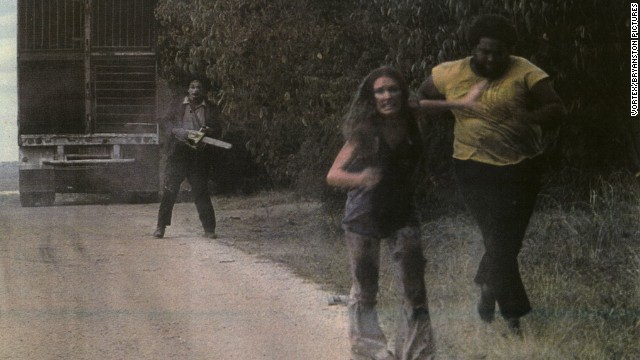
- Marilyn Burns was a college student when she landed her "Texas Chainsaw Massacre" role
- Burns portrayed Charles Manson follower Linda Kasabian in TV's "Helter Skelter" mini-series
- Her later career focused on stage productions in Texas
- Moviefone named Burns one of the "10 Sexiest Scream Queens" in 2009
(CNN) -- Actress Marilyn Burns, a "scream queen" in the original "Texas Chainsaw Massacre," died Tuesday, her manager said. She was 64.
"She was found unresponsive by a family member" in her Houston-area home, manager Chris Roe said.
Burns' acting career began with a small role in Robert Altman's "Brewster McCloud," which was filmed in her hometown of Houston in 1970, according to her biography published in 2009 when she was inducted into the International Horror & Sci-Fi Film Festival Hall of Fame.
She was a University of Texas student when she landed the role of Sally Hardesty, the sole survivor in the first "Chainsaw" film in 1974.
"Chainsaw" director Tobe Hooper also cast Burns in "Eaten Alive" in 1977. She played "a vacationer who unwittingly stumbles upon a hotel run by a madman who feeds his guests to his pet alligator," the biography said.
Her other horror movie roles include "Brutes and Savages" (1977), "Caution: Children at Play" (1981), "Kiss Daddy Goodbye" (1981) and "Future-Kill" (1985).
Burns played a real-life character in the 1976 television miniseries "Helter Skelter." She portrayed Charles Manson follower Linda Kasabian, who testified against the cult leader and other members at their murder trial.
She was given a cameo role in the 1994 "Texas Chainsaw Massacre" remake, but her later career focused on stage productions in Texas.
Moviefone named Burns one of the "10 Sexiest Scream Queens" in a list published in 2009, citing her "vulnerability (and hotness, natch) feels as real as can be."
Top 10 horrific movie moments
People we've lost in 2014
CNN's Carolyn Sung contributed to this report.
Hackers rely on us to break in
8/6/2014 9:20:45 PM
- Douglas Rushkoff: News of Russia hacking makes us check our passwords, move on
- That's not enough: If network compromised, we all are. We're in it together, must take steps
- Keep good personal Internet hygiene, follow IT security rules in your business, he says
- Rushkoff: Hackers use us to breach firewalls of companies we depend on -- thwart them
Editor's note: Douglas Rushkoff writes a regular column for CNN.com. He is a media theorist, the author of the book "Present Shock: When Everything Happens Now" and professor of media studies at CUNY/Queens. The opinions expressed in this commentary are solely those of the author.
(CNN) -- Most people's first response on hearing that 1.2 billion usernames and passwords have been compromised by a group of Russian hackers? We check our own most important accounts for evidence of misuse, and change our passwords. If a week or two goes by with nothing out of the ordinary happening on our credit cards, we breathe a sigh of relief and go back to life as normal.
In short, if nothing happens to us, personally, then we really don't care.
But that's not how the Internet works. We're all in this thing together, and when the network is compromised, so too are we all.
So what lessons should we take from the news that this cyberposse has managed to break into over 420,000 websites of companies large and small?
First off, your data is not safe -- certainly not in an online universe where it's supposed to be protected by consumer-created passwords and computer-illiterate merchants. Over the years, I have been laughed off more than one panel for suggesting that we won't begin to take digital education seriously until nine Chinese teenagers break into a major Wall Street bank and create such havoc that we're forced to reset the entire economy to yesterday at noon.
So it turns out to be a dozen Russian 20-somethings in a small city near Mongolia, but the achievement was equally spectacular and should provoke an equally widespread response.
Yes, the compromised 420,000 websites belonging to companies large and small need to be reconfigured, but so does our entire approach to information and its security.
You've been hacked! Here's what to do
In the most immediate and practical sense, we pedestrians have to accept the fact that we are utterly incapable of protecting ourselves on the information superhighway. We don't use good passwords, we use the same ones on multiple sites, we don't change them often enough, and we store them in files and e-mails and other places where they are not secure.
The easy cure is to use a password service such as Dashlane, KeePass or LastPass to create and manage your passwords for you. You can even share passwords securely with others, revoke access, and change passwords regularly without having to remember anything but your own master key.
Likewise, those of us working in businesses simply have to learn to surrender authority of our security to those IT people who keep telling us to do stuff that we ignore. We have to respect the firewalls, scan USB sticks before we stick them in our machines or printers, and not defeat the security protocols they've established for us. They are not the enemy.
It's akin to good collective hygiene. When you don't wash your hands, that's one thing. If you work in a restaurant, it's another. Now that we're all connected digitally, we are all working in the equivalent of a virtual cafeteria, spreading whatever we happen to pick up to everyone else.
That's the vulnerability these Russian kids exploited. They collected all these usernames and passwords through a botnet installed on our computers. That weird file you opened that didn't seem to have anything in it? Or that link you clicked on and the extra window that opened in your browser? That was you installing a piece of malware on your machine -- a tiny program that turned your laptop into part of this tiny hacker group's global supercomputer. Your processor, your contact list, and your access becomes theirs. From there, they just watch and collect.
Basic digital literacy is certainly the best option against these infiltrations. But the first and most important step in that education is to realize that there are people who know how this stuff works better than we do. The scary part of living in a networked world is that we're all responsible for our mutual well-being. But the great part is that there are many people out here willing to help us rise to that challenge.
As long as we see our interests as personal and individual, we will continue to be used as a giant battering ram on the firewalls of banks and other companies on whom we are depending. They can patch and update, but their processing power pales in comparison with that of a few hundred million home computers controlled by a malicious gang.
That bounty of 1.2 billion usernames and passwords likely isn't even the prize they're after; it's merely the platform from which they're going after something else. Until we members of a networked society learn to work together, we will continue to be used by those who put us together for themselves.
Read CNNOpinion's new Flipboard magazine.
Follow us on Twitter @CNNOpinion.
Join us on Facebook.com/CNNOpinion.
Is Mideast peace far away as ever?
8/7/2014 2:12:26 AM
- Israel has been clear that the aim of Operation Protective Edge was to demilitarize Hamas
- But CNN's Tim Lister says, to secure peace, Israel needs to offer Gazans a better future
- He says many observers believe a Fatah-Hamas deal in April was the best chance for peace
- Israel rejected that, he says, and while it could be implemented still, lives have been lost
Jerusalem (CNN) -- Israeli Prime Minister Benjamin Netanyahu has been crystal clear about the goals of Operation Protective Edge. Destroy Hamas' tunnels, end its rocket-fire (and that of Islamic Jihad), and bring about "sustainable quiet" for the people of Israel by demilitarizing Gaza.
Those aims were restated by Netanyahu's spokesman, Mark Regev, as the latest ceasefire came into force Tuesday. "We don't want to see that terrorist military machine rebuilt," he told CNN. "We have to make sure that Gaza stays demilitarized."
After nearly a month of combat, the Israeli Defense Forces (IDF) say they have destroyed 32 "offensive" tunnels.
Hamas' stocks of rockets have been depleted (by about two-thirds), its launch facilities hit hard, the IDF says. But how do you define "demilitarized?" Hamas' short-range mortars killed more Israelis than its rockets -- does Israel insist on those being surrendered? How would they even be found? And by whom?
Sustainable quiet will depend on factors Israel can influence, but not control: Above all its willingness to offer the 1.8 million people of Gaza a future that is something better than an open prison. It's estimated around two-thirds of Gazans have never left the Strip; Palestinian writer Amir Nizar Zuabi speaks of a desperate fatalism after nearly a decade of conflict.
"We, who were attacked from the sky, from the sea, from the fields, who had one-ton bombs dropped on our heads in pointless rounds of killing, have turned our back on life," he wrote in Haaretz this week.
Tim Lister, CNN
Can they turn again -- and glimpse a future in which they can sell their produce in foreign markets and travel freely, in which they can find work, build homes and see their children receive an education without the overhanging fear of the next bombardment?
Such a possibility was envisaged in the agreement that ended the last conflict in 2012 and provided for "opening the crossings and facilitating the movements of people and transfer of goods, and refraining from restricting residents' free movements and targeting residents in border areas."
But the agreement was not implemented.
"Israel had committed to holding indirect negotiations with Hamas over the implementation of the ceasefire but repeatedly delayed them," partly because of domestic political considerations, writes Nathan Thrall, a senior analyst with the International Crisis Group, in the London Review of Books.
Israeli officials and analysts have cited elections and coalition-building as delaying any meaningful engagement, even though 2013 saw fewer rocket attacks than any year since 2006.
Will it be different this time?
The destruction of entire Gaza neighborhoods (Zeitoun, Beit Hanoun, Khuzaa to name but three) and the displacement of more than 500,000 people according to U.N. estimates Tuesday -- will demand a huge reconstruction program.
Netanyahu says Israel is "demanding that the rehabilitation of Gaza be linked to its demilitarization." On the contrary, says Maen Areikat, the PLO's envoy in the U.S.: "What they should offer is an end to the blockade, an end to the occupation, before they can even ask the Palestinians to consider the idea of being demilitarized."
Retired Brigadier-General Yossi Kuperwasser, Director-General of Israel's Ministry of Strategic Affairs, says this linkage or sequencing is the $64,000 question. "The old ideas didn't work," he said. "We need new ones. We have to make sure the international community takes steps so that cement coming into Gaza is used for civilian projects."
Kuperwasser said a "totally different structure of supervision should be in place" before Israel can allow what might be called dual-use materials into Gaza.
That structure would include, according to Israeli officials, a Palestinian Authority police force at the Rafah crossing into Egypt. The European Union has offered to reactivate its Border Assistance Mission, which operated at the Rafah crossing between 2005 and 2007, as a second layer of supervision at all crossings.
Hamas: a change of heart, or tactics?
Will Hamas, chastened by a devastating onslaught that has left hundreds of its fighters dead or captured, and which has seen the tunnels in which it invested so heavily blown up and bulldozed, simply start over -- preparing for the next round? Or will it see a new reality amid the dust and rubble?
Few observers expect Hamas to give up the language of defiance. It can derive some satisfaction from the level of resistance its fighters offered, especially in close-quarters fighting in places like Shujayya. The predictions of some Israeli officials that Hamas fighters would melt away once the going got tough were confounded.
Veteran defense writer Amos Harel says in Haaretz: "Hamas was not defeated; the organization will remain in power in Gaza and [will be] the key partner in any future agreement."
But the movement is beleaguered. Its leadership has gone underground, literally and metaphorically, to avoid assassination by IDF air-strikes. It faces a severe financial crisis, unable to pay the salaries of government employees.
It's been abandoned by former patrons Iran and Syria, and is caught in the growing Shia-Sunni divide across the Arab world. Its chief financier, Qatar, which has stepped in to pay $20 million a month in wages to Gazan workers, is under pressure from other Gulf states to scale back support for Hamas.
Above all President Abdel Fattah el-Sisi of Egypt has strangled Hamas economically and militarily. Soon after the overthrow of President Mohamed Morsy a year ago, el-Sisi -- then military chief -- moved to close the smuggling tunnels under the Egyptian-Gaza border, depriving Hamas of much-needed revenue and its only way to import weapons.
Hamas may also face growing dissent within Gaza, or at least less support, as people weigh up the cost, in human and financial terms, of the latest conflict. In Shujayya Tuesday, Hany Mahmoud el Harezen surveyed the ruins of his house.
"I am a wedding photographer. I have nothing to do with this war," he told CNN. "Maybe if we had got some concessions it would be worth it, but we got nothing."
It appears to be a growing sentiment, and one that Kuperwasser thinks will help change Hamas' calculations. "It has made a strategic decision," he says, "to give up part of its terrorist identity in order to keep control over Gaza."
Netanyahu's options
For now, Netanyahu can negotiate from a position of strength. He, his Defense Minister and the Israeli Chief of Staff have enjoyed better than 80% approval ratings for much of the campaign, despite the deaths of more than 60 Israeli soldiers -- a far higher toll than during the fully-fledged invasion of Gaza in 2008-09.
"There is trust from the Israeli public that this triumvirate know exactly what they are doing," said Marcus Sheff of the Israel Project. "They feel they have a leadership that is controlled and moderate in defending them and doing what needs to be done on the military and political level."
Even the opposition Labor Party has praised the conduct of the campaign. "They operate very carefully, proportionately. I think they defend Israel through their decisions," Labor Knesset member Nachman Shai told CNN.
If anything, it is the right-wing that challenges Netanyahu -- with some in the coalition government saying the campaign in Gaza has not gone far enough and that Hamas should be crushed. Netanyahu has warned cabinet ministers pushing for a more aggressive approach to fall into line. He appears to accept that Hamas cannot be eradicated, certainly not without a full occupation of Gaza that would be a quagmire and entail international condemnation.
Some Israeli officials believe Hamas actually serves a purpose -- preventing fundamentalist groups like Islamic Jihad from taking over Gaza. They are also happy to see the Palestinians in two camps: Hamas and the Palestinian Authority rather than united under one flag.
An end to the two-state solution?
Netanyahu is now the second-longest serving Prime Minister in Israel's history, To some observers his longevity is down to his innate caution, his refusal to make compromises that might down the road put Israel's security at risk.
As the latest conflict in Gaza erupted, he said that had Israel given up security control of the West Bank, it would be inviting disaster. "If we were to pull out of Judea and Samaria, like they tell us to, there'd be a possibility of thousands of tunnels"
Expanding on the theme, Netanyahu added: "There cannot be a situation under any agreement in which we relinquish security control of the territory west of the River Jordan."
To many observers in Israel that was shorthand for "there will be no Palestinian state."
The prospect of a wider peace deal seems as far away as ever, even if its essential components are the same as they were 20 years ago -- a two-state solution, co-existence between Israel and the West Bank with mutually agreed territorial swaps, and the removal of most Jewish settlements from the West Bank.
Senior Israeli officials look at the turmoil around them, from Iraq and Syria to Libya, and ask whether settling the Palestinian issue is still the most pressing of the day. Arab governments are preoccupied with survival, not Palestinian liberation. Kuperwasser at Israel's Ministry of Strategic Affairs says the real threat to the region is Islamist radicalism; and that has brought together Israel and moderate Arab states such as Egypt and Jordan (and by extension Saudi Arabia.)
To many observers, an agreement between Fatah and Hamas signed on April 23 this year provides the best -- perhaps the only -- hope of breaking the cycle of violence. In it, Hamas agreed to a "consensus government" of Palestinians that pledged non-violence, the recognition of Israel, and adherence to past agreements, a government that would restore the influence of the Palestinian Authority in Gaza.
"Tragically, Israel rejected this opportunity for peace and has succeeded in preventing the new government's deployment in Gaza," say former U.S. President Jimmy Carter and Mary Robinson, a former U.N. High Commissioner for Human Rights, in "Foreign Policy."
If this government is now allowed to take root in Gaza, to take responsibility for its reconstruction and allow for an internationally-agreed and verifiable program of demilitarization, perhaps the future can be different.
But as Nathan Thrall of the International Crisis Group concludes: "This solution would of course have been available to Israel, the U.S., Egypt and the Palestinian Authority in the weeks and months before the war began, before so many lives were shattered."
Why don't Africans get Ebola drug?
8/6/2014 11:06:49 PM
- Americans with Ebola received an experimental medicine that seemed to help
- Harriet Washington: Poor Africans don't have access to lifesaving medicines
- She says access to drugs often based on how much money you have and if you're a Westerner
- She urges this drug be made in quantity and given to infected West Africans in a trial
Editor's note: Harriet A. Washington, a fellow at the Black Mountain Institute at the University of Nevada, Las Vegas, is the author of "Medical Apartheid: The Dark History of Experimentation from Colonial Times to the Present" and "Deadly Monopolies: The Shocking Corporate Takeover of Life Itself -- and the Consequences for Your Health and Our Medical Future." The opinions expressed in this commentary are solely those of the writer.
(CNN) -- One of the many questions surrounding the revelation that Americans Kent Brantly and Nancy Writebol received a little-known, experimental serum for their Ebola infection is: "Why did we hear nothing about it earlier, and how did they gain access to it?"
Ebola has no cure, although potential medications and vaccines are in various states of development. The serum ZMapp, an experimental product of Mapp Biopharmaceutical, hasn't been tested in humans, which means it doesn't meet a primary requirement for FDA approval -- so its obscurity is no surprise.
The Americans managed to gain access to what more than 1,660 infected people in Guinea, Sierra Leone, Liberia and now Nigeria did not: medicine that seems to work -- although, of course, we don't know for sure yet. Some reports indicate they received ZMapp under the FDA's "compassionate use" rule, which permits untested drugs to be given to consenting patients who might otherwise die. This is a triumph of common sense and compassion over bureaucratic red tape.

One of the chief concerns about using unapproved medications is that we don't know what the risks are: The drug may not work, it may work with serious adverse effects, or it may prove as deadly as the disease. But as a doctor, Brantly understood the risks, and like him, Writebol had no other options. Most people with Ebola die.
Compassionate use is certainly ethically defensible. But apparently only three doses were available, and they were given to Westerners. The lack of broader access to ZMapp highlights what is often a very serious ethical failing.
9 questions about this new Ebola drug
Why didn't Dr. Sheik Umar Khan, the chief Sierra Leone physician who died while treating Ebola patients, receive this medication? Because another method of determining who gets medications is at work here -- the drearily familiar stratification of access to a drug based on economic resources and being a Westerner rather than a resident of the global South.
No health worker wants to intentionally deprive Africans of a needed drug. But informal medical networks, which Africans lack, connect well-to-do Westerners with information and drugs. In addition, the pharmaceutical industry has a history of declining to test medications for diseases of the tropical world, most of whose inhabitants cannot afford high prices.
We don't know how quickly ZMapp could be made in large quantities. If it were to be made available, who should receive it? Some think Ebola doctors and caregivers should, because their survival is essential to treating and quelling the epidemic. This makes sense, but it's not that simple.
First, it violates the principle of distributive justice: The benefits of the drug are being inequitably distributed, with skilled, economically secure professionals more likely to benefit.
Also, by what reckoning do we decide that the doctors' role increases their value and dictates they should be given a preferential chance to survive? Distributing the drug through a clinical trial would allow us to know whether and how well the medication works and what caveats might apply.
Africans must participate in any clinical trial, which would benefit the pharmaceutical company as well as, it's hoped, Ebola victims. This would mean their lives have irreplaceable value, too, in the equation of who should get the drug.
So, will Africans receive this potentially lifesaving medication?
A U.N. official suggested that drugs cannot be tested in the middle of an epidemic -- but he is wrong. Such tests are conducted all the time.
Dr. David Ho tested AIDS drugs in Uganda in the midst of the pandemic, and the meningitis drug Trovan was tested in Kano, Nigeria, in the midst of an epidemic. One of every three industry trials is conducted in developing countries; scientists often point to high disease rates, including epidemics, as a rationale for conducting them there.
The problem is not testing the drug amid an epidemic. The question is how ethically such trials are conducted.
Only small amounts of ZMapp are available now, but as soon as it can be made in quantity, the drug for Ebola should be made available to Africans in all the regions that are threatened by the epidemic, regardless of ability to pay.
If possible, it should be distributed within clinical trials to determine the safety and efficiency of the medications. Many people assume this requires withholding medications in a control group, but this is not necessarily the case. Experts should and can mount a well-designed study that permits early access to the medication to all who need it.
But if they cannot ensure that sick people get the drug early, then a clinical trial should not be any more of a requirement for poor Africans than it was for Kent Brantly.
It's also natural to wonder whether the threat of Ebola to the Western world, not to Africans, drives this initiative because so few such drugs are devised for Africans.
This simply highlights another reason why we should so our utmost to protect people from Ebola: our medical interdependence. If Ebola makes landfall in the United States, we will need drugs like ZMapp, just as Africans need them today.
Read CNNOpinion's new Flipboard magazine.
Follow us on Twitter @CNNOpinion.
Join us on Facebook.com/CNNOpinion.
Cambodia's dark past on show
8/6/2014 7:48:29 PM
- Cambodia doesn't hide from its brutal past, with evidence of Pol Pot's regime on show at Tuol Sleng and the Killing Fields
- Khmer Rouge attempt to create an agrarian utopia left an estimated 1.7 million people dead
- Tuol Sleng's former chief, Comrade Duch, already sentenced to life in prison, other senior Khmer Rouge officials await trials
(CNN) -- Few countries in Asia have suffered as much turmoil and internecine warfare in recent decades as Cambodia.
The "secret bombing" campaign in the early 1970s, orchestrated by the soon-to-be-impeached President Richard Nixon and his secretary of state, Henry Kissinger, the most contentious of Nobel Peace Prize winners, pushed many moderates towards the Khmer Rouge, who stormed into Phnom Penh in April 1975 to declare victory and begin a reign of tyranny that some historians have called the most radical experiment in communism ever conducted.
With an agenda of half-baked Maoism and class warfare that included emptying cities, banning money, and executing intellectuals -- or anyone wearing glasses -- the Khmer Rouge tried to create an agrarian utopia.
Instead, they wound up masterminding a genocide that left an estimated 1.7 million Khmers dead.
That legacy is on grim display in Phnom Penh's most popular dark tourism sites of the secret prison at Tuol Sleng and the Killing Fields.
Textbook tortures
Known by the code name S-21, the former high school of Tuol Sleng became the Khmer Rouge's secret prison and the most potent symbol of its brutality.
Over the course of four years as many as 20,000 prisoners passed through here, including four Frenchmen, one Brit and two Americans.
INTERACTIVE: Five faces of Cambodia's Khmer Rouge
Only seven survived.
Upon arriving at the prison, each inmate was photographed.
These black and white portraits hang in the second of four buildings. They are the most haunting part of this memorial site.
Some inmates are wide-eyed with fright. Others appear resigned to their fate.
Some are mere children. Others are women with babies.
All of them put a human face on what was an inhuman regime hell-bent on extinguishing every last spark of individuality and family loyalty from its citizenry, for the Khmer Rouge referred to itself only as "Angkar" (the Organization).
Its leader was a paranoid megalomaniac whom, as Philip Short recounted in his comprehensive biography, "Pol Pot: The History of a Nightmare," believed in preserving secrecy at all costs, to the point where his handwriting has never yet been identified.
An ongoing struggle for justice after Khmer Rouge
Building A has been preserved exactly as the Vietnamese invaders, weary of Khmer Rouge attacks, found it in early 1979, right down to the bloodstains on the floor and the implements of torture left on the bed frames scabbed with rust.
In another building, paintings by Vann Nath, one of the seven survivors, illustrate in living colors how the prison's torturers went about their deathly business, extracting the most trumped up confessions through the most barbaric of means.
Far from being a museum piece, the tragedy of Tuol Sleng continues to play out in the last act of a UN-backed genocide trial.
The prison's former chief, Comrade Duch, the alias of Kain Guek Eav, has already been sentenced to life in prison for war crimes, while two other members of the Khmer Rouge top brass, Nuon Chea and Khieu Samphan wait in the wings for their trials to begin.
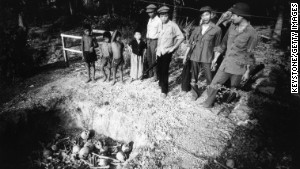
Burial grounds
The first time I visited the Killing Fields outside Phnom Penh in 2003, I was transfixed by a tree with a sign that read in Khmer and English: "Chankiri tree against which executioners beat children."
That was done to save bullets.
My driver pointed at nails sticking out of the tree -- they had been used to drive home the regime's barbarity and speed up the executions.
Just then, a little girl appeared beside the tree, her face peeking over an urn stacked with bones that went up to her neck.
She looked like a ghost, but in fact was one of the child beggars in the area.
The tree still stands, but the urchins have been evicted.
When local authorities renovated the Killing Fields in 2011, this series of mass graves, where the Khmer Rouge executed and buried the prisoners trucked in from Tuol Sleng, they turned it into a site that documents, with painstaking accuracy, the ultra-Maoists' atrocities.
Complete with a pagoda of skulls for an epicenter-piece, these burial grounds have a concussive impact on visitors.
Thanks to the refurbishments, you can listen to the strident battle hymns of the Khmer Rouge once blasted from speakers to drown out the cries of the condemned men and women being beaten to death with the axles of oxcarts, or having their throats slit with the serrated edges of a palm frond.
To really come to grips with Cambodia's dark past and understand why 70% of its populace are under 30, these two memorial sites stand as tombstones to those times of turmoil and the Khmers' courageous resilience in the face of peril.
READ MORE: 35 years on, top Khmer Rouge leaders face justice in Cambodia
Jim Algie has worked as a writer and editor in Bangkok since 1992. His books include the acclaimed non-fiction collection, "Bizarre Thailand: Tales of Crime, Sex and Black Magic" and a collection of short fiction, "The Phantom Lover and Other Thrilling Tales of Thailand."
Why some forces turn on allies
8/6/2014 8:47:19 AM
- Afghan defense official: Recruits must pass background checks and provide government references
- Insider attacks are sometimes committed by Afghan soldiers, sometimes by the Taliban
- Official: Motives range from emotional stress to being influenced by insurgency
- Coalition forces use "guardian angels," or armed troops who guard at meal times and at night
(CNN) -- They dress like allies, but they kill like enemies.
Gunmen wearing Afghan military uniforms turning against coalition troops has been an ongoing nightmare for NATO's International Security Assistance Forces.
It happened again Tuesday, when a man believed to be an Afghan soldier killed U.S. Army Maj. Gen. Harold Greene and shot several others at a military training facility in Kabul.
It's impossible to tell if or when the next "green-on-blue" attack might occur. But here's what we do know:
How often do these attacks happen?
Such assaults were rare in the first few years of the Afghan War, averaging no more than one a year through 2008, according to the New America Foundation. But after the "surge" of 33,000 U.S. troops in 2009, the number of insider attacks jumped to four.
The attacks spiked in 2012 with 48, according to a Pentagon report. The incidents have declined since then, with 15 attacks in 2013 and two in the first quarter of 2014, as more troops withdraw and coalition forces try new ways of mitigating the attacks.
"Despite this sharp decline, these attacks may still have strategic effects on the campaign and could jeopardize the relationship between coalition and ANSF (Afghan National Security Forces) personnel," a U.S. Defense Department report said.
Who carries out these attacks?
Sometimes it's actual Afghan soldiers or police officers; sometimes it's insurgents such as Taliban militants disguised as Afghan security forces.
The Taliban acknowledged Gen. Greene's killing Tuesday, but hasn't claimed responsibility for it. Pentagon spokesman Rear Adm. John Kirby said officials believe an Afghan soldier was the gunman.
An ISAF official said the group of coalition forces was standing outside, and the attacker shot from inside a nearby building at a distance of about 100 yards.
The Pentagon isn't commenting on the possibility of Taliban involvement, saying the Afghan military and international forces are in the early stages of an investigation.
But the Taliban have claimed responsibility for previous attacks. The terror group even released a video showing how their fighters trained to break through the fence at Camp Bastion, the site of a 2012 assault that left two U.S. Marines dead and six jets destroyed.
NATO said the Taliban militants were wearing U.S. Army uniforms. They also carried automatic rifles, rocket-propelled grenade launchers and suicide vests.
What are the motives?
The intentions can run the gamut.
Witnessing the horrors of war sometimes inspires soldiers to turn against their onetime allies, said Philip Mudd, a CNN counterterrorism analyst and former CIA official.
In 2012, the deadliest year of insider attacks, a Defense Department official said the United States estimated 40% of them were due to Afghan members' own combat or emotional stress, and 15% are a result of intimidation by the insurgency or actually being recruited by it.
The official said about 10% came from impersonators who are not part of the military. But in more than 30% of the assaults, no clear motivations were found.
In many cases, such as in Tuesday's attack, the answer might never be known because the assailant was killed.
How does the Afghan military vet its soldiers?
Military recruits are vetted by their high school grades, an entrance exam, a health screening and biometrics, said Daulat Waziri, deputy spokesman for the Afghan Ministry of Defense.
They must also pass a background check and provide two references who are government employees.
It's still unclear whether the gunman in Tuesday's attack had Taliban ties or whether he slipped through the military's screening process.
"I don't think we should look and make judgments about the vetting process too quickly," Mudd said. "You would think on the surface that maybe he was recruited by the Taliban. That's not necessarily the case."
What about allied forces turning against Afghan civilians?
In March 2012, U.S. Army Staff Sgt. Robert Bales slipped away from the camp where he was stationed and into a village in Kandahar province, where he began shooting at civilians. He returned to the base, reloaded, and went out again to target another village.
He left a trail of blood and gore in both villages, with nine children among the dead. Witnesses claimed the U.S. soldier dragged some bodies of his victims' outside and set them ablaze.
By the end of the rampage, 16 villagers were dead. Bales was charged with murder and eventually sentenced to life in prison.
Bales described his attack as "an act of cowardice" and said he'd taken steroids and drank sporadically.
The Taliban vowed to retaliate "by killing and beheading Americans anywhere in the country."
What can be done to mitigate insider attacks?
Coalition forces have started using what they call "guardian angels," or armed troops who oversee others during meal times and when soldiers are sleeping.
Two years ago, after the deadliest spate of attacks, troops started receiving a fold-up pamphlet called "Inside the Wire Threats - Afghanistan Green on Blue" to help prevent such assaults.
A Defense Department official said it advises troops under attack who have their own weapons on them to "resolve the situation with forces at hand" and not wait for backup. Unarmed troops at meetings or dining halls have been vulnerable in the past, but now, all are carrying their weapons, preloaded with a magazine of ammunition. Weapons must be within arm's reach at all times, according to U.S. military sources.
The pamphlet also offers broad indicators of behaviors by Afghans that could indicate they are a threat, the Defense Department official said.
Things to watch for include complaints about other countries or religions, comments that advocate violence, a personality change, becoming isolated and not wanting to be around others, speaking in favor of radical ideology or showing an undue interest in coalition base headquarters or living quarters.
But Kirby said insider attacks are "a pernicious threat" that are "difficult to always ascertain, to come to grips with ... anywhere, particularly in a place like Afghanistan."
"Afghanistan is still a war zone," he noted.
What's the future of U.S. troops in Afghanistan?
In February, the Obama administration announced it had started planning for the possible withdrawal of all U.S. troops by the end of 2014 if Afghanistan did not sign a security agreement pertaining to rights of U.S. troops operating there.
President Barack Obama called for 9,800 U.S. troops to stay in Afghanistan after the end of 2014, along with some allied forces.
The number would get cut roughly in half by the end of 2015, and a year later the U.S. military presence would scale down to what officials described as a "normal" embassy security contingent.
CNN's Masoud Popalzai, Barbara Starr, Randi Kaye, Emily Smith and Greg Botelho contributed to this report.
Why don't Africans get the Ebola drug?
8/6/2014 9:37:53 AM
- Americans with Ebola received an experimental medicine that seemed to help
- Harriet Washington: Poor Africans don't have access to lifesaving medicines
- She says access to drugs often based on how much money you have and if you're a Westerner
- She urges this drug be made in quantity and given to infected West Africans in a trial
Editor's note: Harriet A. Washington, a fellow at the Black Mountain Institute at the University of Nevada, Las Vegas, is the author of "Medical Apartheid: The Dark History of Experimentation from Colonial Times to the Present" and "Deadly Monopolies: The Shocking Corporate Takeover of Life Itself -- and the Consequences for Your Health and Our Medical Future." The opinions expressed in this commentary are solely those of the writer.
(CNN) -- One of the many questions surrounding the revelation that Americans Kent Brantly and Nancy Writebol received a little-known, experimental serum for their Ebola infection is: "Why did we hear nothing about it earlier, and how did they gain access to it?"
Ebola has no cure, although potential medications and vaccines are in various states of development. The serum ZMapp, an experimental product of Mapp Biopharmaceutical, hasn't been tested in humans, which means it doesn't meet a primary requirement for FDA approval -- so its obscurity is no surprise.
The Americans managed to gain access to what more than 1,660 infected people in Guinea, Sierra Leone, Liberia and now Nigeria did not: medicine that seems to work -- although, of course, we don't know for sure yet. Some reports indicate they received ZMapp under the FDA's "compassionate use" rule, which permits untested drugs to be given to consenting patients who might otherwise die. This is a triumph of common sense and compassion over bureaucratic red tape.
One of the chief concerns about using unapproved medications is that we don't know what the risks are: The drug may not work, it may work with serious adverse effects, or it may prove as deadly as the disease. But as a doctor, Brantly understood the risks, and like him, Writebol had no other options. Most people with Ebola die.
Compassionate use is certainly ethically defensible. But apparently only three doses were available, and they were given to Westerners. The lack of broader access to ZMapp highlights what is often a very serious ethical failing.
9 questions about this new Ebola drug
Why didn't Dr. Sheik Umar Khan, the chief Sierra Leone physician who died while treating Ebola patients, receive this medication? Because another method of determining who gets medications is at work here -- the drearily familiar stratification of access to a drug based on economic resources and being a Westerner rather than a resident of the global South.
No health worker wants to intentionally deprive Africans of a needed drug. But informal medical networks, which Africans lack, connect well-to-do Westerners with information and drugs. In addition, the pharmaceutical industry has a history of declining to test medications for diseases of the tropical world, most of whose inhabitants cannot afford high prices.
We don't know how quickly ZMapp could be made in large quantities. If it were to be made available, who should receive it? Some think Ebola doctors and caregivers should, because their survival is essential to treating and quelling the epidemic. This makes sense, but it's not that simple.
First, it violates the principle of distributive justice: The benefits of the drug are being inequitably distributed, with skilled, economically secure professionals more likely to benefit.
Also, by what reckoning do we decide that the doctors' role increases their value and dictates they should be given a preferential chance to survive? Distributing the drug through a clinical trial would allow us to know whether and how well the medication works and what caveats might apply.
Africans must participate in any clinical trial, which would benefit the pharmaceutical company as well as, it's hoped, Ebola victims. This would mean their lives have irreplaceable value, too, in the equation of who should get the drug.
So, will Africans receive this potentially lifesaving medication?
A U.N. official suggested that drugs cannot be tested in the middle of an epidemic -- but he is wrong. Such tests are conducted all the time.
Dr. David Ho tested AIDS drugs in Uganda in the midst of the pandemic, and the meningitis drug Trovan was tested in Kano, Nigeria, in the midst of an epidemic. One of every three industry trials is conducted in developing countries; scientists often point to high disease rates, including epidemics, as a rationale for conducting them there.
The problem is not testing the drug amid an epidemic. The question is how ethically such trials are conducted.
Only small amounts of ZMapp are available now, but as soon as it can be made in quantity, the drug for Ebola should be made available to Africans in all the regions that are threatened by the epidemic, regardless of ability to pay.
If possible, it should be distributed within clinical trials to determine the safety and efficiency of the medications. Many people assume this requires withholding medications in a control group, but this is not necessarily the case. Experts should and can mount a well-designed study that permits early access to the medication to all who need it.
But if they cannot ensure that sick people get the drug early, then a clinical trial should not be any more of a requirement for poor Africans than it was for Kent Brantly.
It's also natural to wonder whether the threat of Ebola to the Western world, not to Africans, drives this initiative because so few such drugs are devised for Africans.
This simply highlights another reason why we should so our utmost to protect people from Ebola: our medical interdependence. If Ebola makes landfall in the United States, we will need drugs like ZMapp, just as Africans need them today.
Read CNNOpinion's new Flipboard magazine.
Follow us on Twitter @CNNOpinion.
Join us on Facebook.com/CNNOpinion.
Can West live with al Qaeda offshoot?
8/6/2014 1:16:19 PM
- The West may decide on a "wait and see" approach regarding ISIS, writes Fahad Nazer
- Nazer: Unlike other al Qaeda branches, ISIS doesn't seem eager to attack the West
- Its focus appears to be consolidating and expanding areas under its control, he says
- The declaration of a caliphate last month by ISIS leader signaled a major shift, he writes
Editor's note: Fahad Nazer is a terrorism analyst with JTG Inc, an analysis and intelligence company in Vienna, Virginia, that has government and private clients -- including defense companies in the U.S. and abroad. Nazer is a former political analyst at the Embassy of Saudi Arabia in Washington. His writing has appeared in The New York Times, CNN, Foreign Policy, Yale Global Online and Al Monitor. Follow him on Twitter. The opinions expressed in this article are solely those of the author.
(CNN) -- As the international community contemplates what should be done about the Islamic State, formerly the Islamic State in Iraq and Syria (ISIS) -- the brutal al Qaeda offshoot that now controls a wide swath of territory spread across the Iraqi-Syrian border -- the West, with the United States at its helm, may decide that while ISIS constitutes an imminent threat to the security of the countries in whose midst it has risen, a "wait-and-see" approach, remains a viable option for a simple reason: Unlike other al Qaeda branches, ISIS doesn't seem eager to attack the West. It has too much to lose.
Its nascent, quasi "state" could be destroyed if it sponsors a terrorist attack in the West and it knows it. Its focus instead appears to be consolidating -- and expanding -- the areas that have already come under its control in Iraq and Syria. Its clarion call to Muslims is not so much to attack the West but to "migrate" East, where it claims "Caliphate" has been restored.
The declaration of a caliphate last month by ISIS leader Abu Bakr al-Baghdadi, signaled a major shift. The former al Qaeda affiliate has eschewed being just another branch of a secretive, loose, international network that launches small- and occasionally large-scale terrorist attacks against soft targets in the West in an effort to force it to disengage from the Muslim world, and across the Muslim world to destabilize and ultimately supplant the regimes there.
That does not mean that ISIS will abjure the barbaric violence, insidious sectarianism and abhorrent intolerance that have been the hallmarks of al Qaeda. However, there are indications that Baghdadi's declaration may be more than mere delusions of grandeur. The Islamic State is starting to act less like a "base" from which to plan terrorist attacks and more like a very violent "state."
The world grew accustomed to Osama bin Laden's audio and video messages from undisclosed locations in which he railed about Western "crusaders" and their "agents" in the Arab and Muslim worlds and vowed to bring death and destruction to both. Although what appears to be Baghdadi's first audio message after the declaration of the caliphate still hit on those themes, war against the West doesn't seem to be his focus.
Fahad Nazer
His sermon in a mosque in Mosul was startling. The image of Baghdadi preaching in public -- mostly about the implications of the establishment of his caliphate and his responsibility to Muslims and theirs to him -- was a game changer. It was a stark contrast to bin Laden's -- and his successor, Ayman al-Zawahiri's -- messages, which are recorded in makeshift studios with no audience and remain largely reflective of an organization engaged in a covert, asymmetrical war whose aim is to weaken its adversaries and their "patrons" before it can establish its ultimate goal. Baghdadi portrays al-Zawahiri's dream as his current reality.
In addition to controlling more territory than any al Qaeda branch ever has, ISIS has commandeered heavy weaponry from Iraqi security forces that have failed to defend Sunni-majority areas. Its total assets in cash and weapons are estimated at about $2 billion.
Its rapid advances in Iraq also indicate that it has learned from other al Qaeda affiliates' mistakes, as it has forged tentative alliances with some Sunni tribes and ex-Baathists. Its propaganda makes clear that the group is committed to presenting itself as an entity that can actually govern and that can provide the public goods and services -- including security -- that weak or oppressive states fail to provide. In short, it is adopting the Hamas and Hezbollah model.
While the West has never been comfortable with Hamas in Gaza or Hezbollah in Lebanon, it has largely left it up to the countries of the wider Middle East to deal with these militant, Islamist organizations. Likewise, and despite what has been described by the U.S. Ambassador to the U.N. as the "systematic, industrial-style slaughter and forced starvation killings" being carried out by Syrian President Bashar al-Assad, the West appears unwilling to intervene militarily to stop the catastrophic war in Syria.
Many will argue that al Qaeda has repeatedly attacked the West in the past and has vowed to do so again. However, ISIS is unlike any al Qaeda affiliate. It has accomplished what "al Qaeda central" and other affiliates have failed to do for years. Thanks to al-Assad's brutality, it was able to craft a jihadist narrative that made Syria the favorite destination of thousands of Islamist militants. Iraqi Prime Minister Nuri al-Maliki's sectarianism and his inept military that has seceded entire cities to ISIS, lent credibility to the notion that an Islamic "state" actually exists.
The West may find solace in the fact that ISIS has many enemies in the Arab and Muslim worlds. In addition to al-Assad and al-Maliki, Sunni-led Saudi Arabia, Egypt, Turkey and Jordan, see it as a terrorist organization committed to their destruction.
As it has done in Syria, and contrary to its grandiose claims of restoring the dignity of Muslims, ISIS has systematically terrorized anyone who stands in its way, including Shia, Sunnis, Sufis and even Christians. While many will unfortunately suffer from ISIS brutality, its violent ideology and brutality makes its endurance over the long-term unlikely.
As Syria has shown, the West appears resigned to leave it to Arabs and Muslims -- and recently Israelis -- to sort out their conflicts. Unless ISIS makes it so by planning a major terrorist attack in the West, the latter will likely adhere to its new mantra: "It's not our war."
MAPS: Understanding the crisis
READ: Iraqi Yazidi lawmaker: 'Hundreds of my people are being slaughtered'
READ: Facing fines, conversion or death, Christian families flee Mosul
The views expressed in this commentary are solely those of Fahad Nazer.
Rosetta makes history with comet
8/6/2014 7:17:23 PM
- Rosetta is attempting to become first spacecraft to orbit and land on a comet
- European Space Agency's 10-year mission has taken Rosetta billions of miles across solar system
- Scientists hope to learn more about the composition of comets
- The robotic lander Philae is due to touch down in November
(CNN) -- After a 10-year chase taking it billions of miles across the solar system, the Rosetta spacecraft made history Wednesday as it became the first probe to rendezvous with a comet on its journey around the sun.
"Thruster burn complete. Rosetta has arrived at comet 67P. We're in orbit!" announced the European Space Agency, which is leading the ambitious project, on Twitter.
Rosetta fired its thrusters on its final approach to Comet 67P/Churyumov-Gerasimenko, known as "Chury" for short, on Wednesday morning. Half an hour after the burn, scientists announced that the craft had entered into the orbit of the streaking comet.
"After 10 years, five months and four days travelling towards our destination, looping around the sun five times, we are delighted to announce finally 'we are here'," said Jean-Jacques Dordain, ESA's Director General, in a statement.
"Europe's Rosetta is now the first spacecraft in history to rendezvous with a comet, a major highlight in exploring our origins. Discoveries can start."
ESA tweeted a photo of the comet after Rosetta's maneuver. Chury and the space probe now lie some 250 million miles from Earth, about half way between the orbits of Jupiter and Mars, according to ESA.
The first spectacular and detailed images taken from just 80 miles away shows boulders, craters and steep cliffs and are already causing excitement.
"Churyumov-Gerasimenko looks like it's been through the wars!" said Dr Robert Massey of the Royal Astronomical Society in the UK.
"With that odd looking 'neck', either we're looking at two objects that merged together or so much material has been lost in its many passes around the sun that the comet is a shadow of what it started out as.
"The pictures coming back so far look intriguing -- and imagine the kind of scenes we can expect when Philae lands this coming November," he said.
To get to its destination the spacecraft has covered more than three billion miles and as the comet hurtles towards the sun it will reach a speed of about 62,000 miles per hour.
The mission has now achieved the first of what it hopes will be a series of historic accomplishments. In November mission controllers aim to place the robotic lander Philae on the surface -- something that has never been done before.
Astronomer Robert Massey
Previous missions have performed comet fly-bys but Rosetta is different. This probe will follow the comet for more than a year, mapping and measuring how it changes as it is blasted by the sun's energy.
Mission controllers had to use the gravity of Earth and Mars to give the probe a slingshot acceleration to meet its target on the right trajectory. Rosetta also had to be put into hibernation for more than two years to conserve power before being woken up successfully in January this year.
Wednesday's thruster burn was the tenth rendezvous maneuver Rosetta has performed since May to get the probe's speed and trajectory to align with the comet's -- and if any of those operations had failed, the mission would have been lost, according to ESA.
Interactive: See how Rosetta chases the comet across the solar system
For the next few weeks, ESA says the spacecraft will be in a triangular orbit until it gets to about 18 miles of the surface when it starts its close observations.
Scientists hope to learn more about the composition of comets and perhaps whether they brought water to the Earth or even the chemicals that make up the building blocks of life.
"It really is such a step forward to anything that has come before," project scientist Matt Taylor told CNN.
Rosetta will soon begin mapping the surface of and finding out more about its gravitational pull. This will help to find a suitable landing site for Philae and allow engineers to keep Rosetta in the right orbit.
As comets approach the sun, any ice melts and is turned into an ionized gas tail. The dust produces a separate, curving tail. It's these processes that Rosetta scientists hope to be able to study from close proximity.
Matt Taylor, Rosetta project scientist
Taylor explained that the survey will show the team what the comet nucleus looks like now and when it gets closer to the sun.
"We'll be able to make a comparison to now, when its relatively inert, to when it's highly active ... making this measurement over a year when we're riding alongside at walking pace and observing how a comet works and interacts with the sun," he said.
"We are there for over a year to see this complete development to the extent that you may even be able to measure the decrease in the volume of the nucleus ... see how much material has left the comet."
Chury is known as a short-period comet. It reappears every six years as its orbit brings it close to the sun. Halley's comet has a period of about 76 years and is not due to return close enough to Earth to be visible until 2061. Others only return after thousands of years.
Matt Taylor says it is unlikely that you will be able to see comet 67P with the naked eye but you can follow the progress of the mission on Rosetta's blog and find out more with CNN's interactive coverage.
CNN's Lauren Moorhouse contributed to this report.
Aussie couple defends leaving baby
8/6/2014 9:00:22 PM
- Australian couple say they were told male twin, Gammy, would die
- Boy is now seven months old and in the care of his Thai surrogate mother
- Couple said they were scared the surrogate would change her mind about the girl
- Surrogate accused couple of abandoning Down Syndrome boy in favor of healthy sister
(CNN) -- What was supposed to be a straightforward cash deal to carry a child for desperate parents has turned into an international spat over who said what, and exposed the darker side of a business credited with creating happiness for many couples.
At the center of the debate is Gammy, a seven-month-old Down Syndrome baby with a congenital heart condition who is currently receiving treatment for a lung infection at a private hospital in Thailand.
For days, Gammy's surrogate mother, 21-year-old Thai food stall worker Pattharamon Chanbua, has been telling local and foreign press that the couple abandoned their son, taking home his healthy sister.
After initially denying they knew about baby Gammy, a friend of the couple issued a statement to a local Australian newspaper saying the pair only left Gammy because they were told he was likely to die.
"Gammy was very sick when he was born and the biological parents were told he would not survive and he had a day, at best, to live and to say goodbye," the unnamed friend told the Bunbury Mail, in Western Australia, where the couple live.
Fear and lies
The friend said the surrogate mother gave birth at a different hospital to the one agreed upon, which made the surrogacy agreement void. The couple was scared, she said, that Pattharamon would change her mind about the second child, and they'd have to leave Thailand with no children at all.
According to the report, the friend noted that the backdrop to the surrogacy row was a military coup in the country and "it was very difficult to get around."
The takeover took place in the early hours of May 22, 2014 when Commander of the Royal Thai Army General Prayuth Chan-chua announced in a national broadcast he was now in charge.
"This has been absolutely devastating for them, they are on the edge," the friend added, referring to the days of media scrutiny and debate over their decision, months after they returned home.
Pattharamon claimed the couple asked her to terminate the Down Syndrome child when she was seven months pregnant.
Not true, the couple's friend said.
After the babies' birth, Pattharamon claimed they bought nappies and milk for the baby girl, but "didn't even look at the boy."
Gammy's parents via friend statement
Also a lie, the friend added.
Whatever the details of who said what, the case has attracted attention to a largely unregulated industry subject to a confusing tangle of laws and loopholes.
Surrogate 'is legal parent'
In the state of Western Australia, where the couple is from, it's legal to seek surrogacy abroad.
There are no checks for criminal history, and no counseling is required for couples seeking offshore surrogacy, said Jenni Millbank, an expert in Australian surrogacy law from the University of Technology in Sydney.
"If surrogacy were taken onshore there would be counseling protocols prior to conception, as well as a welfare report after birth required before legal parentage is transferred; but these are not steps that occur with offshore surrogacy," said Millbank.
She said the surrogate mother is the legal parent regardless of whose egg was used. The rights of the genetic father are also "uncertain" as "different judges have taken varied approaches," she said.
Australian authorities are looking into the case, as are Thai authorities, who had already announced a crackdown on the industry amid claims rules were being flouted.
Pattharamon said she agreed to be paid 300,000 baht ($9,300) for carrying the couple's babies, money she needed to help care for her own two children, aged six and three. After she voiced concerns about how she was going to pay for Gammy's care, funds started flowing to an online campaign, which to date has raised more than $237,000 (US$220,000).
Jenni Millbank, Macquarie University
Could baby girl be returned?
Pattharamon said she's prepared to take the baby girl back if the Australian couple is are "not ready" to take care of her.
She said she doesn't intend to pursue legal action against the parents, though Millbank says she could apply to the Family Court of Australia to have the child returned.
"The Family Court of Australia has jurisdiction over anyone who has an interest in the care, welfare and a development of a child so (the intending parents) could still make their case and argue for the baby to live with them," Millbank said.
"The court would examine the competitive proposals of the parties, probably appoint an independent children's lawyer and do a welfare assessment of the child's needs and then make a decision."
The Australian courts have only ever heard one case involving a child born via surrogacy, Millbank said.
It involved a child called "Evelyn" whose birth was the result of an agreement between friends that went wrong.
"That was in the 1980s and they ended up removing the child from the family that had been raising her and taking her to the other family," Millbank said.
"It was an altruistic arrangement where the birth mother changed her mind about seven months later. And she ultimately won. She got the child back."
New leaker reveals U.S. secrets
8/6/2014 7:04:17 AM
- FIRST ON CNN: New documents formed the basis of story on news site, Intercept
- The site is run by Glenn Greenwald, who published leaks by Edward Snowden
- Article focuses on the growth of names on terror databases during the Obama administration
(CNN) -- The federal government has concluded there's a new leaker exposing national security documents in the aftermath of surveillance disclosures by former NSA contractor Edward Snowden, U.S. officials tell CNN.
Proof of the newest leak comes from national security documents that formed the basis of a news story published Tuesday by the Intercept, the news site launched by Glenn Greenwald, who also published Snowden's leaks.
NSA leaker Edward Snowden asks to extend Russia asylum
The Intercept article focuses on the growth in U.S. government databases of known or suspected terrorist names during the Obama administration.
The article cites documents prepared by the National Counterterrorism Center dated August 2013, which is after Snowden left the United States to avoid criminal charges.
Greenwald has suggested there was another leaker. In July, he said on Twitter "it seems clear at this point" that there was another.
Government officials have been investigating to find out that identity.
In a February interview with CNN's Reliable Sources, Greenwald said: "I definitely think it's fair to say that there are people who have been inspired by Edward Snowden's courage and by the great good and virtue that it has achieved."
He added, "I have no doubt there will be other sources inside the government who see extreme wrongdoing who are inspired by Edward Snowden."
It's not yet clear how many documents the new leaker has shared and how much damage it may cause.
So far, the documents shared by the new leaker are labeled "Secret" and "NOFORN," which means it isn't to be shared with foreign government.
That's a lower level of classification than most of the documents leaked by Snowden.
Government officials say he stole 1.7 million classified documents, many of which were labeled "Top Secret," a higher classification for the government's most important secrets.
Big databases
The biggest database, called the Terrorist Identities Datamart Environment, now has 1 million names, a U.S. official confirmed to CNN.
That's boosted from half that many in the aftermath of the botched attempt by the so-called underwear bomber to blow up a U.S.-bound jetliner on Christmas Day in 2009.
The growth of TIDE, and other more specialized terrorist databases and watchlists, was a result of vulnerabilities exposed in the 2009 underwear plot, government officials said.
A year after Snowden
The underwear bomber, Umar Farouk Abdulmuttalab, was not on government watchlists that would have prevented him from being allowed to fly to the United States.
In 2012, the National Counterterrorism Center reported that the TIDE database contained 875,000 names. There were about 500,000 in 2009 before the underwear bomb plot.
The Intercept first reported the new TIDE database numbers, along with details of other databases.
The Intercept article
As of November, 2013, there were 700,000 people listed in the Terrorist Screening Database (TSDB), or the "Terrorist Watchlist, according to a U.S. official. Fewer than 1% are U.S. persons and fewer than 0.5% are U.S. citizens.
The list has grown somewhat since that time, but is nowhere near the 1.5 million figure cited in recent news reports. Current numbers for the TSDB cannot be released at this time.
The Intercept report said, citing the documents, that 40% on the "Terrorist Watchlist" aren't affiliated with terror groups.
U.S. officials familiar with the matter say the claim is incorrect based on a misreading of the documents.
Americans on lists
The report said that as of August, 2013, 5,000 Americans were on the TSD watchlist. Another 15,800 were on the wider TIDE list.
A smaller subset, 16,000 names, including 1,200 belonging to Americans, are listed as "selectees" who are subject to more intensive screening at airports and border crossings.
According to the Intercept, citing the documents, the cities with the most names on the list are: New York, Dearborn, Michigan; Houston; San Diego; and Chicago. Dearborn is home to one the nation's biggest concentrations of Arab and Muslim populations.
According to the documents cited by the Intercept, the government has also begun a new effort to collect information and biometric data on U.S. persons in the aftermath of the 2013 Boston Marathon bombings.
The data includes photos from driver's licenses. That effort likely was spurred by the fact that FBI agents investigating the Boston bombings found existing databases lacking when they tried to match images of the two bombers isolated from surveillance video, according to U.S. officials familiar with the matter.
Stored on Pentagon system
Documents classified as "Secret" are stored on a Pentagon-operated computer system called SIPRNet, which the Defense and State departments use to share classified information.
A recent Government Accountability Office study found that between 2006-2011 there were 3.2 million approved by the Pentagon to handle secret, top secret, SCI (sensitive compartmented) information.
SIPRnet is one of the computer systems that the former Army soldier now known as Chelsea Manning accessed to leak hundreds of thousands documents, including State Department cables.
The Manning leak was the largest U.S. intelligence leak until Snowden.
Obama, Congress working on changes to NSA
Opinion: NSA and your phone records: What should Obama do?
Review board finds potential abuses in NSA phone, internet surveillance
You are receiving this email because you subscribed to this feed at feedmyinbox.com
If you no longer wish to receive these emails, you can unsubscribe from this feed, or manage all your subscriptions

No comments:
Post a Comment