 | Start Running App Marketing Campaigns That Increase Revenue & Engagement From our sponsors |
| CNN.com - Top Stories |
| CNN.com delivers up-to-the-minute news and information on the latest top stories, weather, entertainment, politics and more. |
French politician 'pulls grenade pin'
8/26/2014 12:59:28 PM
- On Monday morning, the French government presented its resignation
- Economic and ideological reasons are behind the turmoil, Agnes Poirier says
- Many ask why it took so long to get rid of Economy Minister Arnaud Montebourg, she says
- Poirier: The French government must now decide what direction it wants to take
Editor's note: Agnes Poirier is a French journalist and political analyst who contributes regularly to newspapers, magazines and TV in the UK, U.S., France, Italy. Follow @AgnesCPoirier on Twitter. The opinions expressed in this commentary are solely those of the author.
Paris, France (CNN) -- When France's Economy Minister Arnaud Montebourg was quoted in French daily newspaper Le Monde over the weekend attacking the economic policies of his very own government, he knew what he was doing: Pulling the pin out of a grenade. And he certainly seemed to have no regrets.
France's Prime Minister Manuel Valls, appointed 147 days ago after President François Hollande's Socialist Party took a severe beating in local elections, was not going to take such overt rebellion kindly. "It's me or him," he is reported to have told Hollande. On Monday morning, the whole French government presented its resignation and Valls was immediately asked to form a new cabinet.

Apparently savoring the effects of his political sortie, the cocky Montebourg, in a televised address from the ministry of the economy, said that he would follow into the steps of Cincinnatus, a kind of gentleman farmer Roman senator, who in 500 BC came to represent civic virtue for his modesty and restraint. Cincinnatus was also known for his beautiful curly mane, just like Arnaud Montebourg. Many observers were quick to point out that vanity, rather than political restraint, were probably what the French minister shared most with the great Roman senator.
Why is the French government imploding and its members at loggerheads? It's the economy and it is ideological. Montebourg, at the left of the French Socialist Party, advocates the end of austerity measures that supposedly kill economic growth, while Valls, at the right of the French socialist party, as well as President Hollande who long dithered about what economic direction to take, both favor a more German approach, with policies focusing on reducing public deficits and corporate tax breaks.
In fact, many people in France are asking why it took more than two years to get rid of Montebourg, whose histrionic style and interventionist mantra have made him more enemies than friends, especially in the business world. You may remember how he lectured French and foreign investors such as the Peugeot family and Lakshmi Mittal over their plans to scale down their activities in some of their French factories.
Montebourg has been a thorn in the side of President Hollande ever since his appointment as minister, however he is also the symbol of Hollande's confusing and mostly unreadable economic choices.
When the French president finally decided back in March to reclaim some control over his unruly government, and to impose a new series of business-friendly measures, the appointment of Valls was seen as a coherent and strong sign that political and economic uncertainty had finally ended.
However, Hollande insisted that his new prime minister keep Montebourg in government and give him the economy portfolio. As The Economist put it: "Hollande calculated that the risk of a confusing economic policy was less high than that of having his firebrand left-winger sniping from the outside." How wrong Hollande was.
In fact, Hollande seems to have been governing France as if he was still leader of the Socialist Party, trying desperately and at all costs, to hold a divided family together. If such strategy can work for a political party, it may be disastrous when governing a country.
To be president and to govern is to make clear choices. Since his arrival in power in May 2012, Hollande has given the country the impression of playing it by ear, steering the wheel on the right or the left as events came along. This has certainly not proved popular. With an approval rating of barely 20%, Hollande is one of the most unpopular presidents of the Fifth Republic, founded in 1958.
Will the exit of the most rebellious socialists from the government be enough for the president and his prime minister to restore some credibility and be able to implement at last a string of pro-Business measures? If this heralds the end of Hollande's political contradictions, this will be most welcome.
However, the new French government, which will be announced later today, will have to convince French MPs and be backed by a majority in Parliament. Montebourg and the anti-austerity crusaders within the socialist party may want to systematically hinder the government's actions and force Hollande to dissolve parliament and call for new elections. However, this would not necessarily be good news for the opposition, as the French Right, shaken by a series of scandals, has almost disappeared from political debate.
The facts remain that economically, France is not performing as well as expected. With unemployment at more than 10% and two consecutive quarters without growth, France is not going to reach its deficit target of 3.8% of GDP in 2014.
The French government must now decide what direction it wants to take and have the courage to stay the course. France is not performing in a vacuum and Hollande's ability to work in tandem with its European partners, Germany in particular, will prove key to a much-needed coherence.
In fact, as Brussels-based journalist Ian Traynor rightly points out: "The turmoil in Paris presages more battles ahead in Brussels and between EU capitals as the existential crisis that was the euro emergency turns more political."
READ: French government dissolved amid turmoil among ministers
The opinions expressed in this commentary are solely those of Agnes Poirier.
Can peace come to Ferguson?
8/26/2014 9:55:21 AM
- Granderson: At Michael Brown funeral, people spoke of peace, but that's more than no protests
- He says black community's underrepresentation, targeting by police are longstanding
- Peace can't come until that's solved, he says, and voting is the way to do it
- 4,500 people attended funeral; turn that energy into political power, he urges
Editor's note: LZ Granderson is a CNN contributor, a senior writer for ESPN and a lecturer at Northwestern University. He is a former Hechinger Institute fellow and his commentary has been recognized by the Online News Association, the National Association of Black Journalists, and the National Lesbian and Gay Journalists Association. Follow him on Twitter @locs_n_laughs. The opinions expressed in this commentary are solely those of the author.
St. Louis (CNN) -- The lines to get a seat inside Friendly Temple Missionary Baptist Church started forming before 8 a.m. By then the sun was already high and the air thick.
Many of the elderly who arrived early for Monday's funeral retreated to the few pockets of shade around the rim of the building, while a handful of younger women used their Sunday hats as fans. The few men who bothered to put on suit jackets joked about a change of heart. Their smiles, framed by streams of sweat, greeted friends and strangers alike.
It would appear that after protests, riots, tear gas and rubber bullets in Ferguson gripped national headlines for a week, this Missouri summer waited until cooler heads prevailed before unfurling one of its hottest days.
"I just want peace, girl, peace," I overheard a woman saying.
"Yes, Lord," was the reply.
The word "peace" was heard a lot during Michael Brown's homegoing. For many, this was a day of peace because there were no protests. I find that notion misguided. For to pin all of the events that have brought chaos over the past two weeks on Officer Darren Wilson firing six bullets into an unarmed 18-year-old is to oversimplify a much more complicated problem.
Blacks in and around Ferguson have felt targeted by police and disenfranchised for decades. They are overrepresented in police stops and arrests and underrepresented as police officers and lawmakers. They have been frustrated by this dynamic since long before Michael Brown was born -- so no, it is not this day that would confer peace, no matter how many hugs and smiles came with it.
That's because nothing has changed.
It might have been a day devoid of violence in these streets, but the unrest within the souls of the people who walk them remained. How can there be peace? The power structure must change. And when you know that just 6% of eligible black voters made it to the polls in the last municipal election in a city that is nearly 70% black, where to start that change is clear.
"We have got to vote," said Shirley Minter, a mature woman, who arrived early because, she said, "I needed to be here."
"There is not a whole lot we can do to fight this injustice if we're not willing to make our voices heard. And the main way to make our voices heard is by voting. Especially our young people."
Her friend, Stella Dermin, agreed.
"I'm originally from Louisiana. I can remember when they used to charge us $3 to vote. And you had to pass a test. And if you didn't pass that test, you couldn't vote," she said. "Now the young people don't even bother voting and it's holding us back. All of this protesting -- this boy's death will mean nothing if we don't start doing what we can to change the way things are."
Makeshift voter registration booths had popped up around Ferguson, most notably at the burned-down QuikTrip which has served as ground zero for protesters, and another near where Brown was shot and killed. But signing up is not the same as following through. And following through does not guarantee a slate of candidates who are sensitive to their constituents' needs.
The day of Michael Brown's funeral may have been without violence, but that should not be mistaken for peace.
"I vote, but many of my friends don't because they think it doesn't matter," said 21-year-old Joshua Jones, a native of Ferguson who said he recently graduated from DePauw University and is starting graduate school at St. Louis University this fall. He said he didn't know Brown but came to his funeral because "he could've been me."
"The thing is, my friends think the system isn't looking out for them. And it's hard for me to argue with them when so many things around support what they are saying," Jones said. "But I don't think anything in Ferguson is going to change unless black people start voting."
A statement that is as true as it is sad and frustrating. So much blood was shed to fight for the black community's right to vote and too many of us choose not to -- still. It's hard to point an angry finger at an unjust system when we surrender any power that we have to change it.
Though on this day, there are signs that true peace may be on the horizon here. The oppressive heat drew plenty of complaints, but it did not stop the people from coming.
So when the pews of the sanctuary were full, church greeters directed those who came to pay their respects to Michael Brown and his family to the overflow building next door. And when the designated overflow area was full, the community was sent to the gymnasium, where a sea of folding chairs waited. And when that was full, people were sent across the street to another overflow area where the funeral was being broadcast on portable screens.
More than 4,500 came to say goodbye to Michael Brown, many of whom did not know him personally. If that energy can be converted into political power, who knows? Maybe peace isn't that far away.
"I'm here because I believe we can turn things around here," said Gary Orr Sr. "We've got to. It's not up to white people to make things better for us, it's up to us. We've got to care about each other more, look out for each other more, get involved."
Orr, who brought his family to the ceremony, was standing in front of one of the overflow buildings during my interview with him. Afterward, I went inside. That's when I saw a mural bearing Isaiah 40:31:
But they that wait upon the Lord shall renew their strength, they shall mount up with wings as eagles, they shall run and not be weary; and they shall walk and not faint.
That's what the people of Ferguson must do when the cameras are gone. The tears have all dried. The protests done. Whether Wilson is indicted or not, they must run and not be weary.
Walk and not faint.
Vote -- lest the outrage that followed Michael Brown's passing be for naught, and true peace remain unattainable.
Read CNNOpinion's new Flipboard magazine.
Follow us on Twitter @CNNOpinion.
Join us on Facebook.com/CNNOpinion.
U.S. jihadi killed fighting for ISIS
8/26/2014 3:18:58 PM
- NEW: Group: McCain died fighting for ISIS in a battle against a rival extremist group
- U.S. officials: McCain was among Americans suspected of being in militant groups
- McCain's uncle says he was killed last weekend; the family learned on Monday
- He converted to Islam years ago; family saw Facebook posts sympathetic to ISIS
(CNN) -- An American named Douglas McCain was killed last weekend in Syria, where he was fighting for ISIS, two U.S. officials told CNN.
The man's uncle, Ken McCain, said that his nephew had gone to fight as a jihadi and that the U.S. State Department told the family Monday about the death.
He died in a battle between rival extremist groups in the suburbs of Aleppo, Syria's once-bustling commercial capital and largest city, according to the Syrian Observatory for Human Rights, a British-based group that monitors the conflict.
Like the U.S. officials, the group described McCain as an ISIS fighter and said he was killed in a battle with the al-Nusra Front, an al Qaeda-linked organization that the U.S. government has blacklisted as a foreign terror organization.
According to his uncle, Douglas McCain's journey to Syria began sometime after he converted several years ago from Christianity to Islam.
The family wasn't alarmed by his conversion, but they became aware of Facebook posts sympathetic to ISIS, an Islamist terror group, when he traveled to what they believed to be Turkey.
U.S. counterterrorism investigators had been looking into Douglas McCain's activities for some time before his death, one U.S. official said.
He was among a list of Americans who are believed to have joined militant groups and who would be stopped and subjected to additional scrutiny if he traveled, according to the official.
Ken McCain
Defense Secretary Chuck Hagel has called ISIS, which claimed responsibility for the recent beheading of American journalist James Foley, "beyond just a terrorist group" and "beyond anything we have seen."
Whatever group he ended up with, the fact that Douglas McCain became a jihadi left his family "devastated" and "just as surprised as the country," Ken McCain said.
He described the nephew he knew as "a good person, loved his family, loved his mother, loved his faith" -- the latter being a reference to the Christianity he practiced before his conversion.
Who is ISIS?
Douglas McCain isn't the first American to fight for a militant group during Syria's three-year civil war.
In May, radical Islamists claimed in an online video and on social media that one attacker in a suicide bombing in northern Syria was an American whom they identified as Abu Hurayra Al-Amriki. Al-Amriki is Arabic for "the American."
Abu Farouk al Shamy, a spokesman for the rebel Suqour al-Sham battalion, said the attack was executed in coordination with the al-Nusra Front.
U.S. officials later confirmed the Islamists' boast that an American was involved in the attack. U.S. State Department spokeswoman Jen Psaki said he was believed to be Moner Mohammad Abu-Salha, a U.S. citizen who grew up in Florida and went to school there.
U.S.: Jihadi in suicide bombing video grew up in Florida
Until now, the United States largely has limited its involvement in Syria to diplomatic efforts and supporting the "moderate opposition," as described by Joint Chiefs Chairman Martin Dempsey and others, that is fighting to unseat Syrian President Bashar al-Assad.
That's the same goal, ironically, as ISIS -- which aims to rule a caliphate, known as the Islamic State, spanning Iraq and Syria.
The United States began airstrikes this month on ISIS forces in Iraq, in support of Iraqi and Kurdish troops and to curb the Islamist extremists' murderous advance.
Syria could be next. Already, the United States has started gathering intelligence on the locations of ISIS leadership and troops in Syria, two U.S. officials previously told CNN. To this point, President Barack Obama has OK'd reconnaissance flights over the war-ravaged nation, according to a U.S. official.
Official: Obama authorizes recon flights over Syria
Man arrested after overseas trip, accused of sympathizing with ISIS
Opinion: ISIS: Is it really a threat to the U.S.?
CNN's Evan Perez, Raja Razek, Samira Said and Hamdi Alkhshali contributed to this report.
What is ISIS' Achilles' heel?
8/26/2014 10:30:04 AM
- ISIS' "ability to continually shape and control the conflict will be sorely tested," analyst says
- Its success so far is largely due to the weakness of its opponents, analysts say
- For now, observers say ISIS still has momentum, but opponents can turn the tide
(CNN) -- Surprise, mobility and the merciless treatment of opponents: the blueprint of the Islamic State in Syria and Iraq as it has gobbled up territory in both Syria and Iraq over the past few months. But as its adversaries regroup, ISIS -- which now calls itself the Islamic State -- may begin to suffer setbacks on the battlefield, according to a new analysis of its capabilities and tactics.
"As a defensive force, the ISIS may struggle to hold terrain if it is attacked simultaneously at multiple points or if its auxiliary allies begin to defect," says Michael Knights, who has worked throughout Iraq and is now a fellow at The Washington Institute for Near East Policy.
Knights says ISIS has a deep bench of talented military planners, veterans of the Iraq insurgency during the U.S. occupation and of the group's creation of a mini-state in Syria. It has foreign jihadists who have fought in Chechnya and the Balkans. "Yet the pace of the war against the ISIL is accelerating, and the group's ability to continually shape and control the conflict will be sorely tested," Knights writes in the latest edition of Sentinel, published by the Combating Terrorism Center at West Point.
Military analysts say ISIS' success so far is largely due to the weakness of its opponents, as well as years of meticulous planning after Abu Bakr al-Baghdadi's "reboot" of the group in 2010.
READ: Syria ready to cooperate with U.N.
This war of attrition included a campaign to intimidate and assassinate senior members of the Iraqi security forces last year, a campaign al-Baghdadi called the "Soldiers' Harvest." Al-Baghdadi built a command structure designed to combine centralized control with execution at the local level. This was highly successful during 2012-13 when the group synchronized waves of car bombings in different locations across Iraq. It was in evidence at the weekend in Kurdish-controlled Kirkuk, when a series of three car bombs and a roadside bomb killed at least 20 people.
ISIS has weaved this tactic into its current military campaign. Earlier this month, a well-planned attack against the Kurdish town of Jalula began with a suicide car bomb that killed more than 20 Peshmerga, "a second tanker truck suicide device in the town center, followed by individual suicide-vest bombings on 12 checkpoints by fighters wearing Kurdish-style uniforms," Knights says.
These multiple suicide bombings instil fear and panic in civilians and military opponents alike. They are ISIS' "shock and awe" tactic, complemented by the agility and speed of ISIS units. "The relative compactness of Iraq, where good roads allow large swathes of the country to be traversed in a single day, gives an aggressive force strong ability to concentrate forces at a given point of attack," says Knights.
There have been claims that ISIS is using U.S.-made M-1 Abrams tanks and Humvees seized from the Iraqi army. And sometimes heavy armor has made an important difference. ISIS used a single Iraqi T-55 tank of Soviet vintage earlier this month to fend off an attempt to break the siege of Amerli. But pinpoint U.S. airstrikes have already changed the local balance around the Mosul Dam and Sinjar.
READ: 5 key questions in the fight against ISIS
Knights told CNN: "Though ISIS have undoubtedly captured 200-300 Humvees and will be able to keep them operational for many months before they require spare parts, other U.S.-provided vehicles are present in very limited amounts. In part this is because they are complex to operate and maintain. Very few were captured in good working order because the Iraqis themselves were having trouble keeping them running."
Knights says that there is no evidence that ISIS fighters have been able to operate M-1 Abrams -- nor U.S. manufactured 155mm howitzers. It does have far more armored trucks with heavy machine guns than it did before June, allowing it to overrun lightly armed checkpoints. "But faced with U.S. airpower or even the slowly recovering Iraqi and Kurdish security forces, such vehicles become death traps," says Knights, citing the group's losses at the Mosul Dam.
Making resistance appear hopeless to potential opponents is a critical part of ISIS' strategy. A tribal revolt in Zowiya in Salahuddin province last month was met with sustained mortar fire that almost razed the town. Those who wanted to re-enter Zowiya had to "repent."
"If local populations cannot mount an effective resistance to ISIS, then they likely will not attempt to do so," says Jessica Lewis at the Institute for the Study of War.
ISIS may have as few as 15,000 fighters for a vast area stretching from northern Syria to the middle of Iraq. So deception is also critical to its success. On many occasions it has appeared to be launching an attack -- drawing defending forces toward it -- only to strike the place those forces have left. Earlier this month, ISIS hit Jalula, after Peshmerga had left the town to confront an ISIS thrust at Makhmour.
The fact that it has relatively few fighters per square mile may explain why it prefers to depopulate some towns because of an "accentuated fear of local uprisings and informers," says Knights. That could be a double-edged sword, because living among civilians in densely populated places should offer the group some protection. But there is evidence that the Iraqi air force strikes even when civilians are present. "My sense from talking to people along the ISIS front line is that the group welcomes being able to shuffle discretely around depopulated towns," says Knights.
And airstrikes, unless limited and carefully targeted, might even end up helping ISIS. "Airstrikes into the Sunni heartland of Iraq or Syria may exacerbate the sectarian conflict in the region by illustrating a passive or active alignment of the U.S. with Iran in order to bring firepower to bear against Sunnis," says Lewis.
ISIS has also traded on tribal rivalries to consolidate its position, "such as by plugging into the anti-Kurdish sentiments of Arab tribes around Jalula or allowing Arab tribes to harvest the ripe wheat fields of displaced Shi`a Turkmen farmers at Amerli," says Knights.
These local arrangements may work for a time, but ISIS is likely to encounter stiffer opposition. Its use of surprise will be slowly devalued, as its tactics are studied -- and especially as the Iraqi Security Forces and Kurdish Peshmerga begin to receive a flow of real-time intelligence from the U.S. surveillance. Knights says he was told by Kurdish sources that ISIS tried to infiltrate the town of Tuz Khurmatu after dark two weeks ago. But its fighters were detected by the U.S. military, which provided Kurdish artillery with the coordinates required to blunt the attacks.
Knights told CNN that "U.S. special forces seem to be operating along the front line, visually checking and designating targets. U.S. headquarters personnel at the joint operations center in Irbil [the capital of Iraqi Kurdistan] are helping the Kurds and the [Iraqi] air force to coordinate their actions and to avoid 'friendly fire'."
And then there is the weight of expectation among ISIS supporters. Its momentum has helped swell its ranks as both foreign fighters and young radicalized Iraqi Sunnis have flocked to join. But al-Baghdadi's declaration of a Caliphate means ISIS has to "demonstrate that its physical stronghold is defensible, or at least prevent rival militaries from attacking it," says Lewis.
Michael Knights, fellow at The Washington Institute for Near East Policy
ISIS has shown a rudimentary ability to defend its gains, building berms, booby-trapping approach roads and destroying bridges. It has successfully ambushed Iraqi troops and Shia militia trying to retake Tikrit. But defensive positions and predictable counterattacks leave its forces more exposed to airstrikes.
"ISIS' defensive style has two components," Knights told CNN. "They use roadside bombs and vehicle-carried remotely detonated bombs to create explosive emplacement hazards along key routes and in key towns. The U.S. has shown that, along with ground sources, it can remotely spot and destroy these from the air."
READ: Bergen: A new ISIS worry?
"ISIS' other key preference is for counterattacks, almost as an instinctive reaction to losing ground. This is an organization that much prefers to be on the attack, even tactically, as part of a defensive operation. But counterattacking ISIS convoys are easy meat for U.S. airpower and even for Iraqi aviators," he adds.
And if ISIS has to do more defending than attacking -- as seems likely -- the Sunni communities that have supported, accepted or acquiesced to it may think twice.
"If the ISF and Kurdish forces undertake selective offensive operations on a widening number of battlefields," Knights says, ISIS and its allies "will undoubtedly become stretched, particularly if its ability to move and mass counterattacking forces is limited."
Another vulnerability may be lines of communication between Raqqa in Syria, ISIS' administrative headquarters, and its units in Iraq. "Snapping the ISIS caliphate in half is a key objective, both to undermine the narrative of a transnational caliphate that can be defended, and to reduce the synergies of two insurgencies fighting back-to-back," Knights told CNN.
For now, observers say ISIS still has momentum, and repeatedly demonstrates its ability to fight on many fronts simultaneously, pacify or co-opt towns and villages that might otherwise resist and hold territory against the Iraqi Security Forces, which have been weakened by several years of political interference and poor leadership. The idea that the ISF are capable of retaking Mosul anytime soon seems far-fetched.
Better co-ordination among its opponents, and the psychological effect of going on the defensive, may begin to turn the tide. But to borrow a phrase from another conflict, most analysts believe we are not close to the beginning of the end in the battle against ISIS, rather anticipating the end of the beginning.
READ: Former CIA chief: Matter of time before ISIS tries to attack West
Fury, fear in Ebola quarantine town
8/26/2014 4:11:54 PM
- NEW: World Health Organization pulls workers from Kailahun post in Sierra Leone
- The World Health Organization says 120 health care workers have died in the outbreak
- Quarantine on West Point slum was imposed after rioters looted a treatment center
- The center is slowly being rebuilt, the only refuge for the slum's frightened residents
Monrovia, Liberia (CNN) -- A red rope guarded by police marks the "quarantine line" around the West Point slum in the Liberian capital, Monrovia.
Beyond it, more than 70,000 people are trapped -- angry, scared and increasingly hungry -- as authorities seek to halt the spread of the deadly Ebola virus.
As soon as a CNN team crossed the line, it was swarmed by people desperate to be heard.
Since the government designated the slum an Ebola quarantine zone last week, there has been no way out. Stuck without sanitation or running water, and with food supplies for many running low, people fear for their lives.
The quarantine measures were imposed after rioters looted an Ebola treatment center in the slum, claiming the virus was a government hoax.
A nurse at the center told CNN she arrived for her shift that night to find the center destroyed and not a patient to be found.
The center is slowly being rebuilt, but it lacks basic equipment and facilities. Medical workers have to wash their protective gear for reuse and have little more than a squirt of bleach to rely on.
'I'm scared of everything'
It is the only refuge for the slum's frightened residents. But the most that they can hope for is to be made comfortable while they wait either to overcome the virus -- or not.
Like many residents of West Point, Charming Fallah, a hairdresser, has to travel out of the township to make a living. She is the only breadwinner for her two children and her elderly parents.
"Right now, my mother doesn't have anything," she told CNN. "First, I was the one that provided for her. But as time goes by, she's complaining the rice is finished. I just came from my parents' house and she has nothing."
Asked if she is more scared by the disease or by hunger, Fallah replied: "Both. That's what's worrying us. The hunger, the Ebola, everything. I'm scared of everything."
Her fears are far from unfounded. Experts have described the West African outbreak, centered in Liberia, Guinea and Sierra Leone, as the worst in the history of the virus.
Doctors, nurses succumb
The World Health Organization said Monday that 120 health care workers have died in the Ebola outbreak, and twice that number have been infected.
Public health experts say several factors are to blame, including a shortage of protective gear and improper use of the gear they do have.
In a commentary released this week in the Annals of Internal Medicine, doctors from the University of North Carolina, Chapel Hill, wrote that personal protective gear made to shield health care workers from Ebola-contaminated fluids isn't being used properly. The commentary says that even with the correct gear, a health care worker is at risk for infection if contaminated protective clothing is not removed correctly.
The Ebola virus is transmitted through direct or indirect contact between bodily fluids from an infected patient; that's why taking off the protective gear correctly is essential.
Dr. William Schaffner, chairman of the Department of Preventive Medicine at Vanderbilt University's School of Medicine, says following the proper sequence of removing protective gear can keep health care workers from infecting themselves.
The sequence is simple. You start with the gloves, then take off the eye protection, gown and surgical mask. Follow up with washing your hands.
Why is this particular sequence so important?
"Because if you leave your gloves on, and take off your eye protection first, you could pass the fluids from the gloves to your eye mucus," explains Schaffner. "No matter where you are, no matter what day of the week it is, never change the sequence of how you take the equipment off."
One or two doctors per 100,000 people
The fact that the disease has killed so many people working to care for infected patients is making it increasingly hard to combat the virus in West Africa, WHO said.
"It depletes one of the most vital assets during the control of any outbreak. WHO estimates that in the three hardest-hit countries, only one to two doctors are available to treat 100,000 people, and these doctors are heavily concentrated in urban areas."
The threat can mean other health facilities close, as staff members choose to stay home rather than risk their lives. This means other medical needs, such as help with childbirth and malaria treatment, are neglected.
"The fact that so many medical staff have developed the disease increases the level of anxiety: if doctors and nurses are getting infected, what chance does the general public have?" the group wrote.
"In some areas, hospitals are regarded as incubators of infection and are shunned by patients with any kind of ailment, again reducing access to general health care."
The heavy toll is also making it harder to secure support from sufficient numbers of foreign medical staff, the group said.
Last week, a WHO health care worker was infected with Ebola in Sierra Leone. The organization has temporarily pulled its health workers from the Kailahun post and has sent a team to review the incident.
"This was the responsible thing to do. The field team has been through a traumatic time through this incident," Dr. Daniel Kertesz, a WHO representative in Sierra Leone, said in a statement. "They are exhausted from many weeks of heroic work, helping patients infected with Ebola. When you add a stressor like this, the risk of accidents increases."
Blood and other bodily fluids
Ebola is one of the world's most virulent diseases and is transmitted through direct contact with blood or other bodily fluids of infected people.
The outbreak has forced various nations to take drastic action, including Ivory Coast, which has said it is closing borders it shares with Guinea and Liberia for an indefinite period.
Senegal also closed its borders over Ebola fears. The closure includes any aircraft and ships traveling to Senegal from Guinea, Sierra Leone or Liberia.
Amid fears of the disease's spread, the Philippines recalled 115 peacekeepers from Liberia.
Dr. Peter Paul Galvez, a spokesman for the Philippines' Department of National Defense, said they would be repatriated as soon as possible. They will be quarantined before departure for 21 days, then quarantined again in the Philippines for another 21 days.
Early symptoms of Ebola include sudden onset of fever, weakness, muscle pain, headaches and a sore throat. These symptoms can appear two to 21 days after infection.
READ: What happens when you survive Ebola?
READ: Are myths making the Ebola outbreak worse?
READ: Ebola virus: Nine things to know
CNN's Kathy Quiano and Val Willingham contributed to this report.
Ferguson death: Legal questions loom
8/26/2014 9:24:13 PM
- A Missouri grand jury is considering whether to bring charges against Darren Wilson
- A federal civil rights investigation is also underway
- Analyst: Federal civil rights cases are difficult to prove
- Former prosecutor: "Jurors are extremely sympathetic to police officers"
(CNN) -- Was a police officer justified in shooting and killing Michael Brown?
That's the question at the heart of the looming legal battles over the controversial case.
What charges could Ferguson Police Officer Darren Wilson face? What would state and federal authorities have to prove in order to pursue charges? And does the fact that the gunman was a police officer change how the case could play out?
Here's a look at what legal analysts say could happen next.
Was a state crime committed?
A local grand jury has started hearing testimony, but that doesn't mean any particular charges are being recommended by prosecutors at this point, CNN senior legal analyst Jeffrey Toobin said.
"An investigation is just an investigation. ... It's just something that they're looking into," Toobin said.
For a criminal case to go forward, the grand jury must decide whether a crime was committed, and whether it's more likely than not that the accused person -- in this case, Wilson -- committed the crime, said CNN legal analyst Sunny Hostin, a former federal prosecutor.
After a fatal shooting, a range of charges are typically on the table, said CNN legal analyst Danny Cevallos, a criminal defense attorney. "They're going to be anything in the spectrum of murder, manslaughter (or) negligent homicide," he said.
The prosecutor will make a recommendation to the grand jury.
From there, the grand jury could decide to indict Wilson, or that there isn't enough evidence to move forward. In order to bring charges against Wilson, nine of 12 jurors will have to agree.
But the prosecutor plays a key role in the hearings, which are not open to the public.
"The grand jury ultimately decides whether to indict, but it's 100% the prosecution's show. ... The prosecutor could, in theory, make less of an effort if he doesn't want someone indicted," Cevallos said.
Some residents and community leaders contend St. Louis County Prosecuting Attorney Robert McCulloch has deep ties to the police and has favored law enforcement in criminal cases.
J.Tom Morgan, a former district attorney in Georgia who knows McCulloch, defended him as fair and objective.
"I believe Mr. McCulloch will present the facts and the evidence to the grand jury and the Missouri law as he is required to do so," Morgan said. "We do not put defendants on trial just to see what a jury will do."
Were Brown's civil rights violated?
As part of a federal civil rights investigation, authorities are interviewing witnesses and weighing a number of factors.
Key among them: whether Wilson exhibited "racial hostility," Toobin said.
"The most important thing would be, did he say anything that indicates racial hostility, either before, or after, or during (the shooting)?" Toobin said.
Wilson is white, and Brown was African-American.
"The bar is very high," Hostin said, "and they're difficult cases to prove."
But race doesn't have to be a factor in the shooting for investigators to allege there was a federal civil rights violation, Cevallos said.
Federal statute says it's a crime for government officials "to willfully deprive a person of a right or privilege protected by the Constitution."
Federal prosecutors could argue that Brown's right to life was violated, Cevallos said, but it's a tough case to make.
"They have to show that the officer intended to deprive somebody of that constitutional right. They would have to show intent to kill...which is not a particularly easy showing to make," he said.
When can police use deadly force?
The fact that Wilson is a police officer could influence whether he faces charges -- and how the case plays out.
"Often jurors are extremely sympathetic to police officers," said Paul Butler, a professor at Georgetown University Law School and a former federal prosecutor. "They think, even if he made a mistake, he's got the hardest job in the world, so they often want to cut police officers some slack."
Authorities also weigh different factors when deciding to prosecute police.
"There are issues that come up when you're prosecuting cases against police officers, because police officers by the very nature of their jobs can use deadly force," Hostin said.
Police officers have the same rights civilians have to self defense, Cevallos said, and they also have the right to make arrests.
"To do that," he said, "they can use deadly force to prevent an escape."
If Brown was trying to get away from the officer, Cevallos said, the Supreme Court case Tennessee v. Garner allows the use of deadly force when an alleged felon is trying to flee if "the suspect poses a significant threat of death or serious physical injury to the officer or others."
But given the number of times Brown was shot, along with newly released audio that may show a pause in rapid gunfire, Wilson has a lot of explaining to do, the analysts said.
"Evidence suggests that he wasn't fleeing and was facing the officer," Cevallos said. "If that's true ... the officer has to explain six shots. He has to explain a reason for each of those six shots. He has to have justifiably been in fear of his life or fear of some eminent serious bodily harm."
Complete coverage of Ferguson shooting and protests
CNN's Jake Tapper, Deborah Feyerick, Holly Yan, Greg Botelho, Eliott C. McLaughlin, Leigh Ann Caldwell and Rick Martin contributed to this report.
China seizes tainted chicken feet
8/26/2014 2:51:44 AM

- Authorities have seized over 30,000 tons of contaminated chicken feet
- Chicken feet are a popular snack in China
- Hydrogen peroxide is used as a disinfectant and bleach, but is harmful to eat
Hong Kong (CNN) -- In the latest stomach-churning food scandal to hit China, authorities have seized over 30,000 tons of chicken feet contaminated with hydrogen peroxide, according to state media.
Thirty eight people have been arrested on charges of producing the tainted items, while 11 suspects remain at large.
Images on Chinese news websites show large troughs filled with chicken feet soaking in what authorities say is hydrogen peroxide, a colorless chemical compound used for sterilization and bleaching.
The chemical, which causes vomiting and other stomach problems if consumed, may have been used to give the chicken feet a whiter, cleaner appearance.
A report by official news agency Xinhua said the tainted items were first discovered in Yongjia County in Zhejiang, eastern China. A subsequent investigation revealed hydrogen peroxide was being used in nine factories in Jiangsu, Anhui, Henan, and Guangdong, affecting several well-known brands of chicken feet sold in stores.
'I want to throw up'
Chinese internet users are reacting with disdain and frustration.
READ: Food safety scandals explained
A top-rated comment on a microblog run by state television CCTV asks: "Are there any Chinese foods left that are safe?"
Another fumes: "From now on, don't tell us what we can't eat — please tell us what we can eat!"
One commenter says: "Yesterday I ate a lot of these, now I want to throw up."
Chicken feet are popular in China, where they are often available as a packaged snack. However, this is not the first time the item has found itself at the center of a safety scare.
In July 2013, police confiscated 20 tons of badly expired chicken feet from a frozen meat warehouse — some of the feet were reportedly 46 years old.
Refugees starved, beaten on boats
8/26/2014 4:01:47 AM
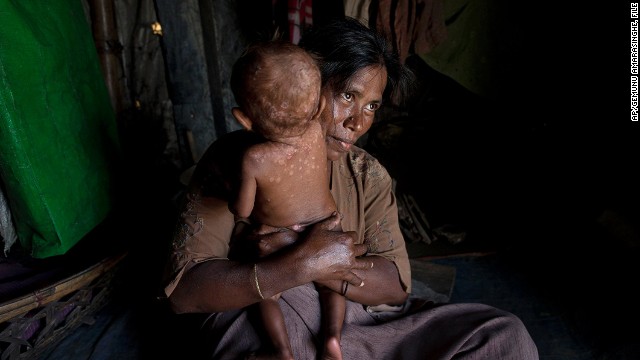
- More than 50,000 people have fled Myanmar-Bangladesh border ports
- U.N. report details abuse, starvation and cramped conditions on boats
- Many fleeing are Rohingya Muslims who are being persecuted in Myanmar
- Around 140,000 are living in camps where supplies have run out
Hong Kong (CNN) -- Tens of thousands of people are fleeing violence in Myanmar only to be robbed, beaten and starved on boats helmed by human traffickers, according to a new report from the United Nations Refugee Agency.
In the 12 months to June, around 53,000 people left ports in the Myanmar-Bangladesh border area -- 61% more than the previous year -- many with the hope of reaching family in Malaysia, according to the report "Irregular Maritime Movements."
They paid between $50 and $300 to board boats carrying up to 700 passengers, some manned by armed guards, many of whom doled out verbal abuse or beatings to prevent their human cargo from moving around.
Some passengers were fed rice and noodles, while others received nothing at all on journeys lasting anywhere from seven days to two months, the report said.
More than 200 people are thought to have died making the trip so far this year, due to illness, heat, lack of food and water, and severe beatings.
However, the number of people who have perished at sea appears to have fallen over the past year, the report noted, after people smugglers hired bigger, more seaworthy vessels.
Persecution in Myanmar
That so many people, the vast majority Rohingya Muslims, are rushing to flee the country is a scathing indictment of the conditions they're being forced to endure in Myanmar, or Burma, as it's also known.
Of around 800,000 Rohingya Muslims living in Rakhine State, violence has pushed around 140,000 into temporary camps, while another 40,000 are effectively detained in isolated villages, according to Human Rights Watch.
"It's a humanitarian disaster," said HRW's Phil Robertson, who said conditions had worsened, especially since February, when the government barred international aid group Medecins Sans Frontieres (MSF) from working in Rakhine State.
The ban was lifted in late July but aid is yet to reach tens of thousands of people, many who are hungry and suffering preventable illnesses in crowded, unhygienic camps.
"What you're seeing is people who are leaving Rakhine State with very frail health to start with; people who have been in these camps and face the slow deprivation of food and basic medical services to the point that they're already weakened," Robertson said.
"They're getting on these boats, and these boats are landing in Thailand, and they're being put in jungle camps where they're on starvation rations unless their relatives can find exorbitant fees that the traffickers are demanding to release them and send them onto Malaysia."
The U.N. report said upon arrival in Thailand, new arrivals said they were driven through the night in pickups with 15 to 20 other people who were forced to sit or lie on top of one another.
They were then taken to camps where hundreds of people, including women and children, were held while smugglers phoned family members abroad, demanding more money for their loved ones' safe passage to Malaysia.
Demands "were accompanied by threats or, when payment was not immediate, severe beating and prolonged detention in a smugglers' camp for up to six months," the report said.
Malnourished in Malaysia
As many as 38,000 people had registered as Rohingya in Malaysia, the report said, noting that since 2013, many had arrived with serious medical conditions.
In the first half of this year, more than 140 people had been diagnosed with beriberi, a condition caused by severe malnutrition and vitamin B deficiency, which can cause paralysis and death. That's 12 times the number diagnosed in the previous 14 months.
Phil Robertson, HRW
"They have faced deprivation, abuse and suffering every step of their way as they try to flee the predations of the Burmese government, and the local state government and the Rakhine state government," Robertson said.
Myanmar doesn't recognize the Rohingya as citizens or as one of the predominantly Buddhist country's ethnic minorities.
"I think the international community really has to push very hard on the Burmese government to accept the reality that these people should be considered citizens of Burma.
"For the government of Burma to maintain this fiction that somehow these are recently arrived migrants from India or from Bangladesh is absolutely unconscionable," Robertson added.
In a statement following their five-day visit to Myanmar last week, two commissioners from the U.S. Commission on Religious Freedom said they were "deeply troubled by reports we received of abuses against the Rohingya Muslim community in Rakhine State."
"No impartial observers question reports of systematic, large-scale and egregious abuses of human rights of this community involving acts and omissions resulting in deaths, injuries, displacement, denial of basic health and other services, denial of freedom of movement, and denial of the right to a nationality, among other violations," said Commissioners M. Zudhi Jasser and Eric P. Schwartz.
In the past few years, Myanmar's new leadership under President Thein Sein has won praise for its efforts to open the once reclusive country to foreign influences and trade. However its treatment of the Rohingya continues to cloud its stated commitment to improving human rights.
Doubt over India rape-hanging claim
8/26/2014 3:59:55 AM
- Evidence was sent to a special DNA fingerprinting facility in southern India for re-examination
- Investigators highlighted several discrepancies in the post-mortem report
- Five people arrested after two girls were found dead hanging from a tree
- Authorities do not plan to charge the arrested men, who included two police officers
New Delhi, India (CNN) -- Two teenage girls, who were found hanging from a tree in northern India in May, were not raped as originally alleged, according to new forensic reports commissioned by federal investigators.
The Central Bureau of Investigation (CBI) sent samples obtained by police in the northern Uttar Pradesh state, where the incident had happened, to a special DNA fingerprinting facility in southern India for re-examination after it took over the case, an official source told CNN Tuesday.
"(Test) results didn't show the girls were sexually assaulted," said the CBI source, who requested anonymity. "There were also several discrepancies in the post-mortem report."
But with the latest evidence appearing to rule out rape, investigators, for now, have dropped plans to file charges against the five.
"The CBI is not going to file the charge-sheet against them as of now. However, we are not giving them clean chit either," CBI spokeswoman Kanchan Prasad said.
She said the investigation into the girls' killing would continue.
Under Indian law, suspects in custody for serious crimes become eligible to apply for bail if formal charges are not filed against them in the trial court within 90 days.
Left hanging from tree
Five people, including two police officers, were arrested after the girls -- who were cousins aged 14 and 16 -- were left hanging from the branches of a mango tree in a remote of village in Budaun district on May 27.
A photo from the village showed the body of one girl, dressed in a green tunic and pants, hanging from the tree. A large group of people, many of them young children, were gathered around the grisly scene.
The girls' families filed a complaint accusing three brothers of rape and murder.
Police said an autopsy confirmed the girls had been raped and strangled.
No quick fix for India's rape crisis
Widespread anger
The case caused widespread revulsion in India and beyond, reminding people about the brutal gang-rape of a girl on a public bus in Delhi in December 2012.
Back then, a 23-year-old physiotherapy student was traveling home from a movie with a male friend when at least five other men on the bus dragged her to the back of the bus and then beat up her friend.
The men took turns raping the woman as the bus drove around the city for almost an hour, police said at the time. The two friends were then dumped by the side of the road, with the young woman later dying from her injuries.
That incident energized activists and women generally, with government officials promising action to ensure that girls and women feel safe.
Rape order on child brings scrutiny on India's village councils
The girl whose rape changed a country
Inmates beheaded in Brazil prison riot
8/27/2014 4:06:59 AM
- NEW: Prisoners release two guards they took hostage
- Two inmates were decapitated, and two were thrown from a roof
- The prisoners were demanding better living conditions
Sao Paulo, Brazil (CNN) -- A prison riot in Brazil that left four inmates dead came to a conclusion Tuesday after officials transferred all the inmates elsewhere and rioters released two guards they had held hostage.
Brazilian authorities had begun moving inmates out Monday after rioting at the prison in the southern city of Cascavel, where two inmates were decapitated and two thrown off the roof of a cell block. According to the state-run Agencia Brasil news agency, there was a fifth victim, too.
Prisoners, demanding better living conditions and more flexible visiting hours, overpowered guards Saturday at the State Penitentiary in Cascavel. They burned mattresses and damaged cells.
The prison housed just over 1,000 inmates, according to local media reports.
Prison riots are not uncommon in Brazil, often sparked by overcrowding, poor conditions and rivalry between criminal gangs.
CNN's Barbara Arvanitidis and Mariano Castillo contributed to this report.
Being a drug addict's mom
8/26/2014 9:46:00 PM
- Mothers of addicts say they go through a range of emotions -- from guilt to sadness to anger
- The Addict's Mom now has over 20,000 members, with chapters in every state
- Moms of addicts are working together to raise awareness of what they say is an epidemic
- For those who can't afford rehab, jail is their treatment, says The Addict's Mom founder
Editor's note: Kelly Wallace is CNN's digital correspondent and editor-at-large covering family, career and life. She is a mom of two girls. Read her other columns and follow her reports at CNN Parents and on Twitter.
(CNN) -- Seven years ago, Barbara Theodosiou, then a successful entrepreneur building a women's business mentoring group, stopped going to meetings, leaving the house and taking care of herself. She grew increasingly distraught.
"You almost wake up and get this haunting feeling, this horrible feeling that my God, I just wish I wasn't going to live today," said Theodosiou, a mother of four from Davie, Florida. "Not that you would take your life but you're so scared."
Petrified, really, but not for herself. For her children.
Theodosiou learned two of her four kids were addicted to drugs.
"I found out within six months that both my sons were addicts and like every other mother, I just wanted to go into bed and never get out."
Her older son, Peter, now 25, took prescription drugs and then escalated to heroin. Her younger son, Daniel, now 22, started what's called robotripping, where he would take large quantities of cough medicine to get high.

She says she first noticed signs of problems when her younger son was 16.
"I was taking Daniel to school one day and he was just like almost choking. I thought he was having a panic attack," she said. A short time later, the school called and said staff members thought Daniel was on drugs.
"I was like, 'There's no way.' ... I have talked to my children my whole life about drugs."
Within just months, after a call from her son Peter's roommate, her husband went to his house and found needles all over the place.
"If you know about addiction then when you find this out, you realize not only are you in for the fight of your life, but this is not something that gets fixed in six months. This could go on," she said.

"It's like having someone punch you in the stomach. ... You're never the same from the second you find out."
How does the mother of an addict cope? How does she juggle the incomprehensible challenge between supporting a loved one and not enabling their habit? And how does she deal with the stigma of having a child who is an addict?
In my in-depth interviews with Theodosiou and other mothers of addicts across the country, they made it very clear that being the mother of an addict is an incredibly lonely and isolating place, and that often the only people who understand what they're going through are other mothers who are going through it themselves.
The fear of getting the call
Theodosiou's son Daniel overdosed three times that first year she realized he was using and nearly died each time.
One day, she returned to her house and saw police officers out front. "I remember pulling up and my heart was beating ... I was just going to faint right there."
The police officer asked if she was Daniel's mother. "For sure, I thought he was going to tell me Daniel was dead, and it ended up Daniel overdosed again, and again he was in the hospital."

Melva Sherwood of Vermilion, Ohio, got that unimaginable call on October 3, 2012. Her son Andrew, 27 at the time, died of an overdose of heroin. It was his son's fifth birthday.
"It was 11:30 at night. I was sound asleep and it was October. All the windows were open, and the entire neighborhood knew what had happened," said Sherwood, who says she screamed "at the reality of it, that it was over, that it was done."
"I have a friend who lives down the street, and she said it was horrifying to hear."
The blame game
Many mothers immediately beat up on themselves when they learn their children are battling addiction.

Brenda Stewart of Worthington, Ohio, says it was heartbreaking realizing two of her three kids were addicts. Her son Jeremy, now 29, used prescription drugs and then heroin, and the drug of choice for Richard, now 31, was crystal meth, she said.
"I've been going to counseling for years to figure out what I did wrong. It's just like, 'What did I do?'" said Stewart, who has adopted Jeremy's two children, ages 5 and 7.
"And then you come to find out through tons of counseling and parents' groups and everything else that this is something you didn't do to your children. And that's the hardest thing to get away from because you always feel responsible."

Debbie Gross Longo, whose son started using drugs at 13 and taking prescription drugs at 15, says the powerlessness of being an addict's mom is worse than people might imagine.
"As a mother, it's been hell," said the mom of four in Stony Brook, New York. "It's like having a child that you cannot help and sitting on the edge of your seat all at the time because you know something might happen."
Viewing addiction as a disease was instrumental, many mothers say, in helping understand they didn't cause their child's addiction and couldn't fix it either.
"When you really start to understand that it is a disease ... you can start looking at your child in a different way, loving them for who they are and hating the disease," said Stewart.
Sadly, the stigma of having a child with addiction is all too real and incredibly painful. Announce to your community your child has a disease like cancer and people will jump to help, said mothers I interviewed. Not so when you tell them your child is an addict.
"There are no little girls selling cookies for addiction. Nobody has bumper stickers on their car," said Theodosiou.
Her son Daniel was in the church group. "When they found out he was an addict, the entire church shunned him. He was completely not invited anywhere."
'The hardest thing in the entire world'
Every mom I spoke with talked about the intense struggle between supporting their addicted child or children and not enabling their destructive habit.
It is "the hardest thing in the entire world," said Theodosiou, who said it was only after seven years and 30-plus stints in rehab that she knew she had to make a drastic change.
"All of these people were telling me you have to stop enabling Daniel. You need to let Daniel go. You need to just stop. ... I had to actually face leaving Daniel on the street," she said.
"I finally spoke to a pastor and an addiction specialist who told me that ... the last person in the world who could ever help Daniel is me."

Sherwood, who lost one son to a drug overdose and has another son who battled drug addiction, said she was never able to cut off her children completely, but she set limits.
"As far as enabling, I think you need to lay it on the table for them. This is what you can do. Here are your options but I'm not going to sit here and let you take advantage of me and lie to me," said Sherwood, who is a registered nurse and the owner of a business providing caregivers for in-home assisted living.
Stewart, whose two sons were addicts, said she eventually realized the longer she enabled her children, the longer they weren't going to face the consequences.
"It took the line in the sand, telling them I love them and if they were ever ready to get the help and really wanted it that I'm here for them ... but I'm not going to set up another appointment," she said.
But the enabling isn't just about the addicts, said Stewart. Parents need to realize they are enabling themselves and are risking losing everything by thinking they can save their children.
"There are moms losing their lives to save their children. ... They're spending their whole paycheck trying to take care of their child. They're not taking care of themselves. That's just a ripple effect."
Finding support from other moms
Theodosiou went through the range of emotions that most mothers of addicts experience: the guilt followed by the intense sadness and then the anger.
"It's just a very, very sad and a very lonely place," she said.
Then, one day about a year and a half into her new kind of normal with two sons who were addicted, she had a conversation with God.
"I said, you know, God, if my sons are going to be living this life and be destroyed by this, I'm going to tell every mother and help every mother I can think of. I'm not going to keep it a secret."
She headed to Facebook and started a group called The Addict's Mom in 2008.
Her friend thought she was insane.
"She was like, 'Are you crazy? You are going to go on Facebook and say that you are an addict's mom?' And I said, 'You know what, I am and I know there have to be a million mothers just like me who are addicts' moms.'"

Six years later, The Addict's Mom, with its Facebook group, its fan page and its online community, has more than 20,000 members, with chapters in every state.
Stewart is the state coordinator in Ohio for The Addict's Mom.
"It's given me a place that I feel at home, a place that I feel I can give back," she said. "I also understand the parent's pain and for me if I can help one parent ease that pain, then I've done something."
Sherwood, who's an administrator for the Facebook group, said the online community was an "unbelievable eye opener."
"It was just like somebody turned on the light in the closet," she said. "It gave me such comfort to ... be able to put something out there online at any time during the day and have 20 people respond back with, 'Hey, we know. We've been where you're at. We feel for you. We're praying for you.' "
"It definitely was a life-changing experience."
'If you can't afford it, jail is your treatment'
Besides providing invaluable comfort and support, The Addict's Mom is a resource center with information on low and no-cost rehabs, psychologists and sober living environments. This month, the group is launching weekly online video meetings where mothers can call in from all over the country and talk with experts on addiction.
The group has also launched offshoots, including The Addict's Mom Healthy Moms, where the focus is solely on helping the mom live a healthy life ("We don't even talk about the addict there," said Theodosiou) and The Addict's Mom Grieving Moms for mothers who lost children to addiction. It's also started The Addict's Dad for fathers and a group called The Addict for the addicts to talk directly with each other.
A big focus now, the moms I interviewed said, is raising awareness about the problem of drug addiction and finding affordable solutions.
"There is treatment if you're rich and if you can afford it," said Theodosiou. "If you can't afford it, jail is your treatment."
The Addict's Mom is starting programs in states including New York, Kentucky and Ohio, where moms go into schools and educate students about addiction. The member moms are also flexing their lobbying muscles, advocating for laws such as legislation that allows a judge to order a person into treatment if a family member feels that person is a danger to himself or others.
"Our children are dying and at such an alarming rate," said Theodosiou, noting how the day before our conversation there were two posts on The Addict's Mom with reports that two children died.
"We are seeing an alarming rate of death in our society. We have to break the stigma. It's a disease,'" said Theodosiou. "They are not bad people. We have to get the word out."
Looking forward
Raising awareness and helping other mothers drives members of The Addict's Mom, but they are also always mindful of the lifelong battle their children are facing.
Sherwood's surviving son is doing well, she said, working full-time in marketing and sales, and planning to take a nutritional coaching course for a possible career in nutrition.
"Today, I have my son back as he learns and implements the plan he has put into place with nutrition, exercise and being with those that truly love him and support his journey toward a better life," said Sherwood. "What more could a parent ask for!"
Stewart's son Jeremy has been in recovery for over two years. He's engaged, is getting ready to buy a house and is very active with his two children. "Our hope is that in the very near future they are back with their father," said Stewart, who currently cares for her son's kids. Her older son, Richard, is also doing well, and has been in treatment since the end of June.
Gross Longo's son, now 25, had been in recovery for six months and just recently relapsed. He entered a detox program and is starting again on the road to recovery, his mother said.
"I am once again heartbroken," she said. "(My son) is doing what he needs to do to get well, but do you understand how this is a day-to-day, year-to-year fight?"
Before her son's relapse, Gross Longo told me she was so pleased about his recovery but also very cautious.
"They could change on a dime," she said. "They could be doing wonderful for five years ... and then one evening it's gone."
Theodosiou's older son, Peter, has been in recovery for 3½ years and is a recent college graduate. He will soon begin a master's program in speech pathology.
Her younger son, Daniel, had been in rehab for five weeks -- his longest time ever in treatment -- but recently relapsed, breaking the condition of his release from jail so he is back behind bars.
"I am really sad about Daniel," said Theodosiou.
Despite her son's setback, she continues to advocate for other moms of addicts, but also gets some much needed help for herself.
A few days before our conversation, a member of The Addict's Mom called her and expressed concern.
"She said, 'Barbara, we're worried about you.' And I said, 'Why?' And she said, 'Because you have to take care of yourself. You help so many other people.'"
"I still struggle with being OK and with my own issues and they help by reminding me, by being there, by being able to talk to them, by sharing resources and supporting me."
Have any of your loved ones ever been addicted to prescription drugs? What do you think is the best way to help addicts and their families? Share in the comments or tell Kelly Wallace on Twitter or CNN Living on Facebook.
Watch CNN Newsroom weekdays 9am to 3pm ET and weekends. For the latest from the CNN Newsroom click here.
Prisoners moved after beheadings
8/26/2014 10:18:01 AM
- NEW: Prisoners release two guards they took hostage
- Two inmates were decapitated, and two were thrown from a roof
- The prisoners were demanding better living conditions
Sao Paulo, Brazil (CNN) -- A prison riot in Brazil that left four inmates dead came to a conclusion Tuesday after officials transferred all the inmates elsewhere and rioters released two guards they had held hostage.
Brazilian authorities had begun moving inmates out Monday after rioting at the prison in the southern city of Cascavel, where two inmates were decapitated and two thrown off the roof of a cell block. According to the state-run Agencia Brasil news agency, there was a fifth victim, too.
Prisoners, demanding better living conditions and more flexible visiting hours, overpowered guards Saturday at the State Penitentiary in Cascavel. They burned mattresses and damaged cells.
The prison housed just over 1,000 inmates, according to local media reports.
Prison riots are not uncommon in Brazil, often sparked by overcrowding, poor conditions and rivalry between criminal gangs.
CNN's Barbara Arvanitidis and Mariano Castillo contributed to this report.
Snake bites Nicki Minaj's dancer
8/26/2014 5:50:27 AM

- Unidentified dancer was sent to hospital after being bitten in arm during rehearsal of hit song
- The bite was from a boa constrictor, which is not venomous
- Attack occurred at The Forum in Los Angeles during a rehearsal for MTV Video Music Awards
(CNN) -- A 6-foot-long boa constrictor named Rocky stole the show Friday during a rehearsal for Nicki Minaj's performance of "Anaconda" at the MTV Video Music Awards when he bit a backup dancer in the arm, according to a statement from MTV.
The female dancer, who was not identified by Viacom representatives, was treated immediately on the spot by a medic at The Forum in Los Angeles and later sent to a local hospital for treatment, Chris Velvin, director of production safety for Viacom Media, told CNN. Her injuries were not life-threatening.
Minaj was on stage for the rehearsal but was not involved in the incident, according to the statement on the MTV website. She remarked, "Did she get bit by the snake?"
Boa constrictors are not venomous, and Velvin said this snake had never attacked anyone before.
"He's a professional entertainment snake," Velvin said. "He's been doing this for 15 years."
The snake's owner, Hollywood Animals, did not return calls asking for comment.
The snake was draped around the dancer's shoulders when it bit her on the inside of her left arm, according to the statement.
It's unknown what provoked the snake, Velvin said, but the rehearsal had been going normally and the injured dancer had practiced with the snake in the past.
Sunday's live performance of "Anaconda," a raunchy remix of Sir Mix-a-Lot's "Baby Got Back," will still include a snake, but it will not be Rocky, Velvin said.
Beyonce releases surprise 'Flawless' remix featuring Nicki Minaj
Ukraine: A bumpy road to peace
8/26/2014 9:42:07 PM
- The Ukraine conflict started with a dispute over a trade deal
- That ballooned into protests, then Russia stepped in
- Looking forward, an outright invasion seems unlikely, analysts say
- It won't be easy to unravel the complex political and economic forces tugging at Ukraine
(CNN) -- More than 2,000 lives lost. A vast and unfolding humanitarian crisis. And the downing of a civilian airliner that shocked the world.
It's hard to imagine -- but true -- that the raging conflict between Ukraine and Russia, or at least Ukraine and pro-Russian rebels, all started with a humble trade agreement.
As tensions run high over a Russian aid convoy described by Western leaders as a provocative incursion, reports of direct Russian military activity inside Ukraine and Ukrainian fears of an outright invasion, it's time to look back on how we got here, and where things are headed:
How it started
While the roots of the crisis run quite deep, what's happening now began to unfold in earnest in the fall of 2013.
That's when then-Ukrainian President Viktor Yanukovych scuttled a trade deal with the European Union that would have pulled the country, so recently a satellite of the Soviet Union, toward Europe in the latest twirl of a dance that has lasted centuries.
Instead, Yanukovych jumped at Russian President Vladimir Putin's offer to buy $15 billion in debt from his cash-strapped government and cut the price of vital natural gas to the country.
Yanukovych's decision set off protests in Ukraine's more Europe-leaning west calling for the government's ouster. Security forces responded harshly, beating protesters and firing live ammunition into demonstrations, resulting in several deaths. As clashes spread, so did international anger over the situation.
By late February, Yanukovych had fled to Russia, the government had fallen and a new pro-Europe government had formed to replace it.
That, in turn, set off pro-Russian demonstrations in Crimea, a semi-autonomous Ukrainian republic and the location of a major Russian navy base.
After thousands of Russian troops filtered into the territory -- purportedly at the invitation of Ukraine's self-exiled president -- Ukraine's regional parliament called a referendum on secession, and before you could say "borscht," Crimea was part of Russia.
And it's here that things turned even uglier. Pro-Russian fighters occupied government buildings in the country's east, demanding a referendum on independence.
Before long, rebel forces -- believed to be supported by Russia -- had taken control of major cities in Ukraine's east. Fighting broke out between the rebel groups and Ukraine's military, fighting that continues today.
In a major and likely inadvertent escalation in July, a suspected surface-to-air missile believed to have been operated by pro-Russian rebels shot down Malaysia Airlines Flight 17, killing all 298 people aboard and hardening Western opinion, particularly in Europe, against Russia.
What's happening now
Ukraine's military has been on the offensive recently against the pro-Russian forces, but those successes seem to have slowed.
Russian troops remain camped along the Ukrainian border, Western leaders say.
And Ukrainian officials said Tuesday that they had detained 10 Russian soldiers in the Donetsk region of eastern Ukraine, further evidence, Kiev says, of direct Russian involvement in the conflict.
Meanwhile, the United Nations has warned of a growing humanitarian crisis sure only to get worse unless something is done to stem the fighting.
What's next
A full-scale invasion is unlikely. While Putin's approval rating among Russians is sky-high, recent polling shows the Russian people aren't wild about an out-and-out invasion of Ukraine, said Robert D. Kaplan, the chief geopolitical analyst for Stratfor. "He may be a dictator, but dictators care about public opinion as much as democrats," he said.
But any talk of peace from Putin is likely a stalling tactic. Putin is buying time so that he can continue slipping arms and aid to help rebels recover from their recent losses, said Heather Conley, senior vice president of Europe and Eurasia at the Center for Strategic and International Studies. "His best option is to have a permanent frozen conflict," she said.
Fall and winter will slow the fighting. Kaplan said the colder seasons in Ukraine mean mud and mud means a slower tempo for military operations. Just don't expect total silence, he says -- there will still be fighting.
Moscow will try to squeeze Ukraine. Putin will slow the flow of crucial natural gas and goods into Ukraine, putting further pressure on Kiev's economy and war-fighting ability. "The Russians will try everything to weaken the regime in Kiev," Kaplan said.
The West has some soul-searching to do. Sanctions applied by the United States and Europe against Russia have so far only played into Putin's playbook, enhancing the image of an aggrieved Russia trying to shake off its detractors, Conley said. Putin's strategy of assembling a larger Russian empire has significant ramifications for Estonia and Latvia, Conley said, raising questions about just what the West will do to stop Russia if Putin chooses to further extend his reach.
And what will it take to end this? Ukraine is a linchpin of Putin's plans for Russia, whether it's reassembling a historical empire or shoring up the Russian economy, Conley says. So whatever happens must support that. Kaplan says Putin can't pull back without gaining assurances that Ukraine will never become part of NATO. Ukraine, he said, needs assurances about its sovereignty and energy security.
How U.S. can help Syria drive out ISIS
8/26/2014 3:45:56 PM
- Robert Ford: U.S. mulling strike on ISIS elements in Syria
- U.S. pressure on Iraq, including to form new government, has bolstered efforts to repel ISIS
- He says aiding moderate Syria opposition would help them do the same, as al-Assad weakens
- Ford: Aid should hinge on rebels making new government with shared focus on driving out ISIS
Editor's note: Robert S. Ford is a senior fellow at the Middle East Institute in Washington. He formerly served as U.S. ambassador to Syria and Algeria, and was deputy U.S. ambassador to Iraq.
(CNN) -- American officials are pondering whether to strike ISIS elements in Syria to better contain the group's fearsome power, following its horrific execution of James Foley and the direct threats it has leveled against the United States.
As they consider how best to confront the organization, there is good news: The United States and its friends have scored some successes against ISIS in the past month. The administration provided material support to Iraqi Kurdish Peshmerga and Iraqi special operations forces, and with judicious use of airstrikes enabled them to repel ISIS attacks northwest and northeast of Baghdad.

The Obama administration wisely understood that these military operations are only a short-term fix. The only sustainable solution is a new Iraqi government able to rally a large majority of Iraqis across ethnic and sectarian lines to fight the Islamic State in Syria. Iraqis have come together before to contain such extremists, and they could again.
Iraq's restive Sunni Arab population, furious at former Prime Minister Nuri al-Maliki, backed ISIS in the Spring, but now Sunni Arab tribal figures in Anbar and Kirkuk, as well as some of the leaders from the urban business-political elite in Mosul and Salah ad-Din, have asked the Iraqi central government in Baghdad for help to fight the organization.
Success is not assured, but the picture is brighter than a month ago.
American pressure -- and tying military assistance to concrete progress toward assembling a broad-based national government -- have encouraged the hesitant Iraqis forward. The United States needs to sustain that approach.
But even with progress in Iraq, the United States and its friends cannot contain the Islamic State for long when it has a vast safe zone in Syria into which its fighters can fall back to rest, regroup, and fight again. As we contemplate a response, we should consider whether any of the strategies used recently in Iraq could also be used in Syria.
In Iraq, the United States identified friends willing to fight the Islamic State on the ground. The Iraqi Kurdish Peshmerga were not perfect -- they are not a regular army, their command structure is at times unwieldy, and their political agendas are not always compatible with ours. However, they were clearly able to help blunt the ISIS advance, so cooperating with them was sensible.
Similarly, providing far more help to moderate elements of the Syrian armed opposition makes huge sense. They are motivated and have been locked in combat against ISIS for nine months. Despite fighting an uphill battle against the well-armed regime of Syrian President Bashar al-Assad, heavily backed by Iran and Russia, they have advanced in some regions.
They share the same frustrating imperfections -- such as lack of professional discipline -- as the Peshmerga and the Iraqi military, but if they were better armed and financed, the moderate Syrian fighters could be helpful in repelling ISIS.
They already did so by expelling it from northwest Syria earlier this year and the Damascus area this summer. With stronger cash flows from governments in the West and Gulf, they could also lure Syrians away from ISIS bankrolls.
American airstrikes might be needed in Syria, but that would not be the most important tactic for success, nor would more material aid to the rebels be sufficient to contain the Islamic State over the long term. As in Iraq, there has to be a political angle as well.
Helping a weakened al-Assad regime to consolidate its position in Damascus is not a recipe for sustainable success. The regime can't roll back the Islamic State now -- it is attracting scores of new jihadis every day. Helping al-Assad would multiply the numbers of recruits.
Rather, as in Iraq, Syria needs a new government.
The U.S. had hoped this would be negotiated in Geneva, where an international conference early this year aimed to find a political solution to the Syria conflict, but al-Assad rejected any serious negotiation. His Russian and Iranian allies, estimating that he could survive, and seeing no alternative, made no effort to convince the regime to do otherwise.
Six months later, however, the regime's pillars of support are weaker. There are reports that the regime earlier this month executed three air force pilots who had refused to obey orders. The minority Alawite sect that has backed al-Assad is openly grumbling about heavy losses in an endless war against the moderate rebels and now the ruthless Islamic State. A publicity campaign called "Scream of the Nation" is under way in the Alawite heartland. Its complaint: Assad keeps his throne while our children go to their coffins.
We need moderate armed opposition leaders in Syria to capitalize on this weariness by moving politically, not just militarily. As we boost aid to the moderate armed rebels, we must condition that help on their reaching out to disaffected regime supporters and developing with them a common political stance for a new, negotiated national unity government, with or without al-Assad.
The al-Assad regime won't go to the table easily, and the moderate rebels will need more help -- perhaps even hardware, like more mortars and rockets to hit airfields and bases and further rattle al-Assad's war machine.
Substantially boosting help to the moderate opposition would also compel Russia and Iran to rethink their blank check to al-Assad, especially if there is a better alternative route to contain ISIS.
As it did with Iraqi Prime Minister Nuri al-Maliki, Iran might consider other reasonable alternatives to the current Syrian leadership. Iran won't, however, until it recognizes that al-Assad can't win and can't rally enough support to contain the Islamic State.
One prominent American observer says it is folly to think that we can aid the moderate armed fighters to topple al-Assad. But toppling wasn't our goal before and shouldn't be now. We should aim to help the Syrian opposition inflict enough pain on the regime so that, despite al-Assad, the regime finally agrees to negotiate a new government whose first task will be to fight the Islamic State and eventually expel it from Syria.
In Syria's brutal, three-sided war, the U.S. has no easy options. We have never controlled events there. It is also true that civil wars don't always end in happy settlements. However, our inability to steer perfectly or to guarantee the best outcome can't be an excuse to maintain our current approach.
Read CNNOpinion's new Flipboard magazine.
Follow us on Twitter @CNNOpinion.
Join us on Facebook.com/CNNOpinion.
Ferguson was 'a propaganda godsend'
8/26/2014 9:48:58 PM
- Frida Ghitis: Critics, foes of U.S. making hay with Ferguson, to portray U.S. in flames
- Ghitis: Venezuela, Iran, Egypt, Russia media played story as if U.S. social order breaking down
- She says Ferguson definitely brings up racism, police weapons, treatment of minorities
- Ghitis: But stories miss Americans' soul searching, civil rights history, size of protests
Editor's note: Frida Ghitis is a world affairs columnist for The Miami Herald and World Politics Review. A former CNN producer and correspondent, she is the author of "The End of Revolution: A Changing World in the Age of Live Television." Follow her on Twitter @FridaGhitis. The opinions expressed in this commentary are solely those of the author.
(CNN) -- America's painful struggle with racism has often brought great satisfaction to the country's rivals, critics, and foes. The killing of Michael Brown by a police officer in Ferguson, Missouri, and its tumultuous aftermath has been a bonanza.
"Protests spread across U.S." announced Iran's state-run Press TV. Russian government-controlled media showcased the dramatic pictures, "huge explosions," "mayhem unraveling," and what might look like the wholesale collapse of social order in America.

Countries hostile to the U.S. ignore this key aspect: Behind the TV images of violence and the stunningly excessive, counterproductive police response, is that America is engaged in a profound, honest and what will prove to be a constructive debate about racism, law enforcement tactics, the weapons police use, and what life is like for minority teens.
In countries where law enforcement is a tool to keep the regime in power and suppress political opposition, countries that have been on the receiving end of American and Western criticism, Ferguson was a propaganda godsend.
Michael Brown's killing is an event with many layers. First, the killing itself, as details slowly emerge. Second, the people of Ferguson's reaction, which points to a reservoir of real grievances beyond the specifics of the Brown case. Then, the police response to the killing and to the protests.
Ferguson has become a symbol of America's continuing struggle against racism, and the extremely serious and very urgent issue of police shooting to kill -- and killing. And there is the matter of their attitude and treatment of minorities.
Any coverage that deliberately ignores the context, that ignores the debate, is incomplete, and there is a good chance that it is deliberately misleading.
Responsible journalists covered the story with nuance and perspective. But that wasn't the case everywhere.
The government of Russia didn't even try to hide its efforts to gain political advantage. In Rossiskaya Gazette, the official government daily, under a picture of what is presumably an African-American man wearing leg shackles, readers learned of a Russian Ministry report condemning the U.S. government's "uses of such inhumane methods as testing medicines on inmates, forced sterilization of minority women, abuse of power by police."
The Kremlin clearly relished the opportunity to clobber the U.S. on its prison system in response to the West's sharp criticism, particularly after members of the group Pussy Riot spent time behind bars and made Russia's prison conditions the subject of international condemnation.
Russia's RT, a government-controlled network whose reporters have been resigning in protest against its biased coverage, had fun mocking America's media freedom after Ferguson police arrested reporters covering the story.
In Iran, where opposition leaders languish in prison for years and human rights violations at the hands of the government are well-documented, authorities used Ferguson to undermine America's criticism.
Iran's Deputy Foreign Minister Majid Takht Ravanchi slammed the U.S. for "its racist behavior and oppression of the protesters in Ferguson." Speaking to reporters in Tehran, he condemned the "racism of Western societies ... those who claim to be advocates of human rights."
Even in Venezuela, the government of Nicolas Maduro, heir to anti-American firebrand Hugo Chavez, portrayed the events in Ferguson as something close to an uprising against the government. The state-owned television network TeleSur, which broadcasts throughout Latin America, said the Ferguson demonstrations confirm "the presence of profound systemic problems with human rights and democratic norms in America society."
Just to be clear, this is Venezuela, Iran, and Russia, criticizing the U.S. for the weaknesses in its democracy and its handling of human rights.
They were not alone in outrageous irony. The government of Egypt, which killed thousands of protesters, urged the U.S. to exercise restraint. And Chinese media twisted the State Department spokesperson's words when she called Ferguson a "domestic affair" outside her purview, to make it sound like Beijing's defense against criticism of its human rights abuses, which it calls domestic affairs, should be off limits to foreign critics.
Even the terrorist group ISIS got in the game, urging Ferguson protesters to embrace radical Islam. "How is democracy treating you guys?" it asked.
To be sure, undemocratic, human rights violators criticizing the U.S. does not exempt America from blame. Clearly, Ferguson points to serious problems which need to be addressed, and are being addressed, with the rapt attention of the entire country.
Less cynical coverage can be readily found in other countries. The respected Dutch newspaper NRC delves not just into the problem of race and policing in America, but into the debate Ferguson has sparked in the United State. Spain's El Pais noted how the lingering racism undercuts America's moral stance in judgment of rights violators. Many describe the inequality and prejudice that persists, but makes it a point to include the progress that has been made in race relations and the race conflicts that have surfaced in the author's own country.
In the end, for all the intensity of emotions and wall-to-wall domestic and international coverage, the Ferguson protests were limited in scope. Another unarmed black man was shot and killed in St. Louis, and there was no uprising. The killing of Brown was a tragedy, but nobody died in the ensuing protests despite high-powered rifles and dramatic fireworks.
America is hardly alone in experiencing racism, as the Pakistani-born Canadian writer Tarek Fatah pointed out. News coverage of the events in Ferguson are a reminder for all of us of the importance of looking at the full context when viewing what happens in any country and protecting ourselves from political manipulation as we follow the news.
Read CNNOpinion's new Flipboard magazine.
Follow us on Twitter @CNNOpinion.
Join us on Facebook.com/CNNOpinion.
You are receiving this email because you subscribed to this feed at feedmyinbox.com
If you no longer wish to receive these emails, you can unsubscribe from this feed, or manage all your subscriptions

No comments:
Post a Comment