 | Start using Mint today to set a budget, track your goals and do more with your money. From our sponsors |
| CNN.com - Top Stories |
| CNN.com delivers up-to-the-minute news and information on the latest top stories, weather, entertainment, politics and more. |
85 Boko Haram hostages rescued
8/17/2014 11:30:45 AM
- Islamist terror group abducted 97 people last week, security sources say
- Chadian security forces stopped a convoy along Lake Chad
- 85 of the hostages in the convoy were rescued, authorities said
Kano, Nigeria (CNN) -- Chadian troops have rescued 85 Nigerians kidnapped last week by the Islamist terror group Boko Haram, security and human rights sources in Nigeria said Saturday.
Dozens of Boko Haram insurgents stormed the Doron Baga fishing and farming village on the shores of Lake Chad late Sunday through Monday and took away 97 young men and boys plus several women, residents said. The raiders killed 28 residents and burned scores of homes, according to residents.
The hostages were loaded onto motorboats and ferried into neighboring Chad, with residents saying they feared the hostages would be forcefully conscripted as foot soldiers.
Chadian security officials reported intercepting a convoy of buses carrying 85 Nigerians" believed to have been kidnapped by Boko Haram terrorists from Baga," a Nigerian security source said.
"The convoy being led by six Boko Haram gunmen was stopped on the Chadian part of the border along Lake Chad for routine checks and the huge number in the convoy raised suspicion," said the source, who asked not to be named because he was not authorized to speak on the issue.
An official of the National Human Rights Commission (NHRC) in Maiduguri confirmed the rescue of the 63 male and 22 female hostages.
The source, who asked that his name not be used, said more than 30 hostages were still being held by Boko Haram. He said their captors sped off with them in motorboats when they spotted the convoy being questioned by Chadian soldiers.
Boko Haram has been waging a five-year armed insurgency to create an Islamic state in northern Nigeria. The group has carried out series of abductions, including the April kidnapping of more than 200 schoolgirls from a boarding school in the town of Chibok.
Boko Haram uses its hostages as conscripts and sex slaves, according to authorities. They say Boko Haram has killed more than 12,000 people and displaced more than half a million residents.
Nigerian schoolgirl describes escape from Boko Haram
The road to Boko Haram's heartland
'Screaming' stowaways in container
8/16/2014 10:19:52 AM

- London dockworkers discovered 35 people inside a shipping container
- One man has died, the rest treated for dehydration and hypothermia
- Police say they are from the Indian subcontinent
- Workers heard screaming and banging from one of the ship's 50 containers
(CNN) -- Dockworkers at a major London port discovered 35 people inside a shipping container Saturday morning.
One of them, an adult male, was declared dead at the scene, according to Essex police Superintendent Trevor Roe.
Several others -- including children -- were said to have "significant health problems," according to a police statement.
Daniel Gore of England Ambulance Service said the patients -- all of whom were conscious when they were found -- are being treated for dehydration and hypothermia at three London-area hospitals.
None of their conditions are believed to be life-threatening, he said.
What caused the one death was not yet known. A homicide investigation is under way, according to Roe.
'Screaming and Banging'
Workers at Tilbury Docks made the discovery after "screaming and banging was heard from inside the container," Roe said.
The stowaways are from the Indian subcontinent, said Roe, but it was not immediately clear if that is where their maritime journey originated, or when it did.
What is known is that the container they were in arrived to Tilbury -- located on the River Thames about 30 miles east of London -- aboard a ship owned by P&O Ferries at 6 a.m. (1 a.m. ET) from the Belgian port city of Zeebrugge after a nearly nine-hour trip.
Company spokeswoman Natalie Hardy told CNN that P&O Ferries operates two such trips a day between London and Zeebrugge.
She said P&O Ferries does not inspect the contents of the containers it transports as a matter of company policy. Such checks, according to Hardy, are the responsibility of the UK Border Agency.
There were 50 containers on the ship, according to Roe. He said they would all be thoroughly searched.
British authorities blasted the "criminal networks" engaged in human trafficking.
"Today's tragic incident at Tilbury is a reminder of the often devastating human consequences of illegal migration," Immigration and Security Minister James Brokenshire said in a statement. "This incident is now a criminal investigation. Border Force officers are fully engaged with Essex police and the Tilbury port authorities as the necessary steps are taken towards bringing those responsible to justice."
Body of 'apparent stowaway' found in U.S. Air Force plane
U.S. Navy rescues 282 apparent migrants in Mediterranean
Italian navy rescues over 1,000 migrants from overcrowded boats in one day
Which foods are off Russian menus?
8/18/2014 7:40:41 AM
- Russia has banned food imports from countries that have imposed sanctions against it
- As the world's fifth largest food importer, Russia relies on supply from abroad
- Russia bought $15.8 billion worth of food from the EU in 2013, and $1.3 billion worth of food from the U.S.
Editor's note: Viewing this on a mobile device? Click here to see the full infographic.
London (CNN) -- The European Union is spending more than $167 million to soothe the pain being felt by fruit and vegetable farmers hit by Russian food sanctions.
The move comes as the trade war between the West and Russia intensifies, and looks likely to hit Europe's growth figures. Fears over the impact of chilling relations has already undermined Europe's fragile recovery.
Around $2.7 billion worth of fruit and vegetables were shipped from the EU to Russia in 2013, the bloc's single biggest export to the market. The package announced by the EU Monday will support producers of fruit and vegetables that are already in season and can't be easily stored.
Russian President Vladimir Putin, in a tit for tat move against Western sanctions, banned imported European cheese, American chicken and Norwegian seafood from the country's dinner tables. The move was in response to countries imposing economic sanctions against Russia in the aftermath of the flight MH17 disaster.
The Kremlin banned most agriculture products from the U.S., the European Union, Norway, Canada and Australia.
Europe's food exports to Russia were worth $15.8 billion in 2013, making up around 10% of the bloc's agriculture exports, according to EU data. European countries sold $1.6 billion worth of pork and $1.3 billion worth of cheese and curd to Russia.
The U.S. shipped $1.3 billion worth of food to Russia, with chicken and other poultry making up a quarter of the total value, around $310 million.
The ban of foreign food is more than just an inconvenience for Russians who like imported food. Russia is the world's fifth largest agricultural importer and remains dependent on food supply from abroad -- its agricultural trade deficit extended to $26 billion in 2013, according to data from the European Commission.
With billions worth of food disappearing from the market, prices are likely to go up and experts forecast increased Russian inflation, which is already running at 7.5%.
Russians will still be able to enjoy European wines and spirits, as well as bread, pasta and cereals. These have escaped the embargo -- even though their ban would hurt Europe economically. In 2013, EU countries sold nearly $1 billion worth of spirits and $733 million worth of wine to Russia.
Explore CNN's infographic above to see what items are likely to disappear from Russian menu.
Russia's food ban leaves Europeans with sour taste
U.S. shooting: New autopsy stirs more anger
8/18/2014 11:07:37 AM
- NEW: "Why would he be shot in the very top of his head, a 6-foot-4 man?" attorney asks
- Witness: Michael Brown was running away and turned around when he was shot
- Several businesses are vandalized or looted, authorities say
- Bullets entered through the front of Michael Brown's body, an autopsy says
Have you documented the protests in Ferguson? Share your photos, videos and opinions with CNN iReport. For local coverage of the fatal police shooting of Michael Brown and its aftermath, go to CNN affiliates KMOV, KSDK, KTVI and KPLR.
Ferguson, Missouri (CNN) -- An independent autopsy into the death of Michael Brown in Ferguson, Missouri, provides "ample" evidence to support the arrest of the police officer who shot him, family attorney Daryl Parks said Monday at a news conference.
Parks was particularly concerned about gunshots that medical examiners hired by the family indicate came from behind and above.
"Why would he be shot in the very top of his head, a 6-foot-4 man?" Parks asked. "Makes no sense."
The autopsy could support witnesses' suggestions that Brown was holding his hands up in the air, said Shawn Purcell, who assisted in the autopsy. But other scenarios are possible, said Dr. Michael Baden, who supervised the inquiry.
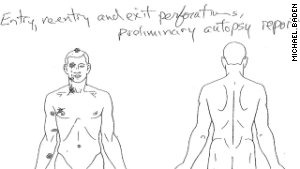
But nothing in the autopsy suggested that Brown had engaged in a struggle, Baden said. Police have said that Brown reached into Officer Darren Wilson's car in a tussle over his gun.
The experts said they will need to examine the original autopsy conducted by officials before they can make final conclusions.
Meanwhile, things in Ferguson have gotten so unruly that Missouri Gov. Jay Nixon has called National Guard troops to the St. Louis suburb.
"Given these deliberate, coordinated and intensifying violent attacks on lives and property in Ferguson, I am directing the highly capable men and women of the Missouri National Guard ... in restoring peace and order to this community," he said in a statement.
Gunfire, tear gas and Molotov cocktails Sunday night marked some of the fiercest clashes yet between police and protesters furious about the death of an unarmed teenager.
And the tensions continued escalating after autopsy results revealed that 18-year-old Michael Brown was shot six times.
Devolution of protests
What began as peaceful protests spiraled into disarray after two civilians were shot and injured, Missouri State Highway Patrol Capt. Ron Johnson said. He said those civilians were not shot by police.
"Tonight, a Sunday that started with prayers and messages of unity, peace and justice took a very different turn after dark," Johnson said early Monday morning.
Some protesters hurled Molotov cocktails at police, and several businesses were vandalized or looted, despite the Brown family's call for calm.
"Based on these conditions, I had no alternative but to elevate the level of our response," Johnson said.
Officers fired tear gas into a crowd of hundreds of protesters, including children, who were marching toward a police command post despite an impending midnight curfew.
But protester Lisha Williams challenged the notion that protesters provoked officers.
"That is a lie. It was no fight, it was no shots fired," she told CNN late Sunday night. "All we did was march to the command center to fall to our knees and say, 'Don't shoot.' And they started shooting."
The clashes kept escalating, with St. Charles County sheriff's officials saying shots were fired in their direction.
At one point, employees at a McDonald's restaurant locked themselves in a storage room after the store was overrun, Johnson said.
Video from CNN affiliate KSDK showed children among the protesters chanting, "Hands up, don't shoot."
St. Louis County police said most of the crowds had dispersed after the curfew went into effect at midnight. The curfew was scheduled to end at 5 a.m. (6 a.m. ET).
But the anxiety remains. Children can't even go to school Monday.
"Information we received from officials on the scene late Sunday evening has contributed to concerns we have about children walking to school or waiting for buses on streets impacted by this activity," the Ferguson-Florissant School District said on its Facebook page.
Autopsy details
Brown, an unarmed black teenager, was shot dead by a white police officer on August 9. He was shot at least six times, including twice in the head, according to the preliminary results of an autopsy that his family requested.
Family attorney Anthony Gray said the independent autopsy conducted Sunday found that Brown was shot twice in the head and four times in the right arm -- all to the front of his body.
Last week, the St. Louis County Police Department said an original autopsy found that the teen died of gunshot wounds. But the department wouldn't say how many times he was shot or give any other details.
According to the preliminary results of the family autopsy, the bullets that struck Brown were not fired from close range, as indicated by the absence of gunpowder residue on his body.
One of the bullets shattered his right eye, traveled through his face, exited his jaw and re-entered his collarbone, according to the autopsy.
The last two shots were probably the ones to his head, attorney Gray said. One entered the top of his Brown's skull, suggesting his head was bent forward when he was struck.
The independent autopsy was conducted by high-profile pathologist Michael Baden, who testified in the O.J. Simpson, Phil Spector and Drew Peterson murder trials.
Dueling narratives
Accounts of exactly what happened when Wilson stopped Brown while the teen was walking down a street vary widely.
Witnesses said they saw a scuffle between the officer and Brown at the police car before the young man was shot.
Several witnesses said Brown raised his hands and was not attacking the officer.
Piaget Crenshaw said she was sitting in her home when she witnessed the shooting. She captured video of the aftermath, including images of Brown's body lying in the middle of the street.
"From it all initially happening, I knew this was not right," she told CNN's "New Day" on Monday.
"I knew the police shouldn't even have been chasing this young boy and firing at the same time. The fact that he got shot in the face, it was something that clicked in me, like no, somebody else needs to see this. This isn't right. I've got to record."
Crenshaw said Brown was running away from police and then turned around. She said that was when Brown was shot.
But police gave a different narrative, saying Brown struggled with the officer and reached for his weapon.
Though the officer has stayed out of the public spotlight, more than 22,000 people have endorsed the "I Support Officer Wilson" Facebook page.
U.S. Attorney General Eric Holder has approved another autopsy on Brown's body, the Justice Department said. That autopsy will be conducted by a federal medical examiner.
5 things to know about Michael Brown's shooting
Complete coverage of the Ferguson shooting
CNN's Steve Kastenbaum reported from Ferguson; CNN's Holly Yan reported and wrote from Atlanta. CNN's Melanie Whitley, Jennifer Duck, Steve Almasy, Dave Alsup, Jim Acosta, Mayra Cuevas, Evan Perez and Joe Sutton contributed to this report.
Pro-China protesters rally in HK
8/18/2014 3:11:36 AM
- Tens of thousands march to protest Occupy Central democracy movement
- Organizer claims quarter-million attended march, other estimates far lower
- Occupy Central organizer Benny Tai says he is not concerned
- China's government will release decision on Hong Kong election reform soon
Hong Kong (CNN) -- Just call it the anti-protest protest.
Tens of thousands of people marched through Hong Kong yesterday in support of China and to protest Occupy Central, a pro-democracy movement that says it will plan to stage a civil disobedience sit-in unless the Chinese government allows the Hong Kong public to nominate and vote for its next leader.
Robert Chow, the organizer of Sunday's march, said it represented Hong Kong's desire to work "peacefully" with the Chinese government in Beijing on political reform.
"We want universal suffrage, but not at any cost," he told CNN Monday.
The pro-government march followed the same route as Hong Kong's massive annual anti-government, pro-democracy rally on July 1, but the tenor was markedly different: Sunday's marchers were arranged into organized groups wearing matching t-shirts, some emblazoned with names of mainland Chinese organizations. Many waved Chinese flags.
Paid protester claim
Local media swirled with reports of marchers getting paid or bused in to attend the pro-government march. One video (Cantonese) purportedly showed cash being handed out to marchers. Other images appeared to show marchers getting paid and enjoying free food in a dim-sum restaurant.
Chow said he took the bribery accusations "seriously" and would "investigate" but maintained that no laws were broken.
There were also conflicting reports on the size of the march. Chow said his group counted a "quarter million" marchers, but an estimate by University of Hong Kong statisticians put the number much lower, between 79,000 and 88,000.
By contrast, July's pro-democracy rally drew between 154,000 and 172,000, according to the university.
Pictures taken by reporters appeared to show a noticeably thinner crowd on Sunday than the crowd in July, but Chow said the difference was because "we were marching very, very fast."
Historic Hong Kong neighborhood fights to preserve its past
Left: July 1 march. Right: Today's march. Both at their apparent peaks. Note different composition, pace & density. pic.twitter.com/Ur7XavMxod
— Alan Wong (@byAlanWong) August 17, 2014 Different visions of democracy
Benny Tai, the organizer of Occupy Central, said Chow's rally offered "nothing substantial" in terms of new ideas.
"[Chow's supporters] talk about universal suffrage, but they never explain what they mean by universal suffrage."
Tai's group has proposed an electoral reform package in which every citizen would be allowed to vote for the city's next leader, with candidates freely nominated by the general public.
Benny Tai, Occupy Central organizer
But Beijing says it will only allow citizens to vote on candidates that are approved by a small, China-friendly committee.
Chow, who supports the government's plan, said Hong Kongers should take the deal rather than risk a volatile showdown with China.
"We want universal suffrage, with peace. Iraq has universal suffrage -- has it got peace? No, we don't want that," he said.
"Benny Tai wants a specific way of election, or else. If we don't get it, then all hell breaks loose."
The current chief executive of Hong Kong, Leung Chun-ying, is favored by Beijing and has signed a petition in support of Chow's movement.
Under the "one country, two systems" policy, the seven million residents of Hong Kong -- defined as a "Special Administrative Region" of China -- are afforded greater civil liberties than those in the mainland, under a leadership approved by Beijing.
This reflects an agreement reached between China and the United Kingdom prior to the handover of the city in 1997, which promised Hong Kong a "high degree of autonomy" for 50 years after its return. But there are increasing fears that those freedoms are being eroded.
OPINION: Hong Kong's struggle for democracy matters
What is Beijing thinking?
The future of Hong Kong could become clear soon.
On August 31, China's powerful National People's Congress Standing Committee is expected to announce a decision on Hong Kong's electoral reform.
If the decision seems to leave open the possibility for Hong Kongers to nominate their own leaders, then Tai has said he'll work with the government to produce an election reform plan that "satisfies international standards."
But if not, "there will be no more negotiation and we will have to plan for Occupy Central."
The threat of civil disobedience "is our bargaining power," he explained. "They take us seriously, though they will never admit that."
Democracy in China?
Although at odds with one another, both Chow and Tai believe democracy in Hong Kong might one day lead to democracy in China.
Tai said Hong Kong is a test case for the mainland's political future.
"For political reform, that is, introducing true elections, Hong Kong could be the experimental ground for the Communist Party. The Chinese government will closely observe how elections will be conducted.
"If Hong Kong gets the chance to have true universal suffrage, that may reflect that China has the intention to introduce political reform or some kind of election in the future -- maybe in five or ten years."
Chow said Chinese democracy might look "very different from the western style of democracy.
"Maybe it'll turn out to be a better system."
READ MORE: Will protest or persuasion shape Hong Kong's future?
Germany 'recorded U.S. officials'
8/17/2014 6:41:02 PM

- German media: German intelligence agency accidentally recorded Clinton, Kerry calls
- German officials say they don't have widespread eavesdropping program, media sources said
- Germany has criticized the U.S. for tapping Chancellor Angela Merkel's phone
- Last month, Germany threw the CIA station chief in Berlin out of the country
(CNN) -- Germany's intelligence service has intercepted phone calls by two U.S. secretaries of state, German media reports reveal.
The news comes several months after Germany complained about the United States eavesdropping on its politicians.
German intelligence service BND intercepted a phone call from then-U.S. Secretary of State Hillary Clinton "by chance" while Clinton was traveling on a U.S. government plane, the German newspaper Sueddeutsche Zeitung reported. The magazine Der Spiegel said this happened in 2012.
And Der Spiegel reported BND intercepted a satellite call from U.S. Secretary of State John Kerry in 2013.
According to the Sueddeutsche article, unnamed members of the German government claim that the wiretapping was accidental and not part of a widespread operation to eavesdrop on U.S. politicians. Der Spiegel said the recorded calls were deleted.
Sueddeutsche says it and German public broadcasters NDR and WDR based their reports on documents from the case of a German intelligence agent who'd given information to the CIA.
Sueddeutsche gives the man's name simply as Markus R. and said he was arrested in July after giving the CIA at least 218 classified documents.
Der Spiegel, quoting unnamed sources, also reported the Germans have spied on Turkey, a NATO member state. The magazine said it viewed documents supporting the claim from 2009.
Relations between Germany and the United States have suffered lately because of revelations about intelligence gathering.
Last month, Germany kicked out the CIA station chief in Berlin after learning that two Germans -- one working at a German intelligence agency, the other in the Ministry of Defense -- were suspected of spying for the United States.
Last year, Edward Snowden leaked information that the National Security Agency tapped Chancellor Angela Merkel's cell phone. A German prosecutor has opened an investigation into the matter.
The U.S. State Department and representatives for Clinton declined to comment Sunday.
CNN Senior Political Correspondent Brianna Keilar contributed to this report.
Real reason Ferguson has big guns
8/19/2014 7:16:02 AM
- Kara Dansky: The militarization of policing has become commonplace across America
- Dansky: That police departments receive surplus military weapons is not whole story
- She says the federal government has been trying to fight the failed War on Drugs
- Dansky: This deliberate strategy negatively impact communities of color the most
Editor's note: Kara Dansky is the senior counsel for the ACLU's Center for Justice and author of "War Comes Home: The Excessive Militarization of American Policing." The opinions expressed in this commentary are solely those of the author.
(CNN) -- It used to be billy clubs, fire hoses and snarling German shepherds. Now it's armored personnel carriers and flash-bang grenades. The weaponry has changed, but the target is still the same.
If some of the photos from Ferguson last week were in black and white, you might confuse them with scenes from the 1950s south. White police officers beating black protestors. Young black men lying face down in the street with police officers standing over them with assault rifles.
We have a long history of aggressively policing communities of color in America. Police have treated black and brown people like the enemy for decades. In that context, the recent events in Ferguson in the wake of Michael Brown's shooting come as no surprise. But they go way beyond Ferguson.
What we're witnessing is the militarization of policing, and it has become commonplace in towns across America.
Every year, the Departments of Defense, Homeland Security and Justice funnel billions' worth of dollars and military equipment to state and local law enforcement agencies to help them amass arsenals of combat-ready weaponry, according to our report "War Comes Home: The Excessive Militarization of American Policing." Two of the armored vehicles patrolling St. Louis right now were purchased with these federal funds. An estimated 600 police departments have received Mine Resistant Ambush Protected vehicles, which are tanks built to withstand armor-piercing roadside bombs. In the years since the terror attacks on September 11, 2001, this sort of federal funding has only become more available for state and local police departments.
We're told that part of the impetus for the federal agencies is to get rid of surplus military equipment. But that's certainly not the whole reason.
At least one third of the wartime weapons flowing to state and local police departments are brand new. The better explanation is that the militarization of state and local police is a deliberate strategy funded by the federal government to aggressively fight the failed "war on drugs." As has always been true of the war on drugs, the battlegrounds are disproportionately in communities of color.
This deliberate strategy explains why almost 80% of the paramilitary raids we studied were to search homes (usually for drugs); why SWAT teams forced their way into people's homes using military equipment like battering rams 60% of the time; and why they were 14 times more likely to deploy flash-bang grenades, originally invented to ambush wartime enemies, in drug raids than during SWAT raids for other purposes.
And just has been true for decades, our police's most aggressive tactics are doing disproportionate damage to communities of color. Overall, 54% of people impacted by the paramilitary searches were people of color. Dumping weapons and equipment designed for overseas combat into local neighborhoods is only adding dangerous fuel to the fire of aggressive policing.
It might be tempting to think that the brutal tactics we've seen are the result of a few bad police officers. It might be comforting to think this is a fluke. And that might be partially true. But when the government arms cops like soldiers, trains them in counter-insurgency tactics, tells them they are fighting an enemy, we should expect this type of combustive, tragic result.
But that doesn't mean we should accept the status quo. We need to change it.
It's time for Congress to rein in its support for programs like the Department of Defense's 1033 program that allows the Pentagon to dole out weapons and stop the Departments of Justice and Homeland Security from handing out cash to police departments.
Cutting this funding is part of a larger recognition that aggressively fighting the war on drugs has failed to abate drug use and instead done incredible damage to communities. The federal government must recognize that the funding currently going toward this war can and should be spent on more effective interventions like drug and mental health treatment and housing.
Concurrently, state and local governments should constrain the ability of law enforcement to raid people's homes and police neighborhoods using wartime weapons and tactics. Part of the reason this hasn't happened yet is that many people were simply unaware of how militarized our police have become. The events in Ferguson should dispel any illusions people may have about that.
It's time for the federal government to stop financing a siege on communities of color.
Read CNNOpinion's new Flipboard magazine
Follow us on Twitter @CNNOpinion.
Join us on Facebook.com/CNNOpinion.
Why Ferguson needs answers
8/19/2014 4:45:42 AM
- Mel Robbins: 9 days later, investigators still haven't told Brown family what happened
- FBI should have been there from start; attorney general should tap special prosecutor, she says
- She says confusing story has varying accounts; investigators should tell what they know
- Robbins: Baden autopsy best information family has gotten so far; they need more answers
Editor's note: Mel Robbins is a CNN commentator and legal analyst. Robbins is the founder of Inspire52.com, a news and entertainment site for women, and author of "Stop Saying You're Fine," about managing change. She speaks on leadership around the world and in 2014 was named Outstanding News Talk Radio Host by the Gracie Awards. Follow her on Twitter @melrobbins. The opinions expressed in this commentary are solely those of the author.
(CNN) -- What's going on in Ferguson? It's been nine days since Michael Brown was killed, and his family is still waiting for information from investigators about what happened to their young man.
Eyewitnesses and cell phone videos recount the minutes after his death --before Brown lay dead for five hours, uncovered in the street -- but the state can't provide the family with any information?
No state autopsy reports. No witness statements. No grand jury indictment. No nothing. There's something seriously wrong here.
Imagine having to conduct an autopsy on your son while his body lies in a funeral home so you can know how he died before you bury him.

The Ferguson Police Department was implicated in racial profiling in a 2013 Attorney General of Missouri report, so how can anyone possibly think they would want to investigate one of their own in a shooting? The FBI should have been on hand from the beginning.
While the National Guard is deploying to Ferguson, I implore local law enforcement to deploy common sense -- withdraw from the investigation.
State Highway Patrol Captain Ron Johnson, appointed to coordinate security operations, has been a tremendously important presence in the community and now we need the same on the prosecutorial side. The attorney general should immediately appoint a special prosecutor working jointly with the Justice Department.
The community needs this.
The first and "very preliminary" autopsy results have just been released, and they paint a very grim picture of how Michael Brown died: He was shot at least six times, including twice in the head, according to acclaimed pathologist Dr. Michael M. Baden, who conducted the autopsy at the request of Michael Brown's family. (Let that sink in, the family had to hire a private pathologist to get answers.)
At least one of the bullets appear to have entered and exited several times, shattering Brown's right eye, traveling through his face, leaving through the jawbone and re-entering through his collarbone, said Baden. The final shot was apparently the fatal one, which hit Brown on the top of the head.
With 50 years of experience (he has conducted some 20,000 autopsies), Baden spoke with calming authority about his findings; he said that the state medical examiner was a trusted colleague who would likely make very similar findings. But since Baden did not have access to Michael Brown's clothing (to examine gun powder residue), or X-rays, or witness statements, or toxicology reports (and I can't help but wonder why he wasn't given access to this), he could not respond to the calls for justice in Ferguson.
He said that Brown was shot from anywhere between one foot and 30 feet away. He said bullet wounds to Brown's arms could have been sustained by Brown putting his hands up or making a defensive gesture by crossing his arms. From where I sit, six bullets pumped into an unarmed kid in broad daylight is excessive force.
But that only moves us slightly closer to truth. The eyewitness' accounts vary so widely -- and eyewitness testimony is notoriously unreliable, often refuted by the scientific evidence produced at trial. At least one witness, Piaget Crenshaw, told CNN that it "looked as if" the officer tried to pull Brown into the car, then was "chasing after the boy" until Brown turned around and was shot.
But others say Brown was shot in the back.
At the moment, the case hinges on the accounts of two conflicting witnesses: Dorian Johnson and Officer Darren Wilson.
Johnson was walking with Brown when the shooting occurred and gave this account, reported by MSNBC:
Johnson said a police officer approached as he and Brown were walking in the middle of the street and told them to use the sidewalk. They complied, and the officer began to drive away, but then threw his car into reverse and came back alongside the teens, nearly hitting them.
Johnson said he heard Wilson say something like "What'd you say?" before trying to open his car door and slamming it into Brown. Then, Johnson said, the officer reached out and grabbed Brown by the neck with his left hand. The two men struggled briefly, and then Wilson, still in his car, shot Brown once, Johnson said.
Johnson said that he and Brown "took off running together," but Brown was shot a second time "striking him in the back," he said. After the second shot, Brown turned around, putting his hands in the air and saying, "I don't have a gun. Stop shooting!" according to Johnson. He said that Wilson then approached Brown and fired several more shots until he "crumbled into a fetal position."
As the news conference for the autopsy was taking place, a caller to a St. Louis radio station, who identified herself only as "Josie," told listeners she knew Wilson's side of the story. Here is a summary of what she said:
He says the boys were walking in the street, Wilson rolled the window down and told them to get out of street.
Wilson may have called for backup when he pulled over.
He heard the call for the strong armed robbery and saw the teens carrying something that might have been cigars.
He pulled over and when he tried to get out of the car, twice he was pushed back into the car by Michael Brown. Brown then punched him in the face and Wilson reached for his gun.
Brown grabbed the gun and at one point had the gun pushed again Wilson's hip so Wilson pushed the gun away and the gun went off.
Brown and his friend ran and Wilson got out of the car and pursued. He told them to freeze and Brown and his friend turned around.
Brown started to taunt him, then bum rushed Wilson, coming at him full speed. Wilson started shooting.
Wilson said the final shot was in the forehead and Brown fell two or three feet in front of the officer.
A source with detailed knowledge of the investigation into the shooting told CNN that "this account is accurate."
Where witness accounts differ, an autopsy can provide certainty, as it will allow us to recreate the crime scene and -- with certainty -- know how far apart the men where, what Brown was doing when he was shot and whether he ever had his hand on Wilson's gun.
There was one important question that Baden could answer for certain. Michael's mother wanted to know whether her son had suffered when he died. Baden assured her that the bullet to the head had rendered him unconscious and in his opinion "he had not suffered."
I hope the local authorities recuse themselves from the investigation and turn it over to a special prosecutor with the attorney general. And for crying out loud, hurry up and complete the three autopsies, the investigation and the grand jury proceedings.
What Ferguson and Michael Brown's family need right now are answers, and until we have them, there will be nothing but more heartbreak, chaos and uncertainty.
Read CNNOpinion's new Flipboard magazine.
Follow us on Twitter @CNNOpinion.
Join us on Facebook.com/CNNOpinion.
Israel responds to rockets with strikes on Gaza targets
8/19/2014 9:01:36 AM
- NEW: Prime Minister Benjamin Netanyahu orders the Israeli military to respond to rocket fire
- Three rockets have been fired from Gaza into the Beer Sheva area, Israel says
- "There hasn't been any progress at all," the lead Palestinian negotiator says of talks
- Indirect talks on a lasting peace deal have been taking place in Cairo
Cairo (CNN) -- New rockets were fired into Israel from Gaza, Israel's military said Tuesday, hours after a truce in the conflict was extended until the end of the day as Palestinian and Israeli negotiators struggle to reach a more lasting agreement.
As the deadline was pushed back, officials on both sides offered little reason for optimism.
"There hasn't been any progress at all," Azzam al-Ahmed, the lead Palestinian negotiator, told reporters, dismissing earlier reports that a deal was set to be signed.
"We hope that every minute in the next 24 hours will be used so we can reach an agreement, or the cycle of violence will continue," he said.
In what appeared to be a new flare-up of violence Tuesday afternoon, three rockets fired from Gaza hit the Beer Sheva area in southern Israel, the Israeli military said.
"No injuries reported. We cease they fire?" said Israel Defense Forces spokesman Peter Lerner via Twitter.
A CNN team on the ground reported seeing what it thought were three rockets being fired from Gaza into Israel, leaving smoke trails in the sky.
Israeli Prime Minister Benjamin Netanyahu ordered the IDF to respond to the rockets, a senior Israeli official told CNN. An IDF statement shortly afterward said strikes were being carried out against targets in Gaza.
"Yet again, terrorists breach the ceasefire and renew fire at Israeli civilians from Hamas ruled Gaza Strip," Lerner said in the statement.
"This continued aggression will be addressed accordingly by the IDF; we will continue striking terror infrastructure, pursuing terrorists, and eliminating terror capabilities in the Gaza Strip, in order to restore security for the State of Israel."
It's not yet clear who fired the rockets.
Shortly before the rockets were fired, Hamas spokesman Fawzi Barhoum said in an e-mailed statement to CNN: "If Netanyahu does not understand our message and people's demands in Gaza through political language, we know a way to make him understand."
Negotiating through Egyptian go-betweens, Israel and the Palestinians have been attempting over the past week to resolve longstanding issues amid a temporary ceasefire in the deadly fighting in and around Gaza.
Under the latest extension, the truce is set to expire at midnight Tuesday ( 5 p.m. ET).
'Very fragile and very explosive'
Mustafa Barghouti, leader of the Palestinian National Initiative, accused the Israelis of blocking the path to an agreement. He said by phone from Gaza, after returning from Cairo, that the situation is "very fragile and very explosive."
Prime Minister Benjamin Netanyahu of Israel said earlier Monday that Israel was "prepared for any scenario," with the Israel Defense Forces ready "for a very firm action if fire is resumed."
Israeli forces have remained positioned around Gaza since they withdrew two weeks ago after destroying more than 30 tunnels, some of which extended under the border into Israel.
The conflict, which began in early July, has killed more than 2,000 Palestinians, leaving entire Gaza neighborhoods in rubble. The violence has killed 67 people on the Israeli side, with militants in Gaza firing roughly 3,500 rockets toward Israel.
'Impossible demands'
In the talks, Israel is calling for Gaza to be demilitarized, demanding that Hamas, which controls the territory, and other militant groups lay down their arms.
Hamas leader Izzat Risheq said Monday that the group's weapons were "for self-defense" against Israel.
"But when we have our own Palestinian state with its own national army to protect its citizens, there will be no need for any party to carry any kind of weapons," he said.
Speaking on condition of anonymity Monday, a Hamas leader said the Israelis had "submitted impossible demands on the Palestinians such as the issue of demilitarization, destroying the tunnels and the issue of preventing Palestinians from developing their missiles technology."
The Israelis, he said, "want everything and want to give nothing."
He said the Palestinians had responded with a counterproposal offering Israel "full security in exchange of full opening of border crossings" or lifting the siege completely.
Dispute over blockade
But a senior Israeli official suggested to CNN that there were contradictions coming from the Palestinian side.
"How can Israel have full security while they're still digging terror tunnels and making rockets?" he asked, saying the Palestinians "can't cherry pick what they want."
Palestinians say Israel's blockade is throttling the economy of the small, impoverished strip of land and the lives of its inhabitants.
Among their demands are the rebuilding and reopening of Gaza's airport and the establishment of a seaport.
But Israeli authorities -- who retain control of Gaza's airspace, Mediterranean waters and their shared border -- say that releasing their grip on what goes into and out of the territory isn't feasible while Hamas and other groups are still building up their arsenals of weapons.
READ: Six decades of war
READ: Gaza's zoo animals caught in crossfire
READ: Israelis jailed for refusing to serve
CNN's Reza Sayah reported from Cairo, and Jethro Mullen reported and wrote from Hong Kong, while Laura Smith-Spark wrote in London. CNN's John Vause, Steve Almasy, Ali Younes, Amir Tal and Andrew Carey contributed to this report.
Cease-fire deal keeps arms silent
8/18/2014 4:36:27 PM
- NEW: Israeli official confirms cease-fire will be extended for 24 hours
- The former cease-fire expired after midnight (5 p.m. ET Monday)
- Indirect talks on a more lasting deal have been taking place in Cairo
- Israeli negotiators have been told to be steadfast on security, says Netanyahu
Cairo (CNN) -- Israeli and Palestinian negotiators have agreed to extend the current Gaza cease-fire by 24 hours, Gamal Shobky, the Palestinian Authority ambassador to Egypt, said Monday.
An Israeli government official confirmed the extension to CNN. The cease-fire is now set to expire at midnight Tuesday ( 5 p.m. ET).
The extension gives negotiators more time to talk about the issues for a lasting peace in Gaza.
Israeli and Palestinian media were reporting Monday that a deal was set to be signed, but no such pact was announced Monday.
Israel's Channel 10, quoting Palestinian sources, said the agreement would include the easing of Gaza border restrictions and enlargement of the fishing zone off the Gaza coast.
Bigger issues -- including demilitarization, the building of a seaport, the release of Palestinian prisoners and the return of the bodies of two Israeli soldiers -- will be discussed at fresh talks in a month's time, Channel 10 said.
Palestinian news agency Ma'an reported that Egyptian consultants were drawing up the documents and that Israel's delegation had left Cairo to discuss the deal with Israel's Cabinet.
Communicating through Egyptian intermediaries, Israel and the Palestinians have been trying to resolve in days issues that have smoldered for decades.
Israeli Prime Minister Benjamin Netanyahu said earlier Monday that Israel was "prepared for any scenario," with the Israel Defense Forces ready "for a very firm action if fire is resumed."
Israeli forces remain positioned around Gaza. In recent weeks, they carried out aerial and ground assaults against Hamas to try to stop militant rocket fire and destroy a network of more than 30 tunnels that extended under the border into Israel.
Operation Protective Edge not over
Israel is calling for Gaza to be demilitarized, demanding that Hamas, which controls the territory, lay down its arms.
After meeting with Defense Minister Moshe Yaalon on Monday, Netanyahu reiterated that Israeli negotiators had been "instructed to insist firmly on Israel's security needs." The strength of the Israeli military and the Israeli people's patience and perseverance would help bring them peace and security, he said.
Yaalon said Operation Protective Edge was not over.
"We are getting ready for the results of the deliberations in Cairo, whether they bring quiet or someone tries to challenge us by escalation," he said.
"The IDF is ready and willing to react with power to any development. Hamas will not drag us to a war of attrition, and if they try, they will get back twice as much."
Disarmament?
A senior Israeli official told CNN that the most central issue on the table was nonviolence.
"On the basis on nonviolence, if you assume that includes no tunnels, then you would be correct. If you assume that would mean no missiles, then you would be correct," he said.
The official said the Palestinian delegation was not united and that Hamas political leader Khaled Meshaal was calling the shots in Cairo.
He pointed to what he said appeared were contradictions coming from the Palestinian side, asking, "how can Israel have full security while they're still digging terror tunnels and making rockets?" The Palestinians, he said "can't cherry pick what they want."
Even during the cease-fire, Hamas has boasted that its rocket-making factories are still operating, replenishing its arsenal.
But in the view of Palestinian officials, disarmament is a nonstarter.
"That is not possible," Palestinian official Nabil Shaath said. "Because Israel will not demilitarize either, will not even commit itself that it will never use military arms against Gaza."
Hamas leader Izzat Risheq said the group's weapons were "for self-defense" against Israel.
"But when we have our own Palestinian state with its own national army to protect its citizens, there will be no need for any party to carry any kind of weapons," he said.
'Impossible demands'
Speaking on condition of anonymity Monday, a Hamas leader said the Israelis had "submitted impossible demands on the Palestinians such as the issue Palestinian demilitarization, destroying the tunnels and the issue of preventing Palestinians from developing their missiles technology."
The Israelis, he said, "want everything and want to give nothing."
He said the Palestinians had responded with a counterproposal offering Israel "full security in exchange of full opening of border crossings" or lifting the siege completely.
Palestinians say Israel's blockade is suffocating the economy of the small, impoverished strip of land and the lives of its inhabitants.
Among their demands are the rebuilding and reopening of Gaza's airport and the establishment of a seaport.
But Israeli authorities -- who retain control of Gaza's airspace, Mediterranean waters and their shared border -- say that releasing their grip on what goes into and out of the territory is too risky, as things stand.
"Building a seaport or an airport in Gaza without demilitarization is like getting a duty-free for rockets and missiles," Israeli Intelligence Minister Yuval Steinitz said.
Death toll passes 2,000
Meanwhile, the total number of Palestinians killed since the start of the offensive has reached 2,016, Ashraf el-Qedra, spokesman for the Ministry of Health in Gaza, said Monday.
The latest deaths include people who were found under rubble and those who died from injuries they received during the previous fighting.
It's unclear how many of the dead were militants. The United Nations has estimated that about 70% were civilians, but Israel has estimated a higher number of militants.
Israel blames Hamas for civilian deaths, saying militants fire rockets from civilian areas and encourage people to stay despite Israeli warnings of impending attacks.
The Israeli military says 64 of its soldiers have been killed, as well as three civilians in Israel.
CNN's Steve Almasy, Kareem Khadder, Amir Tal, Andrew Carey and Jethro Mullen contributed to this report.
Slain U.S. teen rushed policeman, friend says
8/18/2014 8:30:14 PM
- Autopsy suggests Brown kneeling or bending forward when shot in head, lawyer says
- Evidence could be presented to a grand jury as early as Wednesday
- Brown rushed full speed at officer, account called in to St. Louis radio station claims
- A source with detailed knowledge of the investigation says the account is accurate
Have you documented the protests in Ferguson? Share your photos, videos and opinions with CNN iReport. For local coverage of the fatal police shooting of Michael Brown and its aftermath, go to CNN affiliates KMOV, KSDK, KTVI and KPLR.
Ferguson, Missouri (CNN) -- Authorities in Ferguson, Missouri, worked to head off another potentially violent night of protests Monday -- nearing the end of a long day of dizzying developments in the aftermath of the shooting death of Michael Brown.
The preliminary results of an autopsy that Brown's family requested were released, as was a new account of what allegedly happened in the moments immediately before the teenager was killed by a local police officer.
Evidence in the shooting death could be presented to a grand jury as early as Wednesday.
And as the situation in the St. Louis suburb was being watched and talked about across the country, it continued to draw comments from numerous quarters -- including the White House.
"We have all seen images of protesters and law enforcement in the streets. It's clear that the vast majority of people are peacefully protesting. What's also clear is that a small minority of individuals are not," said President Barack Obama.
"While I understand the passions and the anger that arise over the death of Michael Brown, giving into that anger by looting, or carrying guns, and even attacking the police only serves to raise tensions and stir chaos," he said, in a call for calm.
"Let's see some understanding" rather than confrontation, and "let's seek to heal," the President said.
Brown's death has sparked nightly protests in the Ferguson, prompting Gov. Jay Nixon to call out the National Guard.
Monday, protesters marched and chanted. They were told they were allowed to walk, not stand, in protest. A number of arrests occurred, including that of news photographer Scott Olson and longtime activist and Holocaust survivor Hedy Epstein.
Dueling narratives
The officer who killed Brown says the teenager rushed at him full speed in the moments before the shooting, according to an account phoned in to a St. Louis radio station and confirmed by a source with detailed knowledge of the investigation.
According to the version on KFTK, phoned in by a woman who identified herself as "Josie," the altercation on August 9 began after Officer Darren Wilson rolled down his window to tell Brown and a friend to stop walking in the street.
When Wilson tried to get out of his cruiser, Brown first tried to push the officer back into the car, then punched him in the face and grabbed for his gun before breaking free after the gun went off once, the caller said.
Wilson pursued Brown and his friend, ordering them to freeze, according to the account. When they turned around, Brown began taunting Wilson, saying he would not arrest them, then ran at the officer at full speed, the caller said.
Wilson then began shooting. The final shot was to Brown's forehead, and the teenager fell two or three feet in front of Wilson, said the caller, who identified herself as the officer's friend.
A source with detailed knowledge of the investigation later told CNN the caller's account is "accurate," in that it matches what Wilson has told investigators.
But accounts of exactly what happened when Wilson stopped Brown vary widely.
Witnesses said they saw a scuffle between the officer and Brown at the police car before the young man was shot. Several witnesses said Brown raised his hands and was not attacking the officer.
Piaget Crenshaw said she was sitting in her home when she witnessed the shooting. She captured video of the aftermath, including images of Brown's body lying in the middle of the street.
Crenshaw said Brown was running away from police and then turned around. She said that was when Brown was shot.
Police provided a different narrative, saying Brown struggled with the officer and reached for his weapon.
Parallel investigations
A grand jury will hear testimony from witnesses and decide on whether to return an indictment in the case, Ed McGee, spokesman for the St. Louis County prosecuting attorney, said Monday, stressing there is "no time line on this case."
In addition to that proceeding, the Justice Department has opened a civil rights investigation into Brown's death. Attorney General Eric Holder will travel to Ferguson this week, to meet with investigators there.
"I realize there is tremendous interest in the facts of the incident that led to Michael Brown's death, but I ask for the public's patience as we conduct this investigation," the attorney general said in a statement.
"The selective release of sensitive information that we have seen in this case so far is troubling to me. No matter how others pursue their own separate inquiries, the Justice Department is resolved to preserve the integrity of its investigation."
Autopsy findings
An autopsy conducted for the family of Brown found no evidence that he struggled with Wilson before his death, according to the pathologist in charge of the examination.
Dr. Michael Baden conducted the autopsy after an official examination by the St. Louis County medical examiner's office.
Forensics consultant Shawn Parcells, who assisted Baden, said the findings are consistent with witness reports that Brown may have been shot as he walked away and that he was shot again with his hands up.
The family autopsy found that Brown was shot at least six times, including two shots to his head. Three of the bullets may have re-entered his body, causing additional damage, Baden said.
One of the bullets entered his head and came out through his eye; another -- likely the fatal wound, Baden said -- struck Brown on the top of his head and caused irreparable damage to his brain.
Family attorney Benjamin Crump said Brown probably would have been either kneeling or bending forward when he was struck with those bullets.
Brown had abrasions on his face consistent with falling onto the ground, Baden said.
He cautioned that he needs access to autopsy results, including tests on Brown's clothes and X-rays, before making some conclusions.
But Crump said the autopsy already offered more than "ample" evidence to support Wilson's arrest.
"What does this autopsy say? That the witness accounts were true, that he was shot multiple times," Crump told reporters.
Attorney General Holder said a third autopsy was being conducted Monday by medical examiners from the U.S. military.
Michael Brown death: Autopsy unlikely to settle dueling narratives
Devolution of protests
Another family attorney, Anthony Gray, implored protesters to remain peaceful.
"I can see that there is a very disturbing divide that is developing in our community," he said Monday. "This is not what we initially came to the community and called for."
As he spoke, the Missouri National Guard was in Ferguson under orders from the governor to restore peace.
Nixon issued the order early Monday after what began as peaceful protests spiraled into disarray after two civilians were shot and injured, Missouri State Highway Patrol Capt. Ron Johnson said. He said those civilians were not shot by police.
Some protesters hurled Molotov cocktails at police, and several businesses were vandalized or looted despite the Brown family's call for calm.
"Based on these conditions, I had no alternative but to elevate the level of our response," Johnson said.
Officers fired tear gas into hundreds of protesters, including children, who were marching toward a police command post despite an impending midnight curfew.
Two children were treated and released for exposure to tear gas overnight at St. Louis Children's Hospital, according to a spokeswoman there.
Protester Lisha Williams challenged the notion that protesters provoked officers.
"That is a lie. It was no fight, it was no shots fired," she told CNN late Sunday. "All we did was march to the command center to fall to our knees and say, 'Don't shoot.' And they started shooting."
5 things to know about Michael Brown's shooting
Complete coverage of the Ferguson shooting
CNN's Steve Kastenbaum reported from Ferguson; CNN's Dana Ford and Michael Pearson reported and wrote from Atlanta. CNN's Holly Yan, Melanie Whitley, Jean Casarez, Cristy Lenz, Jennifer Duck, Steve Almasy, Dave Alsup, Jim Acosta, Mayra Cuevas, Evan Perez and Joe Sutton contributed to this report.
Ferguson protesters, police in tense standoff
8/18/2014 11:15:28 PM
- Autopsy suggests Brown kneeling or bending forward when shot in head, lawyer says
- Brown rushed full speed at officer, an account called in to St. Louis radio station claims
- A source with detailed knowledge of the investigation says the account is accurate
Have you documented the protests in Ferguson? Share your photos, videos and opinions with CNN iReport. For local coverage of the fatal police shooting of Michael Brown and its aftermath, go to CNN affiliates KMOV, KSDK, KTVI and KPLR.
Ferguson, Missouri (CNN) -- An evening of peaceful protests devolved into another tense standoff in Ferguson on Monday night as a few protesters hurled bottles and rocks at a heavy police presence, and they responded by firing stun grenades and tear gas canisters.
Police in riot gear and gas masks formed a barricade. They used LRAD (Long Range Acoustic Device (LRAD) crowd control systems to send out piercing and painful sounds to disperse the crowd.
Some officers sat with guns pointed atop armored vehicles, while others darted into the crowd to make an occasional arrest before retreating.
Police told protesters they have to keep walking. If they stood still, they were warned, they risked arrest for unlawful assembly.
Most obliged, but not all.
Some demonstrators ripped out a "Do Not Enter" street sign and pointed it toward officers.
"There's nothing going on on this street right now that merits this scene out of Bagram," said CNN's Jake Tapper, reacting to the heavy police presence. "This doesn't make any sense""
The rowdy demonstrators were greatly outnumbered by fellow protesters trying to keep the gathering peaceful.
"Get out of the street! Don't fight!" some protesters bellowed on bullhorns.
Protester Jerrell Bourrage grabbed one of the bottle-hurling demonstrators and told him to stop.
"We don't need these antagonizers out here. We need people who can stand out here to the side and still let your word be known," Bourrage said.
"I came to keep my brothers safe. We have fathers, brothers, mothers and aunties out here."
Some believe those causing trouble are from outside Ferguson.
"We are not going to let outside provocateurs to come here. We can't allow this movement to be destroyed," said Malik Shabazz, national president of Black Lawyers for Justice. He wouldn't say who the men were.
The renewed tensions came after the preliminary results of an autopsy that Brown's family requested were released, as was a new account of what allegedly happened in the moments immediately before the teenager was killed by a local police officer.
Evidence in the shooting death could be presented to a grand jury as early as Wednesday.
And as the situation in the St. Louis suburb was being watched and talked about across the country, it continued to draw comments from numerous quarters -- including the White House.
"We have all seen images of protesters and law enforcement in the streets. It's clear that the vast majority of people are peacefully protesting. What's also clear is that a small minority of individuals are not," said President Barack Obama.
"While I understand the passions and the anger that arise over the death of Michael Brown, giving into that anger by looting, or carrying guns, and even attacking the police only serves to raise tensions and stir chaos," he said, in a call for calm.
"Let's see some understanding" rather than confrontation, and "let's seek to heal," the President said.
Brown's death has sparked nightly protests in the Ferguson, prompting Gov. Jay Nixon to call out the National Guard.
Officials temporarily detained several people, including news photographer Scott Olson and longtime activist and Holocaust survivor Hedy Epstein.
Dueling narratives
The officer who killed Brown says the teenager rushed at him full speed in the moments before the shooting, according to an account phoned in to a St. Louis radio station and confirmed by a source with detailed knowledge of the investigation.
According to the version on KFTK, phoned in by a woman who identified herself as "Josie," the altercation on August 9 began after Officer Darren Wilson rolled down his window to tell Brown and a friend to stop walking in the street.
When Wilson tried to get out of his cruiser, Brown first tried to push the officer back into the car, then punched him in the face and grabbed for his gun before breaking free after the gun went off once, the caller said.
Wilson pursued Brown and his friend, ordering them to freeze, according to the account. When they turned around, Brown began taunting Wilson, saying he would not arrest them, then ran at the officer at full speed, the caller said.
Wilson then began shooting. The final shot was to Brown's forehead, and the teenager fell two or three feet in front of Wilson, said the caller, who identified herself as the officer's friend.
A source with detailed knowledge of the investigation later told CNN the caller's account is "accurate," in that it matches what Wilson has told investigators.
But accounts of exactly what happened when Wilson stopped Brown vary widely.
Witnesses said they saw a scuffle between the officer and Brown at the police car before the young man was shot. Several witnesses said Brown raised his hands and was not attacking the officer.
Piaget Crenshaw said she was sitting in her home when she witnessed the shooting. She captured video of the aftermath, including images of Brown's body lying in the middle of the street.
Crenshaw said Brown was running away from police and then turned around. She said that was when Brown was shot.
Police provided a different narrative, saying Brown struggled with the officer and reached for his weapon.
Parallel investigations
A grand jury will hear testimony from witnesses and decide on whether to return an indictment in the case, Ed McGee, spokesman for the St. Louis County prosecuting attorney, said Monday, stressing there is "no time line on this case."
In addition to that proceeding, the Justice Department has opened a civil rights investigation into Brown's death. Attorney General Eric Holder will travel to Ferguson this week, to meet with investigators there.
"I realize there is tremendous interest in the facts of the incident that led to Michael Brown's death, but I ask for the public's patience as we conduct this investigation," the attorney general said in a statement.
"The selective release of sensitive information that we have seen in this case so far is troubling to me. No matter how others pursue their own separate inquiries, the Justice Department is resolved to preserve the integrity of its investigation."
Autopsy findings
An autopsy conducted for the family of Brown found no evidence that he struggled with Wilson before his death, according to the pathologist in charge of the examination.
Dr. Michael Baden conducted the autopsy after an official examination by the St. Louis County medical examiner's office.
Forensics consultant Shawn Parcells, who assisted Baden, said the findings are consistent with witness reports that Brown may have been shot as he walked away and that he was shot again with his hands up.
The family autopsy found that Brown was shot at least six times, including two shots to his head. Three of the bullets may have re-entered his body, causing additional damage, Baden said.
One of the bullets entered his head and came out through his eye; another -- likely the fatal wound, Baden said -- struck Brown on the top of his head and caused irreparable damage to his brain.
Family attorney Benjamin Crump said Brown probably would have been either kneeling or bending forward when he was struck with those bullets.
Brown had abrasions on his face consistent with falling onto the ground, Baden said.
He cautioned that he needs access to autopsy results, including tests on Brown's clothes and X-rays, before making some conclusions.
But Crump said the autopsy already offered more than "ample" evidence to support Wilson's arrest.
"What does this autopsy say? That the witness accounts were true, that he was shot multiple times," Crump told reporters.
Attorney General Holder said a third autopsy was being conducted Monday by medical examiners from the U.S. military.
Michael Brown death: Autopsy unlikely to settle dueling narratives
Devolution of protests
Another family attorney, Anthony Gray, implored protesters to remain peaceful.
"I can see that there is a very disturbing divide that is developing in our community," he said Monday. "This is not what we initially came to the community and called for."
The situation remains so unstable that the Ferguson-Florissant School District has canceled classes for the rest of the week.
The Missouri National Guard was in Ferguson under orders from the governor to restore peace.
Nixon issued the order early Monday after what began as peaceful protests spiraled into disarray after two civilians were shot and injured, Missouri State Highway Patrol Capt. Ron Johnson said. He said those civilians were not shot by police.
Some protesters hurled Molotov cocktails at police, and several businesses were vandalized or looted despite the Brown family's call for calm.
"Based on these conditions, I had no alternative but to elevate the level of our response," Johnson said.
Officers fired tear gas into hundreds of protesters, including children, who were marching toward a police command post despite an impending midnight curfew.
Two children were treated and released for exposure to tear gas overnight at St. Louis Children's Hospital, according to a spokeswoman there.
Protester Lisha Williams challenged the notion that protesters provoked officers.
"That is a lie. It was no fight, it was no shots fired," she told CNN late Sunday. "All we did was march to the command center to fall to our knees and say, 'Don't shoot.' And they started shooting."
5 things to know about Michael Brown's shooting
Complete coverage of the Ferguson shooting
CNN's Steve Kastenbaum reported from Ferguson; CNN's Dana Ford and Michael Pearson reported and wrote from Atlanta. CNN's Holly Yan, Melanie Whitley, Jean Casarez, Cristy Lenz, Jennifer Duck, Steve Almasy, Dave Alsup, Jim Acosta, Mayra Cuevas, Evan Perez and Joe Sutton contributed to this report.
Assange to leave embassy 'soon'
8/18/2014 11:18:42 AM
- WikiLeaks says "his departure is not imminent"
- Assange is accused of sexual assault in Sweden
- He says he fears Sweden will transfer him to the U.S.
- If transferred to the U.S., he says he'll be charged for publishing government secrets
(CNN) -- WikiLeaks founder Julian Assange said he'll leave the Ecuadorian Embassy in London "soon" after living there for two years to avoid extradition to Sweden.
"I can confirm I am leaving the embassy soon, but not for the reason you might think," Assange said at a news conference Monday.
He did not provide additional details but said he is suffering from health problems and would leave "when conditions are right."
However, WikiLeaks said, "his departure is not imminent."
Ecuador's foreign minister, who sat next to him, said his freedom is long overdue.
"The situation must come to an end ... two years is too long," Ricardo Patino said. "It is time to free Julian Assange. It is time for his human rights to be respected."
Swedish authorities want to question him over allegations that he raped one woman and sexually molested another.
He denies the allegations and describes them as politically motivated.
"I've not been charged with an offense in the UK or Sweden," he said Monday.
Patino said Swedish prosecutors have disregarded offers to get evidence from Assange via video conference or send prosecutors to the embassy.
As a result, he said, the case remains unresolved years later, an injustice to both Assange and the two women.
"The end result is these requests have not been heeded," Patino said.
Assange says he fears Sweden will transfer him to the United States, where he could face the death penalty if he is charged and convicted of publishing government secrets through WikiLeaks.
Last month, his lawyers argued that the detention order against him should be revoked.
But Stockholm District Court Judge Lena Egelin ruled that Assange is still suspected, with probable cause, of sex crimes and his detention order should remain in place.
After the decision last month, prosecutor Marianne Ny said the warrant could remain in place until the statute of limitations takes effect -- five years for unlawful coercion and 10 years for rape.
Assange rocketed to international fame when WikiLeaks began publishing secret government documents online.
In addition to the Guantanamo procedures manual, it also published documents related to U.S. activities in Iraq and Afghanistan, and diplomatic cables from U.S. embassies.
In August 2010, Swedish prosecutors issued an arrest warrant for him over allegations of sexual assault from two female WikiLeaks volunteers.
He turned himself in to London authorities the same year, and was remanded in custody.
At the time, a judge ruled that he should be extradited to Sweden, and Assange launched a series of appeals that went all the way to the British Supreme Court. It denied his appeal.
In June 2012, Assange fled to the Ecuadorian Embassy to seek asylum, which was granted in August of the same year.
He's been living at the embassy in London since then.
Caution thrown to wind as WikiLeaks breaks gag order
CNN's Sara Delgrossi, Atika Shubert and Claudia Rebaza contributed to this report.
Tear gas, Molotov cocktails fly during Ferguson chaos
8/19/2014 3:18:19 AM
- Some protesters threw rocks, bottles and Molotov cocktails at police
- Most demonstrators try to keep the peace
- Two people were shot and injured, the head of the police operations says
Have you documented the protests in Ferguson? Share your photos, videos and opinions with CNN iReport. For local coverage of the fatal police shooting of Michael Brown and its aftermath, go to CNN affiliates KMOV, KSDK, KTVI and KPLR.
Ferguson, Missouri (CNN) -- At least 31 people were arrested in Ferguson after peaceful protests devolved into another night of chaos. And many of those arrested came from as far away as New York and California, said Missouri State Highway Patrol Capt. Ron Johnson early Tuesday.
Johnson didn't provide additional details, but his remark confirmed what many in Ferguson have been saying all along: the protesters who have turned the nightly demonstrations into tense confrontations with heavily armed police officers aren't local residents.
"I'm telling you, we're going to make this neighborhood whole," Johnson said. "And I am not going to let criminals that have come out here from across this country or live in this community define this neighborhood and define what we're going to do to make it right."
He has a Herculean task ahead of him.
Chosen by the Gov. Jay Nixon to head up security operation -- after Ferguson police was roundly criticized for its heavy-handed approach -- Johnson was welcomed last week.
But those sentiments have soured as security forces under his command lob tear gas and stun grenades at rowdy protesters who toss rocks and Molotov cocktails at them.
CNN's Jake Tapper echoed the frustrations of many in the crowd after the latest encounter Monday night.
"Absolutely there have been looters, absolutely over the last nine days there has been violence, but there is nothing going on in this street right now that merits this scene out of Bagram. Nothing.
"So if people wonder why the people of Ferguson, Missouri, are so upset, this is part of the reason. What is this? This doesn't make any sense."
Situation deteriorates
The evening began peacefully Monday.
For almost two hours, police in riot gear formed a barricade and stood watch as hundreds of protesters marched in a single-file line that stretched so long that different parts chanted different slogans.
"Hands up, don't shoot," some repeated. "No justice, no peace," others said. Still others were singing church hymns.
But the scene quickly deteriorated after a handful of protesters threw rocks, bottles and Molotov cocktails at police. Officers responded by firing stun grenades and tear gas canisters.
Amid the frenzy, the sounds of gunfire rang out from different parts of the city. Police found two people shot within the protest site, Johnson said.
One group of protesters made a barricade with portable toilets and orange cones. Some ripped out street signs, including the symbolic "Do Not Enter" sign.
Armored vehicles rolled down the streets with officers perched atop, their hands steadied on guns. Other officers darted into the protest crowd to make an occasional arrest before retreating.
Johnson said a building and an unoccupied house were set on fire, and that his officers came under "heavy gunfire."
"We have been criticized for using SWAT trucks during protests. We did not deploy them into crowds until things deteriorated," he said. "Once again, not a single bullet was fired by officers despite coming under heavy attack."
Outside provocateurs
To be sure, the rowdy demonstrators were greatly outnumbered by fellow protesters trying to keep the gathering peaceful.
"Get out of the street! Don't fight!" some protesters bellowed on bullhorns.
Protester Jerrell Bourrage grabbed one of the bottle-hurling demonstrators and told him to stop.
"We don't need these antagonizers out here. We need people who can stand out here to the side and still let your word be known," Bourrage told CNN.
"I came to keep my brothers safe. We have fathers, brothers, mothers and aunties out here."
Many residents believe those causing trouble are from outside Ferguson.
"We are not going to let outside provocateurs to come here. We can't allow this movement to be destroyed," said Malik Shabazz, national president of Black Lawyers for Justice. He wouldn't say who the provocateurs were.
Grand jury proceedings likely
Ferguson has seen protests every night since Michael Brown, an unarmed black teenager, was shot to death by a white police officer 10 days ago.
The situation remains so unstable that the Ferguson-Florissant School District has canceled classes for the rest of the week, and the The Missouri National Guard has been called out by Gov. Jay Nixon to guard police command posts.
A grand jury could begin to hear testimony from witnesses and decide on whether to return an indictment in the case as early as Wednesday.
In addition to that proceeding, the Justice Department has opened a civil rights investigation into Brown's death.
'Make your voices heard' - during the day
Johnson, during an early morning news conference, urged demonstrators to protest during the daylight hours Tuesday and not after dark.
"Make your voices heard where you can be seen and you're not the cover for violent agitators," he said.
"There is a dangerous dynamic in the night. It allows a small number of agitators to hide in the crowd and then attempt to create chaos."
Earlier, in an interview with CNN, Johnson added, "This has to stop."
"It has to stop," he said about the violence." I don't want anybody to get hurt. We have to find a way to stop it."
5 things to know about Michael Brown's shooting
Complete coverage of the Ferguson shooting
CNN's Eliott C. McLaughlin and Steve Kastenbaum reported from Ferguson; CNN's Holly Yan reported and wrote from Atlanta. CNN's Dana Ford, Jean Casarez, Cristy Lenz, Eric Marrapodi and Mayra Cuevas contributed to this report.
Cash, papers seized from Saudis
8/18/2014 6:54:55 PM
- Gunmen stopped a Saudi convoy, seizing cash and diplomatic papers
- A police union spokesman said the attackers brandished weapons but did not fire a shot
- A prince was in the convoy, but the men seemed focused on the contents of one vehicle, he said
- Le Parisien website reported that the gunmen were armed with Kalashnikov rifles
(CNN) -- Gunmen attacked a Saudi Embassy convoy in Paris on Sunday, stealing 250,000 euros ($334,000) and diplomatic documents, French police say.
According to a police union spokesman, a Saudi prince was traveling with the motorcade, but the gunmen appeared to be most interested in the contents of one of the vehicles, forcing it to a stop by brandishing automatic weapons, but without firing a shot.
The spokesman described the stolen documents as "sensitive."
The gunmen's car was later found burned out and with the license plates removed. There was no sign of the gunmen, and police are investigating.
Le Parisien said that the attack took place near Porte de la Chapelle in the city's 18th administrative district and that the gunmen were armed with Kalashnikov rifles.
The website said Monday that the convoy of 12 vehicles was traveling from a hotel on the Champs-Elysees in central Paris to the Paris-Le Bourget Airport -- northeast of the city -- when two cars stopped it, seizing a minivan containing three people.
Le Monde said five to eight robbers were involved. The newspaper quoted an investigator as saying the crime would be more complex if the diplomatic documents had been its target.
Frederic Lagache, from the Alliance police union, described the offenders as "a heavily armed and determined group of individuals," French news agency AFP reported.
CNN has so far been unable to contact the Saudi Embassy in Paris.
CNN's Marion Lory contributed to this report from Paris, and Susannah Cullinane reported from London.
You are receiving this email because you subscribed to this feed at feedmyinbox.com
If you no longer wish to receive these emails, you can unsubscribe from this feed, or manage all your subscriptions

No comments:
Post a Comment