 | BookBub brings you free & bargain national bestselling eBooks in the genres of your choice! Sign up now & join 1.5 million happy readers. From our sponsors |
| CNN.com - Top Stories |
| CNN.com delivers up-to-the-minute news and information on the latest top stories, weather, entertainment, politics and more. |
Arsenal grabs 1st English season win
8/10/2014 1:49:03 PM

- Arsenal wins FA Community Shield at Wembley
- Beats EPL champions Manchester City 3-0
- Cazorla, Ramsey and Giroud score goals
- Arsenal new signing Alexis Sanchez started
Follow us at @WorldSportCNN and like us on Facebook
(CNN) -- Arsenal claimed the first trophy of the 2014-15 English season Sunday with an emphatic 3-0 win over Manchester City in the FA Community Shield at Wembley.
The traditional match is between the English Premier League champions and the FA Cup winners of the previous season and comes a week before the start of the regular league season.
FA Cup winners Arsenal were two-up by halftime as midfielders Santi Cazorla and Aaron Ramsey scored fine goals.
The introduction of David Silva to an understrength City team gave them a glimmer of hope after the break, but substitute Oliver Giroud sealed the victory with a curling effort on the hour mark.
Victory will be a morale boost for Arsene Wenger's men, who start their EPL campaign at home to Crystal Palace, while City begins its title defense at Newcastle.
Wenger was also able to give starts to keynote signing Alexis Sanchez, formerly of Barcelona and other new boys Calum Chambers and Mathieu Debuchy.
One man moving in the opposite direction to Sanchez is Belgian defender Thomas Vermaelen, whose move to Barcelona was confirmed Sunday as he was unveiled at the Nou Camp.
Vermaelen's old team was winning the Community Shield, formerly the Charity Shield, for the 13th time and the first since 2004.
Wenger said that his squad had been improved by recent signings. "I would say overall it was a united team performance and it was a first half of quality, togetherness and good movement," he told gathered reporters.
"It's very difficult to compare (with past squads) but yeah, in the last two I've been speaking about big transfers. In the years before that we always lost big transfers so (the current policy) has now strengthened the squad."
He will be hoping that last season's Community Shield is not a precedent.
It turned out to be David Moyes' only honor as Manchester United manager after Robin van Persie scored two goals in the 2-0 defeat of Wigan.
United went on to finish seventh in the EPL and Moyes was sacked before the end of the season, to be replaced by Louis van Gaal.
McIlroy wins PGA Championship
8/10/2014 8:17:14 PM

- Rory McIlroy wins PGA Championship at Valhalla
- Second straight major for world number one
- Has to withstand challenge from U.S. pair Mickelson and Fowler
- Tournament finishes in gloom after rain delay
Follow us at @WorldSportCNN and like us on Facebook
(CNN) -- Rory McIlroy battled back from a poor start to claim his second straight major title in the fading gloom of Valhalla Sunday with a one-shot victory over Phil Mickelson in the PGA Championship.
In near pitch darkness, the 25-year-old from Northern Ireland parred the final hole for a three-under 68 to finish on 16-under 268 and deny American veteran Mickelson his fifth major title at 44 years of age.
McIlroy was winning the Wanamaker Trophy for the second time and his fourth major, consolidating his status as world number one.
The overnight leader trailed Rickie Fowler by three shots as he turned for his back nine but rekindled his hopes with a stunning eagle on the par-five 10th to go 14-under.
But up ahead, Fowler was joined on 15-under by playing partner Mickelson and Sweden's Henrik Stenson, who was also making a tremendous last round charge.
Read: Rory on top of the world again
McIlroy, bidding for his third straight victory after his British Open and WGC-Bridgestone titles, refused to be daunted and a birdie on the 13th saw him draw level.
First Stenson, then Fowler and Mickelson dropped shots to go back to 14-under and when McIlroy birdied the 17th he led by two playing the last.
With the light fading fast, Fowler and Mickelson agreed to let McIlroy and his last day partner Bernd Wiesberger of Austria to also hit their tee shots on the 18th, effectively playing it as a fourball.
McIlroy nearly found the water with his drive and had to settle for his par, while Mickelson made his birdie to edge ahead of Fowler and Stenson into second place.
American pair Jim Furyk and Ryan Palmer finished on 12-under in joint fifth.
Read: Rory shares tears of joy with his mum at Hoylake
McIlroy thanked Mickelson and Fowler for their sportmanship as he accepted the trophy and said there was never any doubt in his mind he would finish the job Sunday.
"I wanted to win this thing and get out of here," he said.
His latest triumph completed a remarkable run for McIlroy, who had endured a difficult 2013 after first PGA Championship success two years ago.
"I'd never dreamed I'd have a summer like this," he admitted.
Only the U.S. Masters title now eludes McIlroy to complete a full set of the majors and he will surely focus his efforts on the 2015 edition at Augusta in search of a hat-trick of successes at golf's highest level.
Radwanska beats Venus in Montreal
8/10/2014 6:09:33 PM

- Agnieszka Radwanska wins Rogers Cup in Montreal
- Beats Venus Williams 6-4 6-2 in final
- Jo-Wilfried Tsonga stuns Roger Federer in Toronto final
- Tsonga beat Novak Djokovic on the way to title match
Follow us at @WorldSportCNN and like us on Facebook
(CNN) -- Venus Williams could not find the energy and inspiration which had seen her defeat sister Serena in the last four as she slipped to a straight sets defeat to Poland's Agnieszka Radwanska in the final of the Rogers Cup in Montreal Sunday.
Maybe the effort of three straight three-set matches took its tool, but the seven-time grand slam champion was rarely a factor as she lost 6-4 6-2 in 81 minutes at the hard court tournament.
"I am sorry. I fell a little short. I didn't have as much to give as I would have liked," Venus said.
Read: Venus beats Serena for first time since 2009
She took the opening game of the match before Radwanska went on a run of four straight to take an early stranglehold. Williams broke back for 4-3, but the third seed rounded out the set 6-4.
The pair exchanged breaks at the start of the second, but Radwanska broke again in the fifth game and did not drop another to claim her 14th WTA career title.
The Wimbledon 2012 runner-up to Serena Wlliams was delighted by her victory and a check for $467,000 for the win. "Everything was working for me today," she said.
Consolation for Williams is that she will improve her current ranking of 26 after her fine run at the tournament and an earlier title in 2014.
Later Sunday, Jo-Wilfried Tsonga completed a triumphant week at the men's Rogers Cup in Toronto with a straight sets victory over Roger Federer.
The Frenchman had beaten world number one Novak Djokovic and Andy Murray on his way to the title match at the Masters 1000 tournament and Federer went the same way in a 7-5 7-6 victory.
The 13th seed had also gone into this match as the underdog, with Federer looking for a remarkable 300th win at this level.
But a single break after a pair of errors from Federer saw him wrap up the opener.
The second set went with service with Tsonga wrapping up the tiebreaker 7-3 to win his second Masters 1000 crown and to climb back into the top 10 of the world rankings.
Tsonga had not won a title in 18 months after struggling with injury and loss of form, but has returned to his best with a vengeance ahead of the U.S. Open later this month.
Read: Djokovic stunned in Toronto
10-up for MotoGP ace Marc Marquez
8/10/2014 5:01:07 PM
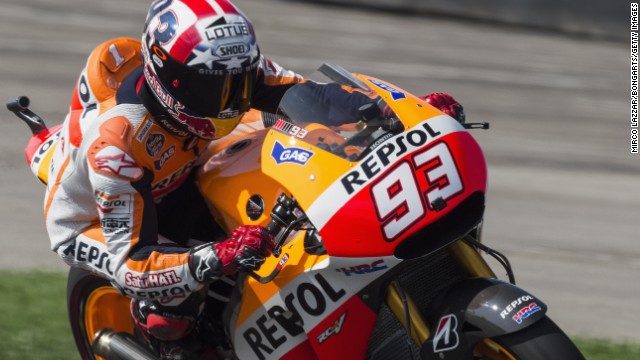
- Marc Marquez wins MotoGP round at Indianapolis
- 10th straight win for Spaniard since start of season
- Valentino Rossi takes final spot on podium
- Rossi passes 4,000 point mark in MotoGP
Follow us at @WorldSportCNN and like us on Facebook
(CNN) -- Marc Marquez continued his record breaking 2014 MotoGP season with a 10th straight win Sunday to match the feat of Australian Mick Doohan in 1997.
The reigning world champion has proved all-conquering on his Repsol Honda but was pushed all the way in Indianapolis by Yamaha pair Jorge Lorenzo and Valentino Rossi, who occupied the other podium positions.
Rossi briefly led before slipping back to the third place, but the points saw him become the first man to top 4,000 in MotoGP.
"It was a good start though as I was able to lead. I tried to push to the limit to stay with Marc but he got past. I would have hoped to have a bit of a better battle with Lorenzo. But I am satisfied." the Italian legend told the official MotoGP website.
Read: 'Perfect' race for Marquez in Germany
Marquez took the lead on lap 11 as he found his way past the Yamaha pair and eventually finished two seconds clear by the finish.
His teammate Dani Pedrosa finished fourth as he came through from eighth.
Pol Espargaro (Monster Yamaha Tech3) took a fine fifth with his British teammate Bradley Smith in sixth after a heavy crash in Saturday practice.
Smith's compatriot Cal Crutchlow (Ducati) was seventh with his teammate Andrea Dovizioso in eighth.
But it was Marquez again who took the plaudits to continue his remarkable run and he is already looking to the next round in Brno in the Czech Republic.
"The race was very hard, especially as the track temperature was very high. I struggled a little with the front tyre so I stayed behind Rossi to try to keep the front tire cool,"he said.
He added, "We will try to fight for the victory in Brno. The test we had went well but it was very slippery so we don't have too much data. I have never gone great there and Jorge and Vale are very strong there."
Khmer Rouge leaders face life in prison
8/10/2014 10:52:52 PM
- Two top leaders of Cambodia's 1975-79 Khmer Rouge regime found guilty of crimes against humanity
- Both men sentenced to life imprisonment
- Nuon Chea was the regime's "Brother No. 2" and Khieu Samphan its "No. 4"
- The men are the first Khmer Rouge leaders ever to face justice
(CNN) -- Two former top leaders in Cambodia's notorious Khmer Rouge, which ruled the Southeast Asian country between 1975 and 1979, were found guilty of crimes against humanity by a specially-convened Cambodian court Thursday.
Before the verdict, only one person had been brought to justice over one of the 20th century's great atrocities.
Nuon Chea, the former Deputy Secretary of the Communist Party of Kampuchea, and Khieu Samphan, the one-time President of Democratic Kampuchea both received life sentences.
Nuon Chea, 88, known as "Brother Number Two," and Khieu Samphan, 83, known as "Brother Number Four," were expressionless as the verdict was read.
They were found guilty of the following: Crimes against humanity, of extermination, murder, political persecution, and other inhumane acts comprising forced transfer, forced disappearances and attacks against human dignity committed within the territory of Cambodia between 17 April 1975 and December 1977.
"The chamber finds that as a consequence of the crimes of which the accused have been convicted, the civil parties and a very large number of additional victims have suffered immeasurable harm, including physical suffering, economic loss, loss of dignity, psychological trauma, and grief arising from the loss of family members and close relations," a judge said in the ruling.
The men were taken into custody after their arrest in 2007. The defendants can appeal the judgment, and Victor Koppe, part of Nuon Chea's defense team, indicated that they would be seeking to exercise that right. The defense team for Khieu Samphan also said they would appeal the verdict.
The charges were heard in Phnom Penh in the Extraordinary Chambers in the Courts of Cambodia (ECCC) -- a special United Nations-backed tribunal that was formed in 2006 to prosecute senior Khmer Rouge leaders and other regime figures responsible for especially heinous acts.
Amnesty International welcomed the result as an important step towards justice.
"This long-awaited ruling is an important step towards justice for the victims of the Khmer Rouge period and highlights the importance of addressing impunity," said the organization's Deputy Asia-Pacific Director Rupert Abbott.
"But the earlier refusal of senior Cambodian government officials to give evidence, as well as allegations of political interference in other ECCC cases, is troubling and raises concerns around the fairness of the proceedings and respect for victims' right to hear the full truth regarding the alleged crimes."
Amnesty also welcomed the court's decision to endorse 11 reparation projects for victims.
"However, much more must also be done by the government of Cambodia towards repairing the harm suffered by victims."
A timeline of the Khmer Rouge regime and its aftermath
A bloody regime
The two men were senior leaders in the Khmer Rouge regime, which ruled Cambodia between 1975 and 1979. During that time at least 1.7 million people -- about a quarter of the Cambodian population -- are believed to have died from forced labor, starvation and execution, as the movement ruthlessly executed its radical social engineering policies aimed at creating a purely agrarian society.
An ongoing struggle for justice after Khmer Rouge
The pair were tried in a "hybrid" tribunal -- officially "an ad hoc Cambodian court with international participation" -- uses both Cambodian and international judges and staff employed by the U.N. in order to ensure the trials are conducted to international standards and to mitigate against the weakness of the Cambodian legal system.
"This judgment represents an important milestone for Cambodians and victims around the world," a joint statement from the office of the co-prosecutors read. "For 35 years (the leaders of the regime) evaded justice for some of some of the most brutal and cruel crimes ever committed."
Around 3,500 victims participated in the trial, as witnesses giving evidence, observers and in seeking reparations.
"The trial has allowed Cambodia to reset its moral compass, which was destroyed by the accused 40 years ago," the statement said.
Until today's conclusion, the ECCC had delivered only one verdict in its eight years of existence.
In the ECCC's Case 001, Kaing Guek Eav, commonly known by his alias, Duch, was sentenced to life imprisonment following his 2010 convictions for war crimes, crimes against humanity, murder and torture. He was the commandant of the notorious Tuol Sleng S-21 prison in Phnom Penh, where more than 14,000 people died.
The verdicts on Thursday in the case known as 002/01 was the first time that senior leaders of the regime have faced justice.
Recognizing the limitations of the court, the ECCC's Legal Communications Officer Lars Olsen told CNN: "We can't prosecute everyone who committed a crime 35 years ago. That's the nature of international justice."
Disappointment
Some victims of the crimes of the regime were not satisfied by the verdict. Theary Seng, founding president of the Center for Cambodian Civic Education, told CNN that the scope of the Court, and the trial, by focusing on the forced movements, and the murder of 250 Lon Nol (the previous Prime Minister) officials and troops at Tuol Po Chrey shortly after the regime was installed was insufficient.
"Cambodia hasn't got to the heart of the genocide.
"It's a missed opportunity... it completely missed the mark. What have we seen from $200 million and eight years (of the existence of the ECCC)? (It is) really a disservice to the other Cambodian victims."
She did allow that the trial was the "beginning of a process of healing" and that it would "serve as a catalyst for conversations in Cambodia about our past."
Seng was just seven years old in 1978 when both her parents were killed after several months in prison. It was at a time when the leadership was, she said, in "extreme paranoia" and even party cadres were being purged. Her mother was taken from the cell she shared with her children and other families, and "tiptoed to her death" to avoid waking up Seng and her younger brother.
"The tragedy of my story is that it's so common," she said. "It stays with us -- how can it not?"
READ MORE: See places where Cambodia's shocking past is on show
Spaceship designed for new frontiers
8/10/2014 10:54:54 PM
- Reusable spacecraft passes tests, approaches flight readiness
- Skylon promises cheap, frequent travel into orbit and deep space
- Could also allow exoplanet exploration and colony construction
(CNN) -- More than half a century after Sputnik, space travel remains shockingly wasteful. Every rocket we launch at the cost of hundreds of millions of dollars can only be used once and completes its mission by falling to Earth in pieces. This disposable design has scarcely advanced since the 1960s.
British engineer Alan Bond has been developing a new concept for over 30 years, and is now on the verge of achieving it. His Skylon "spaceplane" design is intended to withstand multiple uses and requires minimal repairs and turnaround time, so it can function as a rapid response unit for space missions, and go far beyond the existing horizons.
"The intention is to replace existing rockets," Bond says. "The technology we are working on would enable more frequent and reliable missions by large factors."
Alan Bond, Managing Director and Chief Engineer at Reaction Engines Ltd.
Central to the design is a HOTOL (Horizontal Take Off and Landing) system similar to a regular plane -- albeit from a much longer runway -- so that the craft returns intact. Beyond this, Bond's team at Reaction Engines Ltd. has invented multiple new technologies, most crucially an ingenious concept engine, the SABRE (Synergistic Air-Breathing Rocket Engine).
While existing rockets carry several heavy fuel tanks that are worked through and jettisoned over the course of the journey, SABRE powers the craft from a single chamber carrying liquid oxygen and liquid hydrogen. It minimizes the load by taking in oxygen from the atmosphere during the ascent, which is cooled and and combined with hydrogen to make fuel. Once the craft reaches an altitude of 28 kilometers the engine converts to using the stored liquid oxygen.
Read: Have a taste of the world's first stem cell burger
"We have passed the major obstacles, and what we have now are normal engineering problems," says Bond. "It's about designing and testing, but there's no question that with the physics efficiencies the engine depends on -- we're there."
The European Space Agency (ESA) agrees, having approved the mechanisms of the engine in a series of tests. "The idea has been around since the 1950s but this is the first time anyone has managed to achieve a working system," said ESA head of propulsion Mark Ford.
Progress has been steady, with day-to-day work on readying SABRE for test flights that Bond says could take place as early as 2018.
The ESA has also praised the economic model, claiming the Skylon could meet its launch cost target of €70 million ($94 million), in addition to the efficiency savings of being able to repeatedly reuse the same craft.
Bond sees Skylon's primary initial use being in cargo -- "essentially a truck to haul kit cheaply into space on a very regular basis." This would dramatically reduce the logistical headaches involved in routine tasks such as repairs to the International Space Station, or transporting satellites.
But once the concept is proven as easier and more efficient, it can be applied to far more ambitious targets. Bond sees human colonization of other planets as inevitable and necessary, and feels his system can be applied to deep space exploration and the study of exoplanets, as well as enabling rapid construction on them that would precede habitation.
Read: Wireless electricity? It's here
Experts believe a paradigm shift is necessary to revitalize the field of space exploration.
"There would need to be an increased rate of flights to lower the cost of an initially more expensive launch system," says David Baker of the British Interplanetary Society. "But if there were 100 a year the cost would fall through the floor ... It's the very thing that's needed not only to service the existing industry but also to open broader applications."
The market exists to support such a rate of flights, says Baker, detailing a huge backlog of potential clients from universities to enthusiasts ready with experimental missions and payloads should cost and logistics become more manageable. Even intercontinental flights could make use of hypersonic-enabled engines.
Baker also points to Elon Musk's reusable "Falcon spacecraft" to show the growing feasibility and popularity of multi-use designs. The concept must reach popular acceptance, but could be "absorbed into the commercial world in the next decade or two," he says.
The Skylon could be in operation far sooner than that, with tentative plans to reach the International Space Station by 2022. Beyond this, the horizon goals of exploring the universe from mining resources to finding life to the colonization of planets will follow.
Read more from Make, Create, Innovate:
This 'Star Trek'-style molecular sensor reads your food
Spider lessons: How to mend your body with silk
The artificial leaf that could power the world
Khmer Rouge leaders face life in jail
8/11/2014 3:02:08 AM
- Two top leaders of Cambodia's 1975-79 Khmer Rouge regime found guilty of crimes against humanity
- Both men sentenced to life imprisonment
- Nuon Chea was the regime's "Brother No. 2" and Khieu Samphan its "No. 4"
- The men are the first Khmer Rouge leaders ever to face justice
(CNN) -- Two former top leaders in Cambodia's notorious Khmer Rouge, which ruled the Southeast Asian country between 1975 and 1979, were found guilty of crimes against humanity by a specially-convened Cambodian court Thursday.
Before the verdict, only one person had been brought to justice over one of the 20th century's great atrocities.
Nuon Chea, the former Deputy Secretary of the Communist Party of Kampuchea, and Khieu Samphan, the one-time President of Democratic Kampuchea both received life sentences.
Nuon Chea, 88, known as "Brother Number Two," and Khieu Samphan, 83, known as "Brother Number Four," were expressionless as the verdict was read.
They were found guilty of the following: Crimes against humanity, of extermination, murder, political persecution, and other inhumane acts comprising forced transfer, forced disappearances and attacks against human dignity committed within the territory of Cambodia between 17 April 1975 and December 1977.
"The chamber finds that as a consequence of the crimes of which the accused have been convicted, the civil parties and a very large number of additional victims have suffered immeasurable harm, including physical suffering, economic loss, loss of dignity, psychological trauma, and grief arising from the loss of family members and close relations," a judge said in the ruling.
The men were taken into custody after their arrest in 2007. The defendants can appeal the judgment, and Victor Koppe, part of Nuon Chea's defense team, indicated that they would be seeking to exercise that right. The defense team for Khieu Samphan also said they would appeal the verdict.
The charges were heard in Phnom Penh in the Extraordinary Chambers in the Courts of Cambodia (ECCC) -- a special United Nations-backed tribunal that was formed in 2006 to prosecute senior Khmer Rouge leaders and other regime figures responsible for especially heinous acts.
Amnesty International welcomed the result as an important step towards justice.
"This long-awaited ruling is an important step towards justice for the victims of the Khmer Rouge period and highlights the importance of addressing impunity," said the organization's Deputy Asia-Pacific Director Rupert Abbott.
"But the earlier refusal of senior Cambodian government officials to give evidence, as well as allegations of political interference in other ECCC cases, is troubling and raises concerns around the fairness of the proceedings and respect for victims' right to hear the full truth regarding the alleged crimes."
Amnesty also welcomed the court's decision to endorse 11 reparation projects for victims.
"However, much more must also be done by the government of Cambodia towards repairing the harm suffered by victims."
A timeline of the Khmer Rouge regime and its aftermath
A bloody regime
The two men were senior leaders in the Khmer Rouge regime, which ruled Cambodia between 1975 and 1979. During that time at least 1.7 million people -- about a quarter of the Cambodian population -- are believed to have died from forced labor, starvation and execution, as the movement ruthlessly executed its radical social engineering policies aimed at creating a purely agrarian society.
An ongoing struggle for justice after Khmer Rouge
The pair were tried in a "hybrid" tribunal -- officially "an ad hoc Cambodian court with international participation" -- uses both Cambodian and international judges and staff employed by the U.N. in order to ensure the trials are conducted to international standards and to mitigate against the weakness of the Cambodian legal system.
"This judgment represents an important milestone for Cambodians and victims around the world," a joint statement from the office of the co-prosecutors read. "For 35 years (the leaders of the regime) evaded justice for some of some of the most brutal and cruel crimes ever committed."
Around 3,500 victims participated in the trial, as witnesses giving evidence, observers and in seeking reparations.
"The trial has allowed Cambodia to reset its moral compass, which was destroyed by the accused 40 years ago," the statement said.
Until today's conclusion, the ECCC had delivered only one verdict in its eight years of existence.
In the ECCC's Case 001, Kaing Guek Eav, commonly known by his alias, Duch, was sentenced to life imprisonment following his 2010 convictions for war crimes, crimes against humanity, murder and torture. He was the commandant of the notorious Tuol Sleng S-21 prison in Phnom Penh, where more than 14,000 people died.
The verdicts on Thursday in the case known as 002/01 was the first time that senior leaders of the regime have faced justice.
Recognizing the limitations of the court, the ECCC's Legal Communications Officer Lars Olsen told CNN: "We can't prosecute everyone who committed a crime 35 years ago. That's the nature of international justice."
Disappointment
Some victims of the crimes of the regime were not satisfied by the verdict. Theary Seng, founding president of the Center for Cambodian Civic Education, told CNN that the scope of the Court, and the trial, by focusing on the forced movements, and the murder of 250 Lon Nol (the previous Prime Minister) officials and troops at Tuol Po Chrey shortly after the regime was installed was insufficient.
"Cambodia hasn't got to the heart of the genocide.
"It's a missed opportunity... it completely missed the mark. What have we seen from $200 million and eight years (of the existence of the ECCC)? (It is) really a disservice to the other Cambodian victims."
She did allow that the trial was the "beginning of a process of healing" and that it would "serve as a catalyst for conversations in Cambodia about our past."
Seng was just seven years old in 1978 when both her parents were killed after several months in prison. It was at a time when the leadership was, she said, in "extreme paranoia" and even party cadres were being purged. Her mother was taken from the cell she shared with her children and other families, and "tiptoed to her death" to avoid waking up Seng and her younger brother.
"The tragedy of my story is that it's so common," she said. "It stays with us -- how can it not?"
READ MORE: See places where Cambodia's shocking past is on show
Israel: Its own worst enemy?
8/11/2014 3:52:38 AM
- Levy: Unprecedented cracks in Israel's democracy have been revealed after month of Gaza conflict
- Levy: Biggest problem is Israeli mainstream's failure to tolerate dissenting voices
- Levy: Many Israelis no longer perceive Palestinians as equal human beings
- Levy: Dehumanization allows Israel to strengthen its occupation and deny Palestinians rights
Editor's note: Gideon Levy is a columnist for the Israeli daily Haaretz, which appears both in Hebrew and in English. He has covered the Israeli occupation of the West Bank and Gaza for the last 25 years. His most recent book, "The Punishment of Gaza," was published in 2010 by Verso. The opinions expressed in this commentary are solely his.
(CNN) -- The streets of Ashkelon were half empty when I arrived on a Monday afternoon. The latest war was under way, and Haaretz had just published a critical article I'd written about Israel's air force pilots and the grave consequences of their bombardment of Gaza.
I came to this southern Israeli town, not far from Gaza, to chronicle the fear spreading throughout Israeli communities near the border. As a columnist for the country's leading liberal newspaper, I am quite used to people being hostile towards my views, but this was something new.
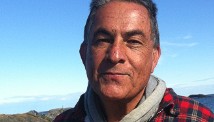
As I arrived in the town center for a live interview with Channel 2, a crowd of people immediately swarmed around me, cursing me with an aggression that I've never seen before. The bullies encircled me, jumping in front of the camera in an attempt to prevent the interview from going on. The show's host cut the broadcast off. The mob hurled insults at me, calling me "garbage" and a "traitor" and accused me of claiming that Israeli pilots were murderers -- something I never said.
As the crowd's anger grew, I rushed to my car and drove out of the town center, the men's screams trailing off as I steered my way out of Ashkelon. But it wasn't just the street mobs. Leading figures in Israel have publically called me a traitor. Yariv Levin, a senior member of Prime Minister Benjamin Netanyahu's party, called on TV for me to be charged with treason during war time. Haaretz has hired a bodyguard to ensure my safety, and my life has been turned upside down by the incident.
They haven't succeeded in silencing me. I will continue to write about the brutality of this war, about the atrocities, the mass killing of civilians and the horrifying destruction in Gaza.
Gideon Levy
But I am not the story. The real tale to be told is of the unprecedented cracks in Israeli democracy that have been revealed in just one month of conflict. Years of nationalistic incitement by the Israeli government, of expressions of racism, of anti-democratic legislation, of price-tag actions against Palestinians in the West Bank, without anyone being brought to justice -- all of that intolerance has suddenly exploded in our faces.
Anti-war protesters have been assaulted in the streets by right-wing hooligans. People were reportedly fired from their jobs because of critical remarks they made on their private Facebook accounts. And social media was flooded with racist, nationalistic and exceptionally brutal and callous content, which was then spread to tens of thousands of Israelis.
Several weeks ago a university professor in Ramat Gan emailed his students to say he hoped that their families, whoever they might be, would be safe during these dark times. This simple act of kindness was enough for the dean of the faculty to try to have the professor apologize to his students, some of whom claimed to have been offended by his words. Failing to make a distinction between the value of Israeli and Palestinian blood is apparently enough to contravene the values of Israeli academia and cause a public scandal in Israel in 2014.
B'Tselem, an Israeli human rights organization, was concerned that Israeli media never mentioned the names of the Palestinian victims of Israel's offensive. So they produced a paid advertisement listing the names and ages of some of the children who had been killed in Gaza. But the Israeli broadcasting authority refused to air it, on the grounds that it was "politically controversial".
The list of examples could go on and on.
But the biggest problem is not the marginal extremist who cheers for the killing of Palestinian children in Gaza, or applauds every Israeli bomb that falls on a private residence. The biggest problem is the Israeli mainstream, which spoke with one voice during this war, and which had zero tolerance for any kind of dissent, or even the simplest human compassion with Palestinian sacrifice, suffering and bloodshed.
It is all about dehumanization. As long as Israelis don't perceive Palestinians as equal human beings, there will never be a real solution. Unfortunately, dehumanizing the Palestinians has become the best tool to strengthen the occupation, to ignore and deny its crimes and enable the Israelis to live in peace, without any moral dilemmas. If the Palestinians are not human beings, there is no question about human rights. This process climaxed in this war and this is the real basis for the moral blindness which has covered Israel.
One of Israel's greatest assets -- as well as the source of its greatest pride -- has been our liberal, democratic and free society. But what we're doing to ourselves now is a greater threat to our existence than Hamas' rockets could ever be. Israel likes to describe itself as "the only democracy in the Middle East," but it's really only a democracy for its Jewish citizens who are quick to fall in line with the mainstream every time Israeli tanks roll across the border.
It may not have always been this way, but I fear that this new phenomenon is here to stay. There is no one to stop it. The Israeli media, commercial and free, is collaborating with it; the legal and legislative systems are stepping back, and so is the political system. We will carry the scars of this summer with us from now on. The people who were too afraid to speak out against Israeli aggression this time around won't be any more likely to stand up next time. Can you think of any worse news out of Israel?
The opinions expressed in this commentary by Gideon Levy are solely his.
Mideast spiraling into war, terror
8/11/2014 3:52:48 AM
- The Iraqi government and security forces are battling ISIS
- A three-year civil war is raging in Syria
- "No one is winning; no one can win," says U.N. secretary-general
- Official warns Libya is at risk of becoming a failed state
(CNN) -- It's a region of crises next door.
A brutal civil war in Syria has spawned an equally, if not more, ruthless crusade in Iraq. Libya is at risk of becoming a failed state. And even Israel -- a relative oasis of calm -- is in the midst of a campaign in Gaza, where people are being killed nearly every day.
What's going on?
A casual observer could be forgiven for being lost. The region, rich in history, is as complex as it can be confusing.
With so many conflicts, on so many fronts, here's a quick look at what's happening:
Iraq
Who's fighting?
The Iraqi government and security forces are battling ISIS, which calls itself the Islamic State. Since spilling into Iraq from Syria, the group has captured city after city, including the country's second-largest city, Mosul.
The United States is supporting the Iraqi military in its effort, by bombing ISIS positions and making humanitarian airdrops.
Why?
ISIS is clear about what it wants: To create a caliphate, or Islamic state, spanning Iraq and Syria.
Its Sunni Muslim fighters have been targeting Iraq's Christians and other minority groups, as well as Shiite Muslims.
"Those people are not people; they are monsters," said a student, 22, who spoke to CNN in the Iraqi city of Irbil, after fleeing his home. "Not monsters; monsters are better."
What's the latest?
The situation on the ground is in constant flux. U.S. airstrikes are ongoing.
More than two years after President Barack Obama brought home forces from the country, officials have ruled out getting involved in a combat role.
But, "when we have the unique capabilities to help avert a massacre, then I believe the United States of America cannot turn a blind eye," the President said.
Will anyone stop ISIS?
Syria
Who's fighting?
What started as a popular protest against Syrian President Bashar al-Assad has swelled into a civil war of more than three years and counting.
The armed opposition is made up of various groups, including the Free Syrian Army. The government says it is fighting terrorists.
Why?
Rebels want an end to the rule of al-Assad, whose government is determined to keep power.
The United Nations says more than 150,000 people have been killed in the past three years.
"No one is winning; no one can win," U.N. Secretary-General Ban Ki-moon said. "Even if one side were to prevail in the short term, the devastating toll will have sown the seeds of future conflict."
What's the latest?
ISIS, also known as the Islamic State of Iraq and Syria or the Islamic State of Iraq and the Levant, is using the opportunity of war to carve a swath of territory deep inside Syria. It has consolidated control over several towns along the Euphrates River in the east.
"ISIL is no longer simply a terrorist organization. It is now a full-blown army," said Brett McGurk, with the U.S. State Department.
Terror havens in Syria and Iraq: Five reasons the West should worry
Israel and Gaza
Who's fighting?
Israel is faced off against the Palestinian side, which includes Hamas, Islamic Jihad and the Palestine Liberation Organization.
Counties in the region, and outside, also have a stake in the outcome. Egypt is attempting to help broker a peace, with the United States playing a supporting role in talks.
"It's a proxy war for control or dominance in the Middle East," said CNN's Fareed Zakaria.
Why?
Israel is calling for Hamas, the militant Islamic group that runs Gaza, to disarm.
Hamas, meanwhile, wants an end to the Israeli blockade of Gaza, a measure Israel says is necessary to stop weapons being smuggled in.
It's a decades-old conflict, with potentially new complications.
Gaza: Why it's different this time
What's the latest?
A brief period of calm was shattered Friday.
The Israeli military said it carried out strikes on militant targets in Gaza in response to a barrage of rocket fire after a three-day truce came to an end without a longer-term agreement.
Renewed hostilities mean more misery for the people of Gaza.
Close to 1,900 people have been killed there so far, including hundreds of children, according to Palestinian health authorities.
The United Nations estimates at least 70% of the dead were civilians.
Israeli officials have said 64 Israeli soldiers and three civilians in Israel died. Israel's Iron Dome missile defense system intercepts many of the rockets fired at populated areas of the country.
What is Hamas' endgame in Gaza?
What is Israel's endgame in Gaza?
Libya
Who's fighting?
Nearly three years after Libyan rebels overthrew a longtime dictator, the country is no closer to a lasting peace. In fact, the fighting is the worst it has been since the revolution.
The civil war that culminated in Moammar Gadhafi's 2011 death has given way to warring militias, which outnumber and outgun the country's security forces.
Why?
The overthrow of Gadhafi created a power vacuum.
Many inside Libya are desperate to get out while others are moving in to take advantage of the increased instability.
"These people do not recognize borders. For them, if there's an opportunity for them to act, they act," Libyan Foreign Minister Mohamed Abdelaziz said about extremists. "And we should not give the opportunity to them."
What's the latest?
Witnesses reported heavy shelling and fighting last month around the international airport in Tripoli, which has been under attack by an alliance of powerful militias from the city of Misrata and Islamist groups.
The fighters are trying to take the airport from militias from the city of Zintan, which have controlled it since the 2011 revolution.
With Tripoli under siege, Libya's newly elected parliament met in far-away Tobruk. It called for an immediate cease-fire under U.N. supervision.
"I must really underline the fact that all the factors at the moment are leading in the direction of a failed state," Abdelaziz said.
July: U.S. Embassy in Libya evacuates personnel
CNN's Holly Yan, Josh Levs, Jethro Mullen, Tom Cohen, Frederik Pleitgen, and Hala Gorani, contributed to this report.
Studio Ghibli faces uncertain future
8/10/2014 10:52:02 PM

- Studio Ghibli co-founder: Firm needs to "think about its future"
- Retirement of legendary director Hayao Miyazaki leaves future in doubt
- Expert: Ghibli must figure out how to carry on with younger talent
(CNN) -- Watch a movie from acclaimed Japanese animators Studio Ghibli, and you might see a boy turn into a flying dragon, a deer morph into a monstrous god, or a fish transform into a young girl.
But with the retirement last year of Hayao Miyazaki, the studio's legendary co-founder, signs suggest the venerable and inimitable company is headed for a transformation of its own.
In a Japanese TV interview last Friday, Ghibli co-founder Toshio Suzuki said the firm needed to "think about its future," and would be "changing the way we make (animation)."
He also speculated that Miyazaki might "make something again," though it might be a no more than a short film for the Studio Ghibli museum.
Helen McCarthy, anime expert
Suzuki's comments followed his own remarks from early last week, when he said Studio Ghibli would take a "brief break," leading to panicked online speculation that the studio was about to close.
A Ghibli representative told CNN the speculation was untrue, saying "Studio Ghibli has decided nothing officially for the future of the studio."
Yet after concluding nearly three decades with Miyazaki at the helm, the fate of the company suddenly looks uncertain.
The secret to Ghibli's longevity
The studio has been producing hand-drawn animated films for decades, sticking to old-school, painstaking frame-by-frame methods even as other studios have long embraced computer-aided animation and CGI.
Every one of Studio Ghibli's hits -- from "My Neighbor Totoro" (1988) to "The Wind Rises" (2013) features a signature artistic style -- delicately rendered characters, exquisitely crafted environments, and an effortless sensation of movement.
Anime expert Helen McCarthy says Ghibli has been able to perfect its hand-drawn tradition because it has employed the same animators for a very long time -- unlike many other studios, which rely on per-project contracts and short-term piecework.

"This means Ghibli can be sure of a consistent quality of artistry and craftsmanship," she said.
But as Ghibli's staff ages, the firm must figure out how to carry on with younger talent.
McCarthy says the Japanese studio has focused for decades on "the personal visions of two remarkable directors," Hayao Miyazaki and Isao Takahata -- both now in their 70s.
"(Studio Ghibli) is like a great violin, a Stradivarius maybe, in the hands of two great musicians. But when those musicians retire it has to be passed on to new players or else falls silent, because its structure is expensive to maintain."
What's next?
The big question: Can anybody succeed Hayao Miyazaki?

"Studio Ghibli has young creators, Goro Miyazaki and Hiromasa Yonebayashi," Studio Ghibli's representative told CNN. "They are continuing to work for the studio."
But the films of Goro Miyazaki, -- Hayao Miyazaki's 47-year-old son -- and Yonebayashi, 41, have yet to achieve anywhere the success of the elder Miyazaki's work.
Hayao Miyazaki's 2001 epic, "Spirited Away," grossed a record-breaking $274 million worldwide and took home the Academy Award for Best Animated Feature. In 2013, Miyazaki's swansong "The Wind Rises," made over $117 million.
By contrast, the studio's newest film, "When Marnie Was There," directed by Yonebayashi, is only expected to make $36 million. Goro Miyazaki's 2013 "From Up on Poppy Hill" made about $61 million.
That's why the studio must now perform a sober self re-evaluation after enjoying years of steady success.

"We wanted to make a dream company," said Suzuki. "We were able to realize (that dream) to some extent and we're very happy about that. But now we're at a point where we've got to think about what we'll do next."
Should fans be worried? McCarthy says Ghibli's tradition of hand-drawn animation should survive, as long as audiences "accept the high costs and the demands it places on the workers involved."
"Art is viable as long as people are willing to make it and buy it."
CNN's Junko Ogura contributed to this report.
Chinese cops dazzle traffic offenders
8/10/2014 10:51:29 PM

- Blindingly simple idea sees Chinese police using headlights to punish traffic offenders
- Use of high-beam lights punished in Shenzhen with eye-for-an-eye punishment
- China's netizens split on the subject with some complaining of police overreaching their authority
Hong Kong (CNN) -- How's this for a bright idea? Police in the southern Chinese city of Shenzhen are responding to headlight infractions with an eye-for-an-eye punishment.
If you're caught using your brights in the city, which shares a border with Hong Kong, police will sit you down in the full glare, not of an interrogation room lamp, but of their own full-beams.
A post on the Shenzhen traffic police's Weibo account spells it out.
"Do you dare to use full-beam headlights anymore?" the post asks. "From now on, 'uncle cop' will have you stare at the lights for five minutes if they catch you abusing them."
Weibo user @shenzhenlaocui
The stern warning is offset by an animated laughing emoticon. There is also the addition of a more traditional fine of 300 yuan ($49).
Mixed response
Responses on Chinese social media ranged from the amused and the approving, to those doubting the safety -- and legality -- of the biblical-style punishment.
User @chas125 said: "I wholeheartedly support this. Shanghai traffic police should adopt the measure, too," while another user, whose weibo handle suggests a connecttion with the city, was even more enthusiastic.
"I'm hitting 'likes' with my hands and feet," @shenzhenlaocui posted. "Full-beam headlights are evil. I suggest they extend the stare time to 30 minutes, splitting it into three time periods, and let people take a 60-second break in between."
@Zhengxunlaoshi, however, was a little more phlegmatic. "People hate others who use full-beam headlights too much. I experience that unpleasantness as you do, and it is not safe," the user said.
"But the police 'educate' the violators beyond laws -- remember laws don't authorize them to do so -- illegally enforcing the law is more dangerous than using full-beam headlights."
Indiscriminately using brights can be hazardous and can dazzle oncoming traffic. Given the rapid increase of cars and motor scooters on China's roads as the country's economy expands almost unabated, road awareness is an increasing concern.
CNN's Shen Lu in Beijing contributed to this report
Toddler breaches White House security
8/10/2014 10:50:42 PM
- A toddler slips through the fence at the White House
- The security breach delays Obama's address on Iraq
- The pint-sized intruder is back with his parents
(CNN) -- President Barack Obama was about to address the nation on Iraq Thursday night when the briefing was delayed because of a security breach on the North Lawn of the White House.
But this wasn't your normal breach, this was one of a pint-sized variety.
A toddler forced the President, the press corps and the nation to wait.
The little boy managed to squeeze himself between the bars of the White House fence, just before the briefing was expected to start. It forced a temporary lockdown.
It didn't take long to resolve the matter and he's now back with his parents.
"We were going to wait until he learned to talk to question him, but in lieu of that he got a timeout and was sent on way with parents," according to Edwin Donovan, spokesman for the United States Secret Service.
The boy's parents now have a story to tell their son -- the night he made the nation wait for the president.
U.S.: Russia not to intervene in Ukraine
8/9/2014 7:50:56 PM
- Kerry and Lavrov discuss measures to "prevent an impeding humanitarian catastrophe"
- Pro-Russian separatists to consider humanitarian cease-fire
- The ongoing fighting has killed close to 1,400 people -- civilians and combatants
(CNN) -- U.S. Secretary of State John Kerry warned his Russian counterpart, Sergey Lavrov, on Saturday that "Russia should not intervene in Ukraine under the guise of humanitarian convoys or any other pretext of 'peacekeeping,'" according to a senior State Department official.
Kerry urged "all parties to work through international organizations" to provide humanitarian assistance in eastern Ukraine, the official said.
In a separate call Saturday, U.S. Vice President Joe Biden and Ukrainian President Petro Poroshenko agreed that any Russian action in Ukraine, even for purported "humanitarian" purposes, without the formal, express consent and authorization of the Ukraine government would be "unacceptable and a violation of international law," according to the White House.
Russia has denied allegations that it is supporting separatists in Ukraine and maintains it wants to see a diplomatic solution to the ongoing crisis there. But U.S. and Ukrainian officials have accused Russia of saying one thing while doing another: increasing troop levels along the border and continuing to send support to pro-Russian separatists.
Pro-Russian separatists say 'fight to the death'
Despite claims by Ukrainian officials, the pro-Russian separtists hold firm that Ukrainian forces "have never been able to take over the Donetsk districts" -- the hotbed of violence in eastern Ukraine.
The self-proclaimed leader of the Donetsk people's republic said on Saturday that pro-Russian separatists would consider a humanitarian cease-fire to bring aid to civilians but they are not ready to surrender their territory and would "fight to the death."
"We are ready for ceasefire to avoid escalation of the humanitarian disaster in Donbass," Alexander Zakharchenko, prime minister of the self-styled Donetsk People's Republic in a statement, said, referring to the populous region that includes Donetsk.
Earlie this month, The United States and European Union increased economic sanctions on Moscow for supporting pro-Russian separatists fighting Ukraine government forces in the eastern regions of Donetsk and Luhansk, along the border with Russia.
Ukraine: Rebel leader resigns; militants shoot down fighter plane
What is Putin's endgame in Ukraine?
Who are Ukraine's pro-Russia rebels?
48 die in plane crash in Tehran
8/10/2014 5:32:40 AM
- Black boxes found as Iran media outlets differ on death toll
- The plane crashed shortly after leaving the runway
- The crash also injured people on the ground, including employees at a glass factory
- Some of those hurt suffered severe burns
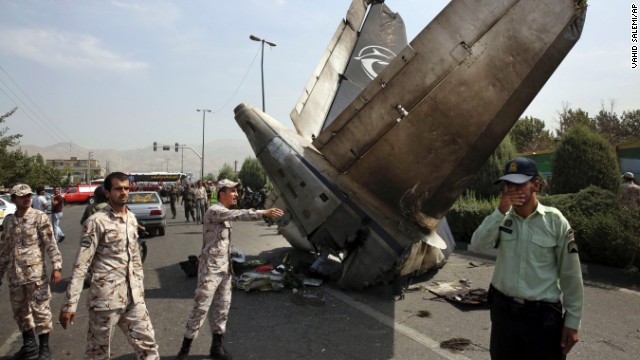
Tehran (CNN) -- A passenger plane crashed in Tehran on Sunday, killing at least 39 people on board, official news agencies in Iran reported.
The Antonov-140 propeller plane went down shortly after leaving the runway at Mehrabad International Airport after an engine failed, the FARS semiofficial news agency reported.
Sepahan Airlines Flight 5915 was carrying 40 passengers and a crew of eight when it went down, according to official news reports.
Though the Islamic Republic News Agency and Tehran Times initially said that all crew and passengers were killed, Press TV reported 37 people died in the crash, two more died at a Tehran hospital and nine others were in critical condition with serious burns.
IRNA later said that 40 people had been killed.
"Both black boxes of Iran-140 airplane of Hesa Co. (Iran Aircraft Manufacturing Industrial Company) were found in search operations," Ahmad Majidi, Iran's deputy minister of roads and urban development, told the Iranian Students' News Agency, according to Press TV.
The crash also injured people on the ground, including employees at a glass factory, FARS said.
Some of the injured suffered severe burns, Tasnimnews reported.
A witness told FARS that the tail of the plane fell from the sky first, and the front of the plane crashed farther away.
Rescue workers were still working Sunday afternoon to remove bodies from the wreckage, Tasnimnews said.
CNN's Eliott C. McLaughlin and Sara Mazloumsaki contributed to this report.
Tour bus accident in Tibet kills 44
8/9/2014 10:46:07 PM
- Bus was involved in three-vehicle pileup, Chinese authorities say
- Crash site was along the National Highway in Tibet
(CNN) -- A tour bus accident in southwest Tibet left at least 44 people dead, China's state-run news agency Xinhua reported via Twitter Saturday. Xinhua cited a spokesman with the regional government.
The bus was involved in a three-vehicle pileup along the National Highway in Nyemo County in Tibet, according to Xinhua. It crashed against a sports utility vehicle and a pickup truck, and then plunged into the valley. Photos showed the wrecked bus resting upside down by a riverbank.
Photos also showed emergency personnel and rescue workers carrying passengers from the scene in stretchers. Dozens of pieces of luggage were piled to the side of the retaining wall.
You are receiving this email because you subscribed to this feed at feedmyinbox.com
If you no longer wish to receive these emails, you can unsubscribe from this feed, or manage all your subscriptions

No comments:
Post a Comment