 | GoTo Webinar is a new, affordable, do-it-yourself Web event service that doesn't require a consultant. Get $10 off after your complimentary trial. From our sponsors |
| CNN.com - Top Stories |
| CNN.com delivers up-to-the-minute news and information on the latest top stories, weather, entertainment, politics and more. |
Dozens killed in Iraq suicide attack
7/24/2014 3:00:46 PM
CNN's Michael Holmes reports on another deadly suicide attack and a potential political breakthrough in Iraq.
If your browser has Adobe Flash Player installed, click above to play. Otherwise, click below.
Pope meets apostasy woman
7/24/2014 9:12:13 AM
- Mariam Yehya Ibrahim and her family meet Pope Francis, thank him for his prayers
- Francis thanks Ibrahim and her family for their "courageous constant witness to faith"
- Ibrahim and her family will be in Italy for a short time before traveling on to the United States
- "Today is a day for celebration," says Italian Prime Minister Matteo Renzi
Rome (CNN) -- Mariam Yehya Ibrahim, the Sudanese Christian woman sentenced to death in Sudan because of her faith, arrived in Rome on Thursday, the Italian Foreign Ministry said.
Ibrahim "will remain in Italy for a short time and then will travel on to the United States," the ministry said.
Sudanese authorities had said Ibrahim was guilty of rejecting Islam in favor of Christianity, but her conviction for "apostasy" and adultery was overturned last month on appeal, following weeks of international controversy.
After her release, she and her husband, American Daniel Wani, were detained for two days, accused of falsifying travel documents after going to the airport in Sudan's capital, Khartoum. They were trying to fly to the United States with their baby daughter, who was born while Ibrahim was in prison, and toddler son.
Now their dream of starting a new life in the United States appears to be on the verge of becoming reality.
Not only that, but Ibrahim and her family met with Pope Francis at his private residence in Domus Santa Marta in Vatican City.
During the meeting Thursday, which lasted about half an hour, Ibrahim thanked the Pope for his and the Roman Catholic Church's support and prayers, the Vatican said.
He, in turn, thanked Ibrahim and her family for their "courageous witness and constancy of faith."
Francis also played with the children, 18-month-old Martin and 2-month-old Maya, and greeted the Italian diplomats involved in her journey to Italy.
With this gesture, the Vatican said, the Pope "desired to show his closeness, attention and prayer also to all those who suffer for their faith, in particular to Christians who are enduring persecution or limitations imposed upon their religious freedom."
Ibrahim has said that her mother, an Ethiopian Orthodox Christian, raised her as a Christian.
She remained steadfast in her faith despite the threat of a death sentence, saying at her sentencing hearing in May: "I am a Christian, and I will remain a Christian."
'Day for celebration'
Ibrahim and her family were earlier greeted at the airport in Rome by Italian Prime Minister Matteo Renzi.
In a brief statement to reporters at the airport, Renzi said, "Today we are very happy. ... Today is a day for celebration."
Speaking alongside him, Deputy Minister of Foreign Affairs Lapo Pistelli said Ibrahim and her children were well and in "excellent condition."
He said Pope Francis had been informed Wednesday by the Prime Minister that the family was coming to Italy, and that the government had worked to bring about a meeting between them.
"Mariam and her two children will have important meetings in the following days and then they will travel to the United States."
How Italy helped
Pistelli said Italy had become involved in the case because, as a Catholic country, it was very moved by Ibrahim's story and wanted to help.
Italy has good relations with Khartoum and offered to help the U.S. Embassy there to speed up the process of getting U.S. passports for Ibrahim and her family to leave the country, the minister said.
Pistelli said he had traveled to Sudan two weeks ago to start the process but it was not finalized until Wednesday night.
He posted an image to his Facebook page of himself with Ibrahim and the two children, apparently taken on board the plane shortly before their arrival in Rome. "Mission accomplished," he wrote.
Ibrahim, her husband and their two children are now in a protected government house, he said. It is unclear how long Ibrahim will stay in Rome before flying on to the United States, he said, adding that it had to do with passport procedures.
CNN has not yet been able to reach the U.S. Embassy or the Sudanese Foreign Ministry for comment.
Persecution claim
Ibrahim's ordeal began when one of her relatives, a Muslim, filed a criminal complaint saying her family was shocked to find out she had married Wani, a Christian, after she was missing for several years.
A Sudanese court considered Ibrahim a Muslim because her father was Muslim. She was charged with adultery, because a Muslim woman's marriage to a Christian man is illegal in Sudan. She was also charged with apostasy, accused of illegally renouncing what was alleged to be her original faith.
She insists she has never been a Muslim -- and says she was persecuted as a Christian while in prison.
Convicted when she was about eight months pregnant, she gave birth two weeks later while shackled.
On Monday, a Sudanese Islamic jihadi group which has previously claimed an attack on a Sudanese journalist released a statement threatening Ibrahim.
The group vowed to carry out what it said was the justified death sentence against Ibrahim that was repealed by a higher court.
Amid this threatening environment, Daniel Wani told CNN that his family had reported seeing unknown people outside their old residence in Khartoum. Their numbers had been increasing over the past few days, he said.
READ: Sudanese Christian woman: 'There's a new problem every day'
READ: Exclusive: Sudan apostasy woman's 'brother' says she should repent or die
READ: Why marrying for love should never mean death
CNN's Hada Messia reported from Rome and Nima Elbagir from Khartoum, while Laura Smith-Spark wrote in London.
'Botched' execution: Review ordered
7/24/2014 11:18:44 AM
- Media witnesses say Arizona murderer Joseph Wood gasped intensely
- His attorneys tried to halt execution more than halfway through and have Wood revived
- Arizona officials say he was snoring and did not suffer
- New drug combinations in lethal injections have sparked controversy
(CNN) -- Joseph Wood gasped and struggled to breathe during his nearly two-hour execution involving a novel combination of drugs, some witnesses say.
His last breaths were like "a fish on shore gulping for air," reporter Troy Hayden said. Wood's attorneys tried to stop the execution more than halfway through, with one calling it "bungled" and "botched."
State officials and his victims' relatives disagreed, saying Wood snored and didn't appear to suffer.
Suffering or not, Wood's death Wednesday afternoon took too long, Arizona Gov. Jan Brewer said, and she has ordered the state's Department of Corrections to review it.
Wood's slow death is fueling a debate stirred up as states look for new drug combinations for lethal injections, thanks in part to pharmaceutical companies' decisions to withhold or stop making drugs used in the past.
"It took Joseph Wood two hours to die, and he gasped and struggled to breathe for about an hour and 40 minutes. We will renew our efforts to get information about the manufacturer of drugs as well as how Arizona came up with the experimental formula of drugs it used today," attorney Dale Baich said in a statement.
He added, "Arizona appears to have joined several other states who have been responsible for an entirely preventable horror -- a bungled execution."
One of the victims' relatives had a strongly different view -- that he didn't suffer, and that he got what he deserved.
"I don't believe he was gasping for air; I don't believe he was suffering. It sounded to me like was snoring," said the relative, Jeanne Brown.
"You don't know what excruciating is. What's excruciating is seeing your dad laying there in a pool of blood, seeing your sister laying there in a pool of blood. This man deserved it. And I shouldn't really call him a man," she said.
The state used midazolam, an anesthetic, and hydromorphone, a narcotic painkiller that, with an overdose, halts breathing and stops the heart from beating. It's one of the new combinations that states have tried -- with some controversial results -- after manufacturers based or operating in Europe stopped U.S. prisons from using their drugs in executions.
Opinion: I was 17, on death row -- and innocent
The execution began at 1:52 p.m. (4:52 p.m. ET) Wednesday and concluded, with Wood being pronounced dead, at 3:49 p.m. (6:49 p.m. ET).
Wood, convicted of murder and assault in the 1989 deaths of his estranged girlfriend and her father, objected to the drug combination in courts, arguing that it was experimental, that it would not put him out completely and that it would violate constitutional protections against cruel and unusual punishment.
The Arizona Supreme Court briefly delayed Wednesday's execution to consider his last-ditch request before denying it. The U.S. Supreme Court on Tuesday declined to intervene.
Arizona execution raises questions over novel lethal injections
A federal judge ordered local officials to preserve all physical evidence in Wood's execution.
"One thing is certain, however: Inmate Wood died in a lawful manner and by eyewitness and medical accounts he did not suffer," the governor said. "This is in stark comparison to the gruesome, vicious suffering that he inflicted on his two victims -- and the lifetime of suffering he has caused their family."
Lawyers rush to save him after injection
The Corrections Department said it followed protocol, affirming Wood's "deep sedation" seven times before he was pronounced dead.
Aside from snoring, he did not grimace or otherwise move, the department said.
But as the clock ticked, Wood's attorneys filed an emergency motion to stop the execution and save his life. He was "gasping and snorting for more than an hour," they said.
"He is still alive," the motion read. "This execution has violated Mr. Wood's Eighth Amendment right to be executed in the absence of cruel and unusual punishment."
Attorney Baich said the room was silent as Wood gasped. "I have witnessed 10 executions, and I had never seen that before," he said.
Baich blasted Brewer over her assessment and called for an independent investigation.
Witness: Execution 'was tough for everybody'
Michael Kiefer, a reporter for The Arizona Republic, said this execution was unlike the other four he has witnessed.
"Usually it takes about 10 minutes, the person goes to sleep. This was not that," he told other reporters afterward. "It started off looking as if it was going all right but then obviously something didn't go right. It took two hours."
Kiefer described the sound Wood made as a "deep, snoring, sucking air sound."
Hayden, a media witness from KSAZ-TV in Phoenix, told reporters the execution was difficult to watch. He likened Wood's breathing to a "fish gulping for air."
"It was tough for everybody in that room," he said.
Opinion: 5 ways to improve the U.S. death penalty
Drug combination controversy
As with executions in other states with new lethal drug combinations, many of the objections have centered on the drugs themselves.
Defense attorney Baich vowed to look into how Arizona came up with the "experimental formula of drugs it used."
The American Civil Liberties Union joined in his outrage.
"It's time for Arizona and the other states still using lethal injection to admit that this experiment with unreliable drugs is a failure," it said in a statement.
It called for Arizona and other states to prove the reliability of the drugs or stop the executions.
Some drugs hard to come by now
The quarrel over the drugs used in lethal injections is not new.
Executions have commonly been carried out with a combination of three drugs -- an anesthetic to render the inmate unconscious, followed by a paralyzing agent to keep him or her from flailing, then a third drug to kill the inmate, often potassium chloride to halt the heart.
The commonly used anesthetic was once sodium thiopental, which can also be used for surgical anesthesia.
Its sole U.S. manufacturer, Hospira, based in Illinois, suspended its production in 2009 and ended it for good in 2011. The company said it had never intended it to be used in lethal injections. European manufacturers of the same drug refuse to export it to the United States for the same reason.
Some states then looked to pentobarbital, a powerful anesthetic commonly used to euthanize animals. But that drug has been hard to come by since 2011, when Lundbeck, its Denmark-based manufacturer, said it would do its best to keep the drug from U.S. execution programs.
Controversies in Oklahoma, Ohio
New drug combinations were a focus of controversial executions this year in Oklahoma and Ohio.
Oklahoma put executions on hold after the death of inmate Clayton Lockett in April. Midazolam was part of the injection combination, and it took 43 minutes for him to die, Oklahoma officials said.
While state officials said Lockett was unconscious the entire time, a media witness for CNN affiliate KFOR-TV in Oklahoma City said he uttered the words, "Man," "I'm not," and "something's wrong" before blinds to the execution chamber were closed. His attorney, Dean Sanderford, said the inmate's body twitched and convulsed before he died.
The state Department of Corrections said an "exploded" vein was part of the problem.
"There was some concern at that time that the drugs were not having the effect. So the doctor observed the line and determined that the line had blown," said Robert Patton, director of the Oklahoma Department of Corrections.
In January, Ohio used a midazolam-hydromorphone combination to execute convicted murderer and rapist Dennis McGuire. It took 24 minutes for him to die, and he appeared to gasp and convulse for 10 to 13 minutes, Columbus Dispatch reporter Alan Johnson said.
Ohio's correction department said it had wanted to use pentobarbital, but it ran out of its supply in September.
Combining new drugs in lethal injections may have sparked controversy, but the use of the old drug combination that included sodium thiopental was also not fail-safe, medical critics have said.
It is possible that executions were quicker and inmates flailed less with the old combination, but they may have been conscious as they experienced their executions, some critics say.
The real question to some is not if a specific drug is responsible for suffering, but if the method of execution itself is.
Mississippi mother swaps death row for jail cell to await trial
Death penalty facts that may surprise you
California's death penalty ruled unconstitutional
CNN's Mayra Cuevas, Dave Alsup, Ross Levitt and Michael Pearson contributed to this report.
Deadly twister hits campground
7/24/2014 11:58:54 AM
- NEW: "I was so scared," a survivor says.
- The area where the storm hit was under a tornado warning at the time
- 25 people are being treated at a hospital, with three in critical condition
- Photos show overturned campers and a downed tree on one vehicle
(CNN) -- The voices in the video tell the story.
"Something crazy is going on outside," a woman shouts. "I'm scared."
Moments later, the same voice yells that a tree has fallen and another says, "It's on that guy's camper."
Overturned campers, downed trees
The footage posted on the website of CNN affiliate WAVY came from the Cherrystone Family Camping Resort on the Chesapeake Bay in Virginia, where a powerful storm Thursday toppled campers and sent trees crashing onto vehicles.
Police said two people died, and a hospital official said 25 others treated for injuries included three in critical condition.
Photos from the scene in Northampton County showed overturned campers, with a downed tree crushing one vehicle.
The area was under a tornado warning, and Danielle Rivera -- who shot the video footage -- told WAVY of giant hail and crushing winds that tore off the awning of her family's camper.
"I was terrified"
"I was terrified," the 17-year-old Rivera said. "I was so scared."
She and her mother decided to stay in the camper until the hail and wind relented enough for them to make a dash to their car.
"I thought a tree was going to fall on us," she said.
State Police spokeswoman Corinne Geller said emergency personnel searched the area for additional casualties, and survivors got bused to a high school set up as a temporary shelter.
Riverside Shore Memorial Hospital was treating 25 people injured by the storm, with three in critical condition, according to spokesman Peter Glagola. Most of the injuries involved broken bones and head trauma, he said.
Tornado warning
According to the National Weather Service, a cluster of "supercells" ahead of a cold front formed a storm over Chesapeake Bay just after 8 a.m. ET.
The storm intensified as it moved on ashore about 30 minutes later. The area was under a tornado warning issued at 8:20 a.m.
Cherrystone opened in 1964 occupies 300 acres with 725 sites including cabins, cottages, and deluxe campers, its website says.
Rivera told WAVY she and her family had been going there for 10 years, but "never have I ever witnessed anything this bad."
Budget threat to deep-space rocket
7/24/2014 2:11:36 PM
- Audit says NASA is at "high risk" of missing planned 2017 launch date of deep-space rocket
- Government Accountability Office estimates NASA may need an additional $400 million
- NASA says schedule delays or fund diversions could result in increased costs to taxpayers
(CNN) -- NASA's staggering budget shortfall has put its rocket program at "high risk" of missing the planned 2017 launch date for its $12 billion deep-space rocket, a federal watchdog said.
A report by the Government Accountability Office, the investigative arm of Congress, estimates that NASA may need an additional $400 million to meet the December 2017 deadline for launch.
The GAO reports the space agency's Space Launch System program lacks funding and long term focus.
"Without identifying a range of mission possibilities and their required funding, the program is at risk of making uninformed decisions and pursuing development paths that may not make the most efficient use of limited resources in the near term and could negatively impact longer term affordability," the report states.
It acknowledges that NASA metrics indicate the program is on track in terms of design goals, which demonstrate the capability of the system.
In NASA's response to the report, it warned that "delaying the SLS development schedule or diverting funding from other priorities to satisfy a schedule confidence level could jeopardize these goals and result in an increase in costs to the taxpayer."
NASA said the SLS is set to be "the most powerful rocket in history for deep space missions," with hopes of eventually going to Mars.
The office running the program told GAO investigators there is a 90% chance at this time the rocket will not make its launch date.
Orion, NASA's newest manned spaceship, is set to launch on the first SLS test flight, according to the agency's website.
No astronauts will be aboard the December flight, which will test the spacecraft's systems for future manned missions.
If SLS misses its first launch date, NASA has a second flight scheduled for 2021.
What to know about NASA
Scientists: We're 'very close' to finding another Earth
Buzz Aldrin: After moon, next stop Mars
NASA launches satellite to study carbon pollution in the atmosphere
Video: ISIS destroys Jonah's tomb
7/24/2014 9:01:48 PM
- NEW: Lawmakers elect Fuad Masum to be Iraq's next president
- NEW: Iraqi fighter jets bomb a store, killing eight people, a doctor says
- Jonah's tomb is thought to be the burial place of the prophet Jonah
- ISIS has threatened to destroy any shrine it deems un-Islamic
(CNN) -- If you blink during the video, you might miss the moment Jonah's tomb in Mosul, Iraq, explodes.
The first few frames show the revered shrine towering over its landscape. There's a sudden burst of dust, fire and smoke.
Then, nothing.
CNN could not immediately confirm the authenticity of the video, which was posted to YouTube.
The holy site is thought to be the burial place of the prophet Jonah, who was swallowed by a whale or fish in both the Islamic and Judeo-Christian traditions.
Militants belonging to the Islamic State in Iraq and Syria, or ISIS, planted explosives around the tomb and detonated the explosion remotely Thursday, civil defense officials there told CNN.
The tomb was inside a Sunni mosque called the Mosque of the Prophet Younis.
ISIS is waging war against the Iraqi government and has taken over several cities. It is seeking to create an Islamic caliphate that encompasses parts of Iraq and Syria and has begun imposing Sharia law in the towns it controls.
The group has threatened to destroy any shrine it deems un-Islamic.
Christian families fled Mosul this month after the al Qaeda splinter group issued an ultimatum to Iraqi Christians living there: either convert to Islam, pay a fine or face "death by the sword."
ISIS has blown up several Sunni holy sites in the last few weeks in Mosul.
Last month, it destroyed seven Shiite places of worship in the predominantly Shiite Turkmen city of Tal Afar, about 50 kilometers (31 miles) west of Mosul, Human Rights Watch has reported, citing local sources.
The explosion at the tomb happened the same day eight people were killed and two others were wounded when Iraqi fighter jets bombed a store in the al-Dubat neighborhood, according to Dr. Mohammed Fadel, the director of Mosul's main hospital.
In central Baghdad, two car bombs exploded on a busy commercial street in the Karrada district. At least four people were killed and 14 others were wounded, police officials in the capital said.
Iraqi leaders elect a new president
Also Thursday, Iraqi lawmakers elected Fuad Masum to be the country's next president.
Masum is a veteran Kurdish politician and senior member of the Patriotic Union of Kurdistan leadership council. He has been a member of the Iraqi parliament since 2005 and the head of the Kurdish alliance bloc there for the last four years.
U.S. Vice President Joe Biden called Masum to congratulate him.
"They agreed on the importance of forming a new Iraqi government as quickly as possible and working to arrive at an agreed-upon road map for governance. President Masum expressed the importance of restoring trust and confidence among all of Iraq's communities and continuing to rebuild Iraq's relations in the region," according to the White House.
Meanwhile, the commander of the U.S. Central Command, Army Gen. Lloyd Austin, was in Iraq on Thursday to meet with senior Iraqi officials.
"In our conversations I reinforced the importance of quickly forming a government that is inclusive and representative of all Iraqis.
"I also underscored the point that, in the absence of political movement, any support the U.S. Government might consider providing could have only limited, short-term effects," Austin said in a statement.
Who is the ISIS?
CNN Exclusive: Inside Baghdad's hospital, harrowing tales from the front line
How ISIS is overshadowing al Qaeda
CNN's Hamdi Alkhshali contributed to this report.
Pope to make first visit to U.S.
7/25/2014 10:16:19 AM
(CNN) -- Pope Francis accepted the invitation of Philadelphia Archbishop Charles J. Chaput to attend the World Meeting of Families in Philadelphia next year, the Catholic News Service reported Friday.
It would be the Pontiff's first visit to the United States as Pope.
The news service, which is the official publication of the U.S. Conference of Catholic Bishops, said Chaput made the announcement Thursday before giving his homily during the opening Mass of the Tekakwitha Conference in Fargo, North Dakota.
"Pope Francis has told me that he is coming," said the archbishop as he invited his fellow Native Americans to the celebration being held in Philadelphia on September 22 to 27 in 2015.
The Catholic News Service also reports the Rev. Federico Lombardi, Vatican spokesman, as saying Pope Francis has received invitations to visit other cities as well, which he is considering. Those invitations include New York, the United Nations, and Washington.
What to know about Pope Francis
Pope calls for Middle East cease-fire
Francis ditches bulletproof Popemobile, says 'at my age I don't have much to lose'
Pope excommunicates Italian Mafia members
U.S. journalists 'detained' in Tehran
7/25/2014 7:20:35 AM

- NEW: Iranian official says Jason Rezaian and Yeganeh Salehi are among three journalists held
- The Washington Post says four journalists have apparently been detained this week
- They are Jason Rezaian, a U.S. citizen, and his wife, Yeganeh Salehi, also a journalist
- The others are two freelance photojournalists, the Post says
Tehran, Iran (CNN) -- Concern is growing for the well-being of four journalists apparently detained in Iran this week, three of them American citizens, according to The Washington Post.
The newspaper reported Thursday that its Tehran correspondent Jason Rezaian, a U.S. citizen, and his wife, Yeganeh Salehi, appeared to have been detained Tuesday evening.
Two freelance photojournalists, both American citizens, also have been detained, according to The Post. The paper said officials had not yet named the pair.
An Iranian official confirmed to CNN that Rezaian and Salehi are among three journalists being held by authorities. He did not say what they have been charged with.
The third journalist is a freelance photographer, the official said on condition of anonymity.
It's not clear why there is a discrepancy in the number of journalists held.
Gholam-Hossein Esmaili, the director general of the Tehran Province Justice Department, is quoted by Iran's official IRNA news agency as saying a "Washington Post journalist has been detained for some questions and after technical investigations, the judiciary will provide details on the issue."
He did not specify on what grounds the correspondent, whom he did not name, was being held.
Iranian security forces are vigilant about all kinds of enemy activities, Esmaili added, according to IRNA.
"We are deeply troubled by this news and are concerned for the welfare of Jason, Yeganeh and two others said to have been detained with them," Washington Post foreign editor Douglas Jehl said in a statement Thursday.
He described Rezaian as "an experienced, knowledgeable reporter who deserves protection and whose work merits respect."
'Dismal record'
The Committee to Protect Journalists said it was alarmed by The Post's report and urged Iran to release the four journalists.
"We call on Iranian authorities to immediately explain why Jason Rezaian, Yeganeh Salehi, and two other journalists have been detained, and we call for their immediate release," said Sherif Mansour, its Middle East and North Africa program coordinator.
"Iran has a dismal record with regard to its treatment of imprisoned journalists. We hold the Iranian government responsible for the safety of these four."
According to The Washington Post, Rezaian, 38, holds American and Iranian citizenship. He has been the paper's Tehran correspondent since 2012.
His wife, an Iranian citizen who has applied for U.S. permanent residency, is a correspondent for the UAE-based newspaper the National, The Post said.
Members of Rezaian's family said they did not want to comment at this time, the paper added.
Thomas Erdbrink, Tehran bureau chief for The New York Times, said via Twitter, "I strongly condemn the arrest of my friend and colleague @jrezaian and his wife @YeganehSalehi, and two photographers, also friends."
Past detentions
Rallies are being held in Iran to mark Quds (Jerusalem) Day on what is the last Friday of the holy month of Ramadan.
Muslims worldwide mark this day each year to remember the plight of the Palestinians. Several foreign journalists are in Tehran to cover the event, which includes an anti-Israel demonstration after the Friday prayers.
According to CPJ research, there are 35 journalists in prison in Iran.
The organization also highlights past instances in which Iran has detained international journalists, including the case of U.S. freelancer Roxana Saberi.
Journalist working for CNN detained in Ukraine
Jailed Al Jazeera journalists convicted in Egypt
Defying ban, Iranian women watch World Cup with men in public
Opinion: In Iran, happy gets you arrested
CNN's Shirzad Bozorgmehr and Joe Sutton contributed to this report.
Teen has 232 "teeth" removed
7/25/2014 10:13:20 AM
- A benign tumor caused teeth-like growth in a teenager's jaw area
- Four doctors operated for six hours on Ashik Gavai to remove 232 abnormal teeth
- The "teeth" could grow back
- A government program paid for the $4,000 surgery
(CNN) -- A teenager in India, who had more than 200 "teeth" growing in his mouth due to a benign dental tumor, has had them removed.
Ashik Gavai, a 17-year-old student from Buldhana, underwent the six-hour operation, which involved four doctors at Mumbai's J.J. Hospital on July 21.
The teen had 232 denticles -- abnormal teeth-like growth -- lodged in his mouth due to a complex composite odontoma, a benign dental tumor.
The abnormal teeth were embedded in the bone inside the lower right jaw and were not visible from outside the mouth. Surgeons say the surgery was "dangerous" and the patient's jawbone will take three to four months to heal.
"It is very common for a person to have a (small) number of abnormal teeth, but this many is very rare," said Dr. Sunanda Dhiware, head of the Department of Dentistry at J.J. Hospital. She adds that she knows of cases where 40 to 50 teeth were removed.
Gavai's normal teeth are to remain in his mouth, although the doctors did help to remove a wisdom tooth.
The teen is currently recovering in the hospital and has been put on a liquid diet of mainly coconut water and milk.
According to Dr. Vandana Thoravade, surgeon in the ENT department at J.J. Hospital, the operation could have cost as much as 250,000 rupees (about $4,000), which the Gavai family could not afford. The teen's father is a farm laborer who earns 150-200 rupees ($2-3) a day.
The government's Rajiv Gandhi Jeevandayee Arogya Yojana program -- which supports low income patients -- took care of the bill.
Gavai's doctors said the denticles likely started to form when the patient was six years old, but Gavai did not notice the abnormal teeth until a month ago, when his mouth began to swell.
The village doctors near his home in Buldhana District, about 500 km from Mumbai, were unable to treat Gavai's condition, and referred him to the Mumbai hospital.
Doctors say denticles are likely to grow again in Gavai's mouth, but probably not in such a large number.
Dental screening that could save your life
Five ways to preserve your teeth as you age
Azerbaijan to host first F1 race
7/25/2014 10:12:36 AM

- Azerbaijan will host a Formula One race for the first time
- Street race to take place in capital city Baku in 2016
- Lewis Hamilton is fastest in Friday's Hungary practice
Follow us at @WorldSportCNN and like us on Facebook
(CNN) -- Azerbaijan will make its Formula One debut in 2016 as the latest venue for the Grand Prix of Europe, it was announced Friday.
The race circuit will weave through the medieval streets of the capital city Baku.
An oil-rich nation situated on the western shores of the Caspian Sea, Azerbaijan had been mooted as a venue for next season by F1 chief Bernie Ecclestone.
However, this would have pushed the number of races on the calendar above the agreed limit of 20 unless others were dropped, thus requiring the consent of all F1 teams.
"We are very happy Baku has joined the Formula One family," Ecclestone said in quotes carried by UK news agency, the Press Association.
"This will be a street race, which will pass through interesting and picturesque parts of Baku, and will meet the current Formula One criteria."
The F1 brand has been pushing into Eastern Europe recently with Russia due to host its first race at a circuit built around the Sochi Olympic Park in October.
"Our location at the crossroads of Eastern Europe and Western Asia is a new frontier for Formula One racing," said Azerbaijan's minister of youth and sport Azad Rahimov.
"Azerbaijan is a modern European country that has established a reputation as a center of sporting excellence.
"The deal to bring Formula One to Baku is a very significant new chapter in our ongoing success to attract the world's largest sporting events to our country.
"The course we are planning to design will be similar to leading street circuits already on the calendar."
The event will become F1's latest street race, joining mainstays Monaco and Singapore already on the roster.
Friday's announcement also follows confirmation earlier this week that Mexico will be added to the F1 calendar for the 2015 season.
Previous hosts of the Grand Prix of Europe -- which was held as a standalone race between 1983 and 2012 -- include Spain, Germany and the UK.
The event was last staged in Valencia, also a street circuit.
Hungary practice
Meanwhile, Mercedes' Lewis Hamilton edged out teammate and title rival Nico Rosberg to clock the fastest times in both of Friday's practice sessions for this weekend's Hungarian Grand Prix.
The British driver clocked a time of one minute 25.814 seconds in the first session when the medium-compound Pirelli tire was used, 0.183 seconds ahead of championship leader Rosberg.
When the drivers were allowed a run on the soft rubber, the quicker of the two choices this weekend, Hamilton improved to one minute 24.482, with Rosberg down by 0.238 seconds.
There were concerns for both drivers, however, with 2008 world champion Hamilton at one stage complaining of a loss of braking and his German colleague reporting issues with his car's engine.
Hamilton has a joint-record four victories at the Hungaroring, along with Michael Schumacher, and a repeat of last year's success on Sunday will help him cut Rosberg's 14-point advantage in the drivers' championship standings.
Only two drivers managed to get within a second of the all-conquering Mercedes duo in the afternoon session.
Four-time world champion Sebastian Vettel was 0.629 seconds off the pace in his Red Bull followed by Ferrari's Fernando Alonso, who was 0.955 seconds adrift.
McLaren's Kevin Magnussen was fifth fastest followed by the Ferrari of Kimi Raikkonen and Red Bull's Daniel Ricciardo, the latter fully 1.5 seconds down on Hamilton.
Raikkonen and Alonso had been third and fourth fastest in the morning.
Interactive: Take a trip around the Hungaroring
Read: Latest results and standings
Read: The master chefs who fuel F1
Officials confirm ferry fugitive body
7/24/2014 11:03:05 PM
- South Korean forensics: Body found in June is Yoo Byung Eun
- Authorities: Yoo's cause of death cannot be determined
- Yoo was wanted by prosecutors in connection to Sewol ferry crash
- Two autopsies performed and results matched, says official
(CNN) -- South Korean forensics officials say they are sure the body found in a plum orchard last month is Yoo Byung Eun, a billionaire fugitive who was wanted in connection to the fatal Sewol ferry crash that claimed nearly 300 lives.
But the country's forensics service said there was no way to determine the cause of death of Yoo, 73, because of the decomposed state of the body.
Officials said that fingerprint, dental and DNA evidence confirmed his identity.
According to various tests conducted, Yoo was not poisoned or suffocated.
They found no trace of poison or alcohol, said Lee Han-Young, head of the Central Legal Medical Center. There were no signs of external force that may have caused death, he added.
Yoo had been wanted by South Korean authorities, as prosecutors believed he and his sons controlled the shipping company that operated the Sewol ferry that sank on April 16. Yoo's representatives denied this allegation. His supporters claimed that Yoo had been made into a scapegoat for the ferry tragedy.
The sinking killed 294 people on board, including hundreds of high school students who were on a field trip. More than 100 days after the incident, divers are still searching for bodies. Ten people remain missing.
Yoo was a religious figure of the Evangelical Baptist Church, which was founded by his father-in-law. A spokesman for the group confirmed Yoo's death on Friday.
It was still unclear when Yoo died.
South Korean authorities had been under scrutiny for their inability to find the elusive billionaire despite a massive manhunt, involving 8,000 officers, in the weeks following the incident.
Suggestions that police bungled the investigation prompted officers to hold Friday's press conference.
The identification process took 40 days, after the body was found on June 12. Korean authorities performed two autopsies and the test results matched, Lee said.
Yoo's body can now be turned over to his family, but the whereabouts of most of his children are not known. Yoo's wife, Kwon Yun-Ja, is under arrest in South Korea.
Jung-eun Kim contributed to this report from Seoul, South Korea.
Pope meets apostasy woman
7/25/2014 12:17:58 AM
- Mariam Yehya Ibrahim and her family meet Pope Francis, thank him for his prayers
- Francis thanks Ibrahim and her family for their "courageous constant witness to faith"
- Ibrahim and her family will be in Italy for a short time before traveling on to the United States
- "Today is a day for celebration," says Italian Prime Minister Matteo Renzi
Rome (CNN) -- Mariam Yehya Ibrahim, the Sudanese Christian woman sentenced to death in Sudan because of her faith, arrived in Rome on Thursday, the Italian Foreign Ministry said.
Ibrahim "will remain in Italy for a short time and then will travel on to the United States," the ministry said.
Sudanese authorities had said Ibrahim was guilty of rejecting Islam in favor of Christianity, but her conviction for "apostasy" and adultery was overturned last month on appeal, following weeks of international controversy.
After her release, she and her husband, American Daniel Wani, were detained for two days, accused of falsifying travel documents after going to the airport in Sudan's capital, Khartoum. They were trying to fly to the United States with their baby daughter, who was born while Ibrahim was in prison, and toddler son.
Now their dream of starting a new life in the United States appears to be on the verge of becoming reality.
Not only that, but Ibrahim and her family met with Pope Francis at his private residence in Domus Santa Marta in Vatican City.
During the meeting Thursday, which lasted about half an hour, Ibrahim thanked the Pope for his and the Roman Catholic Church's support and prayers, the Vatican said.
He, in turn, thanked Ibrahim and her family for their "courageous witness and constancy of faith."
Francis also played with the children, 18-month-old Martin and 2-month-old Maya, and greeted the Italian diplomats involved in her journey to Italy.
With this gesture, the Vatican said, the Pope "desired to show his closeness, attention and prayer also to all those who suffer for their faith, in particular to Christians who are enduring persecution or limitations imposed upon their religious freedom."
Ibrahim has said that her mother, an Ethiopian Orthodox Christian, raised her as a Christian.
She remained steadfast in her faith despite the threat of a death sentence, saying at her sentencing hearing in May: "I am a Christian, and I will remain a Christian."
'Day for celebration'
Ibrahim and her family were earlier greeted at the airport in Rome by Italian Prime Minister Matteo Renzi.
In a brief statement to reporters at the airport, Renzi said, "Today we are very happy. ... Today is a day for celebration."
Speaking alongside him, Deputy Minister of Foreign Affairs Lapo Pistelli said Ibrahim and her children were well and in "excellent condition."
He said Pope Francis had been informed Wednesday by the Prime Minister that the family was coming to Italy, and that the government had worked to bring about a meeting between them.
"Mariam and her two children will have important meetings in the following days and then they will travel to the United States."
How Italy helped
Pistelli said Italy had become involved in the case because, as a Catholic country, it was very moved by Ibrahim's story and wanted to help.
Italy has good relations with Khartoum and offered to help the U.S. Embassy there to speed up the process of getting U.S. passports for Ibrahim and her family to leave the country, the minister said.
Pistelli said he had traveled to Sudan two weeks ago to start the process but it was not finalized until Wednesday night.
He posted an image to his Facebook page of himself with Ibrahim and the two children, apparently taken on board the plane shortly before their arrival in Rome. "Mission accomplished," he wrote.
Ibrahim, her husband and their two children are now in a protected government house, he said. It is unclear how long Ibrahim will stay in Rome before flying on to the United States, he said, adding that it had to do with passport procedures.
CNN has not yet been able to reach the U.S. Embassy or the Sudanese Foreign Ministry for comment.
Persecution claim
Ibrahim's ordeal began when one of her relatives, a Muslim, filed a criminal complaint saying her family was shocked to find out she had married Wani, a Christian, after she was missing for several years.
A Sudanese court considered Ibrahim a Muslim because her father was Muslim. She was charged with adultery, because a Muslim woman's marriage to a Christian man is illegal in Sudan. She was also charged with apostasy, accused of illegally renouncing what was alleged to be her original faith.
She insists she has never been a Muslim -- and says she was persecuted as a Christian while in prison.
Convicted when she was about eight months pregnant, she gave birth two weeks later while shackled.
On Monday, a Sudanese Islamic jihadi group which has previously claimed an attack on a Sudanese journalist released a statement threatening Ibrahim.
The group vowed to carry out what it said was the justified death sentence against Ibrahim that was repealed by a higher court.
Amid this threatening environment, Daniel Wani told CNN that his family had reported seeing unknown people outside their old residence in Khartoum. Their numbers had been increasing over the past few days, he said.
READ: Sudanese Christian woman: 'There's a new problem every day'
READ: Exclusive: Sudan apostasy woman's 'brother' says she should repent or die
READ: Why marrying for love should never mean death
CNN's Hada Messia reported from Rome and Nima Elbagir from Khartoum, while Laura Smith-Spark wrote in London.
Chief Ebola doctor contracts virus
7/25/2014 3:10:25 AM
- Dr. Sheik Humarr Khan is being treated in Kailahun, Sierra Leone
- The Ministry of Health took to Facebook to deny reports the doctor died
- Khan had been overseeing Ebola treatment and isolation units
(CNN) -- A doctor who has played a key role in fighting the Ebola outbreak in Sierra Leone is infected with the disease, according to that country's Ministry of Health.
Dr. Sheik Humarr Khan is being treated by the French aid group Medecins Sans Frontieres -- also known as Doctors Without Borders -- in Kailahun, Sierra Leone, Tim Shenk, an agency spokesman, told CNN.
Until falling ill, Khan had been overseeing Ebola treatment and isolation units at Kenema Government Hospital, about 185 miles east of the capital Freetown.
Citing patient confidentiality, Shenk declined to provide additional details about Khan's condition.
The Ministry of Health took to Facebook to deny reports the doctor had died.
The ministry "wishes the general public and all partners working in the healthcare sector to know that . ... Khan is still alive and responding to treatment contrary to social media report of his demise," according to a Facebook post.
Sanjay Gupta: 'It only took moments'
Sierra Leone has had 427 confirmed cases of Ebola and 144 deaths, according to figures released Wednesday by the health ministry.
That puts it, along with Guinea, at the center of an outbreak of the virus that has steadily spread through western Africa since it began earlier this year. More than 1,000 people have contracted Ebola in Sierra Leone, Guinea and Liberia, according to the World Health Organization.
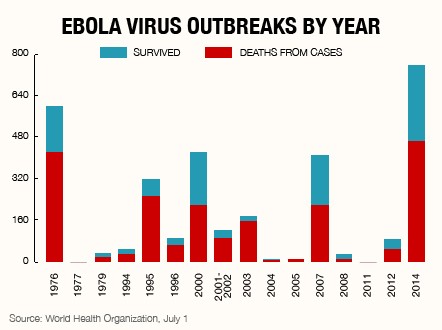
Ebola typically kills 90% of those infected, but the death rate in this outbreak has dropped to roughly 60% thanks to early treatment.
What is Ebola, and why does it kill?
Officials believe that the Ebola outbreak has taken such a strong hold in West Africa due to the proximity of the jungle -- where the virus originated -- to Conakry, which has a population of 2 million. Since symptoms don't immediately appear, the virus can easily spread as people travel around the region. Once the virus takes hold, many die in an average of 10 days as the blood fails to clot and hemorrhaging occurs.
The disease isn't contagious until symptoms appear. Symptoms include fever, headache and fatigue. At that point, the Ebola virus is spread via bodily fluids.
Get the fast facts on Ebola
Health workers are at especially high risk, since they are in close contact with infected people and their bodily fluids. Adding to the danger, in the initial stages of infection doctors may mistake an Ebola infection for another, milder illness.
Aside from his work on Ebola, Khan also serves as the lead physician of the hospital's Lassa Fever Program, another fearsome tropical disease. The hospital's official biography page states Khan took on that job when his predecessor died of Lassa Fever.
I survived Ebola, but villagers shunned me
Wiggins upstaged at C'wealth Games
7/25/2014 3:09:03 AM
- There's still no Commonwealth gold for English cyclist Bradley Wiggins
- His team finishes second behind a quick Australia in a team pursuit final
- Ross Murdoch upsets fellow Scot Michael Jamieson in the pool
- Mo Farah pulls out of the 5,000 and 10,000 meters because of a stomach illness
Follow us at @WorldSportCNN and like us on Facebook
(CNN) -- After crashing in the Tour de Suisse and being overlooked by his team for the Tour de France -- he became the first British winner of the race in 2012 -- Bradley Wiggins hoped relief would come at the Commonwealth Games.
"It's given me another focus rather than just lolling about at home feeling miserable," he was quoted as saying by The Guardian.
Wiggins indeed won a medal Thursday in the first day of action in Glasgow, but it wasn't the one he wanted.
Wiggins and his English teammates could only take home silver, behind a rampant Australia, in the 4,000-meter team pursuit final.
It means that while he has triumphed in France and won four Olympic golds, he's never stood atop the podium at the Commonwealth Games.
But instead of dwelling on the disappointment, Wiggins was already looking ahead to the Olympics in Rio in 2016.
"It's two years to Rio and you can't win all the time," he told BBC Television. "We've had limited preparation.
"That's the reality of it. We'll look back on this in two years with hopefully gold medals around our necks and say this was the start point for us. That's what it's all about.
"It's going to be two years of graft now and it's so different to the road. I can't underestimate how much work it's going to take."
Despite England's runner-up finish, Wiggins enjoyed his time with his teammates.
"It's been brilliant," he said. "I said to the boys, 'It's like being on holiday.' I got to go back to work Monday morning now.
"It's been just a nice break from everything from the road."
The Australian quartet of Jack Bobridge, Luke Davison, Alex Edmondson and Glenn O'Shea set a new Games record, clocking in at three minutes, 54.851 seconds to better England by about six seconds.
Murdoch bests Jamieson
As expected, there was a Scottish winner in the pool in the 200-meter breaststroke. What wasn't expected was that it was Ross Murdoch, not Michael Jamieson.
Jamieson finished second at London 2012 and said he wanted to set a world record at the Commonwealth Games. But the Glasgow native was slower than Murdoch in the heats and once again in Thursday's final.
He narrowly led Murdoch after 100 meters, though Murdoch won comfortably in the end -- by more than a second over his higher profile compatriot.
Murdoch established a Games record time of 2.07.30.
Earlier Thursday, Scotland's Hannah Miley defended her title in the 400-meter individual medley.
She was both ecstatic -- and tired.
"That was just incredible," she was quoted as saying by The Scotsman. "I literally couldn't feel my legs for the last 50 so, when I touched the wall, I was hoping and praying that I could go fast."
Brothers rule in triathlon
It was billed as brother vs. brother in the men's triathlon.
They indeed led the way and not for the first time Alistair Brownlee beat younger sibling Jonny to gold.
Alistair, who also won gold on home soil at London 2012, finished in 1:48.50, 11 seconds better than Jonny -- the bronze medalist at the 2012 Olympics.
They were virtually tied entering the final portion of the triathlon, the run, before Alistair broke away.
This is the way to get back from and reflect on a good race. pic.twitter.com/4xNccHKyE1
— Alistair Brownlee (@AliBrownleetri) July 24, 2014 "This is the goal I wanted to achieve for the season and I've done it now," Alistair Brownlee told BBC Television. "Now I've done everything I've wanted to do in my career. I don't know what to do now. Maybe I should retire," he joked.
Farah pulls out
England's Mo Farah claimed gold in the 5,000 and 10,000 meters at the Olympics in London, making his 'Mobot' celebration a worldwide phenomenon.
But Farah won't be achieving the double in track's two longest races at the Commonwealth Games after pulling out due to a lingering stomach illness.
He'll continue to train in France and hopes to return in time for the European Championships that begin August 12 in Zurich.
"I have taken the tough decision to withdraw from the Commonwealth Games," Farah told the England Athletics website. "The sickness I had two weeks ago was a big setback for me.
"Training is getting better here in Font Romeu but I need another few weeks to get back to the level I was at in 2012 & 2013.
"I really wanted to add the Commonwealth titles to my Olympic and World Championships but the event is coming a few weeks too soon for me as my body is telling me it's not ready to race yet."

You are receiving this email because you subscribed to this feed at feedmyinbox.com
If you no longer wish to receive these emails, you can unsubscribe from this feed, or manage all your subscriptions

No comments:
Post a Comment