 | Unleash yourself and shop our special collection of tees and accessories for you and your pooch. From our sponsors |
| CNN.com - Top Stories |
| CNN.com delivers up-to-the-minute news and information on the latest top stories, weather, entertainment, politics and more. |
Kasem's remains flown to Canada
7/22/2014 11:20:18 PM
- A Washington funeral director says he sent Kasem's remains to Canada last week
- Kasem's wife, Jean, requested the body be flown to Montreal, the funeral director says
- Kasem's daughter Kerri accuses her stepmother of abusing her elderly father
- Casey Kasem was 82 when he died in Washington state last month
Los Angeles (CNN) -- Casey Kasem's body was flown to Canada a month after he died, a funeral home director told CNN Tuesday.
Kasem's corpse was taken from a Washington state funeral home last week before the radio icon's daughter could enforce a court order against it being removed, according to the director of Tacoma's Gaffney Funeral Home.
A lawyer delivered the order a day after the body was sent out of the country, Corey Gaffney said.
"I disclosed to her attorney that the body was no longer in our care," Gaffney said.
Kasem's wife, Jean Kasem, said she has been "blackmailed" by her husband's children for 35 years.
"This is a shakedown and I will not negotiate with terrorists," she told CNN. "I will not give in to their blackmail and attacks."
Casey Kasem's body is missing, daughter says
Daughter Kerri Kasem accuses her stepmother of abusing her elderly father and contributing to his death by taking him from a Santa Monica, California, care facility in May and relocating him to Washington.
Santa Monica Police have "an open and ongoing investigation" into the elder abuse allegation, Sgt. Rudy Camarena said last week.
Kasem, who entertained radio listeners for almost four decades as the host of countdown shows such as "American Top 40" and "Casey's Top 40," died in a hospital in Gig Harbor, Washington, on June 15. He was 82.
Gaffney said Kasem was kept in his funeral home until he was instructed by Jean Kasem to send it to Montreal last week.
"I took Casey to the airport myself, oversaw every detail myself from the moment we brought him into care," Gaffney said. He tracked its arrival in Montreal, he said.
The death certificate listed Urgel Bourgie, a funeral and cemetery business in Montreal, as the planned destination, he said. CNN has not independently confirmed the details of the death certificate or the arrival of the remains at the Montreal funeral home.
Danny Deraney, a representative for Kerri Kasem, said Jean Kasem has the legal right to control her late husband's remains. "The bottom line is that they want to know where he'll be buried," Deraney said. "I think they have that right."
Kerri Kasem is pushing for a new law in California to give adult children visitation rights with their aging or incapacitated parents.
"There are so many people dealing with the same situation my family is dealing with, and we are receiving so many letters and e-mails," she said in a posting on her Facebook page Tuesday.
Casey Kasem tributes: 'Keep reaching for the stars'
Casey Kasem's global reach: long-distance dedications
Queen's horse fails drugs test
7/23/2014 4:54:16 AM

- The Queen's horse Estimate fails a drugs test
- Estimate won the 2013 Gold Cup at Ascot in front of Monarch
- The five-year-old filly tests positive for morphine
Follow us at @WorldSportCNN and like us on Facebook
(CNN) -- Britain's Queen Elizabeth II cheered Estimate on to success at the Gold Cup in 2013 but now her her five-year old filly is in the dock.
Buckingham Palace confirmed to CNN Tuesday Estimate had tested positive for banned substance morphine.
The Monarch was present at Ascot racecourse last year to see her horse claim glory in one of the world's most prestigious races.
Estimate narrowly missed out on defending that crown last month, after which the positive sample is thought to have been taken.
Read: Queen's horse pipped to Gold Cup
A statement released by the Palace said initial findings showed the positive test came from consumption of a contaminated feed product.
Her Majesty has been informed of the situation, it said.
Estimate, trained by Sir Michael Stoute, could now be stripped of that second place finish.
A statement by John Warren, the Queen's Bloodstock and Racing Advisor, said the British Horseracing Authority (BHA) had informed the Palace of the result of post-race samples on July 17.
"Five horses, under the care of various trainers, were affected," it continued. "I can confirm that one of those horses was Estimate, the five year-old filly trained by Sir Michael Stoute and owned by The Queen.
"Initial indications are that the positive test resulted from the consumption of a contaminated feed product.
"Sir Michael is working closely with the feed company involved to discover how the product may have become contaminated prior to delivery to his stables.
"As the BHA investigates this matter, including potential links between the different cases, Sir Michael continues to offer his full co-operation.
"There will be no further comment until the BHA announces its considered findings.
"Her Majesty has been informed of the situation."
Read: Queen's horse wins top award
Read: Hats off to British social season
Father: Son saved alleged molester
7/23/2014 6:58:47 AM
- Father says that his son stopped him from killing alleged molester with knife
- Raymond Frolander, 18, is charged with sexual battery on 11-year-old boy
- On 911 call, dad tells dispatcher he beat Frolander, who was in puddle of blood
- Police chief dismayed that dad posted son's photo with request for $1 million
(CNN) -- A Florida father who beat his 11-year-old son's alleged molester unconscious before calling 911 told a CNN affiliate that his son is a hero and that the youngster is the only reason the man is alive.
"My immediate feeling was to kill him, so he will never hurt anyone again," the father told CNN affiliate WESH.
The father, who CNN is not identifying, told Volusia County emergency dispatch Friday that 18-year-old Raymond Frolander was close to the family and was in the apartment while the father was out.
When he got home, the father said, he saw Frolander with the boy. Frolander's pants fell down to his ankles "and nothing else needed to be said" when he saw exposed genitals, the dad said.
Frolander, who is being held in Volusia County Jail without bond, faces a charge of sexual battery of a child. The father told WESH that Frolander is lucky that's all he is facing.
"My son saved Raymond. Raymond was motionless on our floor. I went to the kitchen to grab a butcher knife, and my son stopped me. My son came in front of me and saved his attacker's life," said the father.
According to the charging affidavit, the 11-year-old victim told authorities that Frolander had performed oral sex on him and instructed the boy to fondle him. The document says the boy told authorities that Frolander began abusing him a few years ago. It also says Frolander told police, "I'm guilty."
An official in the criminal division of the Volusia County Clerk's Office told CNN this is a confidential case because of the age of the victim, so no public record of the suspect's plea or attorney's name is available.
On the 911 call, the father explained that Frolander was breathing, but not speaking, "in a puddle of blood" on the floor. He added, "I loved him up until 15 minutes ago."
At times, the dad is heard talking to the suspect, at one point saying, "You are damn lucky, boy, that I love my God."
The father has not been charged, and when CNN affiliate CFN 13 asked Daytona Beach Police Chief Michael Chitwood whether he had any issue with the father's reaction, he responded Friday, "Not as a police chief and not as a father."
Chitwood had a starkly different reaction this week to news that the father had published his son's photo on the Internet with a plea for cash.
After the boy's assault and his attacker's beating became national news, the father reportedly posted the photo on Facebook saying he needed $1 million to pay for the boy's care after the assault. He also set up a GoFundMe page, which Chitwood derided as a "disaster."
As of Tuesday morning, the GoFundMe link on the Facebook page directed visitors to a page asking for help saving a mother of four from being evicted. GoFundMe said in a statement that its privacy policy prevented it from divulging whether a user's page had gone live, but Chitwood confirmed he had seen it.
"My detectives and I went and looked at it. It was requesting 1 million dollars," he said. "It's out of control. Somebody's thinking 'We're going to cash in on this.' I didn't get it."
Chitwood also expressed concern that the victim could suffer additional psychological stress as a result of his dad's actions.
"He's a parent. He has to do what he thinks is right, but from a law enforcement perspective, we go through great lengths to protect identity of sex assault victims. There are psychological problems that come from being a victim. To put the kid out there is a disaster," he said. "I've been doing this 27 years. I've never seen anything like this."
Nigeria let down on girls' kidnapping?
7/23/2014 9:08:14 AM

- More than 200 Nigerian girls still missing, 100 days after being kidnapped from their hostels
- Agony of girls, and their parents, has haunted Nigeria since, writes Chude Jideonwo
- Years of political infighting between ruling and opposition parties led to breakdown of trust, he adds
- Jideonwo criticizes harassment of leaders of #BringBackOurGirls at international airports
Editor's note: Chude Jideonwo is co-founder of Red Media Africa, which owns the continent's largest portfolio of youth media brands. His latest book is "Are We the Turning Point Generation?" The views expressed in this commentary are solely those of the author.
Lagos, Nigeria (CNN) -- I certainly didn't anticipate this turn of events: that more than 200 Nigerian girls, students kidnapped from their hostels in dead of night, would still be missing, and with their abductors, for 100 days in peacetime, democratic Nigeria.
The agony of the girls, and more specifically of their parents, has haunted the country since. In those weeks, at least 11 of the parents have died: seven of the fathers were among 51 bodies taken to hospital in Chibok after the terrorists attacked Kautakari, just nearby, and at least four are confirmed to have died of heart failure, high blood pressure and other illnesses.

"One father of two of the girls kidnapped just went into a kind of coma and kept repeating the names of his daughters, until life left him,'' a community leader, Pogu Bitrus told the Associated Press.
There is a sense of disbelief among protesters and Nigerians generally -- from across the world. Citizens whisper to themselves in malls, at parties, in the markets, across offices, at newspaper vendor stands and in airport terminals. We knew things were bad; but we didn't know they were so bad that the Nigerian government would be incapable of securing even this symbolic victory over the terrorist Boko Haram for more than 100 days.
When did we become the kind of country where this happens?
Well, it certainly has been a long time coming. Years of political infighting between the ruling and opposition parties led to a breakdown of trust and cooperation across state and federal government agencies; the one suspecting the other of using the terrorists to win political advantage.
The relative inaction has only emboldened Boko Haram, which these days invades communities, taunts Nigerians in videos (including the latest this week by its leader Abubakar Shekau), and hoists flags in villages with the ease of an advancing army.
Opinion: Nigeria's kidnapped girls not forgotten
The 100-day marker for the kidnap of the Chibok girls stands as the highest symbol for the failure of the Nigerian state to protect its citizens, to defend its territory, to inspire hope. From the two weeks it took President Goodluck Jonathan to officially acknowledge the scale of the problem to the relentless cross-government attack against citizen protesters, there has been a sense that the authorities are more interested in protecting their offices, than restoring confidence.
It doesn't help that it took the President 99 days to even meet the parents of the missing girls and only after a foreigner, Pakistan's Malala Yousafzai had pleaded. It doesn't help that, apparently, the 50-plus girls who escaped captivity have not immediately been taken under the wings of the government. It doesn't help that the country's secret service has taken to harassing leaders of the #BringBackOurGirls campaign at international airports.
It has become a broken record: the government says it knows the location of the girls. But this offers little comfort, as little comfort as the lack of information as to how exactly the international community is helping, since it has no boots on the ground.
The meeting with the parents on Tuesday hopefully opens a new chapter in efforts to find these people. For one, the much talked about empathy that has won this president the hearts of Nigerians was on display. Whether manufactured or not, it gave at least a ray of hope for a thirsty citizenry -- as we gather Wednesday in marches across the world, from Lagos to New York, Abuja to London.
Maybe this will be the beginning of stronger cooperation between the Chibok community and its federal government; maybe it will signify a thawing of relations between the presidency and the opposition state government. Maybe it will finally convince the President that protesters, like the parents, do not wish his downfall, they only want a slice of hope.
In a politically charged climate, where everything is interpreted against the backdrop of the coming 2015 general elections, this might be little more than futile hope.
But as we ponder the fates of at least 219 young women, caught in the Sambisa forest, surrounded by mosquitoes, spiders, dirty waters, deadly snakes and deranged fundamentalists, hope -- unfortunately -- is all we can afford.
READ: Nigeria's kidnapped girls not forgotten
Who are Ukraine's pro-Russia rebels?
7/23/2014 4:21:16 AM
- The pro-Russia rebels are concentrated in the eastern regions of Donetsk and Luhansk
- The leader of the self-declared Donetsk People's Republic is Alexander Borodai
- Analysts say he is rumored to be a senior Russian intelligence officer
- The rebels have denied any involvement in bringing down Malaysia Airlines Flight 17
(CNN) -- The horrifying crash of Malaysia Airlines Flight 17 has put the pro-Russia rebels operating in Ukraine's eastern regions center stage -- and raised all kinds of questions about who they are, what they want and who's in charge.
U.S. and other officials have said it appears the plane was shot down by a sophisticated surface-to-air missile located within rebel-held territory.
The rebels have repeatedly denied responsibility and instead point the finger at Ukraine's armed forces.
Where are the rebels?
The rebels are pro-Russia militants concentrated in the eastern regions of Donetsk and Luhansk, with the industrial city of Donetsk a particular stronghold.
Recent gains by Ukrainian armed forces have seen the territory controlled by the rebels contract. But the rural area where MH17 crashed to earth July 17 remains under the rebels' sway.
The various rebel groups operating across the region do not appear to have a strong central command.
When did they first appear on the scene?
After popular protests toppled Ukraine's pro-Moscow President Viktor Yanukovych from power in February, pro-Russia rebels first appeared in Ukraine's Crimea region, where they seized key infrastructure. The region was subsequently annexed by Russia.
Unrest then broke out in eastern Ukraine, a heartland of support for Yanukovych, where many people speak Russian and feel closer ties to Moscow than to Kiev.
Rebel leaders in Luhansk and Donetsk seized key government buildings and declared themselves the heads of the People's Republics of Donetsk and Luhansk. In May, a referendum was held in each region on secession from Ukraine.
Who are the main rebel leaders?
Alexander Borodai, a Russian citizen, was appointed prime minister of the self-declared Donetsk People's Republic and has been a prominent public face for the rebels.
He's the rebel leader who after speaking with Malaysian Prime Minister Najib Razak agreed that the plane's flight data recorders would be handed over.
According to Andrew Kuchins, a Russia expert at the Washington-based Center for Strategic and International Studies, there are rumors Borodai is a Russian intelligence officer who has reached the rank of general in the FSB, the successor to the KGB.
"Borodai himself has denied (the rumors), but I would say that given his trips back and forth to Moscow, he has certainly been consulting with parts of Russian intelligence over the past couple of months," he said.
In an interview with CNN's Chris Cuomo, Borodai denied any responsibility for the downing of MH17.
Another name that crops up frequently is that of Igor Girkin, also known as Igor Strelkov, the self-proclaimed defense minister for the people's republic.
According to U.S. Secretary of State John Kerry, Strelkov on July 17 "posted a social media report bragging about the shoot-down of a transport plane -- at which point when it became clear it was civilian, they pulled down that particular report."
Also a Russian, Strelkov was a military commander in the rebel redoubt of Slovyansk before it was retaken by Ukrainian forces, later reappearing in Donetsk city. He was also present in Crimea at the time of its annexation.
Added to an EU sanctions list in April, he was described as being on the staff of the Russian military's main Intelligence Directorate.
What is the rebels' response to the claim they shot down MH17?
After three months or more of bitter fighting against the Ukrainian authorities, the rebels are disinclined to believe anything they hear from Kiev or the West, says freelance journalist Noah Sneider in Ukraine.
They deny shooting down MH17 and many instead claim it is a provocation conjured up by the Ukrainian authorities in Kiev, he said. Many of them claim they don't have the equipment to have hit the plane.
"Anything that's released by the current authorities in Kiev is seen in rebel eyes as fabricated, as intended to -- essentially to draw NATO into Ukraine," Sneider said.
Asked about the growing weight of evidence gathered by Washington and Kiev, such as social media postings and phone intercepts, Borodai told CNN it was fake.
"It is very simple to disprove it. All of the information that comes through the Internet, in my opinion, is practically all lies," he said.
Would the rebels have been able to shoot down the plane?
Russia denies claims by Kiev and the West that it has provided training, heavy weaponry and logistical support to the rebels. It also dismisses any direct involvement of Russian forces in Ukraine.
In recent weeks, rebel forces have brought down a number of Ukrainian military aircraft in the eastern regions, including two Antonov AN-26 transport planes, several Mi-8 and Mi-24 helicopters, an Su-25 fighter jet and an Ilyushin IL-76 cargo plane.
However, Ukrainian and U.S. officials believe Russian expertise would have been needed to operate the SA-11, or Buk, antiaircraft system that seems increasingly likely to have been used to shoot down MH17.
Vitaly Nayda, Ukraine's director of informational security, told CNN that he is certain a Russian officer personally pushed the button to shoot down the plane.
CNN's Nick Paton Walsh, who has reported extensively from Ukraine and met many of the rebel fighters, said it was hard to say if any of them had the specialist training needed to operate the Buk system.
"The people we've met, the militia, they're ragtag, a lot of them have old military experience, and that's mostly ground, street-to-street fighting, rather than the technological stuff you need to know to run something like that."
A lot of heavy weaponry has flooded in during the past few weeks, said Paton Walsh. "But the majority of video you see of separatist armor and weapons, lighter artillery, even Grad rocket launchers sometimes, are nothing of the scale of the Buk."
What weapons do the rebels have?
The military aircraft brought down by the rebels were flying at relatively low altitudes and were for the most part brought down by shoulder-launched SA-7 missiles and ZU 23-2 anti-aircraft guns. Such weapons were seized when pro-Russian rebels took control of several Ukrainian military depots and bases.
But those weapons are a world away from the Buk system, effective at a higher altitude, at which the Malaysia Airlines plane was flying.
Peter Felstead, an expert on former Soviet military hardware at IHS Jane's, says that "the Buk is in both the Russian and Ukrainian inventories, but it's unclear whether the one suspected in the shoot-down was taken by rebels when they overran a Ukrainian base, or was supplied by Russia."
Video posted by Ukraine's Interior Ministry on its Facebook page shows a Buk system, according to the Ukrainian officials, heading toward Russia, with one missile missing.
Borodai told CNN that the rebels had never been in control of a single Buk missile system.
What does Russia say?
Russia insists it has no direct influence over the separatists. Russian President Vladimir Putin has also been consistent in his denials of any Russian involvement in the bringing down of MH17.
"No one should have the right to use this tragedy to achieve selfish political objectives," he said.
Foreign Minister Sergey Lavrov said Russia wanted to see an objective, open and independent investigation, adding that Ukraine must take the initiative since the tragedy occurred on its territory.
"With regard to the claims raised by Kiev, that it was almost us who did it: in fact I haven't heard any truthful statements from Kiev over the past few months," he told state TV channel Russia 24.
Russian state media reports have sought to suggest that Ukraine's own armed forces may have been involved in bringing down MH17.
Vitaly Churkin, Russia's ambassador to the United Nations, also blamed Ukraine for the crash in remarks Monday. But when asked about audio recordings of purported pro-Russia separatists talking about shooting down a plane, he suggested that if they did, it was an accident.
"According to them, the people from the east were saying that they shot down a military jet," he said. "If they think they shot down a military jet, it was confusion. If it was confusion, it was not an act of terrorism."
READ: How Ukraine's rebels built up an arsenal
READ: Malaysia Airlines Flight 17: Five unanswered questions
READ: Alleged phone call: 'We have just shot down a plane'
CNN's Tim Lister contributed to this report.
Gaza conflict: U.N. slams possible war crimes
7/23/2014 3:10:51 PM
- Mother of Israeli-American teen killed sends message to Palestinian parents
- 693 Palestinians killed, the Gaza Health Ministry says
- 35 killed in Israel including 32 soldiers, Israel says
- U.N. accuses both sides of possible war crimes
Gaza City (CNN) -- As the bloody battles pushed up tragic death tolls on both sides, world powers held a flurry of diplomatic meetings Wednesday aimed at halting the fighting in Gaza.
U.S. Secretary of State John Kerry met with Israeli and Palestinian leaders as well as U.N. Secretary-General Ban Ki-moon, while several Middle Eastern nations worked to try to win Hamas' agreement for an Egyptian-led cease-fire.
But perhaps the most powerful message came from a woman whose son's death played a role in sparking the current fighting.
"Your children and our children -- nobody should really go through what we're going through now," said Racheli Fraenkel, whose son Naftali was among three Jewish teens kidnapped and killed on the way home from school in the West Bank last month. Israel blamed Hamas. Later, a Palestinian teen was killed in what Israel calls a revenge attack. Israel has indicted an adult and two minors for the killing.
The Fraenkels are American citizens. Yishai Fraenkel, Naftali's uncle, works to bring Palestinians into Israel's high-tech sector.
Rachel Fraenkel met with Kerry on Wednesday. Afterward, speaking to media, she said, "I just want to turn to Palestinian parents and say maybe you can stop Hamas from using you as human shields and your death as propaganda."
"I promise the Palestinian parents: All we want is to live in peace and raise our children without threats of missiles or tunnels under our communities," noting that an Israeli kindergarten was struck by a rocket this week -- it was empty at the time.
"Maybe we can teach our children that we want to live in peace," she said.
Some Palestinian parents visited her family after Naftali's death and they had very good conversations, she said. "I do know decent, good Palestinian people."
Israeli Jewish families also visited the family of the Mohammed Abu Khedair, the Palestinian teen killed.
Despite Fraenkel's sentiments, many Palestinian parents accuse Israel of carrying out a "massacre" -- and have called on Israelis to push the government to stop military action.
"Nobody is safe and nobody can flee anywhere because everywhere is targeted," said Enas Sisisalem, a mother of two who lives in the al-Remal neighborhood of Gaza City, as CNN reported Monday. "When we hear the shelling my kids will cry."
Death tolls jump
The Gaza Health Ministry said Wednesday 693 Palestinians have been killed in the fighting, including 166 children.
It's unclear how many of the dead were civilians. The United Nations estimates that more than 70% were. The Israeli military said 230 militants have been killed.
Palestinians have disputed Israeli and American assertions that many of the deaths are due to people choosing to be part of human shields. While Hamas leaders have encouraged people to do so, many Palestinians have told CNN they worried that if they followed Israeli warnings and fled their homes, they'd have nowhere safe to go.
Three more Israeli soldiers were killed Wednesday, bringing the total to 32 plus three civilians. Among the soldiers, three died from friendly fire.
A Hamas mortar shell killed a foreign worker in Ashkelon on Wednesday, marking the third civilian death on the Israeli side.
Hamas has said it is holding an Israeli soldier it captured in an ambush on an armored personnel carrier Sunday. Six other IDF soldiers died in the ambush.
On Tuesday, the Israeli military released the soldier's name -- Sgt. Oren Shaul -- but said it was "working to identify his body."
Israeli media reported that Shaul was missing and presumed dead.
U.N. slams possible 'war crimes'
"There seems to be a strong possibility that international humanitarian law has been violated, in a manner that could amount to war crimes," U.N. High Commissioner for Human Rights Navi Pillay said Wednesday.
"I unequivocally reiterate to all actors in this conflict that civilians must not be targeted. It is imperative that Israel, Hamas and all Palestinian armed groups strictly abide by applicable norms of international humanitarian law and international human rights law," Pillay said.
"This entails applying the principles of distinction between civilians and combatants and between civilian objects and military objectives; proportionality; and precautions in attack. Respect for the right to life of civilians, including children, should be a foremost consideration. Not abiding by these principles may amount to war crimes and crimes against humanity."
Some Israeli officials rejected Pillay's statements about Israel. "She would be better advised to seek credible first-hand information rather than making intolerably biased statements based on newspaper clippings," Foreign Ministry spokesman Yigal Palmor said, according to The Jerusalem Post. He added that Pillay's "embarrassingly shallow and populist affirmations ... do a huge disservice to actual human rights."
Tunnels found, ambulances hit
The Israeli military, meanwhile, said it hit more than 187 targets overnight, and most of them were in Shaja'ia. The Israel Defense Forces has warned residents of the neighborhood to flee multiple times and has accused Hamas of telling people to remain in their homes.
An IDF force found another "terror access shaft" in Gaza on Wednesday, Israel said. Inside it were weapons, maps and IDF uniforms, "all intended for the execution of terror attacks against Israel."
The IDF also "attacked several militants emerging from a tunnel opening" in southern Gaza, Israel said. "Since the beginning of the ground operation, more than 60 access shafts leading to some 28 tunnels were uncovered."
The al-Wafa hospital, near hard-hit Shaja'ia, "is a Hamas military compound," the Israel Defense Forces said Wednesday. At Israel's request, it was evacuated of patients and staff Tuesday, though Hamas gunmen remained, firing at Israeli forces, the IDF said. Israel confirmed the evacuation with a World Health Organization official, then struck the "terror targets" at the site, the IDF said.
The Israeli military released video it said showed secondary explosions from stockpiled munitions when the hospital was hit.
Palestinian ambulances have been shelled, Gazan medics have complained. On Wednesday, the IDF said militants used one to escape the Israeli military.
The International Committee of the Red Cross prepared to go into Shaja'ia early Wednesday. The neighborhood is "partially demolished," the ICRC said.
Cease-fire possible?
Kerry shuttled between Israeli Prime Minister Benjamin Netanyahu in Tel Aviv and Palestinian Authority President Mahmoud Abbas in the West Bank on Wednesday.
Abbas' Fatah party has long controlled the Palestinian government in the West Bank, while Hamas has controlled Gaza. The two groups, which have engaged in violent battles in the past, recently announced another effort at a joint government.
Earlier Wednesday, Kerry met with U.N. Secretary-General Ban Ki-moon, who was already on the ground calling for an end to the bloodshed in Gaza.
Israel has publicly accepted Egypt's call for a cease-fire and condemned Hamas for not doing so. Hamas political leadership lives in Qatar, another country involved in efforts to achieve a cease-fire.
Hamas leader Khaled Meshaal said from Doha, Qatar, that Hamas' demand that Israel end an air, land and sea blockade of Gaza is their most important demand.
"Then we can negotiate," he said.
Turkey and Kuwait are involved as well, a Hamas official told CNN.
Can Kerry end the Gaza-Israel bloodshed?
READ: What is Hamas' endgame in Gaza?
READ: What is Israel's endgame in Gaza?
READ: Gaza crisis: Who's who in Hamas
READ: Is Hamas using human shields in Gaza?
Ian Lee reported from Gaza City. Ben Brumfield and Josh Levs reported from Atlanta. CNN's Steve Almasy, Tal Heinrich, Ali Younes, Kareem Khadder and Tim Lister contributed to this report.
Death penalty facts to surprise you
7/24/2014 2:38:03 AM
- Stats show U.S. executions have plummeted 60% since peaking in 1999
- Most executions have been via lethal injection; some states have trouble obtaining the drugs
- 56% of U.S. prisoners executed have been white, 34% have been African American
- Statistics were compiled by the Death Penalty Information Center
(CNN) -- 2014 has been an eventful year for several of America's death row inmates.
In Oklahoma, a botched lethal injection preceded a prisoner's death by heart attack.
In Ohio, a lethal injection of a new combination of drugs preceded the death of an inmate who reportedly gasped and convulsed before he died.
On Mississippi's death row, doubts about a woman's guilt delayed her execution and then led to a new trial.
In Louisiana, a man who faced a death sentence for 30 years was exonerated and set free.
These and other incidents are prompting many to take a fresh look at America's justice system and its use of the ultimate punishment. Some continue to support death as an option for the most terrible crimes. Others have come out against it.
In the infographic above, statistics by the Death Penalty Information Center offer a fascinating snapshot of executions in the United States, including how they're done, where they take place and how many prisoners are executed each year.
Click here to view on a mobile device.
Norway expects terror bid in 'days'
7/24/2014 7:05:28 AM

(CNN) -- Norway says it thinks Islamist terror could strike the country within a few days but does not know what the plot is, the country announced Thursday.
The Police Security Service "recently received information that individuals affiliated with an extreme Islamist group in Syria may have the intention of carrying out a terrorist action in Norway," the service said in a statement.
A preliminary investigation strengthened the credibility of the information, the statement said. "We also have information indicating that a terrorist action against Norway is planned to be carried out shortly -- probably in a few days.
"We have no information about who is behind such an attack, how it will be carried out, the target or in what way such an attack will be carried out. ... As the information is not specific and not very concrete but at the same time credible, it is difficult to give advice to the citizens of this country on how to act in this situation."
Security has been increased at airports, train stations, ports and major intersections, according to The Nordic Page, a Norwegian English-language news site.
Taiwan's 'painful day' as crash kills 48
7/24/2014 3:11:41 AM
- 48 people killed and 10 injured when plane tried to land in Taiwanese island
- TransAsia Airways Flight GE 222 attempted to land twice, state news agency reports
- Taiwan's transportation minister says there were no casualties on the ground
- Cause of accident is under investigation
(CNN) -- At least 48 people were killed and 10 injured when a twin-engine turboprop plane crashed while attempting to land in Penghu Islands, according to Taiwan's Civil Aeronautics Administration.
TransAsia Airways Flight GE 222 was preparing to land at Magong Airport in heavy rain on Wednesday and had asked for its second go-around before the accident occurred, according to Taiwan's Central News Agency.
Visibility at the airport during the plane's attempted landing was about 1,600 meters (1 mile) and considered acceptable for landing, Jean Shen, Taiwan's Civil Aeronautics Administration director told reporters.
Transportation officials arrived Thursday morning to investigate the disaster and assist in relief work. The cause of the crash remains unclear and authorities have identified 14 of the 48 killed, according to CNA.
The flight data recorder and cockpit voice recorder have been sent to Taipei, the agency reported.
The plane, an ATR 72-500, carried 54 passengers and four crew members.
The domestic flight, which took off from Kaohsiung, Taiwan, had been delayed because of conditions related to a typhoon, the airline said. Typhoon Matmo had struck Taiwan on Wednesday.
Typhoon Matmo threatens mudslides in Taiwan
"Yesterday was an extremely painful day for Taiwan," its President Ma Ying-jeou posted on his official Facebook page, adding that the typhoon had injured 17 people.
"After hearing of the tragedy, and watching relatives break down on TV news, I believe many Taiwanese were the same as me, passing a heartbroken and sleepless night."
Grief in Taiwan
Family members crumpled to the ground, overtaken with grief of losing of loved ones, in footage shown on CNN's affiliate, ETTV.
TransAsia Airways sent families of the victims on a chartered flight to Penghu Islands, the site of the crash, which is located off the west coast of the main Taiwanese island.
The pilots of Flight GE 222 were identified as Lee Yi-liang, who had 22 years of flight experience, and co-pilot Chiang Kuna-hsing who had two-and-a-half years of experience, according to CNA.
Friends of one of the crew members posted on his Facebook page, "Come back" and "Rest in peace."
Also aboard the plane was Yen Ken-chuang, an 82-year-old Taiwanese wood architect, according to the Ministry of Culture's Bureau of Cultural Heritage, CNA reported.
It also reported that a local firefighter, Lee Ming-tsun, 47, was pulled from the wreckage by his colleagues. Lee was a leader of one of the divisions, and was returning from his holiday.
French passengers identified as Jeromine Deramond and Penelope Luternauer died in the plane crash, according to CNA. They were on a one-month exchange program in the field of medicine in Taiwan.
"TransAsia Airways is exhausting all means to assist passengers, victims and families" and working with investigators, an airline statement read.
The airline's president, Chooi Yee-choong appeared briefly at a news conference and bowed in front of news cameras. He choked up as he expressed his sorrow to passengers' families and the public.
"I sincerely apologize," he said.
Crash site
Footage on scene showed the plane had crashed in a residential area and broken into pieces. Witnesses told CNN affiliate ETTV that they saw homes on fire after the plane crashed around 7 p.m. The fallen plane destroyed or damaged 11 houses, EETV reported.
There were no casualties on the ground, said Taiwan's Transportation Minister Yeh Kuang-shih. Five residents were injured, but they were discharged from local hospitals.
The ATR 72-500 plane was delivered to Taiwan's TransAsia Airways from the production line in 2000, according to the aircraft maker.
Xi Jinping, China's president expressed his condolences saying he was "deeply grieved" by the accident.
CNN's Zoe Li, Dayu Zhang and Ashley Fantz contributed to this report.
F1: Mexico GP gets 2015 green light
7/24/2014 7:02:53 AM

- F1 boss Bernie Ecclestone says race will take place in Mexico next season
- Last F1 race in Mexico was held in 1992
- Mexican driver Sergio Perez says award is "sign that Mexico can achieve anything"
Follow us at @WorldSportCNN and like us on Facebook
(CNN) -- Mexico is set to return to the Formula One calendar after an absence of more than two decades, F1 boss Bernie Ecclestone has confirmed.
The Mexico Grand Prix, along with races in New Jersey and South Korea, were included on the provisional calendar for 2014 only to be axed last December.
But after last year's false start, the country now looks set to host its first F1 race in 23 years.
"I'm happy to announce we've concluded an agreement to have a race in 2015," Ecclestone said, the sport's official website reported. "Don't miss this race!"
The race will be run at a refurbished 4.421-kilometre Autodromo Hermanos Rodriguez circuit in Mexico City. A date has yet to be finalized.
Tavo Hellmund, organizer of the U.S. Grand Prix in Austin, Texas and co-founding partner of the new Mexican Grand Prix said he was "delighted" a deal had been reached.
"Ever since Bernie and I began working on a race at Austin, it's been a dream of mine to help Formula One return to Mexico," said Hellmund.
"This announcement has therefore been years in the making, but we've gradually been able to assemble all the right pieces. I'm absolutely delighted," he added.
Force India driver Sergio Perez, one of two Mexican drivers currently on the grid, also hailed the news.
"The return of F1 to our country is a sign that the Mexican state can achieve anything." Perez wrote on his official website.
"It's a great opportunity to show the world what Mexico is and what we are capable of achieving. We're big and when we have the same tools as our competitors, we are the best in the world."
Que increíble noticia!! Tendremos Gran Premio de México!! Un agradecimiento especial a todas las personas que hicieron este sueño realidad!!
— Esteban Gutierrez (@EstebanGtz) July 23, 2014 His compatriot and Sauber driver Esteban Gutierrez also tweeted his approval.
Perez was two years old when Britain's Nigel Mansell won the last F1 race in Mexico in 1992.
Mexico hosted official F1 racing for eight years between 1963 and 1970. The race was taken off the calendar for 15 years before returning in 1986.
Read more: Latest news from 2014 F1 season
Read: Rosberg extends lead with German win
UK set to be Europe's powerhouse?
7/24/2014 7:04:20 AM

- The UK economy expected to grow 3.1% this year, according to the EY ITEM Club
- Employment is at record-high, but wages are growing at the slowest rate on record
- Many economists are also warning the UK about a potential housing bubble
Editor's note: Are you benefiting from the economic recovery? Share your views on Twitter via #CNNBusinessView.
(CNN) -- The UK economy has shaken off the European crisis with growth figures that outshine its G7 peers.
It is expected to grow 3.1% this year, according to a forecast by the prestigious EY ITEM Club, above earlier expectations of 2.9%.
The growth is well above that expected of Germany, Europe's biggest economy and one which dragged the bloc out of crisis, at 1.8%.
"We have moved from the recovery phase to expansion. And furthermore, it's looking very durable," said Peter Spencer, professor of Economics and Finance at University of York and chief economic adviser to the ITEM Club.
Figures due to be released Friday are expected to show the British economy passing the pre-crisis peak from 2008.
Spencer said the growth is no longer financed by people tapping into their savings -- as was the case this time last year -- but by business expansion and a stronger labor market.
Business spending is on the rise, meaning companies are investing into production rather than sitting on cash. Business investment by itself now generates more than half of the UK's growth.
The government is trumpeting a record-high employment -- 73.1% of people were in work in the three months to May, matching up the previous record-high from 2004/2005.
But there is a catch. While record numbers of Brits are working, their wages are growing at the slowest rate on record -- and at about half of the inflation rate.
That fuels another problem of the UK's economy -- the chronic and rising inequality. Of all UK households, only the highest earning 20% increased their disposable income last year. The remaining 80% of households suffered a drop in their income, numbers released by the Office of National Statistics show.
The Bank of England has also warned that the UK productivity has been "extremely and uncharacteristically weak" since the recession.
Productivity growth, which indicates if the economy can produce more for less, remains below the pre-crisis levels, at 16%.
Many economists are also warning the UK about a potential housing bubble. The average cost of a home in the UK is now 20% above the pre-crisis peak in 2007.
The IMF has already warned the UK government that rising house prices and low productivity could hinder the economic growth and urged the country to put in place "early measures" to prevent housing bubble.
But Spencer told CNN the fears of a bubble were overblown. "This is not driven by mortgage borrowing. In London for example, it's mainly cash buying and overseas buyers," he said, pointing to relatively flat mortgage borrowing.
The UK is also vulnerable to shocks from outside. Half of the country's international trade is with the European Union countries, many of which are still suffering from the consequences of the eurozone crisis.
"If Germany takes a hit, we'll suffer too. If Germany does well, we'll do well, like the rest of Europe," Spencer said.
Read more: How to tame your property bubble
Read more: U.K. economy picks up pace
Read more: Britain, Italy include drugs and sex in GDP
Fighters escort jet to UK landing
7/24/2014 5:10:54 AM
(CNN) -- Military fighter planes escorted a Gulfstream jet to the London area's Stansted Airport on Wednesday evening after the jet lost contact with air traffic controllers, an airport spokesman said.
The Gulfstream landed at the airport, about 40 miles outside central London, about 7:45 p.m. local time and was escorted to a remote part of the airfield, Mark Davison said.
At least one flight was delayed as the Gulfstream was escorted to a landing. The airport was reopened after the Gulfstream parked.
Essex police had no immediate comment on the incident.
U.S. extends ban on flights into Israel's Ben Gurion Airport
Dozens feared dead in Taiwan plane crash
CNN's Andrew Carey contributed to this report.
U.S. inmate's execution lasts 2 hours
7/23/2014 9:32:53 PM
- NEW: The American Civil Liberties Union calls for grater transparency
- NEW: A judge orders officials to preserve all physical evidence in Joseph Wood's execution
- A media witness likens Wood's breathing to a "fish gulping for air"
- Wood had argued combination for lethal injection was cruel and unusual punishment
(CNN) -- Joseph Wood snorted and struggled to breathe during his nearly two-hour lethal injection Wednesday, his attorney said.
"It took Joseph Wood two hours to die, and he gasped and struggled to breathe for about an hour and 40 minutes. We will renew our efforts to get information about the manufacturer of drugs as well as how Arizona came up with the experimental formula of drugs it used today," attorney Dale Baich said in a statement.
He added: "Arizona appears to have joined several other states who have been responsible for an entirely preventable horror -- a bungled execution."
Arizona Gov. Jan Brewer had directed the Department of Corrections to review the process, saying she is concerned by the length of time it took to carry out the lethal injection.
A federal judge ordered local officials to preserve all physical evidence in Wood's execution.
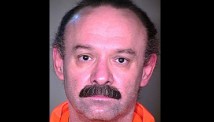
"One thing is certain, however, inmate Wood died in a lawful manner and by eyewitness and medical accounts he did not suffer. This is in stark comparison to the gruesome, vicious suffering that he inflicted on his two victims -- and the lifetime of suffering he has caused their family," Brewer said.
Arizona's corrections department said in a statement that it followed protocol in Wood's execution, re-affirming his "deep sedation" seven times before he was pronounced dead.
Aside from snoring, he did not make grimaces or otherwise move, the corrections department said.
Wood was convicted of murder and assault in the 1989 deaths of his estranged girlfriend and her father.
"I don't believe he was gasping for air; I don't believe he was suffering. It sounded to me like was snoring," said Jeanne Brown, a relative of Wood's victims.
"You don't know what excruciating is. What's excruciating is seeing your dad laying there in a pool of blood, seeing you sister laying there in a pool of blood. This man deserved it. And I shouldn't really call him a man," she said.
The execution procedure began at 1:52 p.m. (4:52 p.m. ET) and concluded, with Wood's being pronounced dead, at 3:49 p.m. (6:49 p.m. ET).
Troy Hayden, a media witness from KSAZ, told reporters the execution was difficult to watch. He likened Wood's breathing to a "fish gulping for air."
"It was tough for everybody in that room," he said.
Michael Kiefer, a reporter for The Arizona Republic, has witnessed five executions, including Wood's.
"Usually it takes about 10 minutes, the person goes to sleep. This was not that," he told reporters afterward. "It started off looking as if it was going alright but then obviously something didn't go right. It took two hours."
Kiefer described the sound Wood made as a "deep, snoring, sucking air sound."
Wood's attorneys had filed an emergency motion for a stay after his execution began, saying then that Wood had been "gasping and snorting for more than an hour."
The motion read: "He is still alive. This execution has violated Mr. Wood's Eighth Amendment right to be executed in the absence of cruel and unusual punishment. We respectfully request that this Court stop the execution and require that the Department of Corrections use the lifesaving provisions required in its protocol."
Inmate objected to drugs
Earlier, the Arizona Supreme Court lifted its brief stay of the murderer's execution.
Wood was first set to be executed at 10 a.m. local time (1 p.m. ET), though it was temporarily halted when the court said it would consider his request for the justices to review his claims.
The court lifted the stay shortly after that, saying without explanation that it considered the request but decided not to review Wood's case.
Wood was the latest American death row inmate to argue that an anesthetic recently introduced in some states' execution protocols could fail to sufficiently knock out the inmate ahead of the lethal drugs, subjecting the person to an agonizing death.
Opinion: 5 ways to improve the U.S. death penalty
Wood claimed among other things that the state was going to use an "experimental" drug protocol of midazolam and hydromorphone.
In documents filed with the state Supreme Court, he contended the use of the anesthetic midazolam was problematic in recent U.S. executions and that it would violate the Constitution's guarantee against cruel and unusual punishment.
Wood was "very concerned they were experimenting," said attorney Baich, who witnessed the execution.
"The room was silent. I was focusing on Mr. Wood. There were seven announcements during the process that Mr. Wood was still sedated. This is -- to confirm that he was still sedated.
"He was still breathing and struggling to breathe and gasping and snorting. I have witnessed 10 executions, and I had never seen that before," Baich told CNN.
Opinion: I was 17, on death row -- and innocent
Controversial Oklahoma execution
Drugs weren't Wood's only contention. He also argued the execution should be stopped because his trial attorney was ineffective and that new evaluations from psychologists show he has cognitive impairments that would make him innocent of premeditated murder.
Some states turned to midazolam this decade after they could no longer get sodium thiopental, a drug that was regularly used for executions. A U.S. manufacturer stopped producing sodium thiopental in 2009, and countries that still produce it won't allow its export to the United States for use in lethal injections.
Earlier this year, Oklahoma put executions on hold after the controversial execution of Clayton Lockett. Midazolam was part of the injection combination, and it took 43 minutes for him to die, Oklahoma officials said.
While state officials said Lockett was unconscious the entire time, a media witness for CNN affiliate KFOR said he uttered the words, "Man," "I'm not," and "something's wrong," before blinds to the execution chamber were closed. His lawyer, Dean Sanderford, said the inmate's body twitched and convulsed before he died.
Oklahoma's Department of Public Safety, acting on orders from Gov. Mary Fallin to get to the bottom of what happened, is investigating whether prison officials followed protocols. The review is also supposed to include recommendations about how to prevent something similar from happening again.
"It's time for Arizona and the other states still using lethal injection to admit that this experiment with unreliable drugs is a failure," the American Civil Liberties Union said in a statement.
"Instead of hiding lethal injection under layers of foolish secrecy, these states need to show us where the drugs are come from. Until they can give assurances that the drugs will work as intended, they must stop future executions," it read.
Mississippi mom swaps death row for jail cell to await trial
Death penalty facts that may surprise you
California's death penalty ruled unconstitutional
CNN's Mayra Cuevas, Dave Alsup, Ross Levitt and Michael Pearson contributed to this report.
World record teen pilot killed at sea
7/23/2014 6:25:01 PM
- NEW: Coach says young pilot was a soccer player who had a knack for when to tell joke
- Haris Suleman, 17, was at the controls during his trip around the world
- His father, Babar Suleman, was traveling with him and is missing
- Daughter says her brother and dad had trained for a water landing
(CNN) -- An American teenager who was trying to set a world record for flying around the world was killed and his father is missing after their plane crashed into the ocean off American Samoa on Tuesday night, the boy's family said.
Haris Suleman, 17, was trying to make the trip in 30 days and was due home in Indiana on Saturday, his sister Hiba Suleman said. The teen's body was recovered.
Still missing was his father, Babar Suleman, who was traveling with Haris and who is also a pilot.
"We're hoping my dad is alive and well, and we're going to keep praying until we have a definitive answer," Hiba Suleman said.
She told reporters the plane was about 23 miles from the island when it crashed. Her father wouldn't have let Haris take off if the weather was bad, she said.
It is unclear why the plane crashed or why the duo took off at night.
"He was doing something that he loved. He was doing something adventurous," she said of her brother, who received his pilot's license in June. And he was doing it to raise money for charity, she added.
The principal of the high school where Haris was a rising senior said the school was deeply saddened by his death.
"Haris' adventurous spirit and huge heart led him to reaching for this personal goal while also seeking to raise funds and awareness for schools supported by The Citizens Foundation, a nonprofit organization headquartered in Karachi, Pakistan," said Melvin Siefert, principal of Plainfield High School.
A soccer coach at the school told the Indianapolis Star that Haris was a great student and a talented player.
"Haris loved to joke a lot," David Knueve told the newspaper. "He just got the team sort of laughing at the right moments."
His sister said Haris planned to be an engineer like his father.
The oldest sibling, a brother, was trying to get from London to American Samoa to pick up Haris' body but there were only a few flights, Hiba Suleman said.
A Coast Guard spokeswoman, Petty Officer Melissa McKenzie, said a plane would aid in the search for Babar Suleman.
He and Haris were wearing "gumby" suits that could help them survive a water landing, Hiba Suleman said. She said they had taken a course in how to survive a crash in the ocean.
They also had life rafts aboard.
The next legs of the trip were supposed to cross the Pacific Ocean, with stops in Kiritimati (also known as Christmas Island) and Hawaii.
The plane has yet to be recovered, but emergency beacons were sending out signals.
The National Transportation Safety Board said the plane was a Beechcraft Bonanza A36.
CNN's Mayra Cuevas and Stella Chan contributed to this report.
Suspected Nazi dies before extradition
7/23/2014 6:26:25 PM
- Alleged Nazi war criminal Johann Breyer, 89, died overnight Tuesday
- Hours later, a federal judge granted a United States' request for his extradition
- Breyer, an accused guard at a Nazi death camp, faced 158 counts of contributing to murder
(CNN) -- A suspected Nazi war criminal died in Philadelphia overnight Tuesday, just hours before a U.S. court ruling cleared the way for him to be extradited to Germany to face trial.
Johann Breyer, 89, died at Thomas Jefferson University Hospital of unknown causes, according to James Burke of the U.S. Marshals Service.
On Wednesday, U.S. Magistrate Judge Timothy Rice granted the U.S. government's request for an extradition certification "based on Breyer's role as a Nazi 'Death's Head Guard,' in the murder of 216,000 European Jews at the Auschwitz II-Birkenau death camp" and one other location from 1943 to 1945.
"As outlined by Germany, a death camp guard such as Breyer could not have served at Auschwitz during the peak of the Nazi reign of terror in 1944 without knowing that hundreds of thousands of human beings were being brutally slaughtered in gas chambers and then burned on site," Judge Rice said in court documents released Wednesday.
He was facing 158 counts of contributing to murder, one charge for each trainload of European Jews who were forcibly deported to Auschwitz, in southern Poland, between May and October 1944, according to court documents.
Breyer's attorney was not immediately available for comment Wednesday. An exact extradition date had not been set.
Breyer was arrested in Philadelphia last month and held without bail. He was awaiting the extradition hearing when his health deteriorated and he was transferred to the hospital on Saturday.
He had lived in the United States since the 1950s, most recently with his family in a red brick row house in northeast Philadelphia.
The U.S. case against Breyer dates to the 1990s, when federal authorities sought to strip him of his U.S. citizenship, arguing that Nazis were not eligible.
Breyer maintained his citizenship, however, after he was able to establish that his mother was born in Pennsylvania and returned to Germany before World War I. After World War II, Breyer migrated to the United States in 1952 and claimed citizenship as a displaced person.
Authorities alleged that he admitted to serving as a guard but deliberately made false statements to minimize his role in the Holocaust.
Philadelphia man accused of war crimes as Nazi death-camp guard
Owner of art collection suspected to contain Nazi loot dies
An extraordinary story of Holocaust defiance
CNN's Julia Talanova contributed to this report.
Costa Concordia makes final voyage
7/23/2014 7:22:25 AM
- The vessel is being towed to the Italian port of Genoa
- Dismantling the cruise ship could take two years
- 32 passengers and crew were killed when the ship capsized in 2012
Giglio, Italy (CNN) -- The wrecked Costa Concordia cruise ship has begun its final voyage.
Salvage crews refloated the ship last week so they can move it from its resting place off Giglio Island to the Italian port of Genoa to be dismantled.
On Wednesday morning, the rusting hulk set off into open waters under tow.
Attached to its sides are the huge steel hollow boxes, or sponsons, that were pumped full of compressed air to give the ship buoyancy.
It's been more than 2½ years since the ship ran aground off Giglio Island with more than 4,200 passengers aboard, killing 32 people in a disaster that drew global attention.
The vessel will be towed -- slowly and carefully -- approximately 240 kilometers (150 miles) to Genoa, where it will be broken up. A convoy of 17 boats will travel along with it.
The ship is expected to arrive in Genoa on Sunday. It'll take about two years to dismantle the massive cruise liner.
Environmental concerns prompted the decision to undertake the expensive and difficult process of refloating the Costa Concordia rather than taking it apart on site.
Since the wreck two years ago, 24 metric tons of debris -- including furniture, dishes, food, personal effects and ship parts -- have been recovered from the seabed.
The Costa Concordia is the largest salvage ever attempted -- and the most expensive, at a cost of $1.5 billion so far.
Nine things to know about the plan to salvage the Costa Concordia
The Costa Concordia salvage by the numbers
How the Costa Concordia was raised
'We'll die without that boat:' What the Costa Concordia leaves behind in Giglio
Apostasy case woman in Rome
7/24/2014 5:46:05 AM
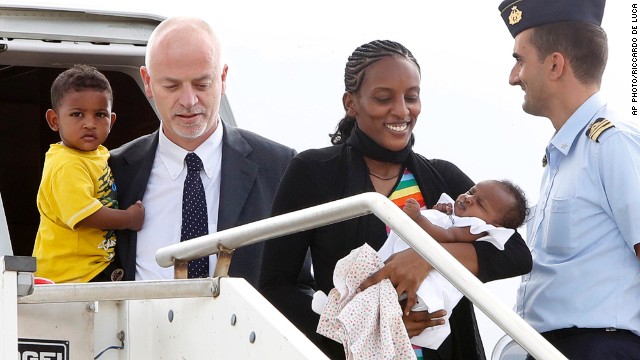
- Mariam Yehya Ibrahim and her family meet Pope Francis, thank him for his prayers
- Francis thanks Ibrahim and her family for their "courageous constant witness to faith"
- Ibrahim and her family will be in Italy for a short time before traveling on to the United States
- "Today is a day for celebration," says Italian Prime Minister Matteo Renzi
Rome (CNN) -- Mariam Yehya Ibrahim, the Sudanese Christian woman sentenced to death in Sudan because of her faith, arrived in Rome on Thursday, the Italian Foreign Ministry said.
Ibrahim "will remain in Italy for a short time and then will travel on to the United States," the ministry said.
Sudanese authorities had said Ibrahim was guilty of rejecting Islam in favor of Christianity, but her conviction for "apostasy" and adultery was overturned last month on appeal, following weeks of international controversy.
After her release, she and her husband, American Daniel Wani, were detained for two days, accused of falsifying travel documents after going to the airport in Sudan's capital, Khartoum. They were trying to fly to the United States with their baby daughter, who was born while Ibrahim was in prison, and toddler son.
Now their dream of starting a new life in the United States appears to be on the verge of becoming reality.
Not only that, but Ibrahim and her family met with Pope Francis at his private residence in Domus Santa Marta in Vatican City.
During the meeting Thursday, which lasted about half an hour, Ibrahim thanked the Pope for his and the Roman Catholic Church's support and prayers, the Vatican said.
He, in turn, thanked Ibrahim and her family for their "courageous witness and constancy of faith."
Francis also played with the children, 18-month-old Martin and 2-month-old Maya, and greeted the Italian diplomats involved in her journey to Italy.
With this gesture, the Vatican said, the Pope "desired to show his closeness, attention and prayer also to all those who suffer for their faith, in particular to Christians who are enduring persecution or limitations imposed upon their religious freedom."
Ibrahim has said that her mother, an Ethiopian Orthodox Christian, raised her as a Christian.
She remained steadfast in her faith despite the threat of a death sentence, saying at her sentencing hearing in May: "I am a Christian, and I will remain a Christian."
'Day for celebration'
Ibrahim and her family were earlier greeted at the airport in Rome by Italian Prime Minister Matteo Renzi.
In a brief statement to reporters at the airport, Renzi said, "Today we are very happy. ... Today is a day for celebration."
Speaking alongside him, Deputy Minister of Foreign Affairs Lapo Pistelli said Ibrahim and her children were well and in "excellent condition."
He said Pope Francis had been informed Wednesday by the Prime Minister that the family was coming to Italy, and that the government had worked to bring about a meeting between them.
"Mariam and her two children will have important meetings in the following days and then they will travel to the United States."
How Italy helped
Pistelli said Italy had become involved in the case because, as a Catholic country, it was very moved by Ibrahim's story and wanted to help.
Italy has good relations with Khartoum and offered to help the U.S. Embassy there to speed up the process of getting U.S. passports for Ibrahim and her family to leave the country, the minister said.
Pistelli said he had traveled to Sudan two weeks ago to start the process but it was not finalized until Wednesday night.
He posted an image to his Facebook page of himself with Ibrahim and the two children, apparently taken on board the plane shortly before their arrival in Rome. "Mission accomplished," he wrote.
Ibrahim, her husband and their two children are now in a protected government house, he said. It is unclear how long Ibrahim will stay in Rome before flying on to the United States, he said, adding that it had to do with passport procedures.
CNN has not yet been able to reach the U.S. Embassy or the Sudanese Foreign Ministry for comment.
Persecution claim
Ibrahim's ordeal began when one of her relatives, a Muslim, filed a criminal complaint saying her family was shocked to find out she had married Wani, a Christian, after she was missing for several years.
A Sudanese court considered Ibrahim a Muslim because her father was Muslim. She was charged with adultery, because a Muslim woman's marriage to a Christian man is illegal in Sudan. She was also charged with apostasy, accused of illegally renouncing what was alleged to be her original faith.
She insists she has never been a Muslim -- and says she was persecuted as a Christian while in prison.
Convicted when she was about eight months pregnant, she gave birth two weeks later while shackled.
On Monday, a Sudanese Islamic jihadi group which has previously claimed an attack on a Sudanese journalist released a statement threatening Ibrahim.
The group vowed to carry out what it said was the justified death sentence against Ibrahim that was repealed by a higher court.
Amid this threatening environment, Daniel Wani told CNN that his family had reported seeing unknown people outside their old residence in Khartoum. Their numbers had been increasing over the past few days, he said.
READ: Sudanese Christian woman: 'There's a new problem every day'
READ: Exclusive: Sudan apostasy woman's 'brother' says she should repent or die
READ: Why marrying for love should never mean death
CNN's Hada Messia reported from Rome and Nima Elbagir from Khartoum, while Laura Smith-Spark wrote in London.
Two-hour execution 'bungled, botched'
7/24/2014 5:33:58 AM
- Media witnesses say Joseph Wood gasped intensely
- His lawyers tried to halt it mid-execution and have Wood revived
- Arizona officials say he was snoring and did not suffer
- New drug combinations in lethal injections have sparked controversy
(CNN) -- The state of Arizona executed Joseph Wood on Wednesday. It took him nearly two hours to die after his veins were injected with a novel combination of two drugs.
Journalists in attendance said it was hard to watch the convicted murderer die. They were expecting the execution to be over swiftly, but it dragged on and on.
Wood's last breaths were like "a fish on shore gulping for air," said reporter Troy Hayden.
His slow death is fueling a debate that has kicked up as states look for new drug alternatives for lethal injections.
Did the execution with the new combination amount to "cruel and unusual punishment" and violate his constitutional rights?
It did, say Wood's lawyers. One of them called it "bungled" and "botched."
The state of Arizona disagrees.
The state corrections department followed protocol in Wood's execution, it said in a statement. It double-checked his "deep sedation" seven times between the time the execution procedure began at 1:52 p.m. local time and the time he was pronounced dead at 3:49 p.m.
Arizona execution raises questions over novel lethal injections
Lawyers rush to save him
Those seven checks were grueling for Wood's lawyers.
As the clock ticked, they filed an emergency motion to stop the execution and save Wood's life. He was "gasping and snorting for more than an hour," they said.
"He is still alive," the motion read. "This execution has violated Mr. Wood's Eighth Amendment right to be executed in the absence of cruel and unusual punishment."
One of the lawyers, Dale Baich, said the room was silent as Wood gasped. "I have witnessed 10 executions, and I had never seen that before," he said.
The corrections department differed in its description of Wood's breathing.
He wasn't gasping, the department said. He was snoring. Otherwise, his face and body were still.
Arizona Gov. Jan Brewer expressed concern about the length of time it took for Wood to die but backed up the corrections department.
"Inmate Wood died in a lawful manner, and by eyewitness and medical accounts he did not suffer," she said. The cruelty he inflicted on his murder victims and their families was much worse, she said.
Brewer directed the corrections department to review the execution process. In its statement, it confirmed it would review "the execution protocol and process."
Baich blasted Brewer over her assessment and called for an independent, outside investigation.
A federal judge ordered local officials to preserve all physical evidence in Wood's execution.
Deserved or wrong?
Witnesses to the execution also gave differing accounts of what they saw.
A relative of the two people Wood was convicted in 1989 of murdering -- his estranged girlfriend and her father -- didn't think he suffered and also got what he deserved.
"It sounded to me like he was snoring," said Jeanne Brown, whose father and sister were Wood's victims.
"You don't know what excruciating is," she said. "What's excruciating is seeing your dad laying there in a pool of blood, seeing your sister laying there in a pool of blood."
Michael Kiefer, a reporter for The Arizona Republic, has witnessed five executions, including Wood's.
"Obviously, something didn't go right," he said. "Usually it takes about 10 minutes, the person goes to sleep. This was not that."
He described Wood's breathing as a "deep, snoring, sucking air sound."
Opinion: 5 ways to improve the U.S. death penalty
Drug combination controversy
As with executions in other states with new lethal drug combinations, many of the objections have centered on the drugs themselves.
Defense attorney Baich vowed to look into how Arizona came up with the "experimental formula of drugs it used."
"Arizona appears to have joined several other states who have been responsible for an entirely preventable horror -- a bungled execution," he said.
The American Civil Liberties Union joined in his outrage.
"It's time for Arizona and the other states still using lethal injection to admit that this experiment with unreliable drugs is a failure," it said in a statement.
It called for Arizona and other states to prove the reliability of the drugs or stop the executions.
It's an old quarrel
The quarrel over the drugs used in lethal injections is not new.
Executions in the past have commonly been carried out with a combination of three drugs -- an anesthetic to render the inmate unconscious, followed by a paralyzing agent to keep him or her from flailing, then a third drug to kill the inmate, often potassium chloride to halt the heart.
The commonly used anesthetic was once sodium thiopental, which can also be used for surgical anesthesia.
Its sole U.S. manufacturer, Hospira, based in Illinois, stopped making it in 2011 to prevent it from being used in lethal injections. The company said it had never intended it to be used that way.
European manufacturers of the same drug refuse to export it to the United States for the same reason.
States wishing to continue with lethal injections have tried out new drug combinations.
In Wood's case, the authorities chose a combination of midazolam, which like sodium thiopental is an anesthetic, and hydromorphone, a narcotic pain killer commonly known by its brand name Dilaudid.
An overdose of hydromorphone halts breathing and stops the heart from beating, according to the National Institutes of Health.
Opinion: I was 17, on death row -- and innocent
Midazolam under fire
Midazolam has come under fire, after the state of Oklahoma used it in an execution that appeared to go awry.
Earlier this year, Oklahoma put executions on hold after the controversial death of inmate Clayton Lockett. Midazolam was part of the injection combination, and it took 43 minutes for him to die, Oklahoma officials said.
While state officials said Lockett was unconscious the entire time, a media witness for CNN affiliate KFOR said he uttered the words, "Man," "I'm not," and "something's wrong" before blinds to the execution chamber were closed.
His lawyer, Dean Sanderford, said the inmate's body twitched and convulsed before he died.
Wood had petitioned for a stay of execution before Wednesday, saying he feared a similar fate.
His lawyers filed documents with the state Supreme Court. They pointed to midazolam as problematic in recent U.S. executions. They said it would violate the Constitution's guarantee against cruel and unusual punishment.
Wood feared he would suffer
Wood was afraid the combination of midazolam and hydromorphone was experimental, that it would not put him completely out and that he would suffer, according to court documents.
He also argued that the execution should be stopped because his trial attorney was ineffective and that new evaluations from psychologists show he has cognitive impairments that would make him innocent of premeditated murder.
Though the combining of new drugs in lethal injections has sparked controversy, the use of the old combination of drugs that included sodium thiopental was also not fail-safe, medical critics have said.
It is possible with the old combination that executions were quicker and inmates flailed less, but they may have been conscious as they experienced their own executions, critics believe.
The real question to some of them is not if the specific drug is responsible for suffering, but if the method of execution itself is.
Mississippi mother swaps death row for jail cell to await trial
Death penalty facts that may surprise you
California's death penalty ruled unconstitutional
CNN's Mayra Cuevas, Dave Alsup, Ross Levitt and Michael Pearson contributed to this report.
Fighters escort jet to UK landing
7/23/2014 3:17:12 PM
(CNN) -- Military fighter planes escorted a Gulfstream jet to the London area's Stansted Airport on Wednesday evening after the jet lost contact with air traffic controllers, an airport spokesman said.
The Gulfstream landed at the airport, about 40 miles outside central London, about 7:45 p.m. local time and was escorted to a remote part of the airfield, Mark Davison said.
At least one flight was delayed as the Gulfstream was escorted to a landing. The airport was reopened after the Gulfstream parked.
Essex police had no immediate comment on the incident.
U.S. extends ban on flights into Israel's Ben Gurion Airport
Dozens feared dead in Taiwan plane crash
CNN's Andrew Carey contributed to this report.
Two fighter jets shot down in Ukraine
7/23/2014 8:08:05 PM
- NEW: Observers say Putin is under pressure at home and abroad
- U.S. officials: Russian troops moving closer to Ukrainian border
- Ukrainian security council spokesman says missiles may have been fired from Russia
- The shootdown comes six days after Malaysia Airlines Flight 17 was brought down
Donetsk, Ukraine (CNN) -- Were the missiles that shot down two Ukrainian military planes on Wednesday fired from the Russian side of the border?
That's a possibility that U.S. intelligence analysts are investigating, U.S. officials told CNN on Wednesday. Pro-Russian rebels quickly claimed credit for downing the military planes. And Ukrainian officials claimed the missiles that hit them might have been fired from inside Russia.
One thing is clear: Tensions in volatile eastern Ukraine seem to be ratcheting up, less than a week after a missile brought down Malaysia Airlines Flight 17 there.
Some of the 12,000-15,000 Russian troops near the eastern Ukraine border have broken up into smaller groups and moved within five miles or less of the border, and some are even positioned right at the border, according to two U.S. officials.
The movement gives the Russian troops the ability to fire surface-to-air missiles, rockets and artillery from inside Russia at Ukrainian positions without having to acknowledge their own presence, the U.S. officials said.
At the same time, the Russians are continuing to reinforce and ship additional weapons into Ukraine "while the world's attention is on MH17," one U.S. official told CNN.
There is also intelligence indicating some rebels have left Ukraine and gone across the border into hiding inside Russia. But the officials said it's not known if any of those people were associated with the shoot-down of MH17.
"What we know is that, incredibly, even after the shootdown of the Malaysia Airlines flight, Russia has persisted in a pattern of destabilization against Ukraine. It's continued to send fighters and heavy weapons, tanks and missile launchers across the Ukrainian border," said Geoffrey Pyatt, the U.S. ambassador to Ukraine.
If it's confirmed that the missiles that brought down the Ukrainian military planes came from the Russian side of the border, Pyatt told CNN, it would be an "outrageous, continued escalation of the crisis by Russia even after the SA-11 (Russian-made missile system) brought down an airplane, leading to the death of nearly 300 innocent people."
In response to reports that Russia continues to arm rebels in Ukraine, the White House is now looking at expanding sanctions on Moscow. Just last week, President Obama announced the U.S. would impose new sanctions on specific targets in Russia's critical energy, banking, and defense industries.
But Deputy National Security Adviser Ben Rhodes told reporters gathered at the White House that the United States might go even further.
"We're continuing to develop our own set of options. The fact is that Russia continues to arm separatists. And so we think there needs to be continuing ratcheting up," Rhodes told reporters.
Putin under pressure
It's unclear whether Wednesday's shootdown was the work of pro-Russian rebels inside Ukraine, or Russian forces themselves -- and whether Russian President Vladimir Putin knew about or approved the operation.
For months, Putin has accused NATO of building its forces in the region to threaten Russia.
"The scale of the training and preparedness is also increasing," Putin said recently. "It is important to prepare our defenses on schedule."
As calls mount from the United States and other Western countries for more stringent sanctions against Russia, Putin took a more conciliatory tone in his most recent public statement.
"There are calls for us to influence the militants," he said earlier this week. "We will do everything in our power."
Jill Dougherty, a Russia expert and CNN's former Moscow bureau chief, said Putin is facing enormous pressure both from the international community and domestically. Business elites are pushing to avoid more sanctions, and Russian nationalists want the country to be tougher on Ukraine.
"You can almost see it, his balancing, he does this when he talks," Dougherty said. "He is a judo expert. And he is prepared, he's ready to parry, thrust and protect Russia from what he expects are going to be the threats."
Ukraine: Pilots ejected after planes were hit
An air defense system shot down the Ukrainian jets Wednesday after the pilots completed a task in Dmytrivka, a village in Ukraine's Donetsk region near the border with Russia, the Ukrainian military's press office said.
The jets' pilots ejected from the planes after they were hit, the military said. Information on their condition wasn't immediately available.
Sergei Kavtaradze, an aide to rebel leader Alexander Borodai, the Prime Minister of the self-declared Donetsk People's Republic, told CNN that the two jets had been shot down by rebel fighters using a shoulder-fired missile system.
But Col. Andriy Lysenko, a spokesman for the Ukrainian National Security and Defense Council, said preliminary information suggested the missiles might have been launched from inside Russia.
The planes were flying at an altitude of 5,200 meters (17,000 feet) when they were hit, he said.
News of the jets' downing Wednesday comes six days after the deadly crash of the civilian passenger plane Malaysia Airlines Flight 17 in eastern Ukraine.
Ukrainian officials have previously accused pro-Russian rebels of shooting down several military aircraft.
In the week leading up to the July 17 crash of MH17, Ukrainian officials said an Antonov An-26 transport plane and a Sukhoi Su-25 fighter jet had been brought down. The Ukrainian military said the missile that struck the Su-25 had been fired from Russian territory.
The latest reported shootdown highlights the ongoing conflict in eastern Ukraine's Donetsk and Luhansk regions between the rebels and Ukrainian security forces.
A CNN team on the ground in Donetsk was turned away by rebel fighters at the entrance to the town of Snizhne, near Dmytrivka. The militants said they had orders not to allow people to travel farther because of fighting.
A jet could be heard passing periodically very high overhead, while on the ground, ambulances rushed past, as did a convoy of rebel fighters in civilian vans and cars.
Claim and counterclaim
The first caskets carrying remains of the crash victims arrived in the Netherlands on Wednesday, where they were met by family members, Dutch King Willem-Alexander and Queen Maxima and other dignitaries. About two-thirds of the 298 victims were Dutch.
As the solemn tribute continued, accusations did not stop.
Meanwhile, the finger-pointing continues over who was responsible for bringing down Flight MH17, a Boeing 777.
U.S. officials say pro-Russian rebels were responsible for shooting down that plane, but they say they now believe it's likely the rebels didn't know it was a commercial airliner, U.S. intelligence officials said Tuesday.
However, Vitaly Nayda, Ukraine's director of informational security, told CNN's Kyung Lah that the person who shot down the flight was "absolutely" a Russian. "A Russian-trained, well-equipped, well-educated officer ... pushed that button deliberately," he said.
Moscow has denied claims that it pulled the trigger. And Russian Army Lt. Gen. Andrei Kartapolov suggested a Ukrainian jet fighter may have shot the plane down. Ukraine's government rejects that claim.
READ: Bodies of some MH17 victims get somber send-off from Ukraine
READ: Who are Ukraine's pro-Russian rebels?
READ: Map: Europe's thirst for Russian gas
CNN's Phil Black reported from Donetsk and CNN's Barbara Starr and Brian Todd reported from Washington. Journalist Victoria Butenko and CNN's Laura Smith-Spark, Catherine E. Shoichet, Kyung Lah, Jim Acosta, Ingrid Formanek and Ivan Watson contributed to this report.
9/11 report: Terror threat far from over
7/23/2014 2:27:54 PM
- Americans don't realize the terrorist threat they face, a new report says
- Get used to "strenuous counterterrorism efforts," the 9/11 commission says
- It issued a new assessment 10 years after its report on the 9/11 terrorist attacks
- Cyber attacks have become a major threat, the new report says
Washington (CNN) -- America's longest war. Much more National Security Agency surveillance. An alphabet soup of new government departments and agencies. Long security lines at airports.
All those things happened in response to the 9/11 al Qaeda attacks on New York and the Pentagon that forever changed U.S. security perceptions and practices.
Now a commission created to examine what happened then says we need to do more now to protect ourselves.
Read the 9/11 Commission's new report
"The 'generational struggle' against terrorism described in 'The 9/11 Commission Report' is far from over," the panel said this week in reference to its assessment a decade earlier. "Rather, it is entering a new and dangerous phase, and America cannot afford to let down its guard."
Its bottom line assessment? "Strenuous counterterrorism efforts will remain a fact of our national life for the foreseeable future."
Here is a look at the report, analyzing what has worked, what hasn't and has to happen now.
WHAT WORKED
Going after al Qaeda's leadership
The immediate reaction to the hijack attacks that toppled the World Trade Center towers and damaged the Pentagon targeted the culprit -- the al Qaeda network of Osama bin Laden operating out of Afghanistan near the Pakistani border.
Years of war in Afghanistan ended the safe haven there for terrorists and achieved the goal of degrading al Qaeda's core, the report said. U.S. special forces eventually killed bin Laden in Pakistan.
Air travel security
Long security lines, reinforced cockpit doors, removing laptops from carry-on bags, no liquids, checking shoes -- all followed the attacks that killed 3,000 people.
A no-fly list that had 16 names before the attacks now has more than 1,000, the report noted.
So far, no similar foreign attack has occurred in America. The closest call came in 2009 when Umar Farouk Abdulmutallab failed to ignite an explosive in his underwear as a Northwest Airlines jet from Amsterdam approached Detroit on Christmas Day.
Expanded government
The Department of Homeland Security. The director of National Intelligence and the National Counterterrorism Center. The Transportation Security Administration. The FBI National Security Branch and the military's Cyber Command.
All exist in response to the 9/11 attacks as part of an unprecedented expansion and reorganization of government security resources.
"These measures have largely succeeded," the report said. "The mass-casualty attacks many feared in the wake of 9/11 did not materialize. Today, in large part because of these many reforms, the United States is a much harder target."
NSA surveillance
The security apparatus also expanded its ability to track telephone and computer communications after 9/11.
Former NSA contractor Edward Snowden leaked classified details of those programs last year, revealing they were much broader and potentially intrusive than publicly known.
A resulting backlash at home and abroad caused the Obama administration to make some changes without substantively changing the ability to monitor suspect communications.
"We believe these programs are worth preserving, albeit with additional oversight," the report said.
The American spirit
The Boston Marathon went on as scheduled this spring, undeterred by the terrorist bombings at the finish line a year earlier, the 9/11 commissioners noted.
"This year's triumphant marathon sent an unmistakable message to the world: Americans will not bend to terrorism," the report said, adding that "the country must continue to prepare for the unforeseen, but it appears to be moving in the right direction."
WHAT HASN'T WORKED
Full disclosure
The new report's biggest takeaway? Tell the people what they need to know.
Prior to the 9/11 attacks, "the government did not effectively explain to the public the evil that was stalking us," it said. "We fear that this is happening again."
On major issues of the day -- a transformed and resurging al Qaeda, the growing terrorist haven spawned by the Syrian conflict, increasing cyber threats -- "public awareness lags behind official Washington's," it said.
"If this gap persists, the political support for needed national security capabilities will fade," the report continued. "In today's very dangerous world, that is something we can ill afford."
Efforts to reduce Islamic extremism
Islamic extremism has increased in the past decade, the report said.
"While al Qaeda's various affiliates are enmeshed in their own local conflicts, hatred of the United States remains a common thread," it added, citing the emergence of groups such as Al Qaeda in the Arabian Peninsula, the Islamic State of Iraq and Syria, Al Shabaab and Boko Haram.
"Partly, this is a consequence of the Arab Spring and the power vacuums and ungoverned spaces that have sprung up in its wake," it said. "Partly, it is the result of America's inability or reluctance to exert power and influence in a number of places."
In particular, the commissioners noted their 2004 report on the 9/11 attacks said that if Iraq became a failed state, "it will go to the top of the list of places that are breeding grounds for attacks against Americans at home."
Today, the Islamic State of Iraq and Syria controls vast territory in those countries, creating "a massive terrorist sanctuary," the latest report said.
A State Department official warned a congressional committee on Wednesday that "ISIS is al Qaeda."
"It may have changed its name, it may have broken with senior al Qaeda leadership such as Ayman al-Zawahiri, but it is al Qaeda in its doctrine, ambition and increasingly in its threat to U.S. interests," said Brett McGurk, the deputy assistant secretary for Iraq and Iran. "In fact it is worse than al Qaeda."
Congress
Not surprisingly, a dysfunctional Congress with some of the lowest approval ratings also gets cited by the 9/11 commissioners.
The funding process for national security is fragmented, with multiple budget categories providing the money. In addition, the Homeland Security Department reports to more than 90 congressional committees and subcommittees.
"While the executive branch has undergone historic change and institutional reform, Congress has proved deeply resistant to needed change," the report said. "It has made some minor adjustments, but not the necessary structural changes in oversight and appropriations for homeland security and intelligence."
WHAT NOW
Prepare better for cyber attacks
According to the report, readiness to deal with cyber attacks "lags far behind the threat."
The commissioners noted the issue got little mention in their 2004 report, but now represents a constant and growing concern.
"One lesson of the 9/11 story is that, as a nation, Americans did not awaken to the gravity of the terrorist threat until it was too late," the report said. "History may be repeating itself in the cyber realm."
It called for government leaders to "describe to the American people, in terms as specific as possible, the nature of the threat and the tools they need to combat it."
"A growing chorus of senior national security officials describes the cyber domain as the battlefield of the future," the report said. "Yet Congress has been unable to pass basic cybersecurity legislation, despite repeated attempts."
Use of military powers
After 2001, Congress authorized the use of military forces against terrorists behind the 9/11 attacks. It remains the legislative permission slip today.
The report said the authorization needs updating, calling on the administration to "clearly explain whether it needs new legal authority to confront threats like ISIS and how far, in its view, any new authority should extend."
Better oversight
Streamline the system so that the NSA and the Homeland Security Department have more clear and direct oversight, the report recommended.
"If Congress is not effectively overseeing these programs, no one is," the report said.
Vigilance
The biggest threat to America is failing to recognize the threat still exists and is growing.
"Many Americans think that the terrorist threat is waning—that, as a country, we can begin turning back to other concerns," the report said. "They are wrong."
The threat remains "grave," it continued, warning "we cannot afford to be complacent—vigorous counterterrorism efforts are as important as ever."
In particular, the report said, "young Americans need to know that terrorism is not going away."
CNN's Mike M. Ahlers and Jeremy Diamond contributed to this report.
Chief Ebola doctor contracts the virus
7/23/2014 7:57:49 PM
- Dr. Sheik Humarr Khan is being treated at a hospital in the Sierre Leone capital of Freetown
- The Ministry of Health took to Facebook to deny reports the doctor died
(CNN) -- A doctor who has played a key role in fighting the Ebola outbreak in Sierra Leone is infected with the disease, according to that country's Ministry of Health.
Dr. Sheik Humarr Khan is being treated by the French aid group Medicins Sans Frontieres -- also known as Doctors Without Borders -- at a hospital in the capital city of Freetown, Tim Shenk, an agency spokesman, told CNN on Wednesday.
Until falling ill, Khan had been overseeing Ebola treatment and isolation units at Kenema Government Hospital, about 185 miles east of Freetown.
Citing patient confidentiality, Shenk declined to provide additional details about Khan's condition.
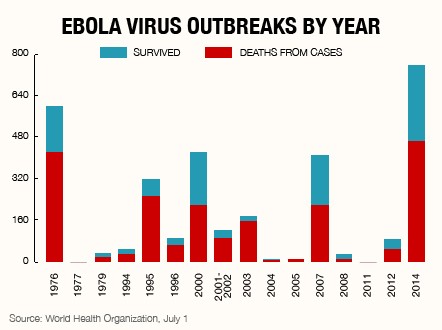
The Ministry of Health took to Facebook to deny reports the doctor had died.
The ministry "wishes the general public and all partners working in the healthcare sector to know that Dr. (Shiek) Umar Khan is still alive and responding to treatment contrary to social media report of his demise," according to a Facebook post.
Sanjay Gupta: 'It only took moments'
Sierra Leone has had 427 confirmed cases of Ebola and 144 deaths, according to figures released Wednesday by the health ministry.
That puts it, along with Guinea, at the center of an outbreak of the virus that has steadily spread through western Africa since it began earlier this year. More than 1,000 people have contracted Ebola in Sierra Leone, Guinea and Liberia, according to the World Health Organization.
Ebola typically kills 90% of those infected, but the death rate in this outbreak has dropped to roughly 60% thanks to early treatment.
What is Ebola, and why does it kill?
Officials believe that the Ebola outbreak has taken such a strong hold in West Africa due to the proximity of the jungle -- where the virus originated -- to Conakry, which has a population of 2 million. Since symptoms don't immediately appear, the virus can easily spread as people travel around the region. Once the virus takes hold, many die in an average of 10 days as the blood fails to clot and hemorrhaging occurs.
The disease isn't contagious until symptoms appear. Symptoms include fever, headache and fatigue. At that point, the Ebola virus is spread via bodily fluids.
Get the fast facts on Ebola
Health workers are at especially high risk, since they are in close contact with infected people and their bodily fluids. Adding to the danger, in the initial stages of infection doctors may mistake an Ebola infection for another, milder illness.
Aside from his work on Ebola, Khan also serves as the lead physician of the hospital's Lassa Fever Program, another fearsome tropical disease. The hospital's official biography page states Khan took on that job when his predecessor died of Lassa Fever.
China meat scandal affects U.S.
7/23/2014 3:45:29 PM
Video from a factory in China shows workers picking meat off the floor before processing it. David McKenzie reports.
If your browser has Adobe Flash Player installed, click above to play. Otherwise, click below.
China flights to be disrupted for weeks
7/23/2014 2:10:36 AM

- Military exercises thought to be behind China flight cancellations and delays for next three weeks
- Domestic travelers switching to train travel, leading to overcrowded trains
- 12 airports in China to be affected, including both Shanghai airports
(CNN) -- For the next three weeks at least, flying to and within China is going to be a stressful affair, for even the hardiest of travelers.
Hundreds of flights were canceled or delayed Monday and China's civil aviation regulator warned that more flights in 12 airports will be affected over the coming three weeks.
The worst affected airports so far have been Shanghai's two airports -- Pudong and Hongqiao -- two of the country's busiest airline hubs. Another 120 flights were delayed for more than two hours.
Domestic travelers have been switching to high-speed trains (Chinese only) after hearing of the widespread delays, leading to severe overcrowding on main rail routes some have likened to the Chinese New Year migration.
Officials and airlines have shed little light on the reasons for the disruptions but local media have suggested the cause is due to military exercises.
Speculation is rife on social media.
"Perhaps I'm ill-informed but I've never heard of any other countries' military exercises affecting civil airlines on such a large scale," posted user @luoyu on Weibo, China's version of Twitter.
"I've also never seen such vast adjustments affecting a quarter of civil airlines' flights in China's history. Whatever is causing the wide-scale delays, it's making history."
What's going on?
Local officials cited "air traffic restrictions" while Shanghai-based China Eastern Airlines said "the airspace was occupied," according to the Shanghai Daily newspaper.
"Among situations for air traffic restrictions being imposed are when military maneuvers are taking place," the newspaper added.
CCTV, the state television channel, shared on its Weibo account -- China's equivalent of Twitter -- a widely circulated memo, originally published on a Chinese flight crew blog, that said the civil aviation authority has requested airlines to reduce flights by 25% in eastern China.
Hundreds of flights to and from eastern China were canceled or delayed Monday, with 200 flights canceled at Pudong and Hongqiao. Flights departing from other eastern Chinese cities' airports, including Nanjing and Hangzhou, were also affected.
MORE: And the world's best airline 2014 is...
Where to expect delays
"The following 12 airports will experience massive delays for 26 days! Fliers, bring snacks and water!" the CCTV post said.
"From July 20 to August 15, operations of these airports -- including Shanghai Hongqiao, Shanghai Pudong, Nanjing, Hangzhou, Hefei, Jinan, Wuxi, Ningbo, Qingdao, Lianyungang, Zhengzhou and Wuhan -- will be affected by high-frequency exercises conducted by another party. All airlines are requested to reduce flights by 25% and fliers are expected to face delays."
Officials at the Civil Aviation Administration of China declined to comment when approached by CNN.
Past delays
This is the second large-scale air traffic disruption in China in the last two weeks.
More than 100 flights were canceled or delayed on July 14 in Shanghai.
In December 2006, Shanghai Pudong International Airport closed and hundreds of flights were canceled or delayed due to military exercises.
Two Internet users have been held by police for allegedly fabricating and circulating "anti-corruption-related" claims, according to Hong Kong newspaper South China Morning Post.
The Internet users claimed the disruption was due to the arrest of a high-ranking government official trying to flee the country.
Another 37 people were reprimanded in the crackdown against Internet "rumor mongers," according to SCMP.
China's air traffic woes continue
Lengthy flight delays are common in China.
The country's largest airports, serving the mega-cities of Shanghai and Beijing, suffer some of the worst flight delays in the world.
In June 2013, Beijing's Capital International Airport hit the bottom of a list of the world's most delayed airports, according to U.S.-based air travel information service FlightStats.
Just 18.3% of flights from the airport left on time during that month and around 42% of flights suffered delays of 45 minutes or longer.
Second worst on the list was Shanghai's Hongqiao, where just 24% of flights departed on time.
Overly cautious air traffic control and airspace restrictions for civilian aircraft are two of the reasons for these delays, but flights are also affected by thick smog and once, an unidentified flying object (UFO).
MORE: Delayed! Why flying in China is hard
Maggie Hiufu Wong, Steven Jiang, Frances Cha and Daojun Wu contributed to this report.
You are receiving this email because you subscribed to this feed at feedmyinbox.com
If you no longer wish to receive these emails, you can unsubscribe from this feed, or manage all your subscriptions

No comments:
Post a Comment