 | CallFire offers affordable Voice Broadcast solutions for businesses just like yours. Smarter communication for today's mobile-driven market. Sign up free! From our sponsors |
| CNN.com - Top Stories |
| CNN.com delivers up-to-the-minute news and information on the latest top stories, weather, entertainment, politics and more. |
How pro-Russian rebels built arsenal
7/20/2014 10:15:47 AM
- Rebels have downed Ukrainian planes flying at high altitudes
- A pro-Russian rebel commander shows off anti-aircraft missiles
- The border region with Russia is very porous, unguarded in many places
- Some contend that larger weapons have come into Ukraine from Russia
(CNN) -- Under a blazing sun in early June, a group of pro-Russian rebels in eastern Ukraine were digging amid pine woods near the town of Krazny Liman.
Their grizzled commander was a bearded man in his 50s who would not tell us where he was from, but acknowledged that he wasn't local. He was proud to show off his unit's most prized possession -- a truck-mounted anti-aircraft unit that was Russian-made.
He told us the weapon had been seized from a Ukrainian base.
A few miles away, in the town of Kramatorsk, rebel fighters displayed two combat engineering tanks they said they had seized them from a local factory. Eastern Ukraine has long been a center of weapons production. They had parked one of the tanks next to the town square.
These were just two instances of how the rebels in eastern Ukraine were steadily adding more sophisticated weapons to their armory, including tanks, multiple rocket launchers -- and anti-aircraft systems.
In early June, they began to target Ukrainian planes and helicopters, with some success.
The day after we met the commander in the pine woods, an Antonov AN-26 transport plane was brought down over nearby Slovyansk.
Several Mi-8 and Mi-24 helicopters were also hit in this period, as was an Ilyushin IL-76 cargo plane near Luhansk -- it is about the size of a passenger jet.
Forty-nine military personnel were killed when the IL-76 crashed short of the airport.
For the most part, these aircraft were flying at relatively low altitudes, and were targeted by shoulder-launched SA-7 missiles and anti-aircraft guns. The pro-Russian rebels had taken control of several Ukrainian military depots and bases and stripped them of their weapons.
The SA-7 was standard Soviet issue. Relatively easy to operate, it is effective to altitudes of some 2,500 meters (8,000 feet).
But it and ZU 23-2 anti-aircraft batteries, which rebel units also obtained, are a world away from the SA-11 or "Buk" system that seems increasingly likely to have been used to shoot down Flight MH17 on Thursday.
Stealing a Buk
Could the pro-Russian rebels have acquired a serviceable Buk from a Ukrainian base and operated it? The evidence is circumstantial; a great deal of Ukrainian military hardware is in poor condition or redundant.
But on June 29, rebels raided the Ukrainian army's A-1402 missile facility near Donetsk. Photographs show them examining what they found.
The Russian website Vosti ran an article the same day titled "Skies of Donetsk will be defended by surface-to-air missile system Buk."
The article claimed: "The anti-air defense point is one of the divisions of the missile corps and is equipped with motorized "Buk" anti-aircraft missile systems."
Peter Felstead, an expert on former Soviet military hardware at Janes IHS, says that "the Buk is in both the Russian and Ukrainian inventories, but it's unclear whether the one suspected in the shoot-down was taken by rebels when they overran a Ukrainian base, or was supplied by Russia."
He told CNN that the Buk "would normally operate with a separate radar that picks up the overall air picture. This was almost certainly not the case with MH17," making it more difficult to identify the target and track its course.
Among the pro-Russian rebels are fighters who served in the Russian army. It is possible that some were familiar with the Buk, but Felstead agrees with the U.S. and Ukrainian assessment that Russian expertise would have been needed to operate it.
"The system needs a crew of about four who know what they're doing. To operate the Buk correctly, Russian assistance would have been required unless the rebel operators were defected air defense operators - which is unlikely."
It is now the "working theory" in the U.S. intelligence community that the Russian military supplied a Buk surface-to-air missile system to the rebels, a senior US defense official told CNN Friday.
Russia has denied that any equipment in service with the Russian armed forces has crossed the border into Ukraine. And Aleksander Borodai, the self-described prime minister of the Donetsk People's Republic, said Saturday his forces did not have weapons capable of striking an aircraft at such a high altitude.
But someone in the border region where eastern Ukraine meets Russia has been using an advanced anti-air missile system.
Late Wednesday, the day before MH17 was presumably hit, a Ukrainian air force Sukhoi Su-25 combat jet was shot down close to the border with Russia.
The Ukrainian Defense Ministry told CNN that the plane was flying at 6,200-6,500 meters (about 21,000 feet) and was hit near a town called Amvrosiivka, which is only some 30 kilometers (20 miles) from where MH17 was hit and 15 kilometers (10 miles) from the border with Russia.
The Ukrainian military alleged the missile had been fired from Russian territory. It was the first time that a combat jet flying at high speed had been hit and came two days after an AN-26 -- flying at a similar altitude in the same area -- was shot down further north, in the Luhansk area.
Smuggling on the black roads
The Russian Defense Ministry said Friday that weapons could not be smuggled across the border "secretly." But they can.
By early June, rebels controlled several crossings along a stretch of border more than 200 kilometers (125 miles) long. The border area is open farmland that was neither patrolled regularly nor even marked in many places.
Dozens of unmonitored tracks known as black roads -- because they have been used for smuggling -- cross the border. Additionally, the Ukrainian border guard service was in disarray after an attack on its command center in Luhansk early in June.
On the road east toward the border through the town of Antratsyt there was no sign of a Ukrainian military or police presence. The pro-Russian rebels had already begun to bring across heavy weapons at that point.
A CNN team visited the border post at Marynivka in June, soon after a five-hour firefight involving border guards and members of the self-declared Vostok battalion of rebels who had been trying to bring over two Russian armored personnel carriers.
They had been abandoned during the battle.
The unknowns are these: Just how much weaponry has been brought in from Russia, how was it obtained, and did it include the SA-11 Buk?
In June, the U.S. State Department claimed that three T-64 tanks, several rocket launchers and other military vehicles had crossed the Russian border. Ukraine made similar accusations, saying the weapons had gone to Snezhnoe, a rebel stronghold close to where MH17 came down.
The State Department said the tanks had been in storage in south-west Russia, suggesting collusion between the Russian authorities -- at some level -- and the rebels. It said at the time that the equipment held at the storage site also included "multiple rocket launchers, artillery, and air defense systems."
It added, notably, that "more advanced air defense systems have also arrived at this site."
Moscow rejected the claims as fake.
NATO has also released satellite images which, it said, showed tanks in the Rostov-on-Don region in Russia early in June, before they were taken to eastern Ukraine. The tanks had no markings.
Even so, some experts, such as Mark Galeotti at New York University's Center for Global Affairs, say the evidence is largely circumstantial. NATO's images did not show the tanks actually crossing into Ukraine.
Wherever they came from, Russian language websites soon featured calls for people with military skills to call a number associated with the separatist Donetsk People's Republic if they could help operate or maintain the tanks.
One answered, "I served in the military engineering academy...and am a former commander in the intelligence."
But the separatists' greatest vulnerability was always from the air.
The Ukrainians had already shown, in driving them away from the Donetsk airport at the end of May, that they could use airpower to devastating effect. And they had begun to fly at higher altitudes to avoid shoulder-launched missiles.
To hold what remained of their territory, the pro-Russian rebels needed to be able to challenge Ukrainian dominance of the skies.
Whether they received help from across the border to do so, and in what way, is the question that governments around the world want answered.
READ: Is this any way to secure a plane crash scene?
READ: Who should investigate MH17 crash?
READ: Athlete, soccer fans, vacationing family among Malaysia Airlines crash victims
Who will speak for the MH17 victims?
7/20/2014 10:41:19 AM
- Nearly 200 of the MH17 victims are from the Netherlands
- Frida Ghitis: Anger is growing against the pro-Russian separatists
- She says the Dutch resist impulsiveness, believe in international cooperation
- Ghitis: Now is the time for Dutch government to lead and press for justice
Editor's note: Frida Ghitis is a world affairs columnist for the Miami Herald and World Politics Review. A former CNN producer and correspondent, she is the author of "The End of Revolution: A Changing World in the Age of Live Television." Follow her on Twitter @FridaGhitis. The opinions expressed in this commentary are solely those of the author.
(CNN) -- The front-page headline put it plainly: "MURDERERS," it accused in huge capital letters, trying to capture the national mood in the Netherlands during a time of grief and anger.
Below the headline the paper printed a photo of scowling, heavily armed pro-Russia separatists in eastern Ukraine, men who many believe fired the missile that brought down Malaysia Airlines Flight 17, with support from Vladimir Putin's Russia.
The Dutch government, to no one's surprise, is moving much more cautiously than the populist press -- too cautiously, in the opinion of many, who are taking to social media to demand more forceful action, echoing the words of U.S. President Barack Obama, who called Thursday's disaster "a wake-up call to Europe."

Not usually known for impulsiveness, the Dutch are demanding that their government respond. No country lost more people on MH17. That puts the Netherlands in a position of moral leadership in the aftermath of the attack. With nearly 200 Dutch citizens on board, it seems almost everyone in the Netherlands has a connection to a passenger on the plane. In a nation of travelers, everyone feels it could have been them or one of their loved ones.
The flags across the country are at half-staff as the magnitude of the loss begins to take shape: An entire family of six wiped away, a leading AIDS researcher, a senator and professor of jurisprudence, a member of parliament along with his wife and daughter -- one son had stayed behind.
One of the most prominent among the Dutch victims was Joep Lange, former president of the International AIDS Society, and a pivotal figure for several decades in the fight against AIDS. He played a key role in developing the treatment protocols that helped HIV patients survive and in making treatment affordable for patients around the world.
The majority of the passengers of MH17-- 193 out of 298 -- were Dutch.
At the crash site, a Dutch journalist posted photos of the horror. "This probably hurts the most," he tweeted, showing a picture of an "I love Amsterdam" T-shirt resting on the debris field.
One by one, the people of the Netherlands are hearing the names, learning the stories. One elementary school, St. Willibrord, announced the terrible news on its website: "Dear parents and guardians, as you may have already heard, the whole Wals family was on the plane that crashed in Ukraine." Similar announcements are appearing in many villages, in places of work and community centers throughout the country; pictures of youngsters setting out on vacation are surfacing, along with images of the wreckage from the Ukrainian field, the travel guides, the children's stuffed toys.
Now that the names and faces of the victims are being made public, disbelief is giving way to outrage -- mostly targeted at Russian President Vladimir Putin -- along with frustration that the Dutch government is moving too cautiously because of economic concerns. Russia is the Netherlands' third-largest trading partner.
"I'm getting totally sick from the cowardly, spineless focus in business interest," said one online comment. Others, online and in private conversations, offered specific, practical ideas about how to respond.
One suggested expelling the Russian ambassador. Someone else said the crash area should be secured by an international military force while investigators, Dutch and others, do their work.
A Dutch physician who was a classmate of Lange, the AIDS researcher, told me she blames Putin for his role in backing the separatists: "All diplomatic ties with Russia should be suspended until he has been brought to justice. ... This would not have happened if it weren't for him." This, she said, "is our 9/11."
Another, skeptical of her country's ability or willingness to act, said nothing will be done unless the U.S. takes the lead.
Russia has been stirring trouble in Ukraine -- inside Europe -- for many months. Some of us have warned that things would get much worse and suggested economic trip wires, escalating sanctions that will go into effect if Russia makes more military moves. But Putin's bullying tactics have successfully instilled fear of retaliation, particularly in parts of Europe that use Russian gas to stay warm in the winter.
The shooting down of a passenger airliner may now, finally, change the calculus. If this doesn't, what will?
The Netherlands is not yet ready to indict the Russian president or the militias he supports, the separatist forces in eastern Ukraine. But Dutch Prime Minister Mark Rutte is growing visibly impatient with Putin, and he is undoubtedly feeling domestic pressure.
On Friday he vowed to find and punish the perpetrators. On Saturday, British Prime Minister David Cameron said he and Rutte had agreed it's time to reconsider Europe's relations to Russia.
Later, Rutte -- clearly irritated with restrictions on access to the crash site and the "utterly disrespectful behavior" of the gunmen controlling the area -- said he had "an extremely intensive" talk with Putin, warning that time was running out for the Russian president to show he is trying to help.
Each one of the 193 Dutch dead, as well as the 43 Malaysians, 28 Australians, and every single person who died in this atrocity, is a tragedy that shakes their families and their communities. It's a chilling reminder that global politics intersects with human lives, and can do so when and where we least expect it.
The disaster puts the Netherlands in a position that goes against its instincts, but one that it cannot avoid. The Dutch are not warmongers. They are consensus-builders, methodical, averse to impulsiveness. The Netherlands has long hosted many international institutions. The city of The Hague is synonymous with international justice. Dutch cells hold war criminals on behalf of the international community, and courtrooms in the Netherlands are the scene of legal dramas over historic misdeeds.
Surely, the Dutch Prime Minister would feel more comfortable following someone else's lead, voting along with other countries in some international body to condemn someone "in the strongest terms."
But strong words and front page headlines are not enough when 298 civilians are killed in a passenger plane.
This time, the Netherlands stands at the center of an affront against the civilized world. This time, the people of the Netherlands are demanding that their country stand up and acknowledge its role to fulfill. This time, the Netherlands has to lead -- and the rest of the world should urge it to set a course of firm action.
Read CNNOpinion's new Flipboard magazine.
Follow us on Twitter @CNNOpinion.
Join us on Facebook.com/CNNOpinion.
Ukraine: Rebels in possession of 192 bodies from crash
7/20/2014 9:33:42 AM
- NEW: Rebels say they might have black boxes, will turn them over if experts confirm
- U.S. secretary of state says drunken separatists reportedly moving bodies
- John Kerry also says it is clear missile system was transferred from Russia
- Reuters distributes video labeled as showing "black box" found
Send iReport your photos and videos.
Grabove, Ukraine (CNN) -- Twenty-seven more bodies have been found at the MH17 crash site in the Donetsk region of Ukraine, Vice Prime Minister Volodymyr Groysman said Sunday. That brings to 233 the total number of bodies recovered from the passenger jet, which was shot down on Thursday.
Pro-Russia separatists are keeping the remains of 192 of those MH17 victims in refrigerated cars on a train, Groysman said, adding that talks are ongoing for their release.
Meanwhile confusion is still rife over the state of the investigation into the crash of the downed plane, which killed all 298 people on board.
The State Emergency Service said the search in the remote area of eastern Ukraine, roughly 40 kilometers (25 miles) from the Russian border, was being "complicated by armed separatists at the site who hinder the work of SES units."
It said that 380 official staff members are taking part in the search for the remains of the MH17 victims, covering an area stretching across 34 square kilometers (13 square miles).
They were being helped by busloads of volunteers from local coal mines who fanned out across the wheat fields where the bodies and debris from the plane fell to earth Thursday.
The situation at the crash site showed some small signs of improvement, with more control and more activity. But it was still far from a well-organized investigation scene, and the area was still under the control of pro-Russia rebels.
Many of the bodies that had littered the fields previously were gone by late morning Sunday as CNN teams observed the crash site, but it was not immediately clear where they had been taken.
Government emergency workers prevented vehicles from driving up the road to the main crash site, but people could still roam around the fields on foot.
U.S. Secretary of State John Kerry told CNN's "State of the Union with Candy Crowley" that there were reports Sunday of "drunken separatists piling the remains of people into trucks in an unceremonious fashion."
He said he spoke Saturday with Russian Foreign Minister Sergey Lavrov in what he called a "direct and tough conversation."
Russia needs to help ensure that investigators can conduct a thorough investigation, he said.
Bodies on train cars
Large numbers of bodies have been collected on refrigerated train cars at a station near the crash site, international observers told CNN.
The observers, from the Organization for Security and Co-operation in Europe, said they have been told the bodies are from the crashed plane but they can't independently confirm that.
The 14-member OSCE team said the train will remain in place until international specialists arrive. It was not clear when that would be or where the train might take the bodies.
It's hard to get reliable information at the scene because several groups of pro-Russian rebels, some of them masked, control the checkpoints leading to the crash site.
"There doesn't seem to be one commander in charge," Michael Bociurkiw, a spokesman for the OSCE observers, told CNN on Saturday.
Rebels are suspected of shooting down the plane with a Russian-made surface-to-air missile.
Three air crash investigators from Ukraine accompanied the OSCE observers on Saturday but didn't have much time to do their work, Bociurkiw said. "They need a lot more time and a lot more freedom of access," he said.
Black boxes found?
Pro-Russia separatists may have recovered the devices, the local head of the rebels said Sunday on the website of the self-declared Donetsk People's Republic. Alexander Borodai said if experts determine the devices found are the so-called black boxes, they would be turned over to international investigators.
"These are some technical objects. We cannot say for sure these are black boxes," he said, according to a CNN translation.
Borodai said the devices are under guard in the region. They will not be given to Ukrainian officials, he said.
The Reuters news agency distributed video on Sunday of what appeared to be an inflight recorder found by a worker in a field in eastern Ukraine. The agency labeled the video, shot Friday, as being of one of the two flight data recorders from MH17.
The Ukrainian government has said the data recorders are still in Ukrainian territory.
Bociurkiw said then that no one at the crash site was able to tell his people where the recorders might be.
Malaysian investigators flew to Kiev, the Ukrainian capital, on Saturday. But Malaysia's official news agency Bernama said they were still negotiating with pro-Russian rebels over access for their 131-member team.
Malaysian Transport Minister Liow Tiong Lai said Saturday in Kuala Lumpur that Malaysia was "deeply concerned that the crash site has not yet been properly secured."
"There are indications that vital evidence has not been preserved in place," he said.
Law enforcement officials from the Netherlands, the United States and Australia have arrived or are being sent to Ukraine to work with the investigation, which is being led by the Ukrainian government in Kiev.
Malaysia Airlines said Sunday that it will retire the flight number MH17 for the route from Amsterdam to Kuala Lumpur, replacing it with the code MH19.
Families' agonizing wait
For the families of the victims, the confusion at the scene of the crash deepens the suffering.
Silene Fredriks said her son and his girlfriend had taken Flight MH17 for a planned vacation in Bali. At Amsterdam's Schiphol Airport on Sunday, she laid flowers and signed the condolence book.
She says she wants Russian President Vladimir Putin to ensure that the two young people's remains make it back to the Netherlands.
"Mr. Putin must take care of my son and my daughter to bring them home," she said. "I can do nothing but wait for their bodies."
The lack of clear information about what's happened to the victims is "horrible," she said: "It's one bad movie."
Pressure on Putin
Governments from around the world have expressed outrage at the disorderly situation at the crash site and called on Putin to use his influence on the pro-Russian rebels.
"There are multiple reports of bodies being removed, parts of the plane and other debris being hauled away, and potential evidence tampered with," the U.S. State Department said in a statement. "This is unacceptable and an affront to all those who lost loved ones and to the dignity the victims deserve."
British Prime Minister David Cameron wrote a Sunday Times opinion article urging Putin to find a way to make the crash site more accessible and calm the strife between Ukraine and the rebels.
"If President Putin does not change his approach to Ukraine, then Europe and the West must fundamentally change our approach to Russia," Cameron wrote. Ten of the passengers on MH17, which was en route from Amsterdam to Kuala Lumpur, were British.
193 Dutch (including 1 dual Netherlands/U.S. citizen)
44 Malaysian (including 15 crew, 2 infants)
27 Australian
12 Indonesian (including 1 infant)
10 British (including 1 dual UK/South African citizen)
4 German
4 Belgian
3 Filipino
1 Canadian
1 New Zealander
Full passenger manifest (PDF)
Australian Prime Minister Tony Abbott, whose country had 27 citizens on the plane, added to the pressure on Putin.
Describing the downing of the passenger jet as "a horrific crime," Abbott said he had summoned Russian Trade Minister Denis Manturov, who is visiting Australia, and "made crystal clear my concerns and dissatisfaction with the way this has been handled."
"Russian-controlled territory, Russian-backed rebels, quite likely a Russian-supplied weapon," Abbott said in a television interview Sunday. "Russia can't wash its hands of this."
'Intensive' conversation
German Chancellor Angela Merkel and Dutch Prime Minister Mark Rutte have spoken out, as well.
"I want to see results in the form of unhindered access and a speedy recovery of the victims' remains," Rutte said Saturday. Nearly two-thirds of the people on the jetliner were Dutch.
Rutte told reporters he had "an extremely intensive telephone conversation" with Putin on Saturday in which he told the Russian leader that "the window of opportunity to show the world that he intends to help is closing rapidly."
The United States has said evidence suggests a Russian-made surface-to-air missile fired from the rebel territory took down the Malaysia Airlines Boeing 777 with citizens from more than 10 nations aboard.
"It's pretty clear that this is a system that was transferred from Russia in the hands of separatists," Kerry told CNN on Sunday.
U.S. officials believe the missile systems may have been moved back across the border into Russia, CNN foreign affairs reporter Elise Labott said Saturday.
Russia has denied any involvement, and Putin said Ukraine's military campaign against the rebels was to blame. He also has called for a "thorough and objective investigation" of the crash.
Finger-pointing
Since the crash, the Ukrainian government and pro-Russian rebels have traded bitter accusations over who was responsible and what has been done since.
Ukrainian officials have said that a Russian-made Buk M1 missile system, brought into eastern Ukraine from Russia, had shot down the Malaysian airliner.
The Ukrainian government has accused the rebels of removing debris and 38 bodies from the scene as part of an attempt to cover up what happened.
Borodai has rejected accusations that his forces shot down the plane, telling reporters that the rebels lacked the firepower to hit an aircraft that high.
Borodai, who calls himself the prime minister of the Donetsk People's Republic, also denied that his forces removed any bodies.
Many of the victims were on vacation
Malaysian plane shot down in Ukraine: What happened?
Crash site in Ukraine goes neglected as bodies decompose
CNN's Phil Black reported from Hrabove, Steve Almasy and Ralph Ellis reported and wrote from Atlanta, and Jethro Mullen reported and wrote from Hong Kong. CNN's Aliza Kassim, Richard Greene, Kellie Morgan, Victoria Eastwood, Erin McLaughlin, Antonia Mortensen, Laura Smith-Spark, Tom Cohen and John Raedler contributed to this report, as did journalists Victoria Butenko and Azad Safarov.
Gaza battle: Both sides suffer deadliest day
7/20/2014 1:32:02 PM
- NEW: 87 Palestinians were killed Sunday, the Gaza Health Ministry said
- 13 Israeli soldiers were killed Sunday, Israel says
- Hamas says it ambushed Israeli soldiers with IEDs
- Israel is still "early on in the mission," military spokesman says
Gaza City (CNN) -- The battle between Israel and Hamas militants in Gaza saw its deadliest day Sunday for both sides.
Eighty-seven Palestinians died, at least 60 of them in Israel's assault on the town of Shaja'ia, the Gaza Health Ministry said.
The Israel Defense Forces said 13 soldiers were killed. Israeli Prime Minister Benjamin Netanyahu, at a news conference, expressed the country's "deep pain" at the loss of the soldiers.
In total, 425 Palestinians have been killed, according to the Gaza Health Ministry. It's unknown how many were militants. The United Nations has estimated that 70% were civilians.
Since beginning ground operations Thursday, Israel said, it has killed at least 70 terrorists and captured others.
"We're doing everything we can not to harm the people of Gaza," Netanyahu added. "Hamas is doing everything they can to make sure the people of Gaza suffer."
But people in Gaza who spoke with CNN painted a different picture. "What is happening is a massacre," said Enas Sisisalem of the al-Remal neighborhood.
Hamas claimed responsibility for the deaths of the Israeli soldiers, saying it had lured tanks into a field in which it had hidden improvised explosive devices. The attack "destroyed the force completely," Hamas said, calling it a "heroic operation."
In total, 18 Israeli soldiers have been killed, in addition to two civilians. Israel has used its Iron Dome defense system to block many missiles, fired by militants in Gaza, from hitting population centers.
Dozens dead in Shaja'ia
Hundreds of people fled in panic into Gaza City on Sunday as Israeli troops focused their firepower on nearby Shaja'ia. Bodies lay in streets beside gashes blasted into apartment buildings, said people who had escaped the violence.
Overnight, Hamas fired rockets from Shaja'ia toward Israel.
For three days, the IDF had warned residents of Shaja'ia to flee, Israel said. Such warnings are delivered through calls and text messages as well as fliers that said "it is the intention of the IDF to carry out aerial strikes against terror sites and operatives" in the area. The fliers told people to head to Gaza City by Wednesday morning and not to return until further notice. The IDF posted an English translation of the fliers Sunday on Twitter.
Some residents said they received the warnings but felt that even if they fled, they could face the same dangers in other parts of Gaza.
But the IDF said Hamas "ordered them to stay" and "put them in the line of fire."
The IDF posted a photo Sunday on Twitter, saying, "We fired a warning shot at this target in Gaza. In response, these civilians ran to the roof and brought their kids."
Hamas' cease-fire demands
Hamas told CNN on Sunday that it would only agree to a cease-fire if it was guaranteed that certain demands would form the basis of negotiations. Izzat Risheq, a senior Hamas political leader in Qatar, said the demands include opening the border crossings, freeing detainees Israel arrested in June, and opening the Gaza port.
The militant group overnight turned down an invitation by Egypt to talk about a cease-fire initiative that Cairo had proposed.
Secretary of State John Kerry told CNN on Sunday he may travel to the region.
"I believe the President is asking me to go over there in very short order to work on the issue of a cease-fire," he told CNN's "State of the Union."
"Israel is under siege by a terrorist organization that has seen fit to dig tunnels and come through those tunnels with handcuffs and tranquilizer drugs, prepared to try to capture Israeli citizens and take them back to hold them hostage. No country could sit by and not take steps to try to deal with people who are sending thousands of rockets your way," Kerry said.
During one phone call with U.S. President Barack Obama, Israeli Prime Minister Benjamin Netanyahu "had to interrupt the conversation with the President of the United States to go to a shelter. People can't live that way," Kerry said.
Obama spoke with Netanyahu again Sunday, White House spokesman Josh Earnest said.
The United States supports Egypt's initiative for a cease-fire and "will work for a fair cease-fire," Kerry told CNN. The United States has "shown our willingness to try to deal with the underlying issues," but Hamas "must step up and show a level of reasonableness," he said.
"No country, no human being, is comfortable with children being killed, with people being killed, but we're not comfortable with Israeli soldiers being killed either or with people being rocketed in Israel."
"Hamas uses civilians as shields," he said. "They fire from a home and draw the fire into the home."
Fawzi Barhoum, a spokesman for Hamas, said on Aqsa TV on Saturday that there would be no truce or surrender while Israel is attacking.
Israel opens field hospital for Palestinians
Israel announced Sunday it would open a field hospital at the Erez Crossing to treat injured Palestinians. On Saturday, the defense forces delivered truckloads of medical supplies to Gaza.
Meanwhile, at Barzilai Hospital in Ashkelon, soldiers have been coming in with serious wounds from shrapnel and gunshots. The hospital treats soldiers and civilians, as well as injured Palestinians, although none were there Sunday.
The hospital is frequently hit by rocket attacks from Gaza. It has emergency procedures in place, including moving its neo-natal ward into a reinforced rocket shelter.
Israel agreed to a two-hour cease-fire Sunday, at the request of the Red Cross, to allow Palestinian emergency medical workers to tend to the wounded and dead in Shaja'ia, the IDF said. Israel also announced it was extending its cease-fire, but said Hamas was not holding its fire.
Hamas, meanwhile, said Israeli forces shelled Shaja'ia after the cease-fire was declared.
The IDF said it has held fire three times since beginning the operation in Gaza, but "Hamas never stopped shooting rockets."
Israel is still "early on in the mission," IDF spokesman Lt. Col. Peter Lerner said Sunday. "You can't erase 10,000 rockets overnight," he said of Hamas' arsenal.
The IDF is adding troops to the incursion. It called up tens of thousands of reservists at the start of Operation Protective Edge to prepare for the ground operations.
Israel said it has struck "2,300 terror targets" in Gaza and found 13 tunnels the militants use for smuggling weapons.
Netanyahu: Demilitarize Gaza
Netanyahu called on the international community to "undertake a program to demilitarize Gaza" in the future.
The situation is "unacceptable" because of Hamas and Islamic Jihad, Netanyahu told CNN's Wolf Blitzer in an interview Sunday
"These people are the worst terrorists -- genocidal terrorists. They call for the destruction of Israel and they call for the killing of every Jew, wherever they can find them."
Hamas fighters in Gaza "don't care" about the dying people around them, Netanyahu said.
Israel has enabled the shipment of concrete into Gaza for buildings, hospitals, and schools, but the militants use hundreds of tons of it for each tunnel, Netanyahu said.
Hamas spokesman: Israel committed 'crime against humanity'
Hamas spokesman Sami Abu Zuhri, speaking to Al-Jazeera, said Israel committed "a crime against humanity," and that most of those killed in Shaja'ia were women and children. "Our people will not sit idle in front of this brutal aggression."
He called on the Palestinian Authority, in the West Bank, to "stop its security coordination with the occupation" and to "stop suppressing the demonstrations in the West Bank." He also said "the Arab world should not sit idle."
The Israeli government has repeatedly said that, unlike Palestinian militants, the IDF does not target civilians and works to avoid innocent casualties.
But in Gaza, one of the most densely populated areas on Earth, more than 70% of those killed in the hail of artillery and airstrikes have been civilians, according to the United Nations. A fifth were children. More than 40% of Gaza's population is 14 years old or younger.
About 81,000 Palestinians have taken refuge in U.N. facilities, Robert Turner, the director of U.N. efforts in Gaza, said Sunday. The United Nations has been investigating a cache of rockets used by militants found in a U.N. school.
Gaza crisis: Who's who in Hamas
Israeli military's 'knock on roof' warnings criticized by rights groups
War-scarred Gaza medical crews also in harm's way
Opinion: A smart way out of the Gaza confrontation
CNN's Ben Wedeman and Karl Penhaul reported from Gaza; CNN's Ben Brumfield and Josh Levs from Atlanta. CNN's Atika Shubert reported from Israel near Gaza. CNN's Tim Lister, MIchael Martinez, Kareem Khadder, Ian Lee, Ali Younes, Ralph Ellis, Tim Lister, Samira Said, Michael Schwartz, Salma Abdelaziz and Tal Heinrich contributed to this report.
Hamas: We've captured an Israeli soldier
7/20/2014 5:23:29 PM
- NEW: U.S. Secretary of State Kerry will travel to Egypt on Monday
- There is no immediate comment from Israel on the report
- 87 Palestinians were killed Sunday, the Gaza Health Ministry says
- 13 Israeli soldiers were killed Sunday, Israel says
Gaza City (CNN) -- Hamas claimed it captured an Israeli soldier Sunday on the deadliest day yet in the battle between Israel and Hamas militants in Gaza.
The solider was taken during an early morning operation, according to Abu Obeida, a spokesman for Hamas' military wing, al-Qassam Brigades.
He provided the supposed soldier's name and ID.
"He is a prisoner, and if Zionists lie about the dead and wounded, then the fate of this soldier is their responsibility," the spokesman said.
Gunfire and cheers erupted in Gaza in apparent celebration of the soldier's capture, according to CNN reporters on the ground.
There was no immediate comment from Israel. The Israel Defense Forces said it was aware of the report and looking into it.
"It's a game changer, immediately, because it's going to change what the Israelis are doing on the ground in that sector. They're going to be looking for him," said CNN military analyst Lt. Col. Rick Francona.
"Overall, the Israeli strategy is not going to change. They're committed to this mission," he said. Though, in the future, Francona said, the Israelis are "going to have to make some sort of accommodation to get this guy back."
In 2006, Israeli soldier Gilad Shalit was captured. He was released some five years later in exchange for more than a thousand Palestinian prisoners.
Gaza battle's deadliest day for both sides
Eighty-seven Palestinians died, at least 60 of them in Israel's assault on the town of Shaja'ia, the Gaza Health Ministry said.
The IDF said 13 soldiers were killed. At a news conference, Israeli Prime Minister Benjamin Netanyahu expressed the country's "deep pain" at the loss of the soldiers.
In total, 425 Palestinians have been killed, according to the Gaza Health Ministry. It's unknown how many were militants. The United Nations has estimated that 70% were civilians.
Since beginning ground operations Thursday, Israel said, it has killed at least 70 terrorists and captured others.
"We're doing everything we can not to harm the people of Gaza," Netanyahu added. "Hamas is doing everything they can to make sure the people of Gaza suffer."
But people in Gaza who spoke with CNN painted a different picture. "What is happening is a massacre," said a resident of the al-Remal neighborhood.
Hamas claimed responsibility for the deaths of the Israeli soldiers, saying it had lured tanks into a field in which it had hidden improvised explosive devices. The attack "destroyed the force completely," Hamas said, calling it a "heroic operation."
In total, 18 Israeli soldiers have been killed, in addition to two civilians. Israel has used its Iron Dome defense system to block many missiles, fired by militants in Gaza, from hitting population centers.
Dozens dead in Shaja'ia
Hundreds of people fled in panic into Gaza City on Sunday as Israeli troops focused their firepower on nearby Shaja'ia. Bodies lay in streets beside gashes blasted into apartment buildings, said people who had escaped the violence.
Overnight, Hamas fired rockets from Shaja'ia toward Israel.
For three days, the IDF had warned residents of Shaja'ia to flee, Israel said. Such warnings are delivered through calls and text messages as well as fliers that said "it is the intention of the IDF to carry out aerial strikes against terror sites and operatives" in the area. The fliers told people to head to Gaza City by Wednesday morning and not to return until further notice. The IDF posted an English translation of the fliers Sunday on Twitter.
Some residents said they received the warnings but felt that even if they fled, they could face the same dangers in other parts of Gaza.
But the IDF said Hamas "ordered them to stay" and "put them in the line of fire."
The IDF posted a photo Sunday on Twitter, saying, "We fired a warning shot at this target in Gaza. In response, these civilians ran to the roof and brought their kids."
Hamas' cease-fire demands
Hamas told CNN on Sunday that it would only agree to a cease-fire if it was guaranteed that certain demands would form the basis of negotiations. Izzat Risheq, a senior Hamas political leader in Qatar, said the demands include opening the border crossings, freeing detainees Israel arrested in June, and opening the Gaza port.
The militant group overnight turned down an invitation by Egypt to talk about a cease-fire initiative that Cairo had proposed.
U.S. Secretary of State John Kerry is scheduled to go to Egypt on Monday to meet with senior officials about the crisis in Gaza. While there, he will push for a cease-fire, a State Department spokeswoman said.
U.S. President Barack Obama spoke Sunday with Netanyahu, the second call in three days. Obama reiterated U.S. condemnation of Hamas attacks against Israel "and reaffirmed Israel's right to defend itself," the White House said in a statement. Obama also "raised serious concern about the growing number of casualties, including increasing Palestinian civilian deaths in Gaza and the loss of Israeli soldiers."
Speaking to CNN's "State of the Union," Kerry said the United States supports Egypt's initiative for a cease-fire and "will work for a fair cease-fire."
The United States has "shown our willingness to try to deal with the underlying issues," but Hamas "must step up and show a level of reasonableness," he said.
"Israel is under siege by a terrorist organization that has seen fit to dig tunnels and come through those tunnels with handcuffs and tranquilizer drugs, prepared to try to capture Israeli citizens and take them back to hold them hostage. No country could sit by and not take steps to try to deal with people who are sending thousands of rockets your way," Kerry said.
"No country, no human being, is comfortable with children being killed, with people being killed, but we're not comfortable with Israeli soldiers being killed either or with people being rocketed in Israel."
"Hamas uses civilians as shields," he said. "They fire from a home and draw the fire into the home."
Separately, Kerry was caught on an open mic, appearing to criticize Israeli assurances that its ground offensive in Gaza would be limited.
His comments occurred between multiple television interviews. He was heard in a phone conversation with a State Department deputy, Jonathan Finer, discussing the deaths of Israeli soldiers killed overnight.
"I hope they don't think that's an invitation to go do more," Kerry said in the unguarded moment. "That better be the warning to them."
At that point, Finer is heard mentioning the number of Palestinians wounded and killed in the past 24 hours.
"It's a hell of a pinpoint operation. It's a hell of a pinpoint operation," Kerry said, a seemingly frustrated comment aimed at Israel.
Fawzi Barhoum, a spokesman for Hamas, said on Aqsa TV on Saturday that there would be no truce or surrender while Israel is attacking.
Israel opens field hospital for Palestinians
Israel announced Sunday it would open a field hospital at the Erez Crossing to treat injured Palestinians. On Saturday, the defense forces delivered truckloads of medical supplies to Gaza.
Meanwhile, at Barzilai Hospital in Ashkelon, soldiers have been coming in with serious wounds from shrapnel and gunshots. The hospital treats soldiers and civilians, as well as injured Palestinians, although none were there Sunday.
The hospital is frequently hit by rocket attacks from Gaza. It has emergency procedures in place, including moving its neo-natal ward into a reinforced rocket shelter.
Israel agreed to a two-hour cease-fire Sunday, at the request of the Red Cross, to allow Palestinian emergency medical workers to tend to the wounded and dead in Shaja'ia, the IDF said. Israel also announced it was extending its cease-fire, but said Hamas was not holding its fire.
Hamas, meanwhile, said Israeli forces shelled Shaja'ia after the cease-fire was declared.
The IDF said it has held fire three times since beginning the operation in Gaza, but "Hamas never stopped shooting rockets."
Israel is still "early on in the mission," IDF spokesman Lt. Col. Peter Lerner said Sunday. "You can't erase 10,000 rockets overnight," he said of Hamas' arsenal.
The IDF is adding troops to the incursion. It called up tens of thousands of reservists at the start of Operation Protective Edge to prepare for the ground operations.
Israel said it has struck "2,300 terror targets" in Gaza and found 13 tunnels the militants use for smuggling weapons.
Netanyahu: Demilitarize Gaza
Netanyahu called on the international community to "undertake a program to demilitarize Gaza" in the future.
The situation is "unacceptable" because of Hamas and Islamic Jihad, Netanyahu told CNN's Wolf Blitzer in an interview Sunday.
"These people are the worst terrorists -- genocidal terrorists. They call for the destruction of Israel and they call for the killing of every Jew, wherever they can find them."
Hamas fighters in Gaza "don't care" about the dying people around them, Netanyahu said.
Israel has enabled the shipment of concrete into Gaza for buildings, hospitals, and schools, but the militants use hundreds of tons of it for each tunnel, Netanyahu said.
Hamas: Israel committed 'crime against humanity'
Hamas spokesman Sami Abu Zuhri, speaking to Al-Jazeera, said Israel committed "a crime against humanity," and that most of those killed in Shaja'ia were women and children. "Our people will not sit idle in front of this brutal aggression."
He called on the Palestinian Authority, in the West Bank, to "stop its security coordination with the occupation" and to "stop suppressing the demonstrations in the West Bank." He also said "the Arab world should not sit idle."
The Israeli government has repeatedly said that, unlike Palestinian militants, the IDF does not target civilians and works to avoid innocent casualties.
But in Gaza, one of the most densely populated areas on Earth, more than 70% of those killed in the hail of artillery and airstrikes have been civilians, according to the United Nations. A fifth were children. More than 40% of Gaza's population is 14 or younger.
About 81,000 Palestinians have taken refuge in U.N. facilities, Robert Turner, the director of U.N. efforts in Gaza, said Sunday. The United Nations has been investigating a cache of rockets used by militants found in a U.N. school.
Gaza crisis: Who's who in Hamas
Israeli military's 'knock on roof' warnings criticized by rights groups
War-scarred Gaza medical crews also in harm's way
Opinion: A smart way out of the Gaza confrontation
CNN's Ben Wedeman and Karl Penhaul reported from Gaza; CNN's Ben Brumfield and Josh Levs from Atlanta. CNN's Atika Shubert reported from Israel near Gaza. CNN's Tim Lister, MIchael Martinez, Kareem Khadder, Ian Lee, Ali Younes, Ralph Ellis, Tim Lister, Samira Said, Michael Schwartz, Salma Abdelaziz and Tal Heinrich contributed to this report.
Israel refutes Hamas capture claims
7/20/2014 10:04:28 PM
- NEW: The Palestinian death toll in Gaza rises to 476, health officials say
- Israeli soldiers from California and Texas are reported killed
- U.S. Secretary of State Kerry will travel to Egypt on Monday
- 13 Israeli soldiers were killed Sunday, Israel says
Gaza City (CNN) -- Hamas claimed it captured an Israeli soldier Sunday on the deadliest day yet in the battle between Israel and Hamas militants in Gaza.
Ron Prosor, Israeli ambassador to the United Nations, denied the report.
"There's no kidnapped Israeli soldier, and those rumors are untrue," he said.
According to Abu Obeida, a spokesman for Hamas' military wing, al-Qassam Brigades, the soldier was taken during an early morning operation.
He provided the supposed soldier's name and ID.
"He is a prisoner, and if Zionists lie about the dead and wounded, then the fate of this soldier is their responsibility," the spokesman said.
Gunfire and cheers erupted in Gaza in apparent celebration of the soldier's capture, according to CNN reporters on the ground.
The Israel Defense Forces said it was aware of the report and looking into it.
"It's a game changer, immediately, because it's going to change what the Israelis are doing on the ground in that sector. They're going to be looking for him," said CNN military analyst Lt. Col. Rick Francona.
"Overall, the Israeli strategy is not going to change. They're committed to this mission," he said. Though, in the future, Francona said, the Israelis are "going to have to make some sort of accommodation to get this guy back."
In 2006, Israeli soldier Gilad Shalit was captured. He was released some five years later in exchange for more than a thousand Palestinian prisoners.
Gaza battle's deadliest day for both sides
Eighty-seven Palestinians died, at least 60 of them in Israel's assault on the town of Shaja'ia, the Gaza Health Ministry said.
The IDF said 13 soldiers were killed. At a news conference, Israeli Prime Minister Benjamin Netanyahu expressed the country's "deep pain" at the loss of the soldiers.
Among those killed was Max Steinberg, a California native, according to the Jewish Federation of Greater Los Angeles. Steinberg attended Pierce College and served as a sniper.
Sean Carmeli, an IDF soldier from South Padre Island, Texas, was also killed, according to Rachel Simony of the Congregation Shoova Israel in South Padre Island.
In total, 476 Palestinians have been killed since the start of Israel's military operations against Hamas on July 8, according to the Gaza Health Ministry. It's unknown how many were militants. The United Nations has estimated that 70% were civilians.
The Health Ministry said 3,130 people have been wounded.
Since beginning ground operations Thursday, Israel said, it has killed at least 70 terrorists and captured others.
"We're doing everything we can not to harm the people of Gaza," Netanyahu added. "Hamas is doing everything they can to make sure the people of Gaza suffer."
But people in Gaza who spoke with CNN painted a different picture. "What is happening is a massacre," said a resident of the al-Remal neighborhood.
Hamas claimed responsibility for the deaths of the Israeli soldiers, saying it had lured tanks into a field in which it had hidden improvised explosive devices. The attack "destroyed the force completely," Hamas said, calling it a "heroic operation."
In total, 18 Israeli soldiers have been killed, in addition to two civilians. Israel has used its Iron Dome defense system to block many missiles, fired by militants in Gaza, from hitting population centers.
Dozens dead in Shaja'ia
Hundreds of people fled in panic into Gaza City on Sunday as Israeli troops focused their firepower on nearby Shaja'ia. Bodies lay in streets beside gashes blasted into apartment buildings, said people who had escaped the violence.
Overnight, Hamas fired rockets from Shaja'ia toward Israel.
For three days, the IDF had warned residents of Shaja'ia to flee, Israel said. Such warnings are delivered through calls and text messages as well as fliers that said "it is the intention of the IDF to carry out aerial strikes against terror sites and operatives" in the area. The fliers told people to head to Gaza City by Wednesday morning and not to return until further notice. The IDF posted an English translation of the fliers Sunday on Twitter.
Some residents said they received the warnings but felt that even if they fled, they could face the same dangers in other parts of Gaza.
But the IDF said Hamas "ordered them to stay" and "put them in the line of fire."
The IDF posted a photo Sunday on Twitter, saying, "We fired a warning shot at this target in Gaza. In response, these civilians ran to the roof and brought their kids."
Hamas' cease-fire demands
Hamas told CNN on Sunday that it would only agree to a cease-fire if it was guaranteed that certain demands would form the basis of negotiations. Izzat Risheq, a senior Hamas political leader in Qatar, said the demands include opening the border crossings, freeing detainees Israel arrested in June, and opening the Gaza port.
The militant group overnight turned down an invitation by Egypt to talk about a cease-fire initiative that Cairo had proposed.
U.S. Secretary of State John Kerry is scheduled to go to Egypt on Monday to meet with senior officials about the crisis in Gaza. While there, he will push for a cease-fire, a State Department spokeswoman said.
U.S. President Barack Obama spoke Sunday with Netanyahu, the second call in three days. Obama reiterated U.S. condemnation of Hamas attacks against Israel "and reaffirmed Israel's right to defend itself," the White House said in a statement. Obama also "raised serious concern about the growing number of casualties, including increasing Palestinian civilian deaths in Gaza and the loss of Israeli soldiers."
Speaking to CNN's "State of the Union," Kerry said the United States supports Egypt's initiative for a cease-fire and "will work for a fair cease-fire."
The United States has "shown our willingness to try to deal with the underlying issues," but Hamas "must step up and show a level of reasonableness," he said.
"Israel is under siege by a terrorist organization that has seen fit to dig tunnels and come through those tunnels with handcuffs and tranquilizer drugs, prepared to try to capture Israeli citizens and take them back to hold them hostage. No country could sit by and not take steps to try to deal with people who are sending thousands of rockets your way," Kerry said.
"No country, no human being, is comfortable with children being killed, with people being killed, but we're not comfortable with Israeli soldiers being killed either or with people being rocketed in Israel."
"Hamas uses civilians as shields," he said. "They fire from a home and draw the fire into the home."
Separately, Kerry was caught on an open mic, appearing to criticize Israeli assurances that its ground offensive in Gaza would be limited.
His comments occurred between multiple television interviews. He was heard in a phone conversation with a State Department deputy, Jonathan Finer, discussing the deaths of Israeli soldiers killed overnight.
"I hope they don't think that's an invitation to go do more," Kerry said in the unguarded moment. "That better be the warning to them."
At that point, Finer is heard mentioning the number of Palestinians wounded and killed in the past 24 hours.
"It's a hell of a pinpoint operation. It's a hell of a pinpoint operation," Kerry said, a seemingly frustrated comment aimed at Israel.
Fawzi Barhoum, a spokesman for Hamas, said on Aqsa TV on Saturday that there would be no truce or surrender while Israel is attacking.
Israel opens field hospital for Palestinians
Israel announced Sunday it would open a field hospital at the Erez Crossing to treat injured Palestinians. On Saturday, the defense forces delivered truckloads of medical supplies to Gaza.
Meanwhile, at Barzilai Hospital in Ashkelon, soldiers have been coming in with serious wounds from shrapnel and gunshots. The hospital treats soldiers and civilians, as well as injured Palestinians, although none were there Sunday.
The hospital is frequently hit by rocket attacks from Gaza. It has emergency procedures in place, including moving its neo-natal ward into a reinforced rocket shelter.
Israel agreed to a two-hour cease-fire Sunday, at the request of the Red Cross, to allow Palestinian emergency medical workers to tend to the wounded and dead in Shaja'ia, the IDF said. Israel also announced it was extending its cease-fire, but said Hamas was not holding its fire.
Hamas, meanwhile, said Israeli forces shelled Shaja'ia after the cease-fire was declared.
The IDF said it has held fire three times since beginning the operation in Gaza, but "Hamas never stopped shooting rockets."
Israel is still "early on in the mission," IDF spokesman Lt. Col. Peter Lerner said Sunday. "You can't erase 10,000 rockets overnight," he said of Hamas' arsenal.
The IDF is adding troops to the incursion. It called up tens of thousands of reservists at the start of Operation Protective Edge to prepare for the ground operations.
Israel said it has struck "2,300 terror targets" in Gaza and found 13 tunnels the militants use for smuggling weapons.
Netanyahu: Demilitarize Gaza
Netanyahu called on the international community to "undertake a program to demilitarize Gaza" in the future.
The situation is "unacceptable" because of Hamas and Islamic Jihad, Netanyahu told CNN's Wolf Blitzer in an interview Sunday.
"These people are the worst terrorists -- genocidal terrorists. They call for the destruction of Israel and they call for the killing of every Jew, wherever they can find them."
Hamas fighters in Gaza "don't care" about the dying people around them, Netanyahu said.
Israel has enabled the shipment of concrete into Gaza for buildings, hospitals, and schools, but the militants use hundreds of tons of it for each tunnel, Netanyahu said.
Hamas: Israel committed 'crime against humanity'
Hamas spokesman Sami Abu Zuhri, speaking to Al-Jazeera, said Israel committed "a crime against humanity," and that most of those killed in Shaja'ia were women and children. "Our people will not sit idle in front of this brutal aggression."
He called on the Palestinian Authority, in the West Bank, to "stop its security coordination with the occupation" and to "stop suppressing the demonstrations in the West Bank." He also said "the Arab world should not sit idle."
The Israeli government has repeatedly said that, unlike Palestinian militants, the IDF does not target civilians and works to avoid innocent casualties.
But in Gaza, one of the most densely populated areas on Earth, more than 70% of those killed in the hail of artillery and airstrikes have been civilians, according to the United Nations. A fifth were children. More than 40% of Gaza's population is 14 or younger.
About 81,000 Palestinians have taken refuge in U.N. facilities, Robert Turner, the director of U.N. efforts in Gaza, said Sunday. The United Nations has been investigating a cache of rockets used by militants found in a U.N. school.
Gaza crisis: Who's who in Hamas
Israeli military's 'knock on roof' warnings criticized by rights groups
War-scarred Gaza medical crews also in harm's way
Opinion: A smart way out of the Gaza confrontation
CNN's Ben Wedeman and Karl Penhaul reported from Gaza; CNN's Ben Brumfield and Josh Levs from Atlanta. CNN's Atika Shubert reported from Israel near Gaza. CNN's Tim Lister, MIchael Martinez, Kareem Khadder, Ian Lee, Ali Younes, Mohammed Tawfeeq, Ralph Ellis, Samira Said, Michael Schwartz, Salma Abdelaziz and Tal Heinrich contributed to this report.
Starving boy ate insects to survive
7/21/2014 6:01:32 AM
- An unidentified boy, 7, was nearly starved and sometimes resorted to eating bugs
- His mother and grandparents are arrested on numerous charges
- Doctor: "The most important medicine used to treat him at the hospital was food"
(CNN) -- A 7-year-old Pennsylvania boy beaten for sneaking food was nearly starved and weighed only 25 pounds when he arrived at a hospital, authorities said. The boy sometimes ate insects he caught on his porch.
The boy's mother, Mary Rader, 28, and his grandparents, Dennis and Deana Beighley, turned themselves in at the Mercer County District Attorney's office Wednesday and were charged with aggravated assault, unlawful restraint of a minor, false imprisonment, endangering the welfare of a child and conspiracy, according to court documents.
The Sharon Herald reported Saturday that child welfare authorities took the Greenville boy to a hospital last month after he was found looking like a human skeleton.
"The child was starved," Dr. Jennifer Wolford of the Children's Hospital of Pittsburgh's Child Advocacy Center was quoted as saying in a criminal complaint. She described the boy as "the worst case of medical neglect that I have ever seen in my seven years as a pediatrician."
The unidentified boy lived with his mother and grandparents and three siblings -- two sisters, ages 4 and 11, and a 9-year-old brother, the paper reported.
The two girls appeared healthy, the criminal complaint said. The brother was underweight though not as severely as the victim.
Since June 6, hospital officials said the boy has gained 20 pounds, The Herald reported.
"The most important medicine used to treat him at the hospital was food," Wolford said in the complaint. "He was within a month of having a major cardiac event that he probably would not have recovered from . ... It is impossible to me that this severe neglect and active abuse was not visible. He was being starved in his own home around others of normal weight."
Rader and the Beighleys turned themselves into authorities with attorney James Stranahan, who did not immediately return calls seeking comment on Saturday.
According the complaint, Rader was home-schooling the victim. The only time he was allowed outside was to be on the back porch, where he sometimes fed on bugs. The boy was only given small portions of tuna fish and eggs.
The victim was often beaten with a belt, sometimes for sneaking bread and peanut butter without permission, the complaint said. He also was punished with ice-cold showers.
The mother and grandparents -- who were released on bond -- will appear before District Judge Brian Arthur on July 30.
The children have been placed in the care of child welfare authorities.
Caretaker now charged with murder in torture, killing of New York boy, 4
Who will speak for the MH17 victims?
7/21/2014 7:35:26 AM
- Nearly 200 of the MH17 victims are from the Netherlands
- Frida Ghitis: Anger is growing against the pro-Russian separatists
- She says the Dutch resist impulsiveness, believe in international cooperation
- Ghitis: Now is the time for Dutch government to lead and press for justice
Editor's note: Frida Ghitis is a world affairs columnist for the Miami Herald and World Politics Review. A former CNN producer and correspondent, she is the author of "The End of Revolution: A Changing World in the Age of Live Television." Follow her on Twitter @FridaGhitis. The opinions expressed in this commentary are solely those of the author.
(CNN) -- The front-page headline put it plainly: "MURDERERS," it accused in huge capital letters, trying to capture the national mood in the Netherlands during a time of grief and anger.
Below the headline the paper printed a photo of scowling, heavily armed pro-Russia separatists in eastern Ukraine, men who many believe fired the missile that brought down Malaysia Airlines Flight 17, with support from Vladimir Putin's Russia.
The Dutch government, to no one's surprise, is moving much more cautiously than the populist press -- too cautiously, in the opinion of many, who are taking to social media to demand more forceful action, echoing the words of U.S. President Barack Obama, who called Thursday's disaster "a wake-up call to Europe."
Not usually known for impulsiveness, the Dutch are demanding that their government respond. No country lost more people on MH17. That puts the Netherlands in a position of moral leadership in the aftermath of the attack. With nearly 200 Dutch citizens on board, it seems almost everyone in the Netherlands has a connection to a passenger on the plane. In a nation of travelers, everyone feels it could have been them or one of their loved ones.
The flags across the country are at half-staff as the magnitude of the loss begins to take shape: An entire family of six wiped away, a leading AIDS researcher, a senator and professor of jurisprudence, a member of parliament along with his wife and daughter -- one son had stayed behind.
One of the most prominent among the Dutch victims was Joep Lange, former president of the International AIDS Society, and a pivotal figure for several decades in the fight against AIDS. He played a key role in developing the treatment protocols that helped HIV patients survive and in making treatment affordable for patients around the world.
The majority of the passengers of MH17-- 193 out of 298 -- were Dutch.
Who were the victims?
At the crash site, a Dutch journalist posted photos of the horror. "This probably hurts the most," he tweeted, showing a picture of an "I love Amsterdam" T-shirt resting on the debris field.
One by one, the people of the Netherlands are hearing the names, learning the stories. One elementary school, St. Willibrord, announced the terrible news on its website: "Dear parents and guardians, as you may have already heard, the whole Wals family was on the plane that crashed in Ukraine." Similar announcements are appearing in many villages, in places of work and community centers throughout the country; pictures of youngsters setting out on vacation are surfacing, along with images of the wreckage from the Ukrainian field, the travel guides, the children's stuffed toys.
Now that the names and faces of the victims are being made public, disbelief is giving way to outrage -- mostly targeted at Russian President Vladimir Putin -- along with frustration that the Dutch government is moving too cautiously because of economic concerns. Russia is the Netherlands' third-largest trading partner.
"I'm getting totally sick from the cowardly, spineless focus in business interest," said one online comment. Others, online and in private conversations, offered specific, practical ideas about how to respond.
One suggested expelling the Russian ambassador. Someone else said the crash area should be secured by an international military force while investigators, Dutch and others, do their work.
A Dutch physician who was a classmate of Lange, the AIDS researcher, told me she blames Putin for his role in backing the separatists: "All diplomatic ties with Russia should be suspended until he has been brought to justice. ... This would not have happened if it weren't for him." This, she said, "is our 9/11."
Another, skeptical of her country's ability or willingness to act, said nothing will be done unless the U.S. takes the lead.
Russia has been stirring trouble in Ukraine -- inside Europe -- for many months. Some of us have warned that things would get much worse and suggested economic trip wires, escalating sanctions that will go into effect if Russia makes more military moves. But Putin's bullying tactics have successfully instilled fear of retaliation, particularly in parts of Europe that use Russian gas to stay warm in the winter.
The shooting down of a passenger airliner may now, finally, change the calculus. If this doesn't, what will?
The Netherlands is not yet ready to indict the Russian president or the militias he supports, the separatist forces in eastern Ukraine. But Dutch Prime Minister Mark Rutte is growing visibly impatient with Putin, and he is undoubtedly feeling domestic pressure.
Opinion: How MH17 disaster backs Russia's Putin into a corner
On Friday he vowed to find and punish the perpetrators. On Saturday, British Prime Minister David Cameron said he and Rutte had agreed it's time to reconsider Europe's relations to Russia.
Later, Rutte -- clearly irritated with restrictions on access to the crash site and the "utterly disrespectful behavior" of the gunmen controlling the area -- said he had "an extremely intensive" talk with Putin, warning that time was running out for the Russian president to show he is trying to help.
Each one of the 193 Dutch dead, as well as the 43 Malaysians, 28 Australians, and every single person who died in this atrocity, is a tragedy that shakes their families and their communities. It's a chilling reminder that global politics intersects with human lives, and can do so when and where we least expect it.
The disaster puts the Netherlands in a position that goes against its instincts, but one that it cannot avoid. The Dutch are not warmongers. They are consensus-builders, methodical, averse to impulsiveness. The Netherlands has long hosted many international institutions. The city of The Hague is synonymous with international justice. Dutch cells hold war criminals on behalf of the international community, and courtrooms in the Netherlands are the scene of legal dramas over historic misdeeds.
Surely, the Dutch Prime Minister would feel more comfortable following someone else's lead, voting along with other countries in some international body to condemn someone "in the strongest terms."
But strong words and front page headlines are not enough when 298 civilians are killed in a passenger plane.
This time, the Netherlands stands at the center of an affront against the civilized world. This time, the people of the Netherlands are demanding that their country stand up and acknowledge its role to fulfill. This time, the Netherlands has to lead -- and the rest of the world should urge it to set a course of firm action.
Read CNNOpinion's new Flipboard magazine.
Follow us on Twitter @CNNOpinion.
Join us on Facebook.com/CNNOpinion.
Gaza hospital shelled as U.N. calls for cease-fire
7/21/2014 8:28:31 AM
- NEW: 5 killed in Gaza hospital, Palestinian officials say
- Israel kills Hamas militants who infiltrate into Israel
- Israel investigating whether soldier was captured
- U.S. Secretary of State John Kerry heads to region to push cease-fire
Gaza City (CNN) -- Israel said it killed Hamas militants who entered the country Monday, while officials in Gaza said Israel shelled a hospital, killing several people. The latest violence, on the heels of the conflict's bloodiest day, came as the United States and world powers stepped up their push for a cease-fire.
The Shuhada Al-Aqsa hospital in central Gaza was hit by shelling, leaving five people dead -- one patient and four relatives, the Gaza Health Ministry said. Hamas TV showed upper floors damaged.
The Israel Defense Forces had no immediate comment. Israel has previously said militants use homes, schools, hospitals and mosques to launch attacks.
Israel killed more than 10 Hamas terrorists who entered the country through tunnels "to attack two different kibbutzim," or communal areas, "where farmers are trying to conduct their daily lives," government spokesman Mark Regev told CNN.
The death toll among Palestinians has passed 500. The biggest assault so far took place Sunday in the town of Shaja'ia.
On the Israeli side, where the Iron Dome defense system helps protect people against missile attacks every day, the death toll stands at 20 -- 18 soldiers and two civilians. Thirteen of the soldiers were killed Sunday in a Hamas attack. Two were Americans: California native Max Steinberg and Sean Carmeli, from South Padre Island, Texas, the U.S. State Department said.
"We will see Hamas come out of this substantially weakened, their arsenal of dangerous weapons diminished," Regev vowed Monday in an interview with CNN's Wolf Blitzer. "They will understand they can't shoot at our people with impunity."
But Palestinian leaders paint a very different picture. "Israeli massacres in Gaza result in mass civilian killings," official news agency WAFA, run by the Palestinian government in the West Bank, reported Monday. "At least 515 Palestinians have been killed," the news agency said.
It's unclear how many of the dead in Gaza were militants. The United Nations has estimated that 70% were civilians. Israel has reported that dozens of terrorists were killed in Gaza.
Israel blames Hamas for civilian deaths in Gaza, noting that the group has encouraged people to stay in their homes despite repeated warnings from Israel in advance of airstrikes. But some Palestinians have said they feared that even if they left they could face the same violence anywhere in Gaza. More than 83,000 Palestinians have taken refuge in U.N. facilities.
"Nobody is safe and nobody can flee anywhere because everywhere is targeted," said Enas Sisisalem, a mother of two who lives in the al-Remal neighborhood of Gaza City. "When we hear the shelling my kids will cry."
In a meeting late Sunday, U.N. Security Council members expressed "serious concern about the growing number of casualties," according to the body's president, Ambassador Eugene-Richard Gasana of Rwanda.
The members urged "an immediate cessation of hostilities" based on the cease-fire that stopped the 2012 conflict between Israel and Hamas, he said.
Israeli soldier captured?
Hamas said Sunday it had captured an Israeli soldier. "He is a prisoner, and if Zionists lie about the dead and wounded, then the fate of this soldier is their responsibility," Hamas spokesman Abu Obeida said.
Gunfire and cheers erupted in Gaza in apparent celebration of the soldier's capture.
Israel's ambassador to the United Nations later disputed that claim. "There's no kidnapped Israeli soldier, and those rumors are untrue," Ron Prosor said.
But Monday morning, the Israeli government said it was unsure.
"It could just be Hamas bravado. We're looking into it," Regev said. "We don't underestimate Hamas. Hamas has built a formidable military machine. We see that with these rockets that they can shoot at the center of our country -- at Jerusalem and Tel Aviv. That network of tunnels under the Gaza Strip, there's a whole subterranean terror world there in Gaza. Some of those can go into Israel and pop up on our side of the frontier with arms, with explosives and can cause murder and mayhem on our side. So we take the Hamas threat very seriously."
If the claim is true, it will be "a game changer immediately because it's going to change what the Israelis are doing on the ground in that sector. They're going to be looking for him," said CNN military analyst Lt. Col. Rick Francona. But, he added, "overall, the Israeli strategy is not going to change. They're committed to this mission."
In 2006, Israeli soldier Gilad Shalit was captured. He was released some five years later in exchange for more than 1,000 Palestinian prisoners.
After hot mic comments, Kerry heads to region
U.S. Secretary of State John Kerry is due to arrive in Egypt on Monday to push for a cease-fire.
Speaking to CNN's "State of the Union" on Sunday, Kerry said that the United States supports Egypt's initiative for a truce. The United States has "shown our willingness to try to deal with the underlying issues," but Hamas "must step up and show a level of reasonableness," he said.
"No country, no human being, is comfortable with children being killed, with people being killed, but we're not comfortable with Israeli soldiers being killed either or with people being rocketed in Israel," Kerry said.
While his public comments were steadfastly supportive of Israel, Kerry appeared to let slip some frustration with Israel in comments caught on an open microphone between television interviews.
After one of his deputies mentioned the latest number of Palestinian casualties, Kerry was heard to say, "It's a hell of a pinpoint operation."
U.S. President Barack Obama spoke Sunday with Israeli Prime Minister Benjamin Netanyahu, the second call in three days. Obama reiterated U.S. condemnation of Hamas attacks against Israel "and reaffirmed Israel's right to defend itself," the White House said in a statement. Obama also "raised serious concern about the growing number of casualties, including increasing Palestinian civilian deaths in Gaza and the loss of Israeli soldiers."
Regev said Israel supports the Egyptian initiative for a cease-fire.
UN: 'Massive' airlift under way
The United Nations is sending supplies into Gaza in what Chris Gunness, spokesman for the U.N. agency for Palestinian refugees, described as a "massive humanitarian airlift."
"In the coming days, more airlifts are scheduled to arrive in Amman, from where UNRWA will truck the aid into Gaza for distribution," he said on Twitter.
The IDF, meanwhile, tweeted, "While Hamas continues its attacks, tons of goods are reaching Palestinians in Gaza from Israel," including 148 trucks of food and medical supplies.
Hezbollah reaches out to Hamas
The Lebanese militant group Hezbollah reached out to Hamas to express its support Monday.
Hassan Nasrallah, the group's secretary-general, spoke with Hamas political chief Khaled Meshaal, who lives in Qatar.
Nasrallah "praised the steadfastness of the resisters and their creativeness in the battlefield, the enormous patience of the wronged people of Gaza and their stand behind their resistance," according to a CNN translation of a Hezbollah statement.
Nasrallah also spoke with Ramadan Shallah, head of Islamic Jihad, another Palestinian militant group, the statement said. Shallah is one of the FBI's most wanted terrorists.
READ: Gaza crisis: Who's who in Hamas
READ: Israeli military's 'knock on roof' warnings criticized by rights groups
READ: War-scarred Gaza medical crews also in harm's way
CNN's Karl Penhaul and Ian Lee reported from Gaza City, Josh Levs from Atlanta and Jethro Mullen from Hong Kong. CNN's Kareem Khadder, Ben Wedeman, Atika Shubert, Ben Brumfield, Tim Lister, Michael Martinez, Mohammed Tawfeeq and Yon Pomrenze contributed to this report.
Actor James Garner dies at 86
7/21/2014 2:41:02 AM
- James Garner died of natural causes on Saturday, police say
- The actor is best known for his roles in "Maverick" and "The Rockford Files"
- He moved easily between film and TV before it became the norm
- Garner took on acting roles well into his 80s
(CNN) -- James Garner, the understated, wisecracking everyman actor who enjoyed multigenerational success on both the small and big screens, has died. He was 86.
Police, who were called to his residence Saturday night in Los Angeles, say he died of natural causes.
Garner starred in hit TV series almost 20 years apart -- "Maverick" in the late 1950s and "The Rockford Files" in the 1970s.
He also had a notable film career, starring in such classics as "Sayonara" (1957), "The Great Escape" (1963), "The Americanization of Emily" (1964), "Grand Prix" (1966) and "Victor/Victoria" (1982), as well as the TV movies "My Name Is Bill W." (1989) and "Barbarians at the Gate" (1993). More recent films included "Space Cowboys" (2000) and "The Notebook" (2004).
He was fiercely independent, challenging the studios on both "Maverick" and "Rockford" when he felt he wasn't being treated fairly. He sued studios twice and won both times.
"The industry is like it always has been. It's a bunch of greedy people," he told The Los Angeles Times in 1990.
Garner was given a Screen Actors Guild Life Achievement Award in 2004. The actors' union head issued a statement about his death Sunday.
"James Garner was the definition of the smooth, dashing leading man, but his talents were so much more than skin deep," SAG-AFTRA President Ken Howard said. "He was a hard worker who dedicated himself wholly to whatever he set out to accomplish, whether it was serving his country or performing for the camera."
A versatile star
He was a valued and convincing pitchman -- in his 1970s and '80s commercials for Polaroid cameras, he had such good rapport with co-star Mariette Hartley that viewers were convinced they were married -- and was nominated for a slew of awards, including Emmys, Golden Globes, SAG Awards and an Oscar (for 1985's "Murphy's Romance"). His performance in "The Rockford Files" won him an Emmy.
He could do serious. His performance in the TV movie "My Name Is Bill W." -- about the founding of Alcoholics Anonymous -- was straightforward and uncompromising. He could also show real heartbreak, whether it was cradling fellow escapee Donald Pleasance in "The Great Escape" or talking with Gena Rowlands in "The Notebook."
But he was rarely one to blow his own horn.
"I got into the business to put a roof over my head," he once said. "I wasn't looking for star status. I just wanted to keep working."
Humble beginnings
James Scott Bumgarner was born April 7, 1928, in Norman, Oklahoma. His mother died when he was 5 and his father remarried a year later. Garner didn't get along with his stepmother and, after a particularly vicious argument, left home at 14. His father, who divorced his stepmother, eventually moved to Los Angeles. At 16, Garner followed, attending Hollywood High School and finding a job as a swimsuit model.
"I made 25 bucks an hour!" he told People magazine. "That's why I quit school. I was making more money than the teachers. I never finished the ninth grade."
After joining the Merchant Marine and the National Guard, he served in the Korean War, where he won a Purple Heart. After the war, he returned to Los Angeles and took up acting -- for the same reason he started modeling, he told the L.A. Times.
"What was I qualified to do to make a living? Nothing," he said. "You don't need qualifications as an actor or a politician. And I didn't want to be a politician."
A small part in Broadway's "The Caine Mutiny Court-Martial" led to a contract with Warner Bros., which cast him in both TV and movie roles. After a performance as a Marine captain in "Sayonara," he took the lead role in a new TV series, "Maverick," which was to make his reputation in many ways.
Leaving his mark
In 1957, "Maverick" was, well, a maverick: a Western filled with comedy, which often parodied other TV Westerns. As a show on ABC, then the third-ranked of the three broadcast networks, it wasn't expected to do well against competitors "The Ed Sullivan Show" and "The Steve Allen Show." But it won its Sunday-night time slot and became one of the hottest programs on television. In turn, Garner -- who played Bret Maverick, a roving card player -- became one of the medium's biggest stars.
But Garner became dissatisfied with the show's grind and being treated like "ham in a smokehouse," as he put it. In 1960 he sued producer Warner Bros. for breach of contract. He won the case and left the show, which replaced him first with Roger Moore (as Beau Maverick) and then Robert Colbert (as Brent) but soon left the air entirely.
Garner, however, was on the verge of movie stardom. Director William Wyler cast him in the film version of Lillian Hellman's play "The Children's Hour" as a sympathetic doctor; two years later Garner starred as Lt. Bob "The Scrounger" Hendley in "The Great Escape," one of the great war movies.
He remembered star Steve McQueen as being rebellious. "Steven would drive that motorcycle with the swastikas on it all over Munich. People would yell. They didn't think that was too good, and I didn't either," Garner told People in 1998.
But the two were close, he added -- in fact, McQueen was his next-door neighbor in Los Angeles. "He looked at me as an older brother," he told the magazine.
Garner followed "Escape" with the film he ranked as his favorite, "The Americanization of Emily." The film, which had a script by Paddy Cheyefsky ("Marty," "Network"), was about a self-described "coward" Navy officer who romances an Englishwoman (Julie Andrews) and -- against his will -- takes part in the D-Day invasion. "Emily" was nominated for two Oscars and helped make Andrews, a famed stage actress whose film "Mary Poppins" was released earlier that year, a star.
His 1966 film, the John Frankenheimer-directed "Grand Prix," gave him another passion -- auto racing. He founded an auto-racing team and drove the pace car in the Indianapolis 500 three times. It was an avocation he shared with a friend, Paul Newman. Garner was also a good golfer and an avowed fan of his alma mater, the University of Oklahoma, where he endowed a chair at the college's drama school.
Garner's movie career languished in the late '60s, though he had a mild hit with "Support Your Local Sheriff!" (1969), and he returned to television in the 1970s. After the short-lived "Nichols" he took the role as Jim Rockford in "The Rockford Files," which was as much an anti-detective series as "Maverick" was an anti-Western. (Both shows were produced by Roy Huggins, who also created "77 Sunset Strip" and "The Fugitive.")
Garner's Jim Rockford may have carried a gun, but he did so rarely (he didn't have a permit anyway) and he would much rather talk than shoot. Once imprisoned for a crime he didn't commit, the Pontiac Firebird-driving detective lived in a dilapidated trailer on the Malibu coast. His friends included a grumpy LAPD detective, a former cellmate, a disbarred lawyer and his father, a retired trucker.
Aging amid stardom
Garner did many of his own stunts on "Rockford," and they took a toll, he told People in 1994.
"The work on the show had worn me down to a nub," he said. Over the course of the series, he broke bones, strained muscles and was even treated for depression. "I was sick and tired of it all." Garner also had quintuple bypass surgery in 1988 and had a stroke in 2008.
He left "Rockford" in 1980, partly because of his ailments and partly because of contractual problems with the studio, which eventually led to his lawsuit. After it was settled, he returned to the role for a series of TV movies in the '90s.
But "Rockford" cemented Garner's status on Hollywood's A-list. He made a number of TV and theatrical movies in the '80s, some duds -- "Tank" (1984) and "Sunset" (1988) -- and some successful: He earned praise for his performance in "Victor/Victoria" and an Oscar nomination for "Murphy's Romance."
He worked steadily in the 2000s, with notable performances in TV's "Barbarians at the Gate," the film version of "Maverick," the miniseries "Streets of Laredo" and the theatrical film "The Notebook." He also returned to series television, joining the cast of "8 Simple Rules" after the death of John Ritter.
The work in front of a live audience intimidated him, he said, despite his experience.
"I started in theater, and that's what scared me to death," he told CNN's Larry King in 2004.
Actor, husband, activist
Garner famously had one of Hollywood's longest-lasting marriages. He married Lois Clarke in 1956 after a brief courtship; they were still married at Garner's death, 58 years later.
"I just let my wife get away with murder," he joked to The Los Angeles Times in 1994.
His co-stars were equally smitten with Garner.
"Jim is funny and dear, and he laughs at my jokes," Sally Field told People in 1985, before the release of "Murphy's Romance." "That's what makes Jim sexy; it doesn't change with years."
Garner was also a longtime political activist. He helped organize the 1963 March on Washington and frequently donated to Democratic candidates and liberal causes.
But he'll likely be best remembered for a James Garner persona that seemed inseparable from the real-life man: professional, unruffled, witty and never too impressed with himself.
"I'm a Spencer Tracy-type actor," he told People in 2005. "His idea was to be on time, know your words, hit your marks and tell the truth. Most every actor tries to make it something it isn't (or) looks for the easy way out. I don't think acting is that difficult if you can put yourself aside and do what the writer wrote."
He is survived by his wife and their two daughters, Kim and Gigi.
People we've lost in 2014
$23.6B payout for smoker's widow
7/20/2014 9:23:17 AM
- NW Florida jury awards Cynthia Robinson $23.6 billion
- She sued R.J. Reynolds, claiming company did not warn of smoking dangers
- Her husband started smoking at age 13 and was 36 when he died in 1996
- R.J. Reynolds calls it a "runaway verdict," says it will appeal
(CNN) -- A Florida jury awarded a widow $23.6 billion in punitive damages in her lawsuit against tobacco giant R.J. Reynolds Tobacco Company, her lawyer said.
Cynthia Robinson claimed that smoking killed her husband, Michael Johnson, in 1996. She argued R.J. Reynolds was negligent in not informing him that nicotine is addictive and smoking can cause lung cancer. Johnson started smoking when he was 13 and died of lung cancer when he was 36.
The jury award Friday evening is "courageous," said Robinson's lawyer, Christopher Chestnut.
"If anyone saw the documents that this jury saw, I believe that person would have awarded a similar or greater verdict amount," he said.
The Escambia County trial took four weeks and the jury deliberated for 15 hours, according to the Pensacola News Journal. The verdict included more than $16 million in compensatory damages, the newspaper said.
Nine ex-smokers on their last cigarette
Chestnut said five of the six jurors who heard the case were 45 or younger, which meant he had to show hem how the tobacco industry presented its product before the public awareness campaigns on tobacco risks and dangers in the 1990s, he said.
In a statement, J. Jeffery Raborn, vice president and assistant general counsel for R. J. Reynolds, said, "The damages awarded in this case are grossly excessive and impermissible under state and constitutional law.
"This verdict goes far beyond the realm of reasonableness and fairness and is completely inconsistent with the evidence presented," said Raborn. "We plan to file post-trial motions with the trial court promptly and are confident that the court will follow the law and not allow this runaway verdict to stand."
Robinson's case was once part of a class-action lawsuit in which a jury had awarded $145 billion in damages, but in 2006 the Florida Supreme Court overturned that verdict. In its ruling, however, the state's high court opened the door for individual lawsuits against tobacco companies.
Robinson filed her lawsuit in 2008.
FDA proposes crackdown on e-cigarettes
Christians flee ISIS deadline
7/19/2014 8:38:06 PM
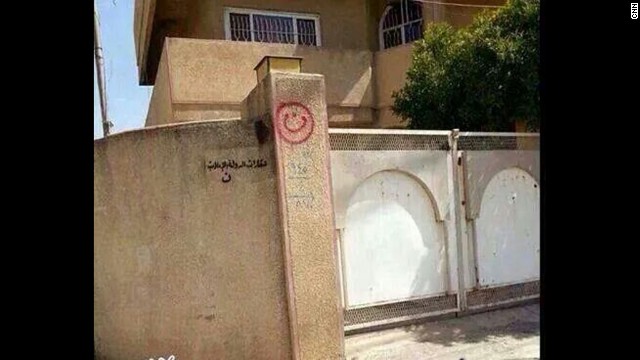
- Families were told to leave their valuables and "go out with only the clothes on you"
- ISIS had decreed that Christians had to convert, pay extra taxes or "face death by the sword"
- On Friday, ISIS leader Abu Bakr al-Baghdadi gave Christians in Mosul one day to leave
Baghdad, Iraq (CNN) -- Just days after the militant group the Islamic State in Iraq and Syria said they killed hundreds of Syrians, dozens of Iraqi Christian families are now fleeing the ISIS-controlled city of Mosul, hoping to avoid a similar fate.
On Friday, the al Qaeda splinter group issued an ultimatum to Iraqi Christians living in Mosul -- by Saturday at noon (5 a.m. ET), they must convert to Islam, pay a fine or face "death by the sword."
A total of 52 Christian families left the city of Mosul early Saturday morning, with an armed group prohibiting some of them from taking anything but the clothes on their backs.
"They told us, 'You to leave all of your money, gold, jewelry and go out with only the clothes on you,'" Wadie Salim told CNN.
Images obtained exclusively by CNN show that the phrase "property of ISIS" scrawled in black paint on a number of the homes that were abandoned.
Some of the families headed for Irbil -- which is currently controlled by Kurdish forces -- and others toward the Dohuk province. The majority went to Dohuk, which is 140 kilometers (87 miles) north of Mosul.
"We did not know how to act," said another Mosul resident, Um Nazik. "Are we going to get killed?"
ISIS was able to take over large swaths of land due to the lack of centralized authority in both Iraq and war-torn Syria. The Sunni militants hope to establish an Islamic state throughout the region it currently controls.
Salman al-Farisi, the ISIS-appointed governor of Mosul, declared that any family that planned to on staying in Mosul and not to converting to Islam would be required to pay 550,000 Iraqi dinar (about $470).
Letters distributed to Christians in Mosul in recent days said ISIS's leader, Abu Bakr al-Baghdadi, agreed to allow those who didn't embrace Islam or pay a special jizya tax to leave.
ISIS is notorious for its brutality -- the group is so violent that al Qaeda has attempted to distance itself from its former affiliate.
On Thursday in Syria's Homs province, the militant Sunni group killed 270 people after storming and seizing the Shaer gas field, the group said.
READ: Islamic extremists kill 270 in attack on a gas field in central Syria, report says
MAPS: Understanding the crisis
CNN's Hamdi Alkhshali reported from Baghdad and Joshua Berlinger wrote this article from Atlanta.
Fireball as van hits bus in China
7/19/2014 3:01:29 AM
- NEW: Six people are injured
- The accident occurred in Hunan Province
- A rescue effort is ongoing
Beijing (CNN) -- A van carrying flammable liquid rammed into a bus in China early Saturday, sparking an explosion that left 43 people dead, state media reported.
Both drivers were among the fatalities in the accident in Hunan Province, according to Xinhua news agency. Another person in the van was also killed.
Six people were injured, four seriously, according to state-run CCTV.
The fate of the other passengers is unclear. The bus had a capacity of 53 people, Xinhua said.
The accident destroyed five cars.
Authorities extinguished the fire, but a rescue effort is under way.
CCTV also reported that the bus operator was blacklisted by local authorities for violating safety rules.
U.N. calls for end to violence as Gazans flee Israeli assault
7/21/2014 2:57:57 AM
- NEW: Israel says it killed more than 10 militants who tried to get in through tunnels
- The Palestinian death toll in Gaza rises to 507, health officials say
- The U.N. Security Council calls for an immediate halt to hostilities
- An Israeli diplomat disputes Hamas' claim that it captured an Israeli soldier
Gaza City (CNN) -- Fierce fighting between Israeli troops and Hamas militants continued near Gaza City on Monday as the death toll from the conflict rose above 500.
Heavy bombardment hit areas east of the city, particularly the neighborhood of Shaja'ia, where a large Israeli assault Sunday contributed to the deadliest day of the war so far.
As clashes escalated over the weekend, Hamas said it had captured an Israeli soldier -- a claim an Israeli diplomat later disputed.
With no sign of either side backing down in a conflict in which most of the victims have been civilians, U.S. Secretary of State John Kerry is due to arrive in Egypt on Monday to push for a cease-fire.
Speaking to CNN's "State of the Union" on Sunday Kerry said that the United States supports Egypt's initiative for a truce and "will work for a fair cease-fire."
The United States has "shown our willingness to try to deal with the underlying issues," but Hamas "must step up and show a level of reasonableness," he said.
"No country, no human being, is comfortable with children being killed, with people being killed, but we're not comfortable with Israeli soldiers being killed either or with people being rocketed in Israel," Kerry said.
Kerry's hot mic moment
However, Kerry also appeared to let slip some frustration with Israeli authorities in comments caught on an open microphone in between television interviews.
After one his deputies mentioned the latest number of Palestinian casualties, Kerry was heard to say, "It's a hell of a pinpoint operation."
In a meeting late Sunday, U.N. Security Council members expressed "serious concern about the growing number of casualties," according to the body's president, Ambassador Eugene-Richard Gasana of Rwanda.
The members urged "an immediate cessation of hostilities" based on the cease-fire that stopped the 2012 conflict between Israel and Hamas, he said.
But as clashes continued Monday, there was no sign that either side would heed the world body's calls.
Gaza toll passes 500
The death toll climbed sharply after Israel's thunderous assault Sunday on Shaja'ia , which sent hundreds of panic-stricken people fleeing into Gaza City.
Scores of Palestinians were killed during heavy shelling of Shaja'ia, bringing the total number killed since the start of Israel's military operations against Hamas to 507, according to the Gaza Health Ministry. More than 3,000 have been wounded.
Extensive fighting continued in Shaja'ia overnight into Monday, the Israeli military said.
Hamas spokesman Sami Abu Zuhri, speaking to Al-Jazeera, said that Israel committed "a crime against humanity," and that most of those killed in Shaja'ia were women and children.
The Israeli military said it had warned residents days in advance to leave Shaja'ia, which it described as a key area that Hamas uses to launch rockets into Israel. It accused Hamas of ordering people to stay in the area.
Israel mourns soldiers
Israel said 13 soldiers were killed Sunday, bringing the total killed during the Gaza conflict to 18, in addition to two civilians. At a news conference, Israeli Prime Minister Benjamin Netanyahu expressed the country's "deep pain" at the loss of the soldiers.
Hamas claimed responsibility for their deaths, calling it a "heroic operation."
Among those killed were Max Steinberg, a California native, and Sean Carmeli, an IDF soldier from South Padre Island, Texas, the U.S. State Department said.
"We're doing everything we can not to harm the people of Gaza," Netanyahu said. "Hamas is doing everything they can to make sure the people of Gaza suffer."
'Nobody is safe'
But people in Gaza who spoke with CNN described a different situation.
"Nobody is safe and nobody can flee anywhere because everywhere is targeted," said Enas Sisisalem, a mother of two who lives in the al-Remal neighborhood of Gaza City. "When we hear the shelling my kids will cry."
She said she had seen people running away from Shaja'ia.
"The shelling did not stop all night or morning," Sisisalem said Sunday. "The people ran away from their houses with their clothes and kids only, barely grabbing anything with them."
The United Nations has estimated that around 70% of the Palestinian killed in Gaza have been civilians.
More than 100,000 people in Gaza have been displaced by the conflict, according to the U.N. Office for the Coordination of Humanitarian Affairs.
Over 83,000 of them are staying in U.N. schools, an increase of more than 400% in a matter of days, according to Chris Gunness, spokesman for the United Nations Relief and Works Agency for Palestine Refugees.
Israeli official denies soldier captured
Hamas' military wing said Sunday it had captured an Israeli soldier during an early morning operation. But Ron Prosor, the Israeli ambassador to the United Nations, later denied the claim.
"There's no kidnapped Israeli soldier, and those rumors are untrue," he told reporters late Sunday at the United Nations in New York.
But Israel Defense Forces spokesman Lt. Col. Peter Lerner said Monday that the military was still looking into the matter and that clarification should come later in the day.
Abu Obeida, a spokesman for Hamas' military wing, had earlier provided the supposed soldier's name and ID, saying, "He is a prisoner, and if Zionists lie about the dead and wounded, then the fate of this soldier is their responsibility."
Gunfire and cheers erupted in Gaza on Sunday in apparent celebration of the alleged capture of the soldier, according to CNN reporters on the ground.
Hamas' claims stirred memories of militants' abduction of the Israeli soldier Gilad Shalit in 2006. He was released some five years later in exchange for more than 1,000 Palestinian prisoners.
Israeli operation expands
Israel launched Operation Protective Edge in Gaza two weeks ago, saying its aim was to weaken Hamas and stop the barrages of rockets the militant group has been firing into Israel.
The operation began with more than a week of aerial bombardments. But after Hamas fighters used a tunnel dug under the border to attempt another line of attack, Netanyahu ordered the start of a ground offensive into Gaza, sending tanks and infantry into the territory.
Having originally billed the incursion as a targeted operation against Hamas' network of tunnels, the IDF said Sunday it was expanding the offensive.
It said the goal is "to strike a significant blow to Hamas' terror capabilities and to restore security and stability to Israel's residents and citizens."
Israel is still "early on in the mission," the IDF's Lerner said Sunday. "You can't erase 10,000 rockets overnight," he said of Hamas' estimated arsenal.
New tunnel attack
The IDF said it killed more than 10 militants who tried in two separate groups to get into southern Israel through tunnels on Monday.
Hamas' military wing said the infiltration attempt was ongoing, claiming its fighters had killed Israeli soldiers.
Efforts to bring an end to the fighting have so far come to nothing.
Israel accepted an Egyptian proposal for a cease-fire last week. But Hamas rejected it, saying it hadn't been consulted and wanted a broader range of issues to be addressed, including prisoner releases and Israel's restrictions on the movement of people and goods in and out of Gaza.
Subsequent talks involving Egypt, the Palestinian Authority, the United States and others have failed to yield any breakthroughs.
READ: Gaza crisis: Who's who in Hamas
READ: Israeli military's 'knock on roof' warnings criticized by rights groups
READ: War-scarred Gaza medical crews also in harm's way
READ: Opinion: A smart way out of the Gaza confrontation
CNN's Karl Penhaul and Ian Lee reported from Gaza City, and Jethro Mullen from Hong Kong. CNN's Kareem Khadder, Ben Wedeman, Atika Shubert, Ben Brumfield, Josh Levs, Tim Lister, Michael Martinez, Mohammed Tawfeeq and Yon Pomrenze contributed to this report.
Actor James Garner dies at 86
7/21/2014 6:59:12 AM
- James Garner died of natural causes on Saturday, police say
- The actor is best known for his roles in "Maverick" and "The Rockford Files"
- He moved easily between film and TV before it became the norm
- Garner took on acting roles well into his 80s
(CNN) -- James Garner, the understated, wisecracking everyman actor who enjoyed multigenerational success on both the small and big screens, has died. He was 86.
Police, who were called to his residence Saturday night in Los Angeles, say he died of natural causes.
Garner starred in hit TV series almost 20 years apart -- "Maverick" in the late 1950s and "The Rockford Files" in the 1970s.
He also had a notable film career, starring in such classics as "Sayonara" (1957), "The Great Escape" (1963), "The Americanization of Emily" (1964), "Grand Prix" (1966) and "Victor/Victoria" (1982), as well as the TV movies "My Name Is Bill W." (1989) and "Barbarians at the Gate" (1993). More recent films included "Space Cowboys" (2000) and "The Notebook" (2004).
He was fiercely independent, challenging the studios on both "Maverick" and "Rockford" when he felt he wasn't being treated fairly. He sued studios twice and won both times.
"The industry is like it always has been. It's a bunch of greedy people," he told The Los Angeles Times in 1990.
Garner was given a Screen Actors Guild Life Achievement Award in 2004. The actors' union head issued a statement about his death Sunday.
"James Garner was the definition of the smooth, dashing leading man, but his talents were so much more than skin deep," SAG-AFTRA President Ken Howard said. "He was a hard worker who dedicated himself wholly to whatever he set out to accomplish, whether it was serving his country or performing for the camera."
A versatile star
He was a valued and convincing pitchman -- in his 1970s and '80s commercials for Polaroid cameras, he had such good rapport with co-star Mariette Hartley that viewers were convinced they were married -- and was nominated for a slew of awards, including Emmys, Golden Globes, SAG Awards and an Oscar (for 1985's "Murphy's Romance"). His performance in "The Rockford Files" won him an Emmy.
He could do serious. His performance in the TV movie "My Name Is Bill W." -- about the founding of Alcoholics Anonymous -- was straightforward and uncompromising. He could also show real heartbreak, whether it was cradling fellow escapee Donald Pleasance in "The Great Escape" or talking with Gena Rowlands in "The Notebook."
But he was rarely one to blow his own horn.
"I got into the business to put a roof over my head," he once said. "I wasn't looking for star status. I just wanted to keep working."
Humble beginnings
James Scott Bumgarner was born April 7, 1928, in Norman, Oklahoma. His mother died when he was 5 and his father remarried a year later. Garner didn't get along with his stepmother and, after a particularly vicious argument, left home at 14. His father, who divorced his stepmother, eventually moved to Los Angeles. At 16, Garner followed, attending Hollywood High School and finding a job as a swimsuit model.
"I made 25 bucks an hour!" he told People magazine. "That's why I quit school. I was making more money than the teachers. I never finished the ninth grade."
After joining the Merchant Marine and the National Guard, he served in the Korean War, where he was awarded a Purple Heart. After the war, he returned to Los Angeles and took up acting -- for the same reason he started modeling, he told the L.A. Times.
"What was I qualified to do to make a living? Nothing," he said. "You don't need qualifications as an actor or a politician. And I didn't want to be a politician."
A small part in Broadway's "The Caine Mutiny Court-Martial" led to a contract with Warner Bros., which cast him in both TV and movie roles. After a performance as a Marine captain in "Sayonara," he took the lead role in a new TV series, "Maverick," which was to make his reputation in many ways.
Leaving his mark
In 1957, "Maverick" was, well, a maverick: a Western filled with comedy, which often parodied other TV Westerns. As a show on ABC, then the third-ranked of the three broadcast networks, it wasn't expected to do well against competitors "The Ed Sullivan Show" and "The Steve Allen Show." But it won its Sunday-night time slot and became one of the hottest programs on television. In turn, Garner -- who played Bret Maverick, a roving card player -- became one of the medium's biggest stars.
But Garner became dissatisfied with the show's grind and being treated like "ham in a smokehouse," as he put it. In 1960 he sued producer Warner Bros. for breach of contract. He won the case and left the show, which replaced him first with Roger Moore (as Beau Maverick) and then Robert Colbert (as Brent) but soon left the air entirely.
Garner, however, was on the verge of movie stardom. Director William Wyler cast him in the film version of Lillian Hellman's play "The Children's Hour" as a sympathetic doctor; two years later Garner starred as Lt. Bob "The Scrounger" Hendley in "The Great Escape," one of the great war movies.
He remembered star Steve McQueen as being rebellious. "Steven would drive that motorcycle with the swastikas on it all over Munich. People would yell. They didn't think that was too good, and I didn't either," Garner told People in 1998.
But the two were close, he added -- in fact, McQueen was his next-door neighbor in Los Angeles. "He looked at me as an older brother," he told the magazine.
Garner followed "Escape" with the film he ranked as his favorite, "The Americanization of Emily." The film, which had a script by Paddy Cheyefsky ("Marty," "Network"), was about a self-described "coward" Navy officer who romances an Englishwoman (Julie Andrews) and -- against his will -- takes part in the D-Day invasion. "Emily" was nominated for two Oscars and helped make Andrews, a famed stage actress whose film "Mary Poppins" was released earlier that year, a star.
His 1966 film, the John Frankenheimer-directed "Grand Prix," gave him another passion -- auto racing. He founded an auto-racing team and drove the pace car in the Indianapolis 500 three times. It was an avocation he shared with a friend, Paul Newman. Garner was also a good golfer and an avowed fan of his home state school, the University of Oklahoma, where he endowed a chair at the college's drama school.
Garner's movie career languished in the late '60s, though he had a mild hit with "Support Your Local Sheriff!" (1969), and he returned to television in the 1970s. After the short-lived "Nichols" he took the role as Jim Rockford in "The Rockford Files," which was as much an anti-detective series as "Maverick" was an anti-Western. (Both shows were produced by Roy Huggins, who also created "77 Sunset Strip" and "The Fugitive.")
Garner's Jim Rockford may have carried a gun, but he did so rarely (he didn't have a permit anyway) and he would much rather talk than shoot. Once imprisoned for a crime he didn't commit, the Pontiac Firebird-driving detective lived in a dilapidated trailer on the Malibu coast. His friends included a grumpy LAPD detective, a former cellmate, a disbarred lawyer and his father, a retired trucker.
Aging amid stardom
Garner did many of his own stunts on "Rockford," and they took a toll, he told People in 1994.
"The work on the show had worn me down to a nub," he said. Over the course of the series, he broke bones, strained muscles and was even treated for depression. "I was sick and tired of it all." Garner also had quintuple bypass surgery in 1988 and had a stroke in 2008.
He left "Rockford" in 1980, partly because of his ailments and partly because of contractual problems with the studio, which eventually led to his lawsuit. After it was settled, he returned to the role for a series of TV movies in the '90s.
But "Rockford" cemented Garner's status on Hollywood's A-list. He made a number of TV and theatrical movies in the '80s, some duds -- "Tank" (1984) and "Sunset" (1988) -- and some successful: He earned praise for his performance in "Victor/Victoria" and an Oscar nomination for "Murphy's Romance."
He worked steadily in the 2000s, with notable performances in TV's "Barbarians at the Gate," the film version of "Maverick," the miniseries "Streets of Laredo" and the theatrical film "The Notebook." He also returned to series television, joining the cast of "8 Simple Rules" after the death of John Ritter.
The work in front of a live audience intimidated him, he said, despite his experience.
"I started in theater, and that's what scared me to death," he told CNN's Larry King in 2004.
Actor, husband, activist
Garner famously had one of Hollywood's longest-lasting marriages. He married Lois Clarke in 1956 after a brief courtship; they were still married at Garner's death, 58 years later.
"I just let my wife get away with murder," he joked to The Los Angeles Times in 1994.
His co-stars were equally smitten with Garner.
"Jim is funny and dear, and he laughs at my jokes," Sally Field told People in 1985, before the release of "Murphy's Romance." "That's what makes Jim sexy; it doesn't change with years."
Garner was also a longtime political activist. He helped organize the 1963 March on Washington and frequently donated to Democratic candidates and liberal causes.
But he'll likely be best remembered for a James Garner persona that seemed inseparable from the real-life man: professional, unruffled, witty and never too impressed with himself.
"I'm a Spencer Tracy-type actor," he told People in 2005. "His idea was to be on time, know your words, hit your marks and tell the truth. Most every actor tries to make it something it isn't (or) looks for the easy way out. I don't think acting is that difficult if you can put yourself aside and do what the writer wrote."
He is survived by his wife and their two daughters, Kim and Gigi.
Garner: 'Like, Zen, man'
People we've lost in 2014
You are receiving this email because you subscribed to this feed at feedmyinbox.com
If you no longer wish to receive these emails, you can unsubscribe from this feed, or manage all your subscriptions

No comments:
Post a Comment